A Better A/B Test Definition That Anyone Can Understand
Go beyond a simple A/B test definition. This guide explains how split testing works with real examples to help you make data-driven decisions that boost growth.

At its heart, A/B testing is a straightforward method for comparing two versions of something to see which one performs better. Think of it as a head-to-head competition for your website or app, designed to take the guesswork out of important business decisions.
What Is an A/B Test and Why Does It Matter?
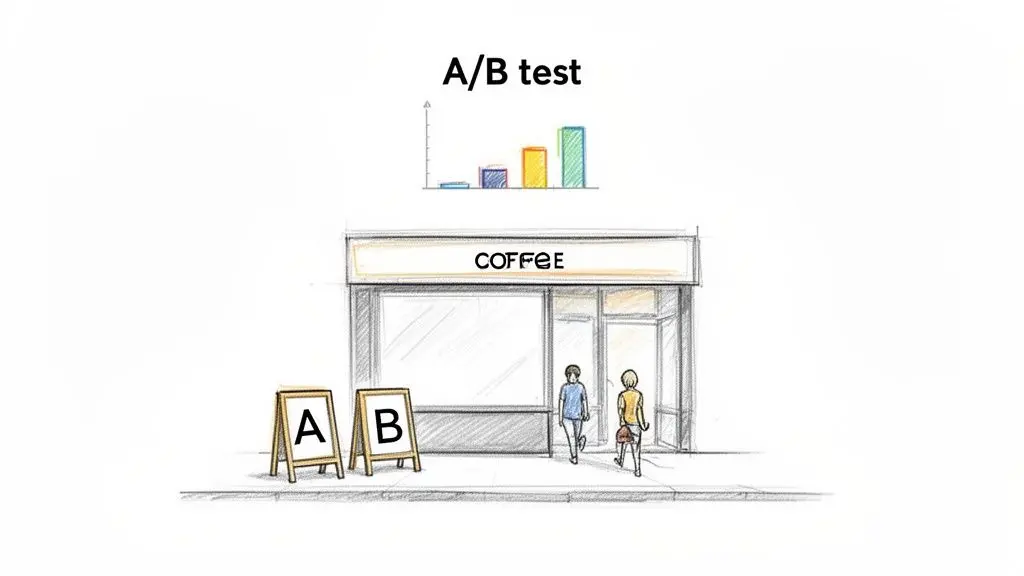
Let's imagine you own a coffee shop. You’ve designed a new sign and want to know if it will bring in more customers than your old one. You could put the old sign (Version A) out on Monday and the new one (Version B) out on Tuesday, then compare the sales from each day. This simple, real-world experiment captures the essence of A/B testing, which is also commonly known as split testing.
On a website, this process is much more scientific. Instead of showing different versions on different days (which could be affected by weather or weekday traffic), you show both versions to your audience at the same time. Half of your visitors will see Version A (the original, known as the control), while the other half sees Version B (the new challenger, or variation).
This is powerful because it allows you to make decisions based on real data, not just a gut feeling. Rather than simply hoping that a new headline, button colour, or page layout improves things, an A/B test gives you cold, hard proof.
To break it down, here are the key pieces of any A/B test.
A/B Testing at a Glance
| Component | Simple Definition | Example |
|---|---|---|
| Control (A) | The original, unchanged version of your page. | Your current homepage with a blue "Sign Up" button. |
| Variation (B) | The new version you're testing, with one key difference. | An identical homepage, but with a green "Sign Up" button. |
| Goal Metric | The specific outcome you're measuring to define success. | The number of people who click the "Sign Up" button. |
| Audience Split | Dividing your website traffic between the two versions. | 50% of visitors see the blue button, 50% see the green one. |
By tracking how both groups behave, you get a clear winner based on actual performance.
The Value of Removing Guesswork
A/B testing is a cornerstone of Conversion Rate Optimisation (CRO) because it directly helps you hit your business goals. By methodically testing different elements, you can find and fix the specific issues holding you back.
Here’s where it really shines:
- Solving visitor pain points: Is a "Buy Now" button hard to find? Are your forms too long? Testing helps you pinpoint what’s causing friction for your users and trial a solution.
- Improving ROI from existing traffic: You can boost sales, leads, or sign-ups without having to spend a single extra penny on attracting new visitors. It’s about making the most of what you already have.
- Making low-risk modifications: A full-site redesign is expensive and risky. A/B testing allows you to make small, incremental changes and measure their impact before you commit.
With testing, you replace "we think" with "we know." It creates a direct path to a better user experience and, ultimately, more revenue. Every test—whether it wins or loses—gives you valuable insight into your customer’s behaviour.
In the end, it all comes down to achieving statistically significant improvements that drive real-world results, whether that’s more sales for an e-commerce shop or higher-quality leads for a B2B company.
The Building Blocks of Every A/B Test
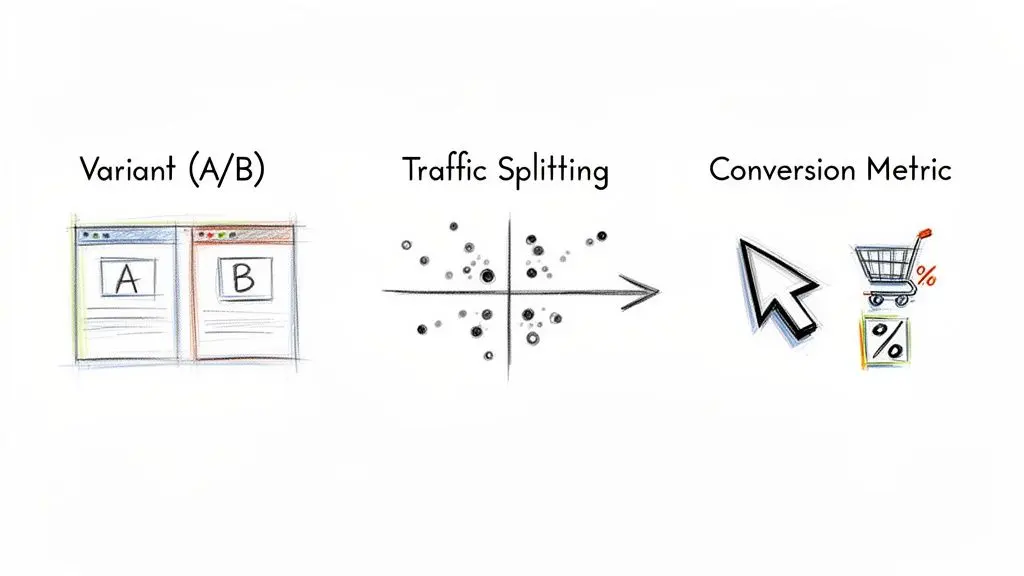
To run a meaningful experiment, you first need to get familiar with its moving parts. Think of these as the essential ingredients you’ll need to cook up a reliable test. Each one has a distinct job to do, making sure your results are clear, trustworthy, and actually help you make better decisions.
Let's break them down, one by one.
Variants: The Control and The Challenger
Every A/B test hinges on a simple comparison between at least two versions of something. You have your original, the control (or version 'A'), and your new idea, the variation (or version 'B'). The control is your baseline—it’s what you’re already doing. The variation is your challenger, the change you believe will perform better.
For example, your control might be a landing page headline that reads, "Discover Our Features." The variation could test a more benefit-driven headline like, "Build Faster, Smarter."
With your two versions ready, it's time to show them to your audience.
Traffic Splitting: Keeping The Fight Fair
Traffic splitting is just a fancy term for randomly dividing your website visitors between the control and the variation. A 50/50 split is the most common approach, where half your audience sees version A and the other half sees version B.
This random assignment is absolutely critical. It ensures that other factors, like what time someone visits or where they came from, don't skew the results. It creates a level playing field, so the only thing that can explain a difference in performance is the change you made.
An A/B test is a controlled experiment. By changing only one variable and splitting your audience randomly, you can confidently attribute any performance difference to that specific change.
So you've got your variants and you're splitting traffic. Now, how do you decide who wins?
Conversion Metrics: How You Measure Success
A conversion metric is the specific action you want users to take that proves one version is better than the other. It’s your goal line. This could be anything from clicking a "Buy Now" button, filling out a sign-up form, or watching a product demo. You have to decide what success looks like before you start the test.
A great real-world example comes from the UK's government digital service, GOV.UK, which handled over 2.5 billion page views in 2023. They used A/B testing to simplify user journeys and found that shortening a form from 10 to 6 fields cut user drop-offs by a massive 18%. In this case, completing the form was their key conversion metric.
These three elements—variants, traffic splitting, and metrics—form the foundation of every successful A/B test. To see how they work together in practice, explore our detailed documentation on setting up experiments.
Right, so you've launched your A/B test. Getting it live is one thing, but knowing when you can actually trust the results is a whole different ball game. This is where you’ll hear people talk about statistical significance.
It might sound a bit intimidating, but the concept is actually straightforward. Think of it as a confidence score for your results.
Imagine you're running a quick poll to see who'll win an election. If you only ask the first ten people you meet, you wouldn't bet your house on the outcome, would you? The sample is just too small. But if you survey thousands of people from all walks of life, your confidence in the prediction shoots up. That’s exactly how statistical significance works for your A/B test.
When a test reaches 95% statistical significance, it means there’s only a 5% chance that the winner won by pure luck. In other words, you can be 95% certain that one version is genuinely performing better than the other.
To get to that point, you need a large enough sample size—that is, the total number of people who have seen your test. You simply have to get enough 'votes' for each variation to make a call you can stand behind.
The Dangers of Stopping a Test Too Soon
One of the most common mistakes we see is people calling a winner the second one variation inches ahead. It’s tempting, I get it, but early results are notoriously volatile and often swing back and forth.
Declaring a winner after just a handful of conversions is like calling a football match over after the first goal. It’s a classic error that often leads to implementing the wrong change based on a random blip in user behaviour.
Patience really is a virtue here. You have to let the test run its course until you’ve gathered enough data to hit that 95% confidence level. This ensures you’re basing your decision on a stable, reliable trend, not just a momentary spike.
The good news is, you don't need a degree in statistics to manage this. Modern testing tools do all the heavy lifting.
- Automated statistics: A platform like Otter A/B runs the complex calculations for you in the background, constantly checking the numbers.
- Clear winner alerts: Instead of you having to guess, the tool tells you the exact moment a variation has won with statistical confidence.
- No more guesswork: You're simply notified when the results are reliable. It gives you the certainty to know when it’s time to act.
By letting the data mature properly, you can make changes knowing they are backed by solid evidence and will bring real, measurable value to your business.
A Real-World A/B Testing Example From Start to Finish
Theory is useful, but seeing A/B testing in action is what makes it click. Let's walk through a classic scenario. Imagine you run an e-commerce shop selling artisan candles, and you have a nagging feeling your best-seller's product page could be doing better.
You suspect the "Add to Basket" button is the culprit. It's a bit plain. This leads you to form a simple, testable hypothesis: "Changing the button colour from a muted grey to a vibrant orange will grab more attention and lead to more clicks."
Setting Up the Experiment
With a clear hypothesis in hand, you’re ready to structure the experiment. This is where you define the moving parts.
- Control (Version A): This is your current page—the one with the standard grey "Add to Basket" button. It’s your baseline.
- Variation (Version B): This is the challenger. It's an identical page, but with one key difference: a new, vibrant orange "Add to Basket" button.
- Traffic Split: You set up your website to split incoming visitors evenly between the two versions. 50% of people see the control, and the other 50% see the new orange button.
- Goal Metric: Your primary goal is straightforward: a click on the "Add to Basket" button. This is the action you’ll measure to decide which version is more effective.
Once you launch the test, the data begins to flow in. After a couple of days, the orange button might show a slight lead, but here’s the crucial part: you don't jump to conclusions. You must wait for your testing tool to confirm the result is statistically significant, meaning the outcome isn't just down to random chance.
This is the patient process of experimentation: collecting data, waiting for a confident result, and only then declaring a winner.
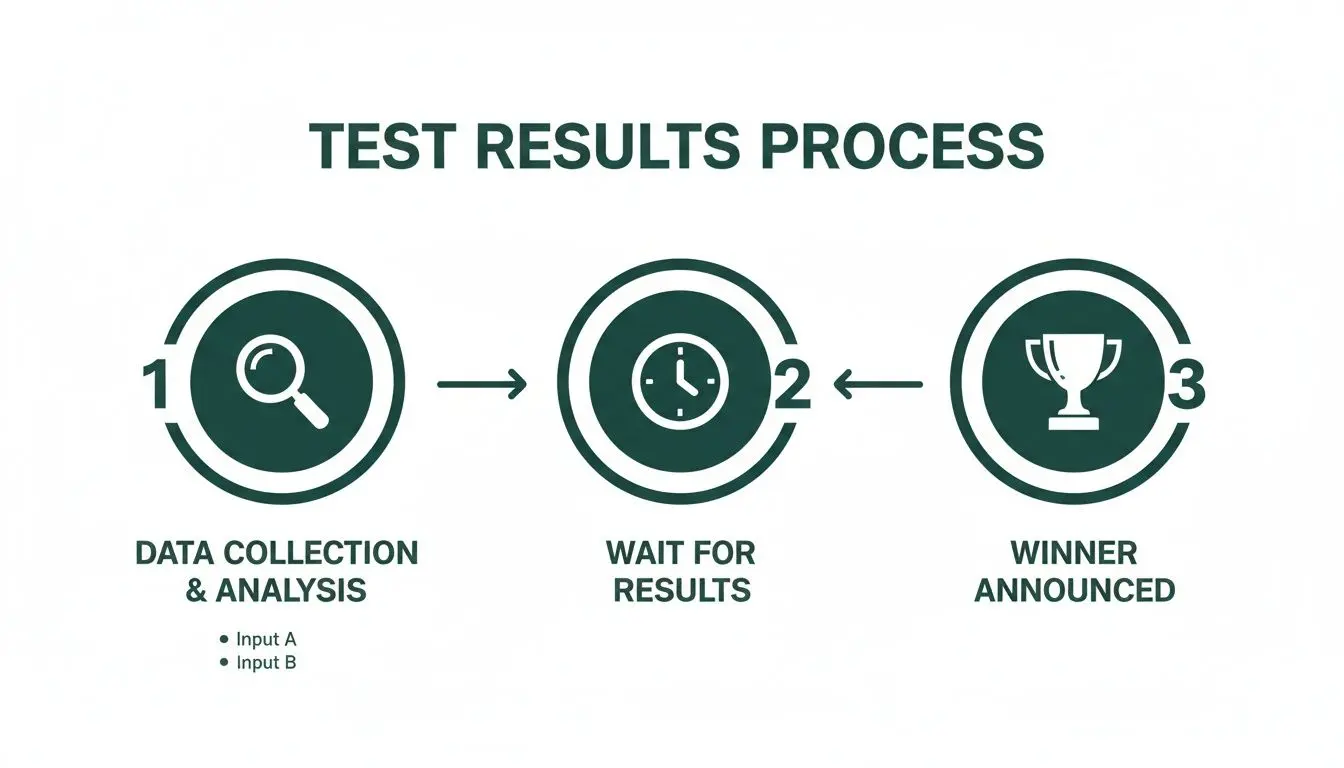
The biggest lesson here is patience. Ending a test too early is one of the most common mistakes, often leading to poor decisions based on noise, not data.
And this principle scales far beyond online retail. Since 2017, A/B testing has been a vital tool for improving UK government digital services. In a powerful example, the NHS used it to tackle hospital non-attendance—a problem costing over £1.2 billion annually.
By testing different wording in their digital reminder messages, they achieved a 15% reduction in no-shows. This simple change boosted appointment adherence to over 94% and saved an estimated £18 million per year in the trial regions alone. You can read more about these and other impactful government comparative studies to see how widely this method is applied.
How to Run A/B Tests Without Slowing Down Your Site
One of the biggest worries that holds teams back from experimenting is site performance. It's a fair question: will running an A/B test slow my website down, frustrate users, and tank my hard-earned SEO rankings? While that used to be a real risk, modern testing tools are built from the ground up to avoid this.
The secret lies in choosing a lightweight solution. Otter A/B, for example, was designed specifically for speed. Its software development kit (SDK) is a tiny 9KB—smaller than most images you’d find on a webpage—and loads in under 50ms. This completely sidesteps any noticeable lag or the dreaded "flicker" effect that can spoil the user experience and hurt your Core Web Vitals.
This means you can run experiments with confidence, knowing your site stays quick and responsive for every single visitor, whether they see the original version or a new variation.
Launch Experiments in Minutes, Not Weeks
Speed isn't just about page load times; it's also about how quickly you can get your ideas live. A great testing platform shouldn't require a team of developers just to launch a simple experiment. The best tools today come with intuitive visual editors and clear dashboards that make the whole process surprisingly straightforward.
Here’s what a typical A/B testing dashboard looks like, giving you a bird's-eye view of your active experiments and how they’re performing in real time.
As you can see, you can easily manage unlimited variations, set your conversion goals, and get tests running with just a few clicks.
This kind of user-friendly design democratises testing, putting the power directly into the hands of marketers and product managers to act on their insights right away. It closes the gap between having a great idea and actually putting it to the test. You can get a better sense of how Otter A/B works and see how it would slot into your team’s routine.
The best tools don't just run tests; they manage the entire experimental lifecycle. Continuous statistical analysis automatically tells you when a winner is found, and integrations with tools like Slack deliver the results right to you.
This level of automation removes the manual grind of checking stats and wondering if you have a winner. You’re free to focus on coming up with smart ideas, while the platform does the heavy lifting with the numbers behind the scenes. And with seamless integrations for platforms like Shopify, Webflow, and WordPress, adding powerful testing capabilities has never been simpler. It’s all about fitting experimentation into your workflow, not disrupting it.
A Few Common A/B Testing Questions
Once you grasp the basics of A/B testing, a few practical questions almost always come up. Let's get those answered so you can move from theory to confidently running your first experiment.
What Elements Should I A/B Test First?
It's tempting to start tweaking tiny details, but the biggest wins come from testing the most influential parts of your page first. Think about high-traffic pages like your homepage, key landing pages, or popular product pages. On those pages, focus on what your visitors see and interact with immediately.
Here are a few great places to start:
- Primary Headline: This is often the first thing people read. A good test pits your current headline against one that focuses on a completely different benefit or value proposition.
- Main Call-to-Action (CTA): The words on your button, its colour, and even its placement can have a huge impact on conversions.
- Hero Image or Video: The main visual sets the mood for the entire page. Try testing a different image or video to see how it affects user behaviour.
The key is to go for bold changes initially. You'll learn far more by testing a completely new headline than by just changing a single word.
How Long Should an A/B Test Run?
There's no single right answer here, as the perfect test duration really depends on how much traffic your site gets. A popular e-commerce site might get the data it needs in a few days, whereas a smaller site might need to run the test for a few weeks.
As a general rule of thumb, plan to run your test for at least one to two full weeks. This accounts for any differences in user behaviour between weekdays and weekends. The most important thing? Don't end the test early just because one version seems to be winning. You need to wait until your testing tool confirms a winner with 95% statistical significance.
Is A/B Testing the Same as Multivariate Testing?
It’s a common point of confusion, but no, they serve different purposes. The difference comes down to complexity and what you're trying to learn.
- A/B Testing is straightforward. It compares two or more completely separate versions of a page (Version A vs. Version B). Think of it as a head-to-head competition to find a single, clear winner, like testing a red button against a green button.
- Multivariate Testing is more complex. It tests multiple changes at the same time to discover which combination of elements works best. For example, you could test two different headlines and two different images, which would create four combined versions for your visitors to see.
A/B testing is perfect for making decisive choices between different designs. If you're comparing a few different approaches, you can learn more about how our platform stacks up against competitors like Optimizely in our detailed comparison.
Ready to replace guesswork with data? With Otter A/B, you can launch flicker-free experiments in minutes and get clear, statistically significant results that drive real growth. Start your free trial today and see which version of your site converts best.
Published via Outrank
Stop guessing
Ready to start testing?
Set up your first A/B test in under five minutes. No credit card required.
- 14-day free trial
- No credit card required
- Cancel anytime