Choosing a Conversion Rate Optimization Service in 2026
Find the best conversion rate optimization service for your business in 2026. This guide covers how to vet agencies, define goals, and measure real ROI.

A conversion rate optimisation service is all about turning more of your website visitors into customers. It's the difference between simply having a website and having one that actively grows your business and delivers a clear return on your investment.
Why Your Choice of CRO Partner Matters More Than Ever
Getting people to your website is only half the battle. The real challenge, and the one that keeps most growth marketers and e-commerce owners up at night, is convincing them to stay and take action.
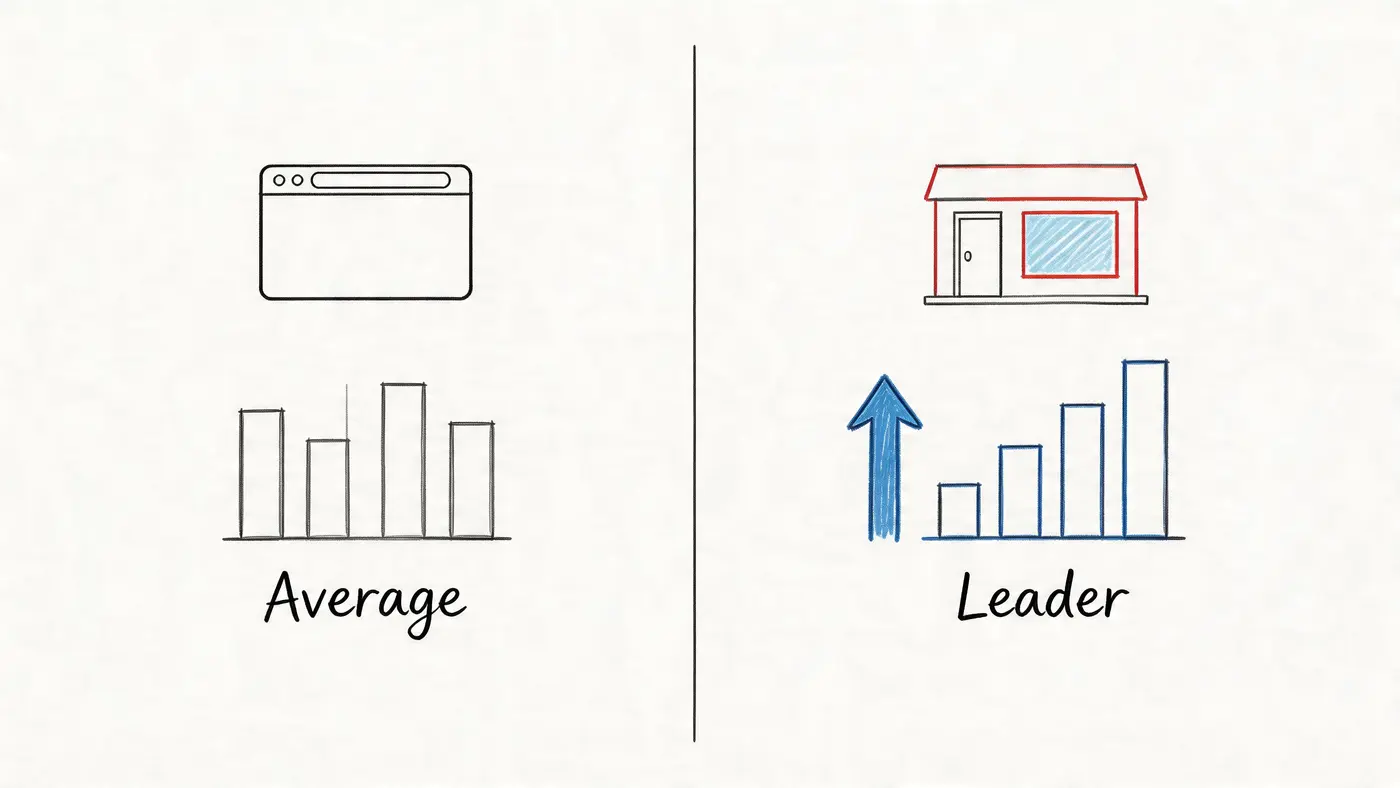
The gap between average online stores and the market leaders is getting wider by the day. A dedicated conversion rate optimisation service is often the single most important factor in closing that gap. If you feel that pressure and need a clear path to finding the right partner, this guide is for you.
The Growing Gap Between Average and Elite Performance
Let’s look at the numbers. The difference between a standard site and a highly optimised one is stark. In the UK, for instance, a typical B2C Shopify site might convert at around 2.1%. But the top performers—those in the elite 20% of digital stores—are hitting 4.8% or even higher, often thanks to a rigorous CRO programme.
That’s more than double the revenue from the exact same traffic. This chasm shows just how powerful a strategic approach to optimisation can be. It’s what lifts a business from being just another player to a leader in their field.
Understanding this is the first step. To dig deeper, it's worth reading why Conversion Optimization is the key to unlocking your business's growth. This isn't about making a few cosmetic tweaks; it's a systematic discipline of research, testing, and analysis that fuels real, sustainable growth.
The core value of a premier CRO service isn't just running A/B tests. It's about bringing an outside perspective, a rigorous methodology, and a data-backed process to uncover hidden revenue opportunities you can't see from the inside.
A Roadmap for Choosing Wisely
So, where do you start? This guide will give you a proper framework for making this critical decision. We'll walk through the exact steps we use when evaluating potential partners, ensuring you're equipped to find the absolute best fit for your company.
Here’s what we’re going to break down:
- Defining Goals and KPIs: We'll go beyond vague objectives to set concrete, measurable targets that truly align with your business goals. It's easy to get fixated on the main conversion rate, but you also need to understand how secondary metrics matter.
- Scrutinising Methodology: You'll learn the right questions to ask about an agency's testing process. We’ll cover everything from their statistical approach to how they generate and prioritise ideas.
- Evaluating Technical Capabilities: It's crucial to know a service can integrate with your tech stack without dragging down your site's performance. We'll show you what to look for.
- Understanding Pricing and ROI: Finally, we’ll demystify the different pricing models and help you build a solid business case for the investment.
Defining What Success Looks Like for Your Business
Before you even think about shortlisting a single agency, you need to get crystal clear on what “winning” actually means for your business. I’ve seen it a hundred times: a company wants to “increase conversions,” but that’s far too vague. It’s like asking an architect to “build a better house” without providing any blueprints.
A top-tier conversion rate optimisation service needs a precise target to aim for. This means getting specific and tying your goals directly to revenue. A SaaS business and a Shopify store both want growth, of course, but what that growth looks like on the ground can be worlds apart.
For example, a UK-based Shopify store might be battling a brutal cart abandonment rate. Their primary goal could be to decrease abandoned carts by 20% in the next quarter. A secondary, but still crucial, objective might be to increase their average order value (AOV) by £15 by improving how they cross-sell products.
A clear brief is the bedrock of any successful CRO partnership. When you can articulate exactly what you want to achieve, every conversation you have with a potential service becomes more focused, strategic, and ultimately, more productive.
Translating Business Goals into Actionable KPIs
Once you've got your high-level goals sorted, it’s time to drill down into the Key Performance Indicators (KPIs) you'll use to track progress. These are the specific, tangible metrics that a good CRO programme will directly influence. Without them, you’re flying blind, with no real way of knowing if the tests are actually moving the needle.
Let's look at how this plays out for different business models:
-
SaaS Business: The big-picture goal is to grow monthly recurring revenue (MRR). The CRO programme's primary KPI might be to increase free trial sign-ups by 30% or boost demo request submissions by 25%. These are the levers that feed the MRR machine.
-
E-commerce Store: The main objective is straightforward: sell more stuff. The primary KPIs here could be getting to a 3.5% add-to-cart rate on key product pages or slashing checkout fall-off by 15%.
-
Lead Generation Site: The goal isn’t just about quantity; it’s about quality. The KPI isn't just "more form fills," but to increase Marketing Qualified Leads (MQLs) by 40%, ensuring the sales team gets leads they can actually close.
Having these sharp targets empowers you. It helps you write a focused brief and quickly weed out any service that doesn't feel equipped to tackle your specific challenges.
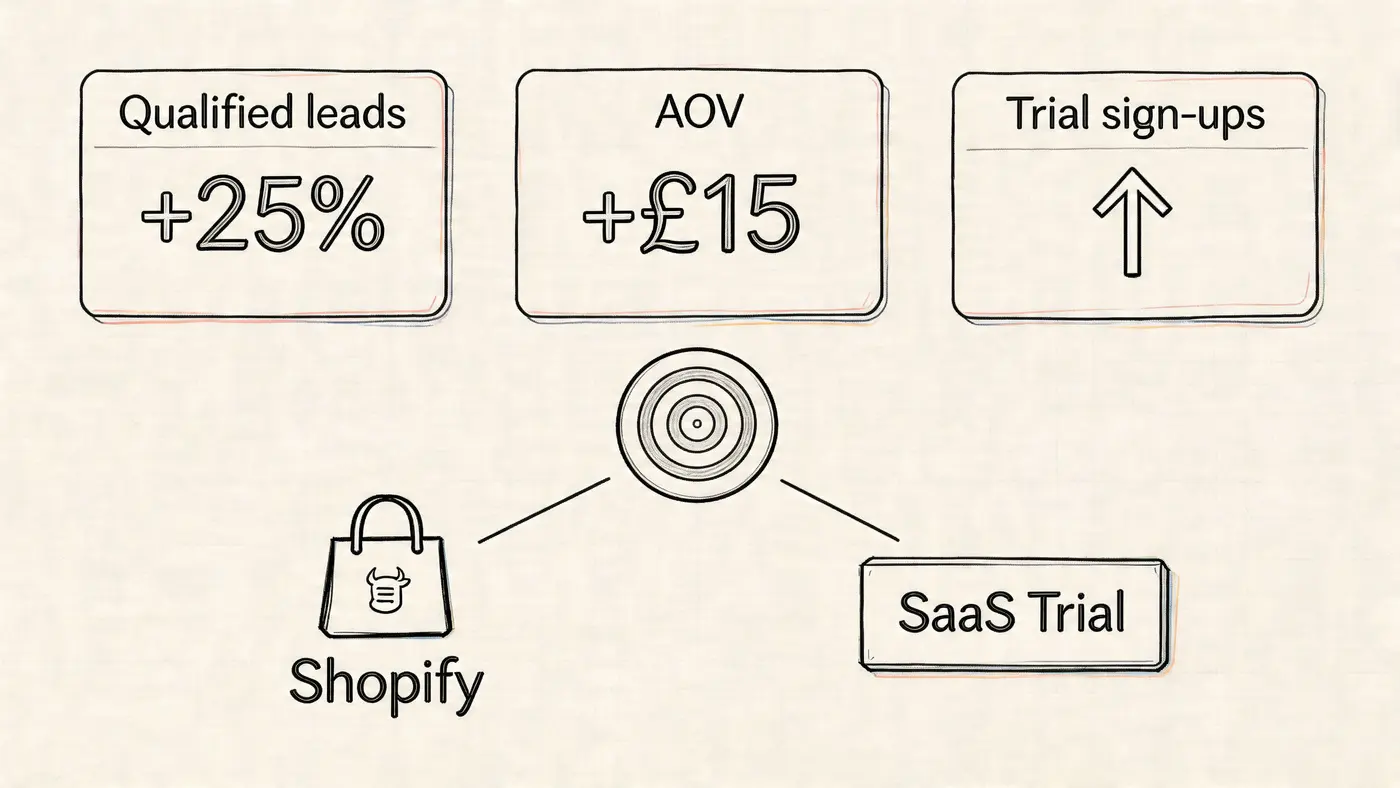
This just goes to show that effective CRO isn't a one-size-fits-all solution. It’s about finding and pulling the right levers that drive growth for your business, whether that’s lead quality for a B2B service or transaction value for an online shop.
Aligning CRO with Broader Financial Objectives
This is the final, and most critical, piece of the puzzle. You have to connect your CRO goals to the company's wider financial targets. This is how you build an undeniable business case for the investment and prove tangible ROI down the line.
Don’t just set a goal to increase AOV. Do the maths and figure out what that lift actually means in hard numbers.
Let’s say your Shopify store gets 50,000 visitors a month, converts at 2% (1,000 orders), and has an AOV of £75. Your monthly revenue is £75,000. If a conversion rate optimisation service can increase your AOV by just £10, that’s an extra £10,000 in monthly revenue. That's £120,000 annually from the exact same traffic.
When you frame it like this, the conversation shifts from "this is a marketing cost" to "this is a strategic investment in growth." It gives you and your finance team a clear yardstick for measuring success.
How to Scrutinise a CRO Agency's Testing Process
An agency’s pitch can be incredibly polished, but the real test of a conversion rate optimisation service is its testing methodology. This is the engine room of CRO. If their process for creating, running, and analysing experiments is shaky, you simply won't see the results you're paying for. It’s where the hard work gets done, and you need absolute confidence that their approach is rigorous and focused on one thing: growing your revenue.
As you start vetting potential partners, your first job is to get a handle on their testing fundamentals. A good starting point is to understand core concepts like split testing (A/B testing), since it’s the bedrock of most optimisation programmes. You have to go deeper than just asking, "Do you do A/B testing?" The devil is in the details of how they do it.
The goal isn’t just finding an agency that runs tests. You need a partner that runs the right tests, the right way. This means digging into everything from how they prioritise ideas to the statistical model they use to call a winner.
Understanding Their Testing Toolkit
A sharp agency will have a full range of testing methods at their disposal and know precisely when to deploy each one. Not every problem is a nail, so they shouldn't just have a hammer. When you talk to them, listen for how they describe their approach to different situations.
-
A/B Testing (or Split Testing): This is the workhorse of CRO. You're comparing one version of a page (the control) against a different one (the variation). It’s perfect for testing bold, decisive changes—think a completely new headline, a different call-to-action colour, or a redesigned hero section.
-
Multivariate Testing (MVT): This is a much more sophisticated approach. Instead of a simple one-to-one comparison, MVT lets you test multiple element changes at the same time to see which combination works best. For example, you could test three headlines and two button styles simultaneously. This is really only practical for high-traffic sites where you want to fine-tune and understand the subtle interactions between elements.
An agency that can clearly explain why they’d choose a straightforward A/B test over a complex MVT shows they have a strategic mind, not just someone who knows how to use a testing tool.
Frequentist vs. Bayesian: Getting into the Stats
Okay, this part gets a bit technical, but it’s a massive differentiator. Every A/B test is underpinned by a statistical model that determines when you have a "winner." The two main schools of thought are Frequentist and Bayesian, and the one an agency uses has real-world consequences for the speed and confidence of your programme.
We can break down the two main statistical models agencies use for testing. Understanding the difference helps you know what to expect in terms of speed and how results are interpreted.
| Aspect | Frequentist Approach (e.g., Z-test) | Bayesian Approach |
|---|---|---|
| Core Idea | Calculates the probability of seeing the observed data (or more extreme) if there was no real difference. You either "reject" or "fail to reject" the idea that the control is better. | Calculates the probability that your variation is actually better than the control, given the data you've collected. |
| Decision Rule | You must decide on a sample size in advance and wait for the test to reach a pre-set 95% statistical significance. Peeking at results early is a major no-no. | You can look at the results at any time. The model provides a "probability to be best" that updates as more data comes in. |
| Speed | Can be slower, as you must wait for the pre-determined sample size to be met. | Often faster, as you can make a decision as soon as the probability of one version being superior becomes very high. |
| Interpretation | "There is only a 5% chance we would see this result if the variation had no effect." It's a bit abstract. | "There is a 98% probability that Variation B is better than Variation A." It's more direct and intuitive. |
So which is better? Honestly, there’s no single right answer. The frequentist model, used by well-regarded tools like Otter A/B, is prized for its scientific rigour and clear-cut rules. Bayesian methods, on the other hand, often provide more flexibility and intuitive results. If you want to really get into the weeds, this article on the differences between Bayesian and Frequentist testing is a great read.
What truly matters is that the agency can defend their choice. They should be able to clearly explain why they use their preferred model and what that means for your programme's speed, risk, and reporting.
Key Questions to Ask About Their Process
When you're talking with a potential conversion rate optimisation service, you need to be ready with some pointed questions. Don't be shy about asking for specifics—this is your investment, after all.
Here are the critical things you need to find out:
- Where do your test ideas come from? A red flag is an agency that just leans on "best practices." You want to hear that they use a blend of quantitative data (analytics, heatmaps) and qualitative feedback (user surveys, session recordings, customer interviews) to form hypotheses.
- How do you decide what to test first? A good agency won't just throw ideas at the wall. They'll use a prioritisation framework, like PXL or PIE, to score test ideas based on their potential impact, your confidence in the idea, and how easy it is to implement.
- What does your quality assurance (QA) process look like? This is crucial. Ask how they guarantee tests look and work correctly across all major browsers and devices. A buggy test is worse than no test at all.
- How do you handle tests that don't win? Failure is a normal and healthy part of optimisation. A mature agency will have a clear process for analysing inconclusive or losing tests to extract learnings and inform the next experiment.
- What statistical significance level do you aim for, and why? The industry standard is typically 95% confidence, but a sharp agency will be able to explain why that's the right level for your business's traffic and risk tolerance.
Evaluating Technical Skill and Platform Integrations
I’ve seen it happen too many times. A conversion rate optimisation service pitches a brilliant, data-backed strategy, only for the technical execution to be a complete disaster. It’s a hard lesson to learn, but a CRO plan is utterly worthless if it breaks your website or slows it to a crawl.
This is where your technical due diligence becomes non-negotiable. A slow, buggy testing setup can do far more harm than good, chipping away at user trust and sending your conversion rates plummeting.
The link between site speed and your bottom line is not a myth; it’s a well-documented reality. Even tiny delays matter. When you’re vetting a service, their tool’s technical footprint isn't just a "nice-to-have" — it's an essential part of protecting your Core Web Vitals and keeping the user journey smooth.
Just look at the mobile opportunity in the UK right now. Mobile devices drive over 60% of all traffic but convert at a much lower 2.9% compared to desktop's 4.8%. A fast-loading experiment is everything here. We know a one-second page delay can cause a 7% drop in conversions, so a heavy testing script is the last thing you need. This is why some platforms focus on performance; for example, Otter A/B’s sub-50ms load times are designed to let developers test layouts and CTAs without ever compromising the user’s experience. You can find more data on how performance impacts conversions by reviewing these conversion rate optimisation statistics.
Implementation Methods and Performance Bottlenecks
You need to get a straight answer on exactly how a service plans to deploy experiments on your site. It usually boils down to two methods: a JavaScript snippet in your site’s <head> or deployment through a tag manager. Neither is right or wrong, but they come with different trade-offs.
-
Direct Snippet: This is often the fastest way to get a test running. It’s your best defence against the dreaded "website flicker," also known as Flash of Original Content (FOC), where users see the original page for a split second before the variation loads in. It’s jarring and immediately signals that something is off.
-
Google Tag Manager: GTM gives your marketing team incredible flexibility to manage scripts without needing a developer every time. The downside? If it isn't set up perfectly, it can introduce a small delay, bringing that flicker issue right back to your doorstep.
When you’re talking to potential partners, ask them point-blank: "How do you prevent flicker?" A confident, experienced team will have a ready answer. They might talk about using a synchronous snippet, specific GTM-loading triggers, or relying on a platform built for speed, like Otter A/B, which uses a tiny 9KB SDK to load in under 50ms and eliminate flicker by design.
Your development team's time is valuable. A CRO partner whose technical setup creates constant support tickets, performance issues, or integration headaches is not a partner but a liability. The goal is seamless collaboration, not a technical bottleneck.
The chart below gives a good overview of the two main statistical methods that underpin A/B testing, which we touched on earlier.
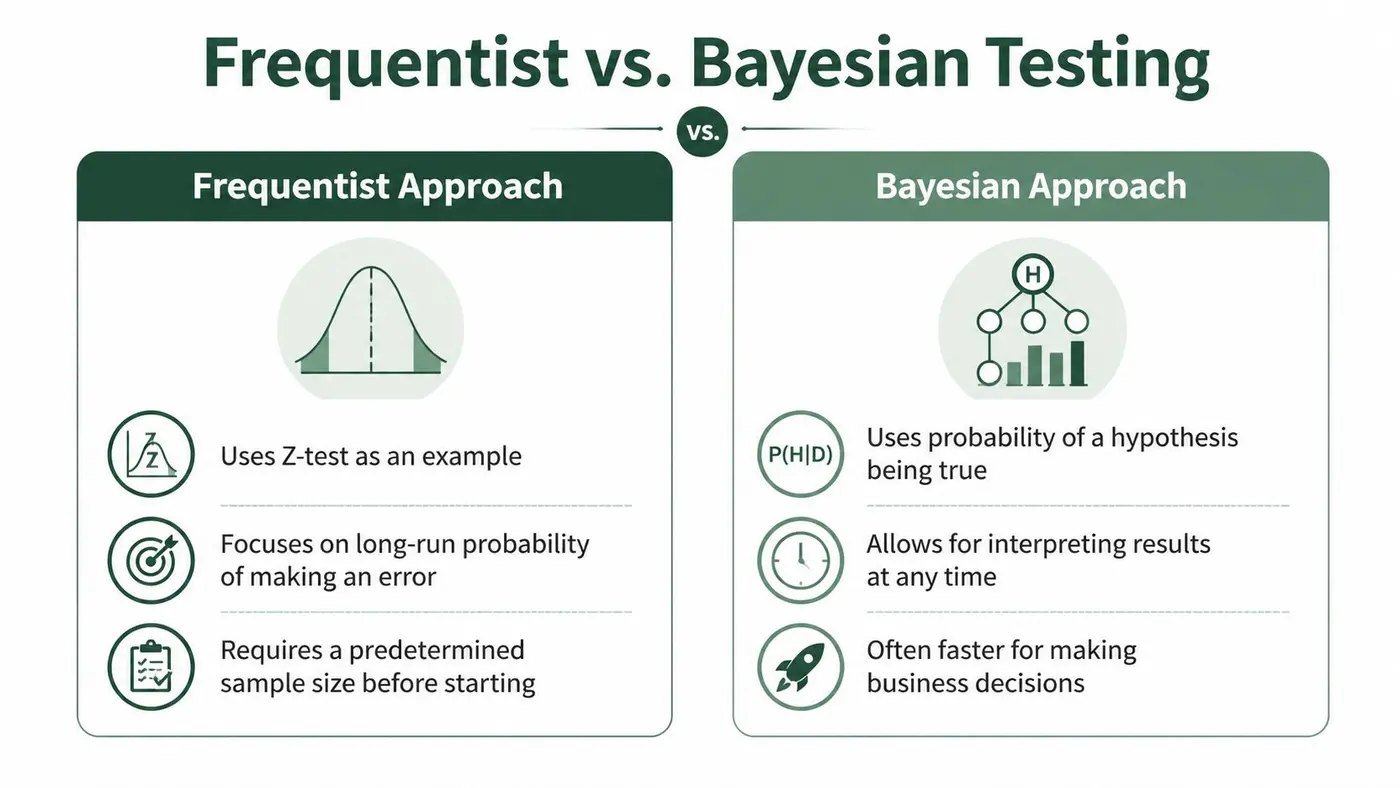
It’s a helpful visualisation of the core philosophical differences, showing how the frequentist model is all about long-run error rates, while the Bayesian approach focuses on the probability that your hypothesis is actually true.
Verifying Crucial Platform and Tool Integrations
Your website is the centre of a whole ecosystem of tools—your e-commerce engine, your analytics suite, your CRM. Any CRO service you hire has to play nicely with your existing tech stack.
Before you even think about signing a contract, make a list of your mission-critical platforms. Then, during the vetting process, ask agencies for specific examples of how they’ve worked with each one.
Key Integration Categories to Verify:
-
E-commerce Platforms: Can they confidently run tests on your product pages, checkout flows, and collection pages? Ask about their hands-on experience with your specific platform, whether it’s:
- Shopify
- WooCommerce
- Webflow
- Squarespace
-
Modern Web Frameworks: This is even more important if your site is a custom build. You need to be sure they can handle modern JavaScript frameworks without breaking things. Ask them about their work with:
- Next.js
- Framer
- Other headless CMS setups
-
Analytics and Data Tools: How do they make sure test data flows cleanly into your analytics? This is absolutely vital for validating results and understanding the wider impact of your experiments. Confirm their process for integrating with tools like Google Analytics 4.
For a deeper look at the landscape, you can explore our guide on the best conversion rate optimisation tools to see how various platforms approach these integrations. A truly proficient service won’t just say "yes, we can integrate." They’ll proactively discuss potential challenges and have solutions ready. That’s the difference between a sales pitch and real expertise.
Comparing Proposals, Pricing Models and Potential ROI
So you've done the hard work. You’ve sifted through the contenders, checked their tech, and grilled them on their methodology. Now for the moment of truth: the proposals. This is where everything gets real, moving past promises and into pounds and pence.
Making a smart decision here means getting everyone to play by the same rules. The best way I’ve found to do this is with a formal Request for Proposal (RFP). It forces potential partners to answer the same critical questions, which makes your job of comparing them so much easier and more objective. Your RFP should dig into their strategy, who’s on their team, how they’ll communicate with you, and, of course, how they'll charge for it all.
Once the proposals start rolling in, you’ll quickly see there’s no standard price tag for a conversion rate optimisation service. Agencies have a few favourite ways to structure their fees, and it’s crucial you understand the pros and cons of each.
Unpacking Common CRO Pricing Models
Getting to grips with the financial side of a proposal is about more than just the bottom line. You need to find a model that fits your budget, your appetite for risk, and what you’re trying to achieve long-term. Most agencies will pitch you one of three main pricing structures.
Here’s a look at the common pricing structures you will encounter when evaluating conversion rate optimisation services.
CRO Service Pricing Models
| Model | How It Works | Best For | Potential Downside |
|---|---|---|---|
| Monthly Retainer | You pay a fixed fee each month for an agreed-upon scope of work, like a certain number of tests or dedicated research hours. | Businesses looking for a long-term, continuous optimisation programme with predictable costs. | The fee is paid regardless of test results, so success really hinges on the agency's ability to perform consistently. |
| Performance-Based | The agency’s fee is tied directly to hitting KPIs, often a percentage of the extra revenue generated from winning experiments. | Companies with high traffic that want a "pay-for-results" setup. It aligns the agency's goals perfectly with your own. | This can get very expensive if the programme is a runaway success. The agency also takes on more risk, which might mean a higher base fee or percentage. |
| Fixed-Price Project | A single, one-off fee for a specific, time-limited project, like a full checkout overhaul or a landing page redesign. | Businesses with a clear, standalone optimisation project in mind, rather than an ongoing programme. | The relationship ends when the project does, so you miss out on the chance for continuous learning and iterative improvements. |
Retainers are by far the most common model. For a quality conversion rate optimisation service in 2026, you should expect retainers to be in the £5,000 to £15,000+ per month range. This varies based on the agency’s reputation and exactly how much work they’ll be doing for you.
A proposal should be more than a price list; it should be a strategic document. I always look for a partner who clearly explains the value I'll get for my investment—from the depth of their research to the cadence of their reporting. A vague proposal often signals a vague process.
Projecting the Financial Impact and ROI
This is the most important part of your evaluation. You need to model the potential Return on Investment (ROI) for each proposal. Don’t think of it as guesswork. It's about building a realistic financial forecast you can take to your boss to get the budget signed off.
Let me walk you through a simple, real-world example.
Let's say you run a UK-based Shopify store and your numbers look something like this:
- Monthly Visitors: 100,000
- Current Conversion Rate: 2.0% (giving you 2,000 orders/month)
- Average Order Value (AOV): £80
- Current Monthly Revenue: £160,000
An agency sends you a proposal for a £7,000 per month retainer. They're confident they can lift your conversion rate from 2.0% to 2.3% within six months. It might not sound like a huge jump, but let's do the maths.
A new conversion rate of 2.3% means 2,300 orders per month from the same amount of traffic.
- New Monthly Revenue: 2,300 orders x £80 AOV = £184,000
- Incremental Monthly Revenue: £184,000 - £160,000 = £24,000
- Monthly ROI: (£24,000 Gain - £7,000 Cost) / £7,000 Cost = 242%
Suddenly, that £7,000 fee doesn't look like a cost anymore—it looks like an incredibly powerful investment. Spending £84,000 over a year to potentially generate an extra £288,000 in revenue? That’s a business case that writes itself.
What to Look for Beyond the Price Tag
While the numbers are critical, a great proposal is about more than a pricing table. It's your first real glimpse into what it’s actually like to work with the agency.
Here’s what I always scrutinise in every proposal I review:
- Clarity of Deliverables: The scope of work has to be crystal clear. Does that retainer get you a set number of tests? How many hours of research? If you see vague phrases like "ongoing optimisation," push them for specifics. It’s a major red flag.
- Reporting and Communication: How often will you actually talk to them? Who is your go-to person? I look for a firm schedule (e.g., bi-weekly updates, monthly strategy reviews) and defined communication lines (like a shared Slack channel).
- Team and Expertise: The proposal should tell you exactly who will be working on your account. You want to see the strategists, analysts, and developers who will drive your programme, not just a generic pitch from a salesperson.
In the end, choosing a conversion rate optimisation service is about finding a partner, not just a supplier. The proposal is the best indicator you’ll get of their strategic thinking, their transparency, and their commitment to delivering results that actually matter to your business.
Your Top Questions About Hiring a CRO Service
As you get closer to choosing a CRO partner, it's natural for some practical questions to bubble up. You're about to make a significant investment, so it's smart to iron out the details. Let's walk through some of the most common queries we hear from businesses just like yours.
How Much Should We Budget for a CRO Service?
This is always the million-dollar question, and the honest answer is: it really depends. The price tag is tied directly to the scope of work, the agency's track record, and the way they structure their fees. But I can give you some ballpark figures.
For a good, reputable CRO agency in the UK, you'll find that monthly retainers usually start around £3,000. For a really comprehensive programme with a top-tier team, that can climb to £10,000 or more per month. Most solid services for mid-sized businesses tend to land in the £5,000-£8,000 bracket. This fee typically buys you a set number of experiments, dedicated research time, and consistent reporting.
You might also come across different models:
- Performance-based fees: Here, the agency takes a cut of the extra revenue they generate for you. It sounds great, but be sure you understand exactly how they calculate the uplift.
- Project-based work: This involves a fixed fee for a one-off job, like a complete checkout overhaul. These projects can run anywhere from £6,000 to over £12,000, depending on the complexity.
When you're looking at proposals, don't be afraid to dig into the specifics. A transparent partner will happily tell you exactly how many experiments are included, which software licences are covered, and what level of analysis you're paying for. If they're vague, that's a red flag.
When Will We Actually See Results?
Everyone wants fast wins, and a sharp conversion rate optimisation service can often spot some low-hanging fruit within the first month or two. These are usually quick, obvious fixes they uncover during the initial audit that can give you a nice little boost straight away.
But building a proper, sustainable CRO programme takes time. Think of the first three to six months as the foundation-laying phase. This is when your agency will be buried in research, building data-backed hypotheses, and getting the first wave of prioritised tests live. You'll typically start seeing meaningful, statistically significant lifts in your main KPIs after that six-month mark. It's a marathon, not a sprint, and patience is your best friend here.
What's the Difference Between CRO and SEO?
This one comes up all the time, and it's a crucial distinction to understand. While both CRO and SEO (Search Engine Optimisation) aim to boost your website’s performance, they operate on different parts of the customer journey.
-
SEO is all about acquisition. Its job is to drive more—and better—organic traffic to your site from search engines like Google. SEO focuses on keywords, backlinks, and technical health to get people in the door.
-
CRO is all about efficiency. Its job is to get a higher percentage of those visitors to take action once they arrive. CRO focuses on user behaviour, usability, and persuasive copy to convert the traffic you already have.
I like to use a brick-and-mortar shop analogy. SEO is your marketing and advertising that convinces people to come to your shop. CRO is the clean layout, the helpful staff, and the easy-to-read price tags that persuade them to buy something. They're two sides of the same coin and work best when they’re in sync.
Is My Company Ready for CRO?
You don't need millions of visitors to get value from CRO, but you do need a certain amount of traffic to run reliable A/B tests. A solid rule of thumb is to have at least 1,000 conversions—be it sales, sign-ups, or leads—per month. This gives you enough data to get answers from your tests in a decent amount of time.
What if you're not there yet? A CRO service can still be incredibly valuable. Instead of relying heavily on A/B testing, they’ll shift their focus to qualitative research (like user interviews and session replays) and heuristic analysis. They'll use these insights to recommend high-impact changes based on established best practices, which can get you moving in the right direction while your traffic grows.
What Should I Have Ready Before I Talk to an Agency?
To hit the ground running and get the most out of your first calls with a conversion rate optimisation service, it pays to do a little prep. First, make sure you can easily grant view-only access to your analytics platform, like Google Analytics 4.
Next, have a clear idea of your primary business goals, just as we discussed earlier in this guide. Finally, be prepared to chat about your ideal customer, who you see as your main competitors, and any optimisation work you've tried in the past—both the wins and the losses. The more context you provide, the sharper and more strategic their proposal will be.
Ready to stop guessing and start growing? At Otter A/B, we provide the tools to make data-driven decisions simple. Our lightweight A/B testing platform helps you discover what truly converts without slowing down your site. Start your free trial today and see the difference for yourself.
Stop guessing
Ready to start testing?
Set up your first A/B test in under five minutes. No credit card required.
- 14-day free trial
- No credit card required
- Cancel anytime