A Marketer's Guide to Testing Statistical Significance
Master testing statistical significance in your A/B tests. This guide explains p-values and data-driven CRO so you can make decisions that boost revenue.

Ever run an A/B test where the new version looked like a winner, only to see the results fizzle out later? It’s a common frustration. That’s where statistical significance comes in. It’s the tool that helps you determine if your test results are real or just a product of random luck.
Think of it this way: you're testing two new coffee blends at your cafe. On day one, Blend A gets 12 votes and Blend B gets 10. Is Blend A genuinely more popular, or could that two-vote lead just be a coincidence from the small group who tried it? This is the exact question marketers face every day, and testing statistical significance is how we find the answer.
It’s a structured way of thinking that moves you beyond gut feelings and misleading early results. For anyone working in conversion rate optimisation, it’s how we prove that a change—whether it’s a new headline or a different button colour—actually caused a genuine shift in user behaviour.
The Role of the Null Hypothesis
At the heart of any significance test is an idea called the null hypothesis. It sounds technical, but the concept is simple. It's the default assumption that your new variation makes no difference at all. The test starts by assuming your new design has zero impact on conversions compared to the original.
Your job as an experimenter is to collect enough evidence to prove that initial assumption wrong. When your test finally reaches "statistical significance," you've gathered enough data to confidently say, "I'm convinced the uplift we're seeing is real, not just a random fluke." This is a fundamental part of modern A/B testing methodology.
Statistical significance provides the mathematical confidence you need to make profitable, data-driven decisions. It stops you from wasting time and money on changes that don't actually work or, even worse, rolling out a "winner" that ends up hurting your conversion rate.
The industry standard for this is a 95% confidence level. In plain English, this means we're willing to accept a 5% chance that our results are just a coincidence. This threshold has become widely adopted because it strikes the right balance between needing certainty and running tests in a practical timeframe.
Before we go any further, here's a quick guide to some of the key terms you’ll come across.
Quick Guide to Key Statistical Terms
This table breaks down the essential concepts of significance testing into plain English, so you can see exactly why they matter for your A/B tests.
| Term | What It Means in Plain English | Why It Matters for A/B Testing |
|---|---|---|
| Null Hypothesis | The default assumption that your change has no effect. | Your goal is to gather enough data to prove this assumption wrong. |
| Alternative Hypothesis | The assumption that your change does have an effect. | This is what you are hoping to prove with your test. |
| Statistical Significance | Proof that your results are very unlikely to be from random chance. | It gives you the confidence to declare a winner and implement the change. |
| Confidence Level | The percentage of certainty that your results aren't random (e.g., 95%). | A higher confidence level means you are more certain about your conclusion. |
Having these terms handy will make it much easier to understand how to interpret your own experiment results and make smarter decisions.
The Core Components of Significance Testing
To really get the hang of statistical significance, you need to understand what’s happening under the bonnet of your A/B testing tool. You don't need to be a statistician, but knowing the basics is like knowing what the pedals and steering wheel do in your car—it helps you get where you're going without crashing.
At the end of the day, these components all work together to answer one critical question: is the uplift I’m seeing real, or is it just a random fluke? Let's break down the key parts that help you figure that out.
The P-Value: Your Risk of Being Wrong
First up is the p-value, or probability value. Forget the complicated academic definitions for a moment and think of it simply as your 'risk-of-being-wrong' score. It tells you the probability that the results you’re seeing happened purely by chance.
For instance, if your test spits out a p-value of 0.25, that means there’s a 25% chance the uplift you’re celebrating is just random noise. That’s a big gamble to take. But a p-value of 0.03? Now we’re talking. That means there's only a 3% chance the result is a fluke. This is why a lower p-value is always better—it gives you stronger proof that your change actually made a difference.
A low p-value is your green light. The industry standard is to aim for a p-value of less than 0.05. When you hit this benchmark, you can be confident your results are statistically significant.
Confidence Level: Your Certainty of Being Right
While the p-value tells you the risk of being wrong, the confidence level is the flip side of the coin. It’s your certainty that the results are genuine and not just a product of random variation. The maths is simple: it’s just 1 - p-value.
Most A/B testing platforms, including Otter A/B, set the default at a 95% confidence level. This lines up perfectly with the standard p-value target of 0.05.
- A p-value of 0.05 gives you a 95% confidence level (you're 95% sure the result is real).
- A p-value of 0.01 gives you a 99% confidence level (you're 99% sure the result is real).
Hitting that 95% confidence level is the goal. It means you’ve collected enough data to be pretty certain that your variation genuinely influenced user behaviour, allowing you to make decisions you can stand behind.
The diagram below shows the two possible states of any A/B test, and statistical testing is how you tell them apart.
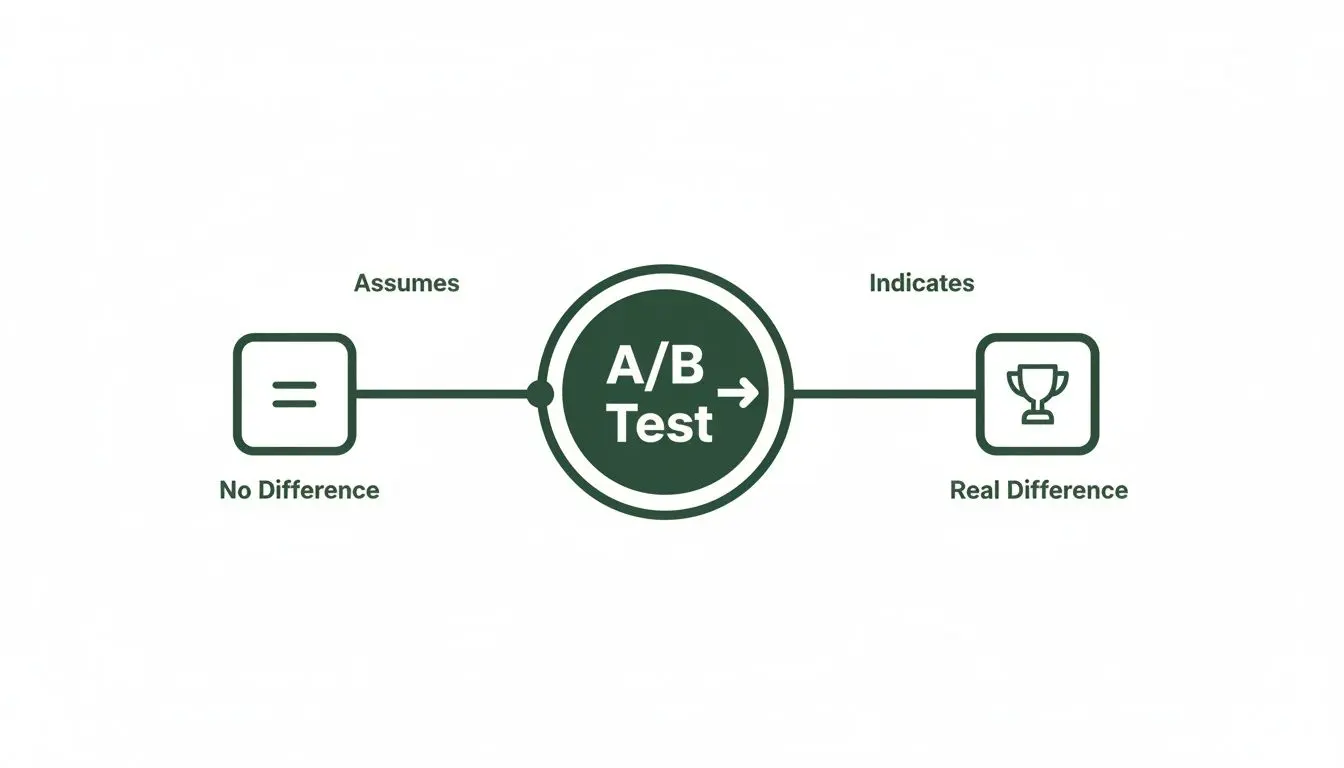
As you can see, every test starts from the assumption of 'no difference.' Your job is to gather enough proof to show a 'real difference' exists.
The Z-Test: Your Statistical Engine
So, where does the p-value actually come from? This is where the statistical models do their work. For A/B tests that compare two conversion rates (like the performance of two landing pages), the workhorse model is the z-test.
Think of the z-test as the engine that powers the entire analysis. It takes a few key ingredients:
- The conversion rate of your original version (the control).
- The conversion rate of your new version (the variation).
- The sample size (number of visitors) for both versions.
The z-test crunches these numbers and produces one key output: the p-value. In a tool like Otter A/B, this isn't a one-off calculation. The z-test engine runs constantly, analysing data as it comes in and updating the p-value in real-time. The moment it drops below the 0.05 threshold, you have a winner.
How to Read and Interpret Your A/B Test Results
You’ve got a test running, traffic is flowing, and data is rolling in. Now for the crucial part: figuring out what those results are actually telling you. This is where the abstract world of statistics turns into real-world business decisions.
Let's imagine a classic scenario. You run an e-commerce store and decide to test a new product description for one of your bestsellers. Your hypothesis is simple: a more detailed, benefit-led description should persuade more people to add the item to their cart.
In this setup, your original description is the control, and your new, improved version is the variation. You split your website traffic 50/50, and as visitors arrive, your A/B testing tool starts counting who sees which version and, most importantly, who clicks "Add to Cart."
Watching the Results Evolve
When you first launch a test, the results can look like a rollercoaster. The variation might shoot ahead with a 20% uplift on day one, only for the control to catch up and even overtake it the next. This is completely normal. It also highlights one of the biggest mistakes you can make: calling a test too early based on these initial swings.
A professional testing platform is always crunching the numbers in the background. For a test comparing two conversion rates, it’s usually running a z-test, constantly recalculating the conversion rate for each version, the uplift of the variation, and the all-important p-value.
Eventually, the noise settles down, and a clearer picture emerges, like in the dashboard screenshot below.
Here, there's no ambiguity. The variation has smashed it, delivering a +27.8% uplift with a p-value that's comfortably below the standard 0.05 threshold.
Knowing When You Have a Winner
The magic moment in testing statistical significance arrives when your test hits its pre-set confidence level. For most marketing and e-commerce tests, this is 95% confidence, which directly corresponds to a p-value of less than 0.05.
Once your p-value drops below 0.05, you have a statistically significant winner. This isn’t just a good feeling; it’s a data-backed conclusion that your change genuinely caused the improvement.
So what does that actually mean for your business? It lets you turn the numbers into a statement of confidence. You can now say, "We are 95% certain that rolling out this new product description will increase our add-to-cart rate." That’s the green light you need to push the winning version to 100% of your audience and lock in that conversion gain. With a platform like Otter A/B, you'll even get a Slack notification the second your test hits this milestone, so you can act on it right away.
What if There Is No Winner?
Just as valuable is a test that finishes without a clear winner. If you've run the test long enough to gather a solid sample size but the p-value is still stubbornly high (say, 0.40), the data is telling you something important: your change didn't make a meaningful difference to user behaviour.
This is not a failure. It’s an incredibly useful result. It stops you from wasting time and resources implementing a change that does nothing, or worse, one that might have quietly hurt your performance. It proves your original hypothesis was wrong, freeing you up to focus on other ideas with more potential.
In conversion optimisation, finding out what doesn’t work is just as important as finding out what does.
Why Sample Size and Statistical Power Are So Important
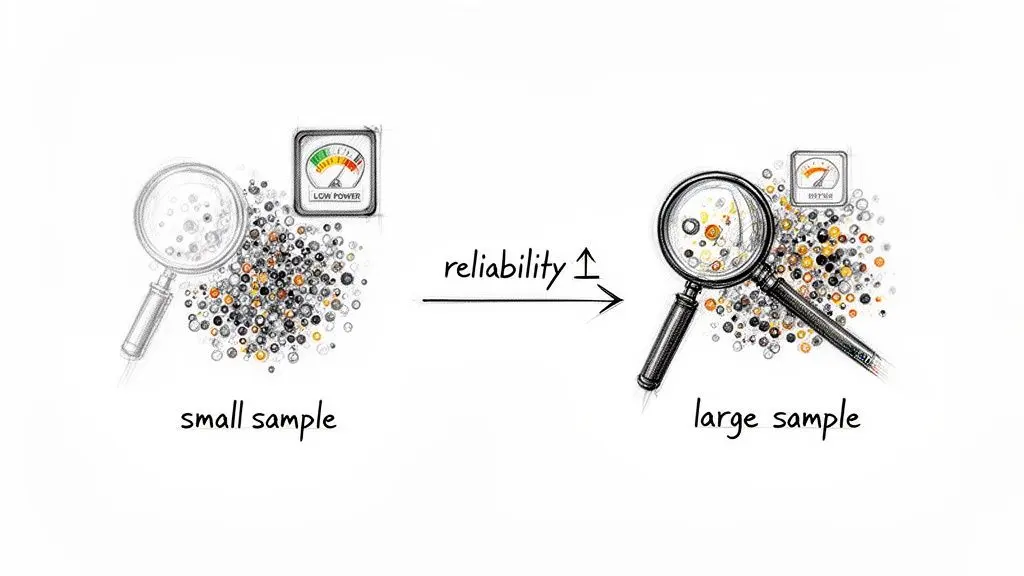
If you've ever glanced at a political poll with a tiny sample and immediately felt a healthy dose of scepticism, you already have the right mindset for A/B testing. How much data you collect—your sample size—has a direct impact on how much you can trust your results.
Running an experiment with too few visitors is like building a house on a shaky foundation. Any lift you see early on is incredibly vulnerable to random chance. Just a handful of unusually motivated buyers can skew the numbers, making an average variation look like a winner until more data rolls in and the results come back down to earth.
That’s why getting a large enough sample is non-negotiable for a credible test. It helps smooth out that random noise, allowing the true performance of each variation to shine through. Without it, you’re just gambling.
Understanding Statistical Power
A closely related concept is statistical power. Think of it as the strength of your magnifying glass. If the power is too low, you simply won’t be able to spot the very thing you’re looking for, even if it’s right there.
In A/B testing, statistical power is your experiment’s ability to detect a real difference between variations. A low-power test, usually caused by a small sample size, runs a high risk of a "false negative." This is where your new variation is genuinely better, but the test fails to notice. You end up ditching a change that could have actually made you more money.
Statistical power is the probability of detecting a real effect if one truly exists. The industry standard is to aim for 80% power, giving you an 80% chance of correctly identifying a winner.
Power is the safety net that protects you from missed opportunities. While statistical significance (the p-value) guards against false positives (rolling out a loser), power guards against false negatives (abandoning a winner). You need both to make smart decisions.
The Trade-Off Between Speed and Certainty
This leads us to a classic dilemma for every growth team: the tug-of-war between getting results quickly and getting them right. We all want to move fast, but ending a test too early with a small sample means you’re running a low-power test you can’t really trust.
This isn't just theory. As the UK government's own guidance on running comparative studies points out, one of the biggest challenges is that “you will need many users for the data to be statistically significant.” Larger samples are needed to achieve enough power to confidently spot a meaningful uplift, a principle you can read more about in the government's detailed documentation on A/B testing.
To make this more concrete, keep these two rules of thumb in mind:
- The smaller the expected lift, the larger the sample you need. If you’re testing a subtle headline change you think will only nudge conversions by 2%, you’ll need far more data to prove it than for a bold redesign you expect to lift conversions by 20%.
- Lower baseline conversion rates need more traffic. A checkout page with a 50% conversion rate will produce reliable data much faster than a newsletter sign-up form that only converts at 3%.
Ultimately, reliable A/B testing requires a bit of patience. You have to let the experiment run long enough to gather the right sample size and hit adequate statistical power. This is the only way to be sure your decisions are based on solid evidence, not just statistical noise. You can dive deeper into structuring these tests in our technical documentation on experimentation.
Of course. Here is the section rewritten to sound natural and human-written, following all your requirements.
Common A/B Testing Mistakes That Invalidate Your Results
Even with the best intentions, it's surprisingly easy to run an A/B test that gives you misleading or completely useless data. The whole point of testing for statistical significance is to be disciplined, but a few common slip-ups can unravel all your hard work and lead to some genuinely poor business decisions.
Getting to grips with these pitfalls is the first step to avoiding them. If you keep your data clean and your method solid, you can be confident that when you declare a winner, it’s a result you can actually trust.
The Number One Mistake: Peeking at Your Results
By far the most common and damaging mistake is ‘peeking’ at your results and stopping the test the second one variation pulls ahead. We’ve all felt the temptation. You see a promising lift, and you want to lock in those gains right away. But this is a statistical trap that massively increases your chances of a false positive.
Early results are notoriously volatile. A variation might shoot into the lead on day one simply because of random chance—what statisticians call statistical noise. If you stop the test right there, you’re basically mistaking a lucky streak for a real, repeatable trend. Patience is everything in reliable testing; you have to let the experiment run until you have a big enough sample size to draw a proper conclusion.
This is a well-known problem in classical Frequentist statistics, which is the model most A/B testing platforms have traditionally been built on. This approach demands that you decide on your sample size and test duration in advance, and peeking before that endpoint breaks the rules. This limitation has even led some UK-based platforms to look into Bayesian alternatives, which are more flexible. If you want to go deeper on the different statistical philosophies, you can explore this deep dive into A/B testing methodologies.
A/B Testing Do's and Don'ts
Beyond peeking, a few other critical errors can easily undermine the integrity of your experiments. To get reliable results you can act on, it helps to have a clear checklist of what to do and, just as importantly, what not to do.
This table breaks down the common traps and the best practices that will keep you on the right track.
| Action | Why It's a Mistake (Don't) | Why It's a Best Practice (Do) |
|---|---|---|
| Peeking at early results | Stopping a test early because a variation is ahead often means you're acting on random noise, not a true trend. This leads to high false positive rates. | Let the test run until your pre-determined sample size is met. This ensures the result is stable and statistically sound, not just a lucky fluke. |
| Testing too many variants | Trying to test ten different button colours at once on a low-traffic page splits your audience too thin. It will take forever to reach significance, if ever. | Focus on a manageable number of variations (A/B or A/B/C). This allows each one to gather enough data in a reasonable timeframe. |
| Changing the test mid-stream | Adding a new goal or changing traffic allocation halfway through contaminates the data. The results become a mix of two different experiments. | Define all your goals, traffic splits, and parameters upfront. If you absolutely must change something, stop the test and start a fresh one. |
| Ignoring business cycles | Running a test for only two days means you might miss big differences in user behaviour between a quiet Tuesday and a busy Saturday. | Always run tests for at least one full week (or a full business cycle). This captures a more realistic and representative sample of user activity. |
Ultimately, a single, well-run test is far more valuable than a dozen sloppy ones. The goal isn’t just to run experiments; it’s to generate insights you can count on.
How to Set Your Tests Up for Success
The good news is that you can avoid these mistakes with a bit of discipline. Following a simple checklist of best practices will keep your data clean and your conclusions sound.
Start by organising your experiments with a clear plan before you launch anything.
-
Define a Clear Hypothesis: Every test needs to start with a specific, testable statement. For example, "Changing the call-to-action from 'Sign Up' to 'Get Started' will increase free trial conversions by 5%." This gives your test purpose.
-
Focus on One Primary Goal: You can, and should, track secondary metrics. But every test must have one primary conversion goal that defines success. This keeps your analysis focused and avoids any arguments later about which variation "won."
-
Document Everything: Keep a record of every single test you run—especially the ones that fail. This builds an invaluable library of learnings for your entire organisation and stops you from repeating the same mistakes six months down the line.
Moving Beyond Clicks to Track Business Impact
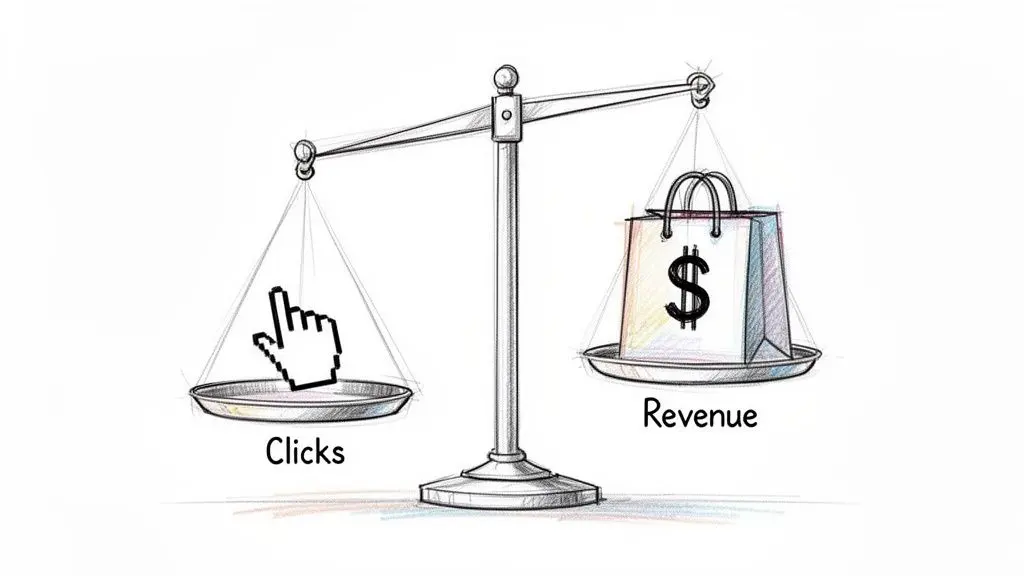
A truly mature experimentation programme knows that chasing button clicks isn't the end game. While optimising for micro-conversions like sign-ups or add-to-carts has its place, the real goal is to drive meaningful growth. That means shifting the focus to what your leadership team actually cares about: revenue and profit.
The good news is that the same principles of testing statistical significance we've been discussing apply just as well to these bigger, more impactful metrics. By tracking the right goals, you can start uncovering insights that genuinely guide business strategy.
From Clicks to Cash
Let's walk through a common scenario. You run a test on a new landing page, and the results show the new variation has a slightly lower click-through rate. The knee-jerk reaction? Call it a failure and revert the change.
But what happens if you look beyond that initial click? Maybe you were also tracking metrics like Average Order Value (AOV) or Revenue Per User (RPU). You might find that while fewer visitors converted, the ones who did went on to spend significantly more. Perhaps the new design filtered out casual browsers and spoke more directly to high-intent visitors ready to buy.
A change that slightly lowers one metric but dramatically boosts another can be a huge win. Without tracking business-level goals, you could easily discard your most profitable ideas, mistaking a revenue victory for a conversion rate loss.
This is where a more sophisticated approach to testing really shines. You stop asking, "Which design got more clicks?" and start asking, "Which experience delivered the most value?"
Aligning Tests with Business Goals
Tracking these higher-value metrics is how you connect your day-to-day optimisation efforts directly to the bottom line. It makes it far easier to demonstrate your team's impact to stakeholders and justify the resources you need.
To get there, you need to set up your experiments to measure what truly matters. Consider tracking goals like:
- Average Order Value: Does a new product page layout encourage customers to add more to their basket?
- Revenue Per User: Which variation generates more overall revenue from every single visitor who sees it?
- Customer Lifetime Value (LTV): Does a new onboarding flow produce customers who stay longer and spend more over their entire relationship with you?
By applying statistical rigour to these bottom-line metrics, you can prove with confidence that a change didn't just get more clicks—it made the business more money. For those curious, you can learn more about how Otter A/B’s workflow ties tests to revenue outcomes. This shift in focus is what separates a good experimentation programme from a great one.
Your Statistical Significance Questions, Answered
Once you get the theory down, the real-world questions start popping up. When you're in the thick of running an A/B test, it's natural to wonder if you're doing it right. Here are a few of the most common questions we hear from growth teams, along with some practical answers to keep you on track.
How Long Should I Run My A/B Test?
There’s no magic number, but we do have some hard-and-fast rules. First, let your test run for at least one full business cycle – usually a week. This ensures you capture the natural ebb and flow of user behaviour, from the Monday morning rush to the quieter weekend browsing.
But the real goal is collecting enough data to get a trustworthy result. A test on your homepage might hit significance in just a few days, while a tweak on a low-traffic checkout page could need several weeks. The most important thing is to let your testing tool tell you when it's done.
Don't be tempted to stop a test early just because one variation is ahead. This classic mistake, known as "peeking," often means you're acting on random noise, not a real winner. You need to wait until the p-value consistently stays below the 0.05 threshold.
What Is a Good P-Value in A/B Testing?
For most A/B tests, the gold standard is a p-value of less than 0.05. Think of it this way: a p-value of < 0.05 means there’s less than a 5% probability that the result you're seeing is a complete fluke.
This lines up perfectly with a 95% confidence level, which is the default setting for almost all professional A/B testing platforms. And if you see an even lower p-value, like 0.01, that's even better! It means you can be 99% confident in the result, with only a tiny 1% chance it happened by random luck.
Can I Trust Results from a Small Sample Size?
It’s tempting, but you really can’t. Results based on just a handful of conversions are incredibly volatile and easily skewed by random chance. You might see a huge, exciting lift on day one, but that's often just statistical noise.
These tests lack what's called statistical power, which is their ability to reliably spot a genuine improvement. Without enough power, you might miss a real winner simply because you didn't collect enough data to prove it – a frustrating "false negative." Always wait until your test has a large enough sample before you even think about making a business decision.
Ready to move from guessing to knowing? With Otter A/B, you can run statistically sound experiments without the complexity. Start for free and make every decision data-driven.
Stop guessing
Ready to start testing?
Set up your first A/B test in under five minutes. No credit card required.
- 14-day free trial
- No credit card required
- Cancel anytime