Marketing for SaaS: The 2026 Growth Playbook
A complete guide to marketing for SaaS in 2026. Learn tactical strategies for positioning, demand-gen, PLG, pricing, retention, and A/B testing to drive growth.
The SaaS market is still expanding, but the economics have become less forgiving. The market is projected to reach $465.03 billion in 2026, yet the median SaaS company now spends $2.00 to acquire $1.00 of new ARR, a 14% increase from 2023 according to Zylo's SaaS statistics. That changes the conversation about marketing for saas.
Growth no longer comes from adding more channels and hoping one works. It comes from building a system where positioning improves traffic quality, onboarding improves activation, pricing improves monetisation, retention improves payback, and experimentation ties the whole machine together. The teams that win aren't always louder. They're usually more organised.
Building Your Marketing Foundation
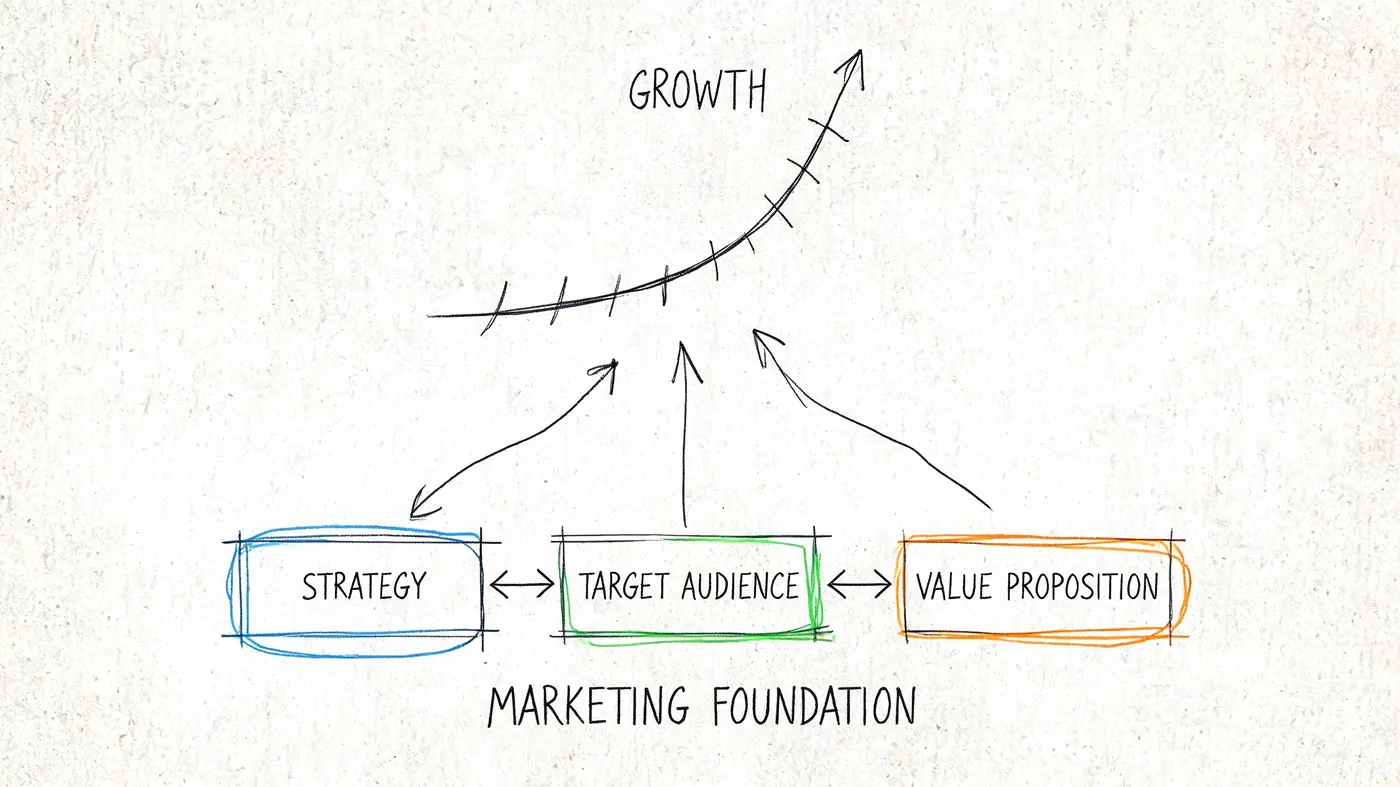
Most SaaS marketing problems don't start in channel execution. They start earlier, when the company hasn't decided who it's for, which pain it solves, or what category it belongs in. If your foundation is weak, every campaign inherits the same confusion.
Marketing operates much like constructing a house. Ads, SEO, email, webinars, and outbound are the upper floors. Positioning, target market, and value proposition are the concrete. If those are unstable, you don't need better tactics. You need a rebuild.
Define the ICP by job, not by persona
A weak ICP reads like this: “mid-market marketing manager in SaaS, aged 30 to 45, interested in growth”. That won't help your website, your sales team, or your product roadmap.
A useful ICP starts with the job the buyer is trying to get done. For example:
- Operational urgency: teams trying to reduce manual reporting across multiple tools
- Revenue pressure: leaders who need to improve conversion efficiency without increasing headcount
- Risk reduction: managers replacing a fragile internal workflow before it breaks at scale
That's why I prefer looking at validation through operational fit, not surface demographics. If you need a sharper framework, 100Signals niche validation for agencies gives a practical way to pressure-test whether your ICP is specific enough to guide marketing decisions.
Build a value proposition your buyer can repeat
Your value proposition shouldn't sound clever. It should sound obvious to the right buyer.
A strong SaaS value proposition usually answers three questions:
- What problem do you solve
- Who feels that problem most acutely
- Why your approach is different or easier to adopt
If the answer depends on a long demo, your message is still too vague. Buyers should be able to explain your product to a colleague after reading the homepage once.
Practical rule: if your sales team keeps “clarifying” the same message in calls, marketing hasn't finished the positioning work.
Choose your category deliberately
Some SaaS companies should create a new category. Most shouldn't. Category creation is expensive because you're teaching the market how to think before you can ask it to buy.
Competing in an existing category is usually the better commercial decision when:
- Buyer intent already exists
- Procurement recognises the budget line
- Your advantage is speed, usability, or a better workflow rather than a completely new concept
The cleaner way to make this decision is to tie it to your growth model and your north star metric framework. If your core metric depends on rapid activation and repeat usage, familiar category language often outperforms novelty.
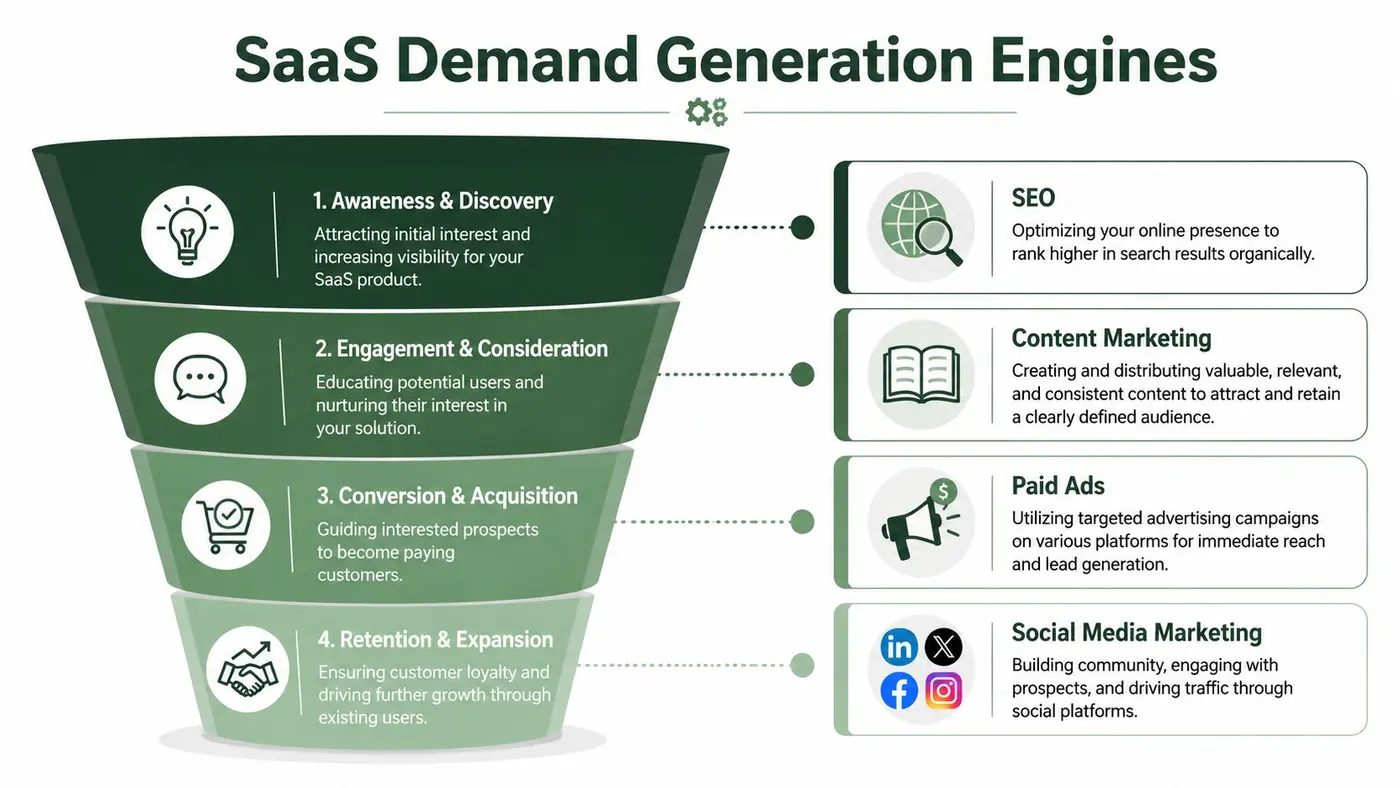
Choosing Your Demand Generation Engines
Many marketing teams don't have a lead problem. They have a channel mix problem. They spread budget and attention across too many engines, then wonder why nothing compounds.
The right way to think about demand generation is by time-to-value, cash efficiency, and fit with your buying motion. A self-serve product, a sales-led platform, and a founder-led niche tool shouldn't run the same playbook.
SEO and content when you need compounding returns
For B2B SaaS, SEO is unusually attractive when the business can wait for the payoff. Oliver Munro's SaaS marketing statistics roundup cites 702% ROI from SEO for B2B SaaS companies, with a 7-month break-even time, while paid search averages an $802 cost per acquisition.
That doesn't mean every SaaS company should pour everything into search on day one. SEO works best when:
- Buyers search for the problem or category
- Your product needs education before purchase
- You can publish content that sales can also reuse
- You have patience to let rankings mature
Content and SEO also force strategic clarity. You can't publish ten useful articles if you don't know your ICP, their use cases, and the objections blocking purchase.
Paid acquisition when speed matters more than efficiency
Paid search, paid social, and sponsorships can work. They just don't forgive sloppy positioning. If your message is weak, paid media helps you lose money faster.
Paid is most useful when:
- You need near-term pipeline
- You're testing offers, audiences, or geographies
- You already know what converts and need volume
- Sales can follow up quickly
I've seen teams treat paid like a growth engine when it was really a diagnostic tool. That's often where budgets get wasted. Use paid to learn fast, validate demand, and support proven motions. Don't use it to substitute for weak messaging or a poor onboarding experience.
Paid traffic magnifies reality. If the product promise and page experience don't line up, the channel exposes the gap immediately.
Partnerships and social when trust is the bottleneck
Some categories don't need more awareness. They need borrowed trust. That's where partnerships, communities, integration marketplaces, consultants, and co-marketing become more valuable than another ad set.
These channels are strong when your buyers rely on peer recommendations or already work inside an ecosystem. Think Shopify apps, HubSpot integrations, agency referrals, implementation partners, or niche communities on LinkedIn and Slack.
A simple comparison helps.
| Engine | Best use case | Main strength | Main weakness |
|---|---|---|---|
| SEO | High-intent discovery | Compounds over time | Slower payoff |
| Content marketing | Category education and trust | Reusable across funnel stages | Requires consistency |
| Paid acquisition | Fast testing and pipeline support | Immediate traffic | Costly if conversion is weak |
| Partnerships | Trust transfer and distribution | Efficient access to warm audiences | Harder to standardise |
If you're choosing where to start, audit your funnel before your channels. The better question isn't “which platform should we use?” It's “where does intent already exist, and where are we best equipped to convert it?” That's also why teams evaluating conversion rate optimisation tools usually get more value when they connect channel selection with landing page performance instead of treating them as separate projects.
Mastering Product-Led Growth and Onboarding
A signup isn't demand captured. It's potential demand. The business only benefits when the user reaches value fast enough to care, returns often enough to build a habit, and sees enough product depth to justify payment.
That's why product-led growth matters even for companies that still have a sales team. PLG isn't just freemium pricing. It's a go-to-market approach where the product does part of the persuasion before a rep enters the conversation.
Free trial or freemium
This decision changes the whole marketing system.
A free trial works when your product's value is clear quickly and the buyer can evaluate it within a bounded period. It creates urgency, keeps support costs more predictable, and aligns well with products that need guided evaluation.
A freemium model works when collaboration, habitual use, or network effects make adoption spread naturally. It lowers the barrier to entry, but it can also flood the business with low-intent signups if activation is weak and qualification is fuzzy.
Neither model wins automatically. The right question is whether your product can deliver a meaningful outcome before the user loses interest.
Onboarding should remove decisions
Many onboarding flows fail because they ask new users to think too much. “Set up your workspace” sounds harmless until the person has to make six configuration choices before seeing any value.
Good onboarding narrows the path. It doesn't just welcome the user. It guides them to one meaningful action.
The strongest flows usually include:
- A role-based entry point so users see the most relevant path first
- A fast setup sequence that asks only for what's essential
- A guided first win inside the product
- A triggered email series that supports the in-app journey rather than repeating it
If you map the first week well, you'll notice most friction isn't technical. It's psychological. Users hesitate when they don't know what “done” looks like.
Blend sales qualification with product behaviour
Sales-led and product-led motions often get treated as opposites. In practice, the best SaaS teams combine them. CXL's guide to SaaS metrics notes that advanced teams use lead scoring to identify leads that need more nurturing, and they track the MQL-to-SQL conversion rate monthly to see whether lead generation and qualification are aligned.
That matters inside PLG too. A user who signs up, invites colleagues, completes setup, and revisits key workflows is different from someone who browses once and disappears. Marketing should use product behaviour to shape nurture tracks, handoff timing, and upgrade prompts.
Don't pass every signup to sales. Pass the signups that have earned the next conversation.
A practical way to tighten this is to map onboarding around moments, not screens. If you need inspiration for how teams break this down, these customer journey map examples are useful because they show where messaging, product usage, and lifecycle communication overlap.
What usually works and what usually doesn't
What works:
- short onboarding paths
- contextual nudges
- templates and pre-built examples
- emails tied to actual product behaviour
- handoff to sales based on intent signals
What usually fails:
- feature tours that explain everything
- generic “getting started” emails
- requiring setup before demonstrating value
- pushing demo requests before the user understands the product
- treating all signups as equally qualified
PLG works when marketing, product, and sales agree on one thing: the first job is not to explain the software. It's to get the user to a result.
Optimising Your Pricing and Packaging
Most companies treat pricing as a finance decision with some homepage copy attached. That's a mistake. Pricing is one of the most direct levers in marketing for saas because it shapes who signs up, how quickly they buy, and what path they follow after conversion.
The pricing page doesn't just collect demand. It filters it.
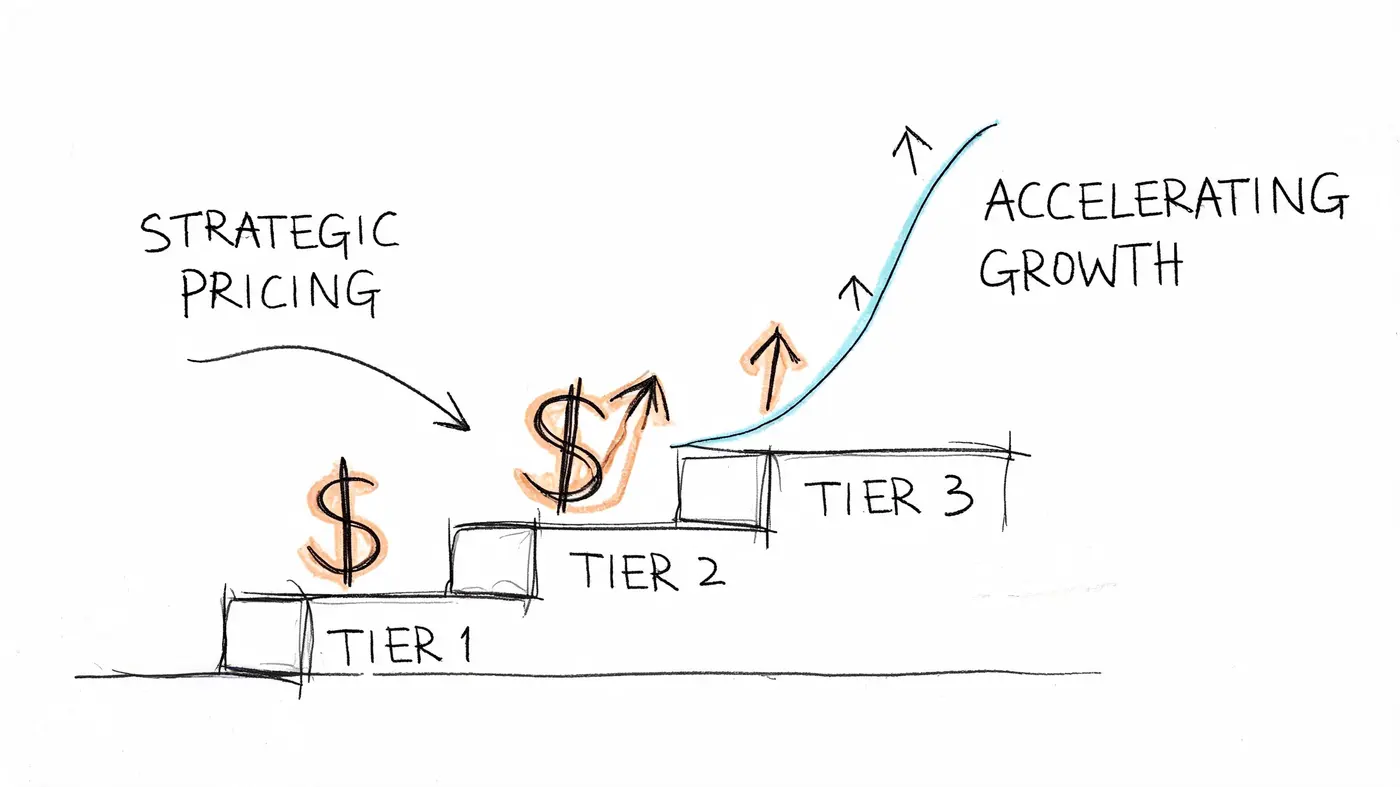
Packaging creates behaviour
The best packaging structures aren't built around internal org charts. They're built around customer progress.
If your entry plan is too limited, users never experience enough value to justify upgrading. If the middle tier is messy, buyers can't tell which option fits. If the enterprise tier looks like a black box, serious prospects hesitate because they can't predict the buying process.
A clean packaging strategy usually does three jobs at once:
- Entry-level plan captures smaller teams or cautious buyers
- Growth tier matches the most common use case and becomes the default choice
- Enterprise option handles governance, support, procurement, and custom requirements
That middle tier holds greater significance than is often recognized. It's often where your messaging, feature design, and monetisation model all collide.
Price to match value, not internal comfort
Too many SaaS firms underprice because they're afraid of friction. Low pricing can increase friction if buyers start questioning whether the tool is serious enough for an important workflow.
Pricing research helps. A practical read on how to price your product correctly is useful because it pushes teams to stop guessing and start tying price to perceived value, willingness to pay, and actual usage patterns.
A few common trade-offs show up repeatedly:
| Model | Best when | Risk |
|---|---|---|
| Per-user | Usage scales with team size | Penalises collaboration |
| Tiered | Buyers need clear upgrade paths | Confusing bundles create hesitation |
| Usage-based | Value scales with consumption | Bills can feel unpredictable |
| Flat-rate | Product is simple to understand | Leaves money on the table for heavy users |
Your pricing page is a conversion asset
Treat the pricing page like a landing page, not a static brochure. Buyers use it to answer practical questions fast.
That means it should make obvious:
- who each plan is for
- what changes at each tier
- which features provide deeper value
- when to contact sales
- what risk-reduction exists, such as a trial, annual option, or implementation support
A useful walkthrough on pricing page thinking sits below.
Packaging should support expansion
The strongest SaaS pricing models don't just convert the first purchase. They create a natural path to expansion.
That can come from additional seats, advanced workflows, governance controls, reporting depth, integrations, service levels, or usage thresholds. What matters is that the upgrade feels like a logical consequence of success, not a forced sales motion.
A good package tells customers where to start. A great package also tells them why they'll outgrow it.
When pricing works, acquisition improves because the offer feels legible, and retention improves because customers can move up without re-evaluating the whole product.
Driving Retention and Customer Activation
A Bain & Company analysis found that improving retention can have an outsized effect on profit. SaaS leaders feel that math fast. If paid acquisition gets harder and sales cycles stretch, retention stops being a post-sale metric and becomes part of the growth model.
That is why I treat activation and retention as one system. Acquisition brings accounts in. Activation gets them to first value. Retention proves the value is repeatable. If any one of those breaks, the whole engine loses efficiency.
Start with the value path
Retention work usually fails because teams build around campaign calendars instead of customer progress. The better approach is to map the sequence of actions that turns a new account into a stable, expanding customer.
For most SaaS companies, that path includes setup, first meaningful outcome, repeated usage, broader adoption, and expansion moments. Those stages will look different for a workflow tool than for a data platform, but the job stays the same. Define what progress looks like, then build messaging, in-product prompts, and human outreach around the gaps.
This is also where trade-offs matter. A small team cannot support ten polished lifecycle programs at once. Pick the two or three stages where customers stall most often and fix those first.
Measure activation by behaviour, not by account creation
Plenty of teams still call a signup an activated user. That inflates reporting and hides churn risk.
Activation should mean the customer completed the actions that make the product useful in their real workflow. That might be inviting teammates, connecting a data source, publishing the first campaign, or closing the first task inside the product. The exact event depends on the category, but the principle does not change. The milestone has to reflect delivered value, not admin completion.
Once that definition is clear, retention marketing gets sharper. Welcome emails can drive one next step. Product education can focus on the features that predict repeat use. Customer success can prioritize accounts that created an account but never reached operational value.
Build triggers around friction and momentum
The strongest lifecycle programs respond to behaviour inside the product.
Use triggers for moments like:
- stalled setup after signup
- first success with no second use case adopted
- repeated usage from one person but no team adoption
- drop in core activity over a defined period
- product limit reached, which signals expansion potential
Each trigger should answer a practical question: what is blocking value right now?
That sounds obvious, but many SaaS teams still send generic nurture messages to every customer in the same stage. Behaviour-based programs perform better because they match the customer's actual situation. If usage drops because the integration was never configured, the message should address setup. If the account is active but shallow, the push should focus on a second use case or stakeholder.
Attribution also matters here. Retention is influenced by more than lifecycle email. Webinars, product announcements, support interactions, paid retargeting, and sales follow-ups can all contribute. A good starting point is this Cometly guide to marketing touchpoints, which helps teams see retention as part of a broader demand and revenue system, not an isolated CS workflow.
Find the behaviours that actually predict staying power
Every product has activity that looks healthy but means very little. Logins can be noisy. Page views can mislead. Even feature usage can overstate adoption if the action is easy to try but hard to repeat.
The useful question is simpler. Which behaviours show that the customer has embedded the product into work they already need to do?
Common signals include:
- recurring use without reminders
- adoption of a second meaningful workflow
- teammate invites or cross-functional usage
- saved configurations, reports, or automations
- evidence that replacing the product would create operational pain
Those are the behaviours worth reinforcing across onboarding, lifecycle messaging, and account management.
Retention usually comes from repeated outcomes, not feature exposure.
Keep the operating model simple
You do not need a complex health-scoring project to improve retention. You need a short list of signals, clear owners, and a weekly habit of acting on them.
A workable review model often includes activation rate, repeat usage, depth of adoption, disengagement flags, and expansion readiness by segment. That is enough to decide where marketing should intervene, where product needs to reduce friction, and where customer success should step in directly.
Simple systems win because teams can maintain them. And in SaaS, consistency is what turns activation into retention, retention into expansion, and expansion back into more efficient acquisition.
Using Metrics and Experiments to Fuel Growth
Teams that test consistently make faster budget decisions, spot funnel problems earlier, and waste less time arguing over preferences. In SaaS, that matters because acquisition, conversion, and retention are tied together. A win at the top of funnel only counts if it improves revenue quality downstream.
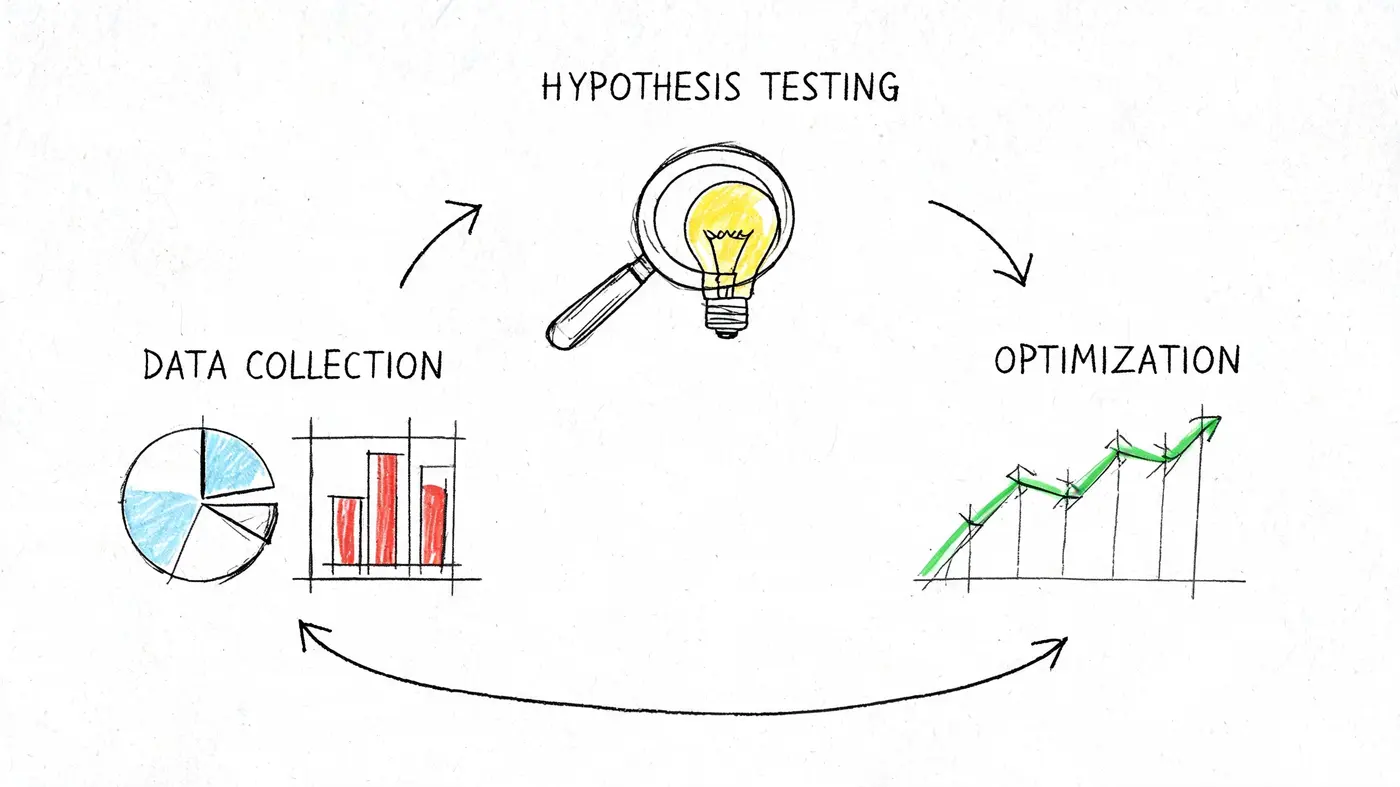
That is why metrics and experimentation should run as one operating system, not as separate reporting and optimisation tasks. Metrics show where the system is underperforming. Experiments explain why and give the team a controlled way to improve it.
Track the metrics that connect cause to money
A crowded dashboard creates false confidence. The job is to track the small set of numbers that explain commercial movement across the whole system.
At minimum, teams should understand how these interact:
- CAC shows what it costs to acquire demand
- CLTV shows how much value a customer can generate over time
- MRR reveals recurring revenue momentum
- Churn shows how much of that momentum leaks away
- Conversion rates by funnel stage show where the system is losing efficiency
The value comes from reading them together. Rising CAC can still be acceptable if activation and retention improve. Flat MRR does not always mean demand is weak. It can point to poor close rates, weak onboarding, or a packaging issue. High signup volume can also hide a quality problem if those users never reach meaningful usage.
This is the discipline many teams skip. They report channel metrics in one meeting, product metrics in another, and churn in a third. The result is fragmented decision-making. A SaaS growth system works better when marketing, product, sales, and customer teams look at the same chain of cause and effect.
Use prediction to decide where to test next
Reporting is useful. Forecasting is more useful.
Hockeystack's piece on SaaS marketing analytics explains how predictive analysis uses historical performance to estimate future outcomes. In practice, that helps teams decide which experiments deserve priority before they spend a quarter rolling out changes everywhere.
The point is not to build an overly complex model. It is to make better bets. If trial-to-paid conversion is weak for a specific segment, a pricing page test and a tighter onboarding path may deserve more attention than another paid acquisition campaign. If expansion is strong among customers who adopt a second workflow, lifecycle experiments should focus there because the revenue upside is clearer.
Prediction sharpens experimentation. Experimentation improves prediction. That feedback loop is what turns isolated tests into a growth flywheel.
Run experiments where the potential impact is highest
The most effective SaaS tests usually sit in a few places:
| Area | Example questions |
|---|---|
| Homepage messaging | Does problem-led copy outperform feature-led copy |
| Pricing page | Does a clearer default plan improve purchase intent |
| Signup flow | Does removing a field increase qualified starts |
| Onboarding | Does a guided checklist improve first-value completion |
| Lifecycle emails | Does behaviour-based timing outperform fixed sequences |
The trade-off is straightforward. Teams can always find small things to test, but easy tests are often low-value tests. Button colour changes rarely fix a weak offer, fuzzy positioning, or a signup flow that attracts the wrong users.
Good experimentation starts with a clear behavioural hypothesis. Why would this change affect buyer intent, user activation, or retention quality? If the team cannot answer that question, the test probably should not be first in the queue.
A useful companion to this work is a proper touchpoint review. The Cometly guide to marketing touchpoints is helpful because it pushes teams to examine how channels and interactions work together, instead of over-crediting the last click.
Good experiments answer two questions: did performance improve, and what did that result teach us about how this customer buys or adopts?
Build a cadence that the team can maintain
Experimentation breaks down when it depends on spare time, one growth manager, or a burst of energy after a bad quarter. It works when the process is boring enough to repeat every month.
A practical operating rhythm looks like this:
- review the funnel
- identify the tightest constraint
- form a clear hypothesis
- run the test
- document the outcome
- feed the result into planning
The last step matters more than many teams think. A test that lifts conversion but never changes budget allocation, messaging, onboarding, or packaging has limited value. The lesson needs to move into the wider system.
That is how experimentation becomes the connector across acquisition, conversion, and retention. Better tests improve traffic quality. Better traffic quality improves activation rates. Better activation supports retention and expansion. Over time, that gives the business more room to spend, more confidence in forecasts, and a much clearer view of what drives growth.
SaaS Marketing Playbooks in Action
A bootstrapped founder, a venture-backed growth team, a sales-led B2B platform, and a B2C product-led app shouldn't copy one another's playbooks. The underlying system stays the same, but emphasis changes based on cash, motion, and maturity.
The useful question isn't “what's the best SaaS marketing strategy?” It's “which version of the system fits how this business grows?”
Sample SaaS Marketing Playbooks by Stage and Model
| Stage / Model | Primary Focus | Key Channels | Core KPIs |
|---|---|---|---|
| Bootstrapped early-stage SaaS | Prove positioning, find repeatable demand, tighten onboarding | Founder-led content, SEO, customer interviews, email nurture, selective partnerships | Qualified signups, activation, trial-to-opportunity quality, churn signals |
| Venture-backed growth-stage SaaS | Scale demand without losing efficiency | SEO, content engine, paid search, paid social retargeting, partner campaigns, lifecycle marketing | Pipeline quality, CAC, funnel conversion by stage, expansion contribution |
| B2B sales-led SaaS | Improve lead quality and shorten the path to revenue | Product marketing, case-study content, SEO for high-intent terms, webinars, outbound support, account-based programmes | MQL-to-SQL movement, demo quality, sales cycle health, win-loss themes |
| B2C product-led SaaS | Drive self-serve adoption and habit formation | App store visibility, creator partnerships, social, referral loops, onboarding email, in-app messaging | Activation, repeat usage, free-to-paid movement, cancellation reasons |
How the playbooks differ in practice
The bootstrapped team can't afford channel sprawl. It needs sharp positioning, a narrow ICP, and a small set of repeatable messages. That usually means founder insight turned into content, direct customer conversations, and a simple onboarding path that reveals where the product promise breaks.
The venture-backed company has a different risk. It can fund growth, but it can also hide bad economics behind volume. Here, discipline matters more than activity. The team should connect paid spend, SEO, onboarding, and lifecycle work into one measurement model instead of letting each function optimise for its own local metric.
Two motions that change execution
For a sales-led B2B SaaS company, marketing's job is often to improve certainty. That means sharper qualification, stronger proof, cleaner category framing, and fewer low-intent demos. Content should help sales handle objections before the call, not just generate form fills.
For a B2C or self-serve PLG product, the product experience carries more of the selling load. Marketing still matters, but mostly as a traffic shaper, expectation setter, and lifecycle driver. If the onboarding path is weak, more traffic just creates more dormant accounts.
The common pattern across all of them
Every model still depends on the same flywheel:
- acquisition brings in the right audience
- conversion helps them reach value
- pricing and packaging monetise success
- retention protects margin
- experimentation improves every step
That's the core playbook. Not a bag of isolated tactics, but one system with shared feedback loops.
If you want to operationalise that system, Otter A/B gives teams a lightweight way to test headlines, CTAs, layouts, and funnel experiences without turning experimentation into an engineering project. It's a practical fit for SaaS marketers, product teams, and CRO specialists who need faster answers and cleaner decision-making.
Stop guessing
Ready to start testing?
Set up your first A/B test in under five minutes. No credit card required.
- 14-day free trial
- No credit card required
- Cancel anytime