Type 2 Error: The A/B Testing Mistake Costing You Revenue
Learn what a type 2 error is, why it creates false negatives in your A/B tests, and how to reduce the risk to stop missing out on winning variations.
You launch a headline test on a product page. Traffic splits cleanly. The variant looks sharper, the copy is clearer, and everyone involved expects a lift. Two weeks later, the dashboard says there's no significant difference.
Many groups stop there.
That's the mistake.
A “no winner” result can mean the variant genuinely did nothing. It can also mean the test wasn't capable of detecting a real improvement. In practice, that second outcome is often more expensive than people realise. You don't just lose a test. You keep serving the weaker experience, keep paying for the same traffic, and keep missing revenue that was available to you.
For UK e-commerce teams, this problem shows up constantly. Traffic is often tighter than internal stakeholders assume, consent rules reduce analysable users, and mature stores are usually chasing modest uplifts rather than dramatic swings. That combination creates perfect conditions for a type 2 error.
The High Cost of a Missed Winner
The dangerous A/B testing outcome isn't always a false positive. Sometimes it's the quiet result that looks responsible on the surface: “no significant difference”.
A type 2 error is a missed winner. Your variation performs better, but your test fails to detect it. The business consequence is simple. You throw away a working change and keep the weaker page live.
Why this hurts revenue
This isn't just a statistics problem. It's an opportunity cost problem.
Amplitude describes type II errors in product testing as “missed opportunities for improvement... or failure to tackle existing issues” in its guide to type 1 and type 2 errors. That's exactly how this plays out in live experimentation programmes. The test ends, the team moves on, and a real improvement never reaches full rollout.
For agencies and in-house CRO teams, the pattern is familiar:
- A landing page test ends inconclusively. The team archives it and prioritises the next idea.
- The original page stays live. Media spend continues to hit the weaker experience.
- The cost compounds. Every paid click, every repeat visitor, and every sales period runs through a page that could have converted better.
One example from the same Amplitude discussion makes the point clearly. If a landing page variation would improve conversion by 12%, but the test returns a false negative, the client continues using the weaker page and absorbs the ongoing loss instead of the gain.
Practical rule: “No significant difference” is not the same as “there is no difference.”
Where teams usually go wrong
Teams rarely create type 2 errors because they don't care about rigour. They create them because they care about speed, traffic is limited, and stakeholders want answers before the data is ready.
The usual culprits are straightforward:
- Too little traffic
- Too short a test duration
- An effect that's real but modest
- A tool-driven workflow that overweights the winner label
That last point matters. When people treat the dashboard as a verdict rather than a measurement system, they stop asking whether the test had any real chance of spotting the lift they wanted to find.
A weak test doesn't protect you from bad decisions. It gives you bad decisions with cleaner-looking charts.
What Is a Type 2 Error in A/B Testing
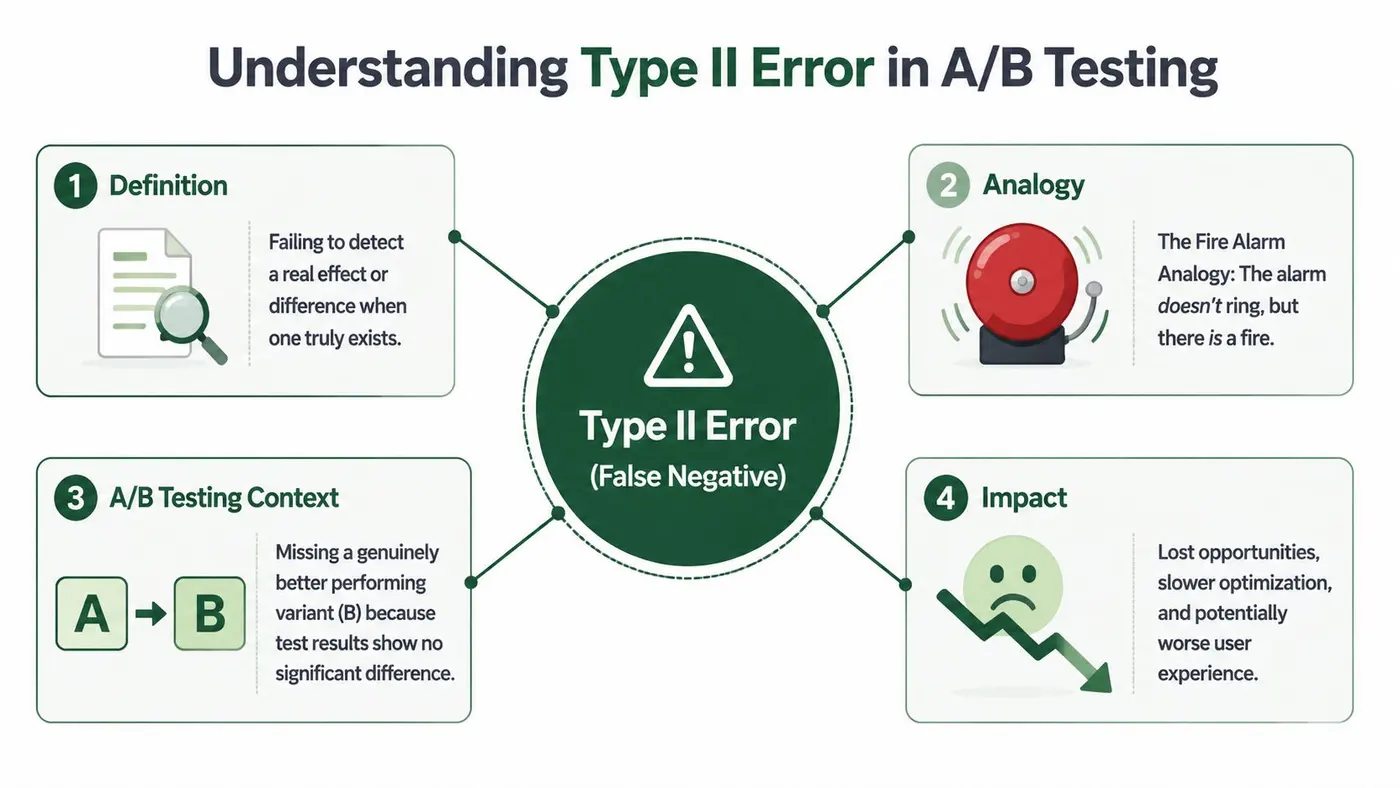
A type 2 error is the testing equivalent of a smoke alarm failing to sound an alert.
There's a real fire, but no alarm goes off.
In A/B testing, there's a real improvement in the variant, but the test says there isn't enough evidence to call it. You keep the control, not because it's better, but because the experiment didn't detect the improvement.
The simple version
In hypothesis testing, the default position is the null hypothesis. In an A/B test, that usually means “there is no meaningful difference between control and variant.”
The alternative hypothesis says the opposite. It says the variant really is different, and in most CRO work, better.
A type 2 error happens when the null hypothesis is false, but you fail to reject it anyway. In plain English, your new version is better, and your test misses it.
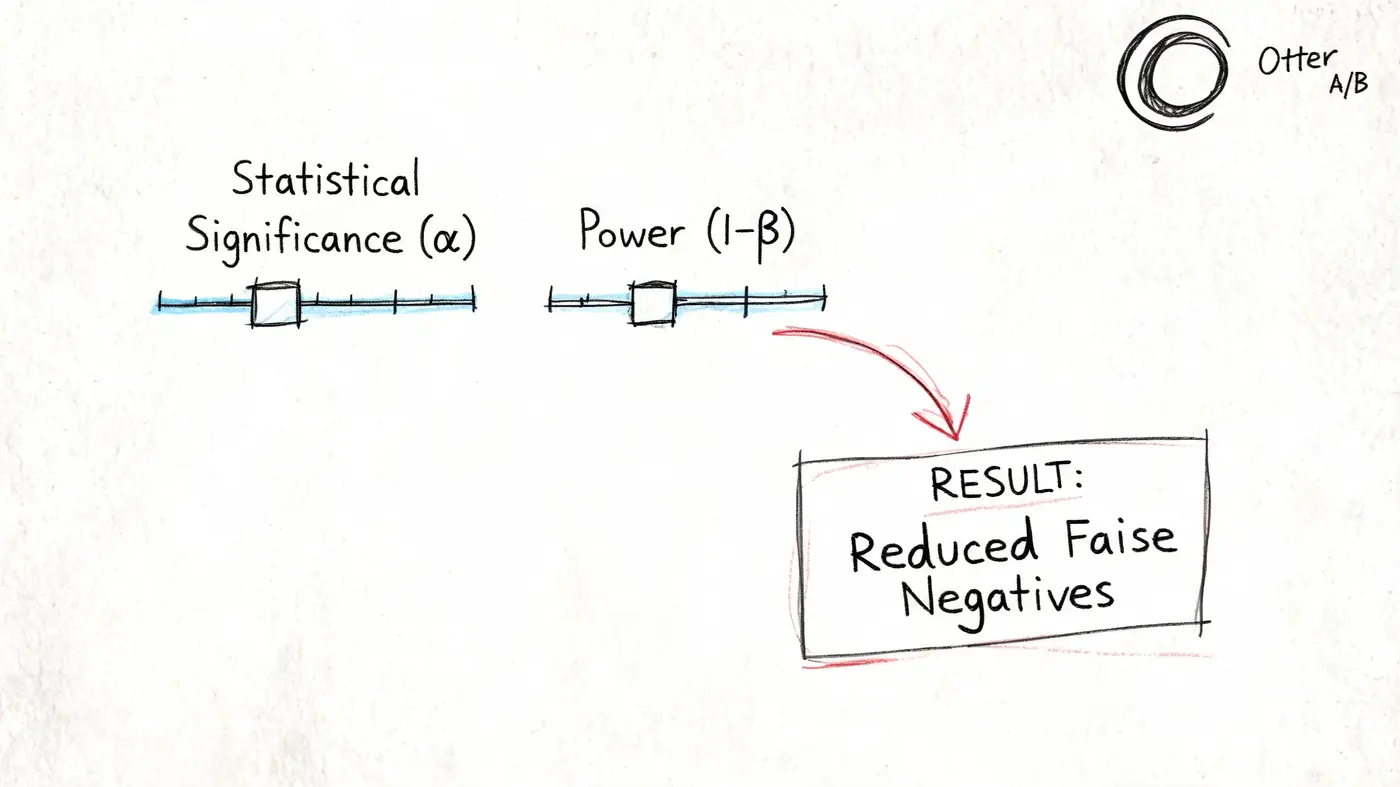
According to the overview of type I and type II errors, the probability of a type II error is denoted by β, and statistical power is 1−β. In practical A/B testing terms, teams typically aim for 80% power or higher, which means β ≤ 0.20, while working at a 95% confidence threshold (α = 0.05).
If you want a clean comparison of both error types, Otter A/B has a useful explainer on type 1 vs type 2 errors.
Type 1 and type 2 are different failures
People often understand false positives faster than false negatives because false positives feel more dramatic. You choose a bad winner and roll out a weaker page.
False negatives are quieter. They're also easier to miss inside a busy experimentation programme.
A simple comparison helps:
| Outcome | What happened in reality | What the test tells you |
|---|---|---|
| Type 1 error | No real effect exists | You think there is one |
| Type 2 error | A real effect exists | You think there isn't one |
Why the trade-off matters
There's no free setting that eliminates both risks.
If you tighten the significance threshold to reduce false positives, you increase the risk of false negatives for a fixed sample size. That matters because many teams instinctively ask for more certainty without accepting what that extra certainty costs.
A stricter standard can make a test look safer while making it less capable of finding real gains.
In CRO, that trade-off should be explicit. If the business wants fewer false positives, it has to accept larger samples, longer runtimes, or bolder test ideas. Otherwise, it's just choosing more missed winners.
The Statistical Balancing Act Behind A/B Tests
Every A/B test sits on four levers. Change one, and the others move with it.
Those levers are alpha, beta, sample size, and minimum detectable effect. Most test failures around type 2 error happen because teams adjust one lever casually and ignore the knock-on effect elsewhere.
Alpha and beta pull against each other
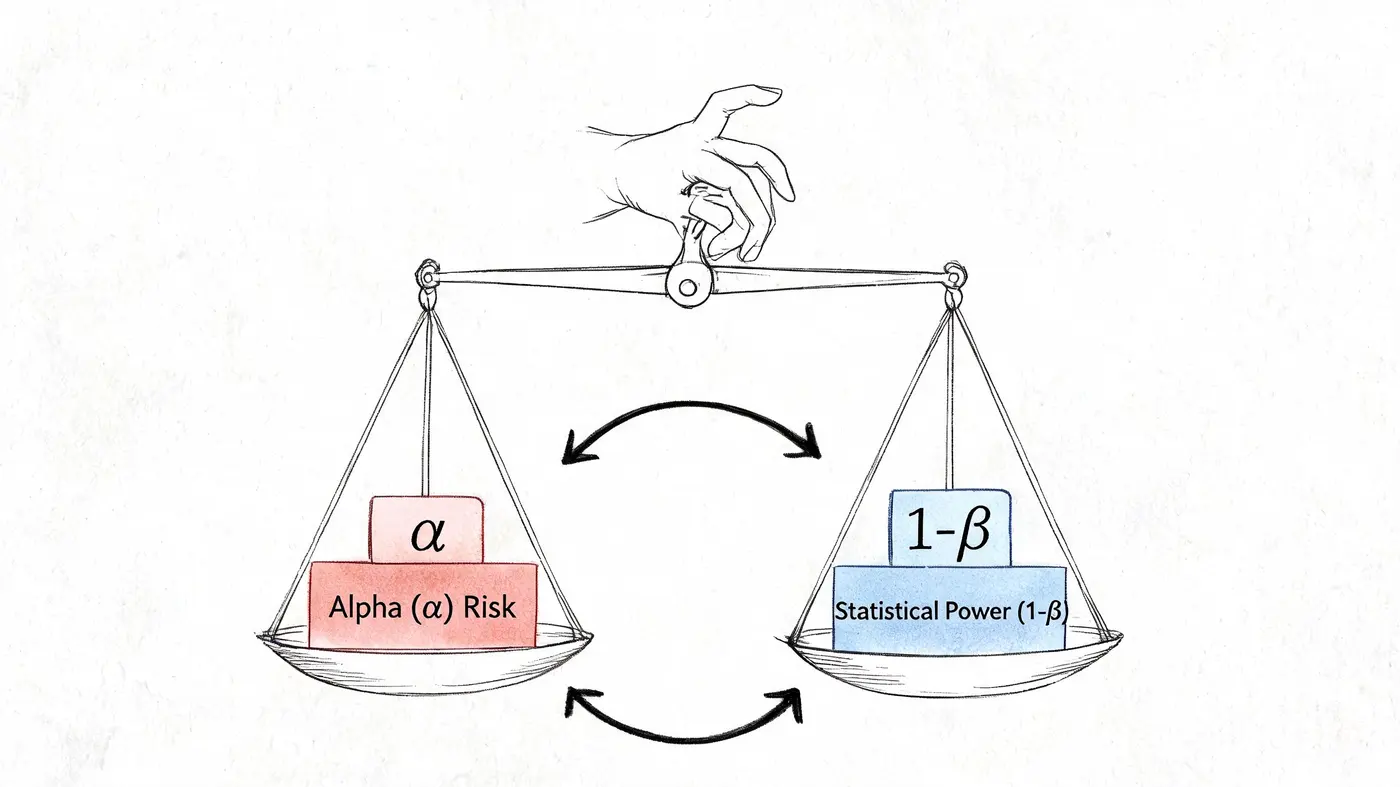
Alpha (α) is your false-positive threshold. In most A/B testing setups, that's the familiar 0.05, or 95% confidence.
Beta (β) is your false-negative risk. If β is 0.20, your test has 80% power.
The important part isn't the terminology. It's the trade-off. If you make alpha more strict without changing anything else, beta usually gets worse. You reduce your appetite for false alarms, but you increase your chance of missing a real winner.
That trade-off shows up well outside e-commerce. A NICE review discussed in this type II error overview found that 22% of oncology trials in the review suffered from type II errors because of low power. The same source notes the common heuristic of β = 0.20, or 80% power, and adds that lowering α from 0.05 to 0.01 can increase β by up to 15% for a fixed sample size.
That's the same balancing act CRO teams face. More caution on one side often means more blindness on the other.
The four variables that shape your test
Here's the practical version of each lever:
- Alpha controls how strong the evidence must be before you call a winner.
- Beta reflects the risk that you miss a real effect.
- Sample size determines how much information the test collects.
- Minimum detectable effect sets the smallest uplift your test is designed to spot.
If you want to detect smaller uplifts, you need more traffic. If you want stricter significance, you need more traffic. If your traffic is limited, you either accept a larger detectable effect or a higher false-negative risk.
That's why “we'll just test it quickly” is often statistically incoherent.
What power means in real work
Power sounds academic, but it answers a very practical question: if a real uplift exists, how likely is this test to find it?
That's the metric too many teams skip before launch.
A lot of execution problems come from running experiments inside rigid operational constraints. The merchandising calendar won't move. Paid traffic is expensive. The product team wants a decision before the next sprint closes. In those cases, planning matters more, not less.
If you're working with Shopify stores, the operational side of experiment setup matters as much as the statistics. This round-up of Shopify A/B testing services is useful because it shows how implementation support, traffic control, and reporting structure affect test quality, not just convenience.
For a clearer grounding in the decision threshold itself, Otter A/B's post on testing statistical significance is worth reading before you trust any winner label too quickly.
Decision standard: Don't ask whether a result is significant only after the test. Ask before launch whether the test is capable of producing significance if the uplift you care about is real.
Practical Strategies to Reduce Your Type 2 Error Risk
A UK retailer runs a homepage hero test for six days, sees no significant difference, and keeps the control. Two months later, the same merchandising idea goes live during a seasonal campaign and lifts revenue. The first test did not prove the change was useless. It failed to give the change a fair chance to win.
That is the commercial cost of a Type II error. You do the work, spend the traffic, delay a rollout, and still miss a variant that could have increased conversion or revenue per visitor.
Start with commercial impact, then scope the test
The right first question is not “what should we test?” It is “what uplift would actually matter to the business?”
For a UK e-commerce team, that usually means tying the experiment to pounds, not abstract percentages. If a product page test would need to add only a tiny conversion lift to be worth shipping, the sample requirement climbs fast. On a lower-traffic store, that often makes the test a poor fit in its original form.
A better approach is to define three things before build starts:
- Primary metric: the one number that decides the test
- Minimum worthwhile uplift: the smallest gain that justifies rollout effort
- Traffic reality: how many users each variant can realistically receive in the planned window
If those three do not line up, change the test design before launch. That saves more money than forcing an underpowered experiment through the calendar.
Use a simple planning rule
Use this as a pre-launch check:
| Test condition | Practical decision |
|---|---|
| Expected uplift is small and traffic is limited | Do not run a subtle test. Increase the size of the change or widen the test scope |
| Traffic is split across too many pages or devices | Consolidate placements so each variant gets enough volume |
| The test must finish by a fixed commercial date | Choose a larger expected effect or postpone the test |
| The result would not change a rollout decision anyway | Do not test it |
Many teams lose margin when they approve a test because the idea feels sensible, not because the traffic can support a reliable read.
Prioritise changes that can earn their sample size
Low-traffic stores should be selective. Testing a button label, a line of reassurance copy, or a minor spacing tweak can be fine on a high-volume site. On a store with constrained traffic, those tests often burn weeks to answer a question that was never likely to resolve cleanly.
Test larger commercial hypotheses instead. A stronger offer presentation, clearer delivery messaging, a revised pricing block, a more persuasive product detail layout, or a shorter checkout step has a better chance of producing a detectable effect.
That does not mean every test needs to be dramatic. It means the size of the idea should match the amount of traffic available.
Set stopping rules before anyone sees the numbers
Type II errors often come from operational pressure, not bad intent. The campaign team wants the banner slot back. Paid traffic costs are rising. The product manager wants a decision before the next sprint planning meeting.
Those are real constraints. They still do not make an under-read test reliable.
Set the rules before launch:
- Minimum sample requirement
- Minimum runtime across normal trading days
- Primary metric that decides the result
- Action if the test finishes inconclusive
That last point matters. “No winner” should trigger a decision process, not a shrug. Sometimes the right call is to rerun with a bigger change. Sometimes it is to combine traffic from similar templates. Sometimes it is to stop testing that idea because the likely upside is too small to justify the time.
Use the tool for execution, not for test design
Platforms help teams ship experiments faster, but they do not fix weak planning. If you are running tests through Otter A/B's experimentation workflow, decide the metric, effect threshold, and traffic plan before the variants go live.
That habit matters because dashboards can make inconclusive tests look more authoritative than they are. A flat result on an underpowered experiment is not evidence that the variant had no value. It is often evidence that the business asked a small test to answer a bigger question than the traffic could support.
A disciplined process looks like this:
- Choose the business outcome first
- Set the smallest uplift worth shipping
- Check whether available traffic can realistically detect it
- Adjust scope, audience, or variant size if it cannot
- Launch only when the test can produce a decision you would trust
That is how teams reduce false negatives in practice. Not by quoting statistical formulas after the fact, but by refusing to run tests that cannot protect revenue in the first place.
Preventing False Negatives with Otter A/B
A UK retailer runs a homepage test for two weeks, sees no statistical winner, and keeps the control. Three months later, a stronger retest on the same idea shows the variant would have lifted completed purchases. The first test did not protect the business from a bad idea. It hid a good one.
That is the practical risk Otter A/B needs to help you control. The platform can run the experiment cleanly, but false negatives usually start before launch, in the assumptions behind the test.
What to set up before launch
Teams using Otter A/B's experimentation workflow should treat the platform as the execution system, not the place where test logic gets invented halfway through.
Its frequentist z-test engine evaluates results at a 95% confidence threshold. That means the commercial rules need to be set before traffic hits the variants. For a revenue-focused e-commerce test, define:
- The one primary metric that decides the rollout
- The minimum uplift worth shipping
- The expected traffic per variant
- The run time needed to reach a decision
- Any segments that must be excluded or analysed separately
That discipline matters more in UK e-commerce because measured traffic is rarely the same as total traffic. Consent choices, uneven device mix, and lower-volume checkout events can all shrink the sample you can analyze. If you forecast from gross sessions instead of eligible observations, the test often looks adequately sized on paper and weak in practice.
What to check inside the results
An inconclusive result only has value if the test had a fair chance to detect the effect you cared about.
Review the result in this order:
- Did the test reach the planned sample size?
- Did the traffic split and tracking behave as expected?
- Did the test cover a normal trading period for the template or audience?
- Did the result rule out the minimum uplift that would have mattered commercially?
The fourth question is the one many teams skip. If the interval around the result still includes a commercially meaningful gain, the business has not learned “there is no winner.” It has learned that the test was too weak to clear the decision threshold.
That difference affects revenue. A missed uplift on a checkout, PDP, or basket test can mean months of paid traffic landing on a weaker experience.
Handle consent-reduced traffic realistically
Consent banners and measurement restrictions change test planning because they reduce the number of users or events available for analysis. The exact impact varies by implementation, traffic source, and analytics setup, so it is safer to plan conservatively than to rely on generic percentages.
In practice, I advise UK teams to estimate duration from analysable traffic only. If a purchase event is your decision metric, use the number of measurable purchase sessions you expect to capture, not the total number of visitors the site receives. That usually leads to one of three better decisions. Extend the test, increase the size of the treatment, or pick a page with higher traffic and faster feedback.
Use Otter A/B to support decisions, not decorate them
Otter A/B is most useful when it makes decision quality visible. If a result is flat, the next question is not whether the chart looks convincing. The next question is whether the experiment had enough information to protect the business from rejecting a profitable change.
For revenue metrics, I prefer a simple operating rule. Do not treat "no winner" as a final answer unless the test reached its planned conditions and had enough sensitivity to detect the minimum upside worth deploying. If those conditions were missed, classify the result as unresolved, not failed.
That is how teams reduce false negatives without turning experimentation into theory for theory's sake. They use the platform to run cleaner tests, forecast from real measurable traffic, and judge inconclusive outcomes by commercial standards rather than dashboard optics.
Conclusion Making Data-Driven Decisions with Confidence
A type 2 error looks harmless because it often arrives wrapped in caution. No winner. No rollout. No risky decision.
But in e-commerce, that caution can be expensive. A missed winner means more than a failed test. It means keeping weaker pages live, paying for traffic that converts less efficiently, and teaching your team to trust inconclusive experiments that never had enough power in the first place.
The fix isn't blind faith in statistics. It's better operating discipline.
That means setting your desired effect before launch, checking whether traffic can support it, accepting the trade-off between alpha and beta, and refusing to treat every “no difference” result as proof that nothing changed. When the underlying design is weak, statistical cleanliness is just false reassurance.
The strongest experimentation teams do something simple and rare. They plan tests around business decisions, not around dashboard features. They know what uplift matters. They know how much traffic they can analyse. They know when to run a bold test and when to stop wasting time on micro-optimisations.
That's what confidence should mean in CRO. Not certainty for its own sake, but decisions that are trustworthy enough to act on.
If you manage type 2 error risk well, your programme gets better in two ways. You stop rolling out noise, and you stop discarding real gains. That combination is what makes experimentation commercially useful.
If you want a simpler way to run website experiments while keeping revenue metrics tied to the decision, Otter A/B gives teams a lightweight setup for testing headlines, CTAs, layouts, purchases, AOV, and revenue outcomes without adding operational drag.
Stop guessing
Ready to start testing?
Set up your first A/B test in under five minutes. No credit card required.
- 14-day free trial
- No credit card required
- Cancel anytime