What is a Type 1 Error? Avoid False Positives in A/B Testing
Understand what is a type 1 error (false positive) in A/B testing. Get strategies to avoid this statistical pitfall and make smarter CRO decisions.
Ever celebrated an A/B test win, only to realise later that the promised lift never actually materialised? If so, you’ve likely fallen victim to a Type 1 error.
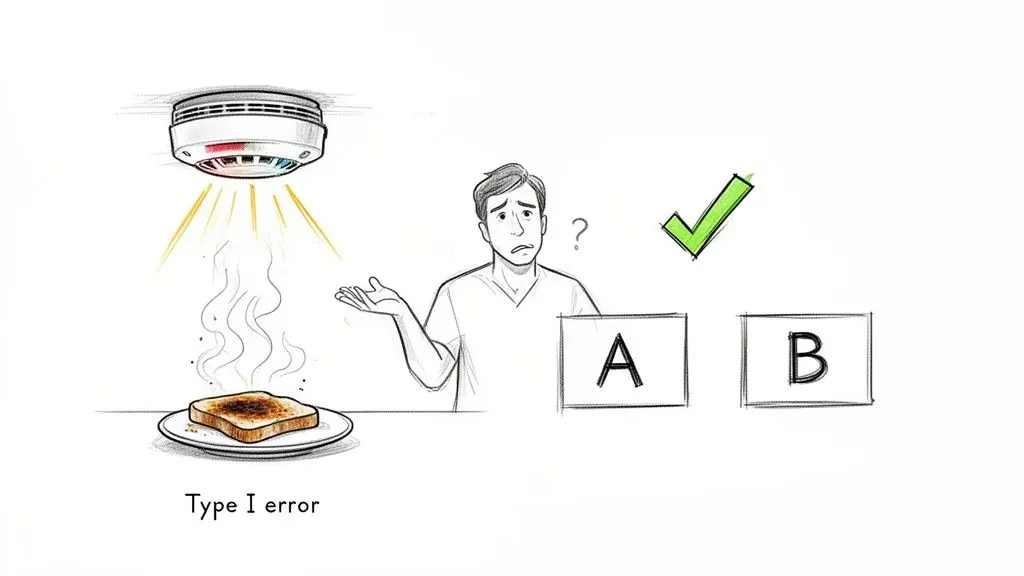
Simply put, a Type 1 error is a false positive. It’s the statistical equivalent of a smoke alarm going off because you’ve burnt your toast. The alarm is real, but the fire isn't.
What Is a Type 1 Error in A/B Testing?
In A/B testing, we start every experiment with a default assumption known as the null hypothesis. This is the idea that your new variation makes no real difference compared to the original version (the control). It presumes that any difference you see in the metrics is just random statistical noise.
A Type 1 error happens when you wrongly reject that assumption. Your test results look promising, suggesting the new version is a clear winner, so you roll it out. The problem is, the "lift" you measured was just a fluke—a random swing in the data, not a genuine improvement.
The Problem with False Positives
Let's imagine you're testing a new checkout button colour. After a few days, your new green button seems to be outperforming the old one with a 10% lift in conversions. That’s exciting! Based on this, your team declares victory and pours development resources into pushing the change live across the site.
But if this was a Type 1 error, that win was just an illusion. The green button actually performs no better than the original. Acting on this false positive isn't just a minor mistake; it's a costly one.
A Type 1 error is when you get fooled by randomness. You believe you’ve found a real effect when, in truth, nothing has fundamentally changed. This leads you to implement changes that bring zero real business value.
To help clarify these concepts, here’s a quick breakdown of how a Type 1 error plays out in practice.
Type 1 Error at a Glance
| Concept | Simple Explanation | A/B Testing Example |
|---|---|---|
| Type 1 Error | A false positive. | Your test says a new headline increased sign-ups, but it didn't. |
| Null Hypothesis | The default assumption that there's no real difference. | The new headline has no effect on sign-up rates. |
| The Mistake | You reject the null hypothesis when it's actually true. | You conclude the new headline works, when its "success" was just luck. |
| The Outcome | You implement a change that provides no actual benefit. | You roll out the new headline, but your conversion rate stays the same. |
Understanding these components is the first step toward avoiding the pitfalls of false positives and building a more reliable testing programme.
Understanding the Real-World Impact
Mistaking a random fluctuation for a genuine win has serious consequences for any conversion rate optimisation (CRO) programme. These aren't just abstract statistical ideas; they come with tangible costs that can derail your efforts. If you're new to the field, it's worth taking a moment to review what an A/B test is in our detailed guide.
When you act on a false positive, you will almost certainly:
- Waste Development Resources: Your engineers and designers will spend precious time implementing a change that has zero impact on your bottom line.
- Incur an Opportunity Cost: While your team is busy rolling out a phantom win, you're missing the chance to test other ideas that could have driven real, sustainable growth.
- Erode Trust in Testing: Nothing undermines confidence in experimentation faster than promised uplifts that never appear. When stakeholders see that the long-term results don't match the test outcomes, they lose faith in the entire process.
Ultimately, a Type 1 error tricks you into making a business decision based on faulty data. You celebrate a win and push an update, but your overall conversion rate, revenue, or user engagement doesn't actually improve. Grasping what a Type 1 error is and why it happens is the critical first step toward building an experimentation culture that drives genuine business results.
The Hidden Costs of False Positives in E-commerce
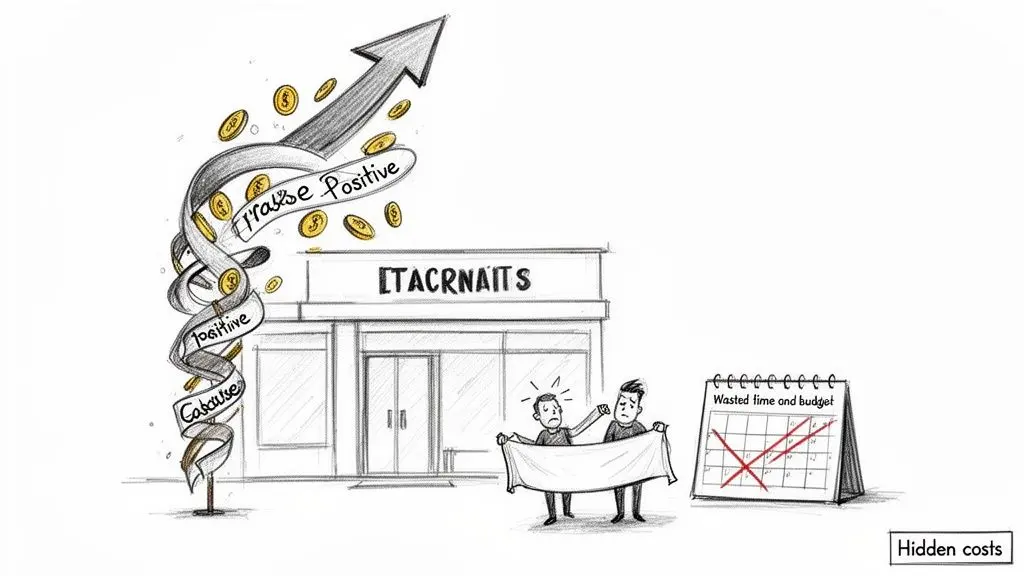
It’s easy to dismiss a Type 1 error as just statistical jargon, but in the world of e-commerce, these mistakes have very real and very expensive consequences. Let's walk through a cautionary tale that plays out all too often.
Imagine a conversion rate optimisation (CRO) team at a fast-growing online clothing brand. They're under pressure to deliver results, so they launch an A/B test on a bold new homepage headline. The null hypothesis, of course, is that the new headline will make no difference to sales.
After just ten days, the results look amazing. The dashboard is flashing green—Variant B is crushing the original. Eager to bank the win, the team calls the test early and pushes the new headline live for everyone. They’re already anticipating the revenue boost. Unfortunately, this is a perfect setup for understanding what a type 1 error is and the damage it can cause.
The Initial Win Becomes a Long-Term Loss
At first, nothing seems amiss. But as the weeks and months roll by, the projected lift in revenue never shows up. The site's overall conversion rate hasn't budged. Confused, the analytics team digs deeper, running a post-hoc analysis on a much larger dataset spanning six months.
The truth they uncovered was a hard pill to swallow. With enough data, it became painfully clear the initial 'win' was just a statistical fluke. The two headlines performed almost identically in the long run. The team had celebrated and acted on a false positive.
This isn't some made-up scenario. One major UK online retailer, back in 2025, made this exact mistake, declaring a new headline a winner after only 10 days. It took six months and 2.5 million sessions for a deeper dive to confirm it was a classic Type 1 error. This mirrors wider industry findings, where 18% of retail A/B tests with small samples turn out to be false positives, costing an estimated £45 million in wasted development and design resources. You can read more on the statistical foundations of these errors in this overview of Type I and II errors.
A false positive isn't just a statistical blip; it's a business decision with a real financial cost. It represents a misallocation of resources based on an illusion of success.
The fallout from this one mistake sends ripples across the company, causing both direct financial loss and more subtle, long-term damage.
The Tangible and Intangible Costs
The direct financial hit is the easiest part to calculate. All the budget spent on developers, designers, and project managers to roll out the new headline was essentially thrown away. That's money that could have funded other experiments that might have actually worked.
But it's the hidden costs that often do the most harm.
- Opportunity Cost: For every hour the team spent implementing a change that did nothing, they weren't working on a different idea that could have been a true winner. The real growth driver was left sitting in the backlog.
- Team Demoralisation: When the analysts revealed the truth, the team's initial excitement soured into frustration and embarrassment. The CRO team lost credibility, and stakeholders started questioning the value of the whole testing programme.
- Polluted Future Learnings: The organisation now operates on the false assumption that a certain style of headline is effective. This flawed 'insight' can poison future creative briefs and lead to a string of poor decisions.
This story highlights a crucial lesson for any team running A/B tests. A Type 1 error isn't just a number in a report; it's a business trap that can waste your budget, derail your strategy, and slowly erode trust in your data.
Connecting P-Values, Alpha, and Significance
To really get a handle on Type 1 errors, we need to talk about the numbers that drive decisions in A/B testing. The two big ones are the p-value and the significance level, which you’ll often hear called alpha (α). Nail these concepts, and you’ll be running experiments you can actually trust.
It's a common trap to think the p-value is the probability that your new version is better than the original. It’s not. The real definition is a bit more specific, and frankly, a little counterintuitive at first.
The p-value is the probability of seeing your test results (or even more extreme ones) if the null hypothesis were actually true. In simple terms, it’s the chance that the "lift" you observed was just random noise.
So, a tiny p-value doesn't prove your new variation is a winner. What it does mean is that your results would be incredibly unlikely to happen by sheer luck if there were no real difference between the variations.
The Role of Alpha: Your Significance Threshold
How small does a p-value need to be for us to call a winner? This is where your significance level, or alpha (α), steps in. Alpha is a threshold you must set before you even start the test.
Think of alpha as your personal line in the sand for risk. It’s the amount of risk you're willing to take of making a Type 1 error. For most A/B tests, this is set at 0.05, which translates to a 95% confidence level.
- Alpha (α) = 0.05: This means you're comfortable with a 5% chance of calling a false positive.
- The Decision Rule: If your p-value is less than your chosen alpha (p < 0.05), you reject the null hypothesis and declare a statistically significant result.
That moment of decision—rejecting the null hypothesis—is precisely where the risk of a Type 1 error lives. By setting your alpha to 0.05, you are knowingly accepting that, over the long run, 1 in 20 tests that you call "significant" could be a false positive caused by nothing more than random chance. You can dive deeper into the practical side of this in our guide on testing for statistical significance.
A courtroom analogy works well here. The null hypothesis is the "presumption of innocence"—the new variation is assumed to be no different until proven otherwise. Alpha is the standard of "beyond a reasonable doubt." If the evidence (your p-value) is strong enough to meet that standard, a verdict is reached. But there's always that small, accepted risk of a wrongful conviction.
The Inseparable Link to Type 2 Errors
But that's only half the picture. The risk of a false positive (Type 1 error) has a counterpart: the Type 2 error, or false negative.
A Type 2 error happens when you fail to reject a null hypothesis that was actually false. In essence, it’s a massive missed opportunity. Your new design was genuinely better, but the test just wasn't sensitive enough to spot the difference. You wrongly conclude it’s a dud and stick with the old version.
To help keep them straight, here’s a quick comparison of the two.
Type 1 vs Type 2 Error: A Quick Comparison
| Characteristic | Type 1 Error (False Positive) | Type 2 Error (False Negative) |
|---|---|---|
| Simple Name | False Positive | False Negative |
| The Action Taken | You implement a change that doesn't actually work. | You miss out on implementing a change that would have worked. |
| Hypothesis Mistake | You reject a null hypothesis that was actually true. | You fail to reject a null hypothesis that was actually false. |
| Analogy | The smoke alarm goes off, but there's no fire. | There is a fire, but the smoke alarm fails to go off. |
This table highlights the fundamental trade-off at the heart of experimentation. There’s an unavoidable seesaw relationship between these two errors. If you try to be more cautious and reduce your risk of a Type 1 error (say, by lowering alpha from 0.05 to 0.01), you directly increase your risk of a Type 2 error. You become so wary of false positives that you start missing out on real wins.
Successfully navigating this trade-off is one of the key challenges every skilled experimenter has to master.
How Peeking at Results Inflates Your Error Rate
It’s one of the most tempting—and destructive—habits in A/B testing: “peeking” at your results before the experiment has gathered enough data. We’ve all been there. It feels harmless, but every time you refresh your dashboard looking for a winner, you’re actually making it dramatically more likely you’ll commit a Type I error.
Think of it like this. Your goal is to flip a coin until you get three heads in a row. If you only give yourself three flips, your chances are pretty slim. But if you stand there flipping it all day long, you’re almost guaranteed to see a streak of three heads eventually. It’s not skill; it’s just luck having enough opportunities to show up.
Peeking at your test results works in exactly the same way. Each time you check, you’re effectively running a new, unofficial test. You’re giving random chance another ticket in the lottery to produce a “significant” lift that isn’t real at all.
The Problem with Multiple Peeks
When you set a 95% significance level (which corresponds to an alpha of 0.05), you’re making a pact with the statistics. You’re accepting a 5% risk of a false positive for a single, pre-planned analysis at the end of the test.
But if you check your results ten times before the test concludes, your cumulative risk of being fooled by randomness skyrockets. It's no longer a disciplined 5% chance; it could balloon to 20% or even higher.
You aren't running one clean experiment anymore. You're running a whole series of messy ones and just stopping the moment one of them gives you the result you were hoping for. This kind of behaviour makes a Type I error almost inevitable.
Peeking doesn't help you find a winner faster. It just makes you more likely to crown a loser by mistake. The more you look, the higher the odds that you'll be deceived by statistical noise.
This simple flowchart shows the decision rule for a single, valid test: your p-value must be less than your pre-set alpha to declare a significant result.
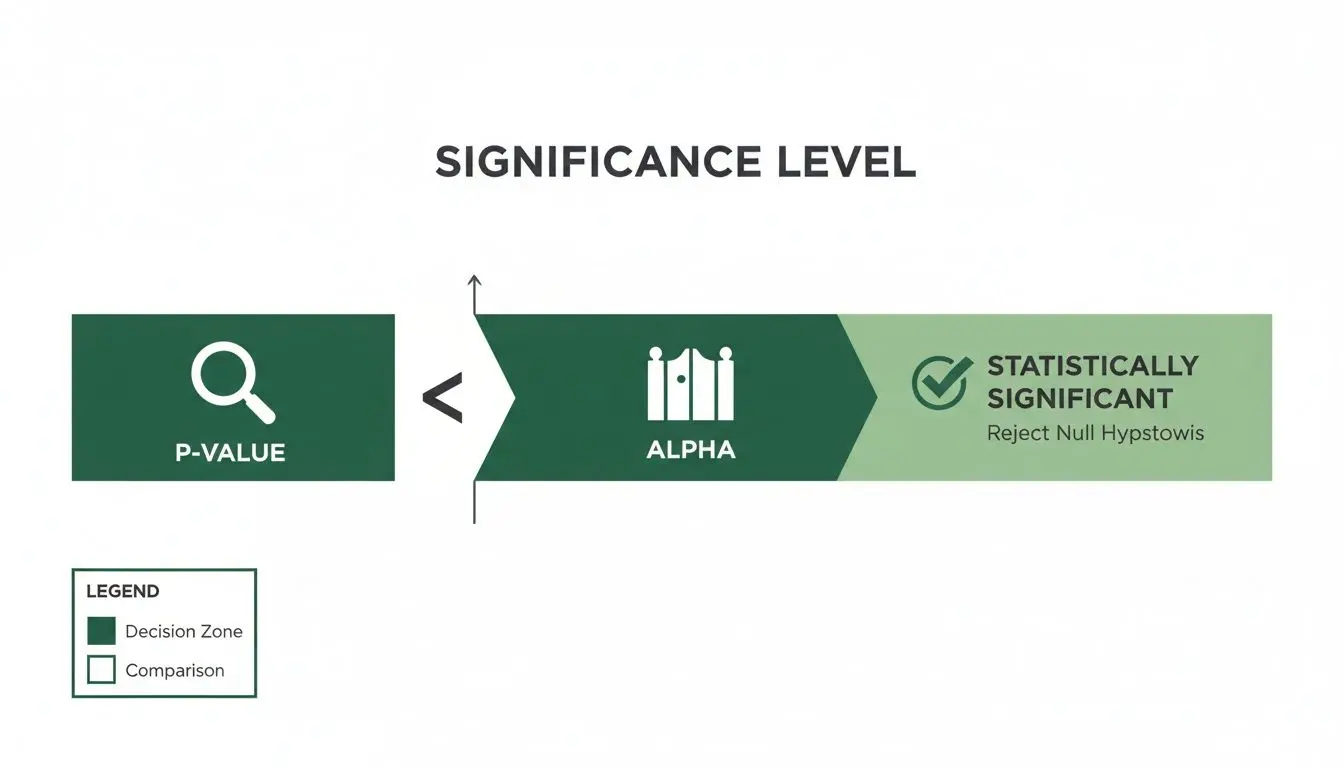
The crucial part is that this check is only meant to be performed once, after your test has reached its required sample size—not repeatedly while it’s still running.
From Peeking to Multiple Comparisons
This exact same statistical pitfall appears in another common scenario: testing too many variations at once. In the world of statistics, this is known as the “multiple comparisons problem.”
Let’s say you test one variation against a control using a 5% alpha. Simple enough; you have a 5% chance of a false positive. But what happens if you run an A/B/C/D/E test with four variations against the control?
- Your chance of a false positive is no longer 5%.
- Each of the four variations has its own 5% chance of being a false winner.
- Your overall experiment-wide error rate inflates substantially.
With four variations, your true probability of getting at least one false positive jumps to roughly 19%. It’s like buying four lottery tickets instead of one—your odds of winning (or, in this case, finding a false positive) just went up. This is a critical risk that many optimisation teams overlook.
The danger here is very real. Recent studies have shown that for engineering teams using flexible tools like Google Tag Manager, the multiple comparisons problem can push error rates as high as 25%. Similarly, e-commerce firms on platforms like Shopify or WooCommerce have reported false positive rates of 21% on layout tests with insufficient sample sizes. A 2026 UK Digital Economy Council survey even found that 28% of CRO professionals regretted a product rollout due to what they later realised was a Type I error. You can dig into the statistical details in this guide to Type I and II errors.
Whether you’re peeking at results or testing too many variations, the root cause is the same. You are giving randomness more and more chances to fool you into thinking a fluke is a real win. This fundamentally breaks the statistical agreement you made when you set your alpha level, making a costly Type I error far more likely. A disciplined, planned approach is the only way to ensure your results are truly trustworthy.
Practical Strategies to Control Type 1 Errors
Knowing about the dangers of peeking and multiple comparisons is one thing, but actively stopping them from happening is another beast entirely. The good news is, you’re not powerless. There are several powerful strategies you can use to protect your experiments from a Type 1 error and build a more robust, reliable testing programme. Think of this as your toolkit for statistical discipline.
These methods are all about enforcing a structured approach, making you decide on the rules of the game before you see any data. This takes the temptation to stop a test early or get fooled by random noise right off the table. It ensures that when you finally declare a winner, it's a conclusion you can actually trust.
Define Your Hypothesis and Sample Size First
The single most effective shield against a Type 1 error is simple, old-fashioned planning. Before you even think about launching an A/B test, you absolutely must define your hypothesis and calculate the sample size you’ll need. This isn't an optional extra; it's the very foundation of a valid experiment.
The statistical tool for this job is called a power analysis. It helps you figure out the minimum number of visitors or conversions required for each variation to confidently detect a specific effect size, assuming one truly exists.
By committing to a sample size upfront, you achieve two vital goals:
- You give your test enough statistical power to actually find a real winner, which also reduces the risk of a Type 2 error (a false negative).
- You create a clear, non-negotiable finish line for your experiment. This is your number one defence against the urge to peek at the results before they're ready.
Once you have your number, you run the test until it hits that pre-determined sample size—no matter how good (or bad) the dashboard looks along the way.
Committing to a sample size before you begin is your first line of defence. It replaces emotional decision-making based on early trends with a disciplined, data-driven endpoint for your test.
Set and Enforce Strict Stopping Rules
A "stopping rule" is just what it sounds like: a pre-defined condition that tells you when to end your experiment. For traditional A/B testing, the simplest and most reliable rule is to stop the test once the pre-calculated sample size has been reached. That’s it.
Your entire team needs to agree to this rule and stick to it religiously. This prevents the all-too-common mistake of stopping a test the second it crosses the 95% statistical significance threshold. A result might look significant early on purely due to random fluctuations, only to drift back towards the average if the test is allowed to run its full course.
This simple discipline is what separates a scientific process from a game of chance, and it's essential for understanding what is a Type 1 error and how to dodge it.
Use Corrections for Multiple Comparisons
But what happens if your test involves more than one variation against the control—say, an A/B/C/D test? As we’ve covered, every extra variation you add inflates your experiment-wide error rate. To bring that risk back down to earth, you need to apply a statistical correction.
The most common method is the Bonferroni correction. It's a straightforward but very effective way to keep the overall risk of a false positive under control.
Here’s how it works:
- Start with your desired significance level (alpha), which is usually 0.05.
- Divide that alpha by the number of comparisons you are making.
- This new, smaller number is now your significance threshold for each individual comparison.
For example, if you're testing three variations against a control (that's three comparisons), you’d divide your alpha of 0.05 by 3. Your new significance threshold becomes 0.0167. A variation is only declared a winner if its p-value is less than 0.0167, which makes it much harder for a random fluke to be crowned a winner.
Explore Sequential Testing Alternatives
For teams that need answers faster or simply can't afford to wait weeks for a fixed-sample test to finish, there is another way: sequential testing. This is a different class of statistical method, specifically designed to let you monitor results continuously without inflating the Type 1 error rate.
Unlike traditional fixed-sample tests, sequential methodologies use clever calculations that adjust the significance boundaries as more data comes in. This allows you to safely check your results as often as you like and stop the test the moment a clear winner emerges (or once it becomes obvious the test is futile). It gives you the flexibility of "peeking" without the statistical penalty, offering a powerful way to speed up your experimentation while maintaining rigour.
How Otter A/B Automates Statistical Best Practices
Knowing the theory behind a Type I error is one thing. Actually applying it perfectly, every single time, under real-world pressure? That's a different story entirely. Manual calculations and gut-feel decisions are where mistakes creep in, which is why the right tooling can act as your safety net, building statistical discipline directly into your workflow.
Otter A/B was designed specifically to help your team sidestep the common traps that lead to false positives. Instead of leaving crucial statistical decisions to chance, our platform handles the heavy lifting. This frees up your team to do what they do best: come up with great ideas, confident that the analysis will be rock-solid.
Built-in Statistical Rigour
At the heart of the platform is a powerful frequentist z-test engine. Otter A/B automatically calculates statistical significance using a pre-set 95% confidence threshold (an alpha of 0.05), giving you a clear and dependable signal. There are no confusing settings to tweak; the platform simply follows established best practices out of the box.
This automation is your first line of defence against one of the most common errors: stopping a test too early and declaring a premature winner. For a product manager testing a new CTA on their Webflow site, calling a test too soon is like misdiagnosing a healthy patient. The Otter A/B dashboard is designed to discourage this, only signalling a winner once the result is truly statistically robust. This is so important, especially when studies in high-stakes fields have found error rates as high as 9.3%, leading to calls for even stricter alpha levels to cut down on false positives. You can read more on the data behind these errors.
Otter A/B’s system is designed to protect you from yourself. By automating significance calculations and providing clear signals, it removes the temptation to peek at results and make decisions based on statistical noise.
The platform sends a clear "winner" notification through the dashboard and optional Slack alerts, but only when the evidence is strong enough to meet that 95% confidence level. You can explore how our platform works to see how this simple automation removes ambiguity and guesswork from your testing programme.
Protecting Data Integrity and Business Outcomes
A trustworthy test isn’t just about the maths—it needs clean, accurate data. A slow or buggy testing script can easily corrupt your results, not to mention frustrate your users. That’s why we built Otter A/B on an extremely lightweight SDK.
- Fast and Flicker-Free: The tiny 9KB script loads in under 50ms and is completely flicker-free. It won’t hurt your Core Web Vitals or create a jarring experience that could skew user behaviour.
- High Reliability: With 99.9% uptime, you can have peace of mind knowing your experiments are always running correctly and collecting accurate data without interruption.
- Focus on Business Goals: The platform helps you look beyond simple conversion rates. You can track the metrics that really matter—like revenue per variant, average order value, and total purchases—to tie every single experiment directly to business growth.
By automating statistical best practices and guaranteeing data integrity, Otter A/B provides the reliable framework you need for an effective experimentation programme. It handles the complex maths so you can focus on what you do best: discovering what truly moves the needle for your business.
Frequently Asked Questions About Type 1 Errors
Even when you've got the basics down, a few common questions about Type 1 errors always seem to surface. Let’s tackle some of those lingering "what ifs" and clear up the finer points.
Can I Completely Eliminate Type 1 Errors?
In a word, no. At least, not without creating other problems. The risk of a Type 1 error is something you manage, not erase. That risk is set directly by the significance level you choose, your alpha (α).
When you set an alpha of 0.05, you're making a conscious decision to accept a 5% chance of a false positive. You could absolutely lower your alpha to 0.01 for more confidence, but there's a trade-off. Doing so immediately increases your risk of a Type 2 error—failing to spot a genuine winner. The goal isn't to chase zero risk; it's to strike a sensible balance that serves your business goals.
Is a P-Value of 0.04 More Significant Than 0.01?
This is a subtle but important trap to avoid. While 0.01 is clearly a smaller number, you shouldn't think of p-values as a sliding scale of "more" or "less" significant. In frequentist A/B testing, the p-value is really a binary decision-making tool.
The p-value has one job: to be compared against your pre-set alpha. If your alpha is 0.05, both a p-value of 0.04 and 0.01 lead to the very same outcome—the result is statistically significant, so you reject the null hypothesis.
Focus on the pass/fail decision you pre-agreed on, not on the exact p-value itself. It’s the conclusion that counts.
How Does Sample Size Affect Type 1 Errors?
Here’s where people often get tripped up. A bigger sample size doesn't actually change your Type 1 error rate—that part is locked in by your alpha level. So why is sample size so crucial? Because it protects you from being fooled by random chance.
Think of it this way:
- Small Samples are Volatile: With very little data, results can swing wildly. A short, lucky streak of conversions can easily push your p-value below the threshold, tricking you into a Type 1 error.
- Large Samples Provide Stability: A properly calculated, large sample size gives your test the statistical power it needs. It smooths out those random fluctuations, giving you a much clearer picture of the real, underlying effect.
In short, a large sample doesn't lower your 5% risk, but it does make it far less likely that sheer random noise will be the reason you fall into that 5% trap. It ensures that when you do declare a winner, it's based on a stable trend, not a fleeting fluke.
With Otter A/B, you can run statistically sound experiments without getting lost in the maths. Our platform automates best practices, calculates significance at a 95% confidence level, and provides clear signals, empowering you to make data-driven decisions you can trust. Start optimising for free at OtterAB.com.
Stop guessing
Ready to start testing?
Set up your first A/B test in under five minutes. No credit card required.
- 14-day free trial
- No credit card required
- Cancel anytime