A Clear Confidence Level Definition for Marketers
Tired of confusing stats? Our guide provides a clear confidence level definition and shows you how to use it in A/B testing for reliable results.

When you run an A/B test, you're looking for a winner. But how can you be sure the result isn't just a fluke? That’s where the confidence level comes in—it’s the statistical backbone of any reliable experiment.
What Is a Confidence Level and Why It Matters for Marketers
Let's cut through the jargon. A confidence level isn’t a measure of how certain you are about a single A/B test result. It’s a measure of how reliable your entire testing process is over the long run.
Think of it this way: imagine you're running a political poll before an election. You can't possibly ask every single voter who they're choosing, so you take a sample—say, a few thousand people—and use their answers to predict the overall outcome.
A confidence level answers the question, "If I ran this exact same poll 100 times with 100 different random groups of people, how many times would my results accurately reflect what the entire voting population thinks?"
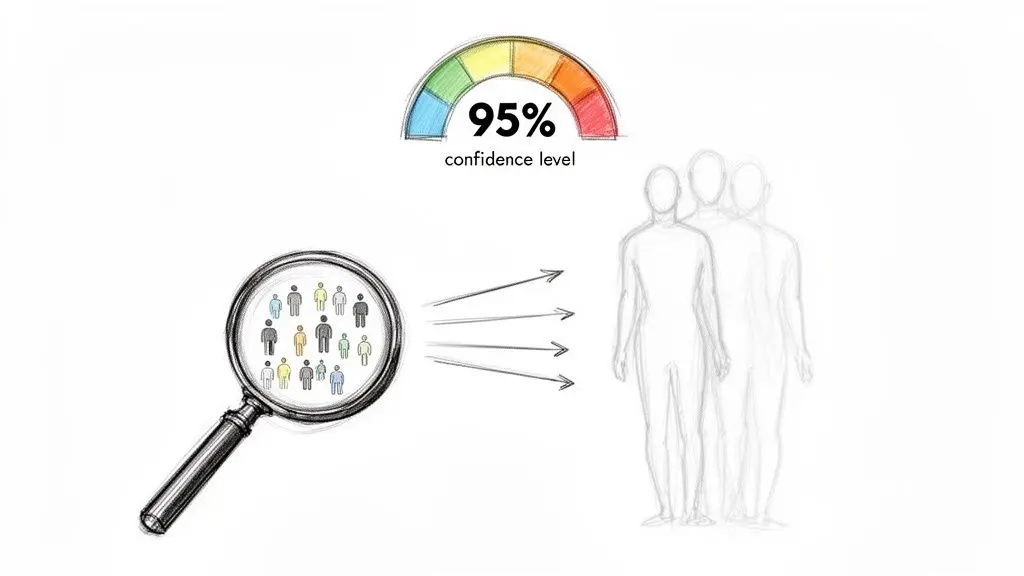
If you have a 95% confidence level, you’re saying that your method will capture the true outcome in about 95 of those 100 attempts. This is the industry standard for a reason. It gives you a solid foundation for making business decisions.
This idea isn't just for marketing. It's a cornerstone of sound statistical analysis. The UK's Office for National Statistics, for instance, famously used confidence intervals in its 2001 Census reporting to provide transparency about the precision of its national data.
Understanding Common Confidence Levels
Most A/B testing tools, including Otter A/B, default to a 95% confidence level. However, you might encounter others. This table breaks down what they mean in practical terms.
| Confidence Level | What It Means | Best For |
|---|---|---|
| 90% | You accept a 10% risk of a false positive. Your method will be reliable in 9 out of 10 tests. | Early-stage testing or low-risk changes where speed is more important than absolute certainty. |
| 95% | You accept a 5% risk of a false positive. Your method will be reliable in 19 out of 20 tests. | The industry standard. A strong balance between confidence and speed, ideal for most marketing and product tests. |
| 99% | You accept a 1% risk of a false positive. Your method will be reliable in 99 out of 100 tests. | High-stakes decisions where a wrong call would be very costly (e.g., major pricing changes or core user flows). |
Ultimately, choosing a confidence level is about managing risk. For most business decisions, 95% provides a robust and practical benchmark.
The Most Common Misinterpretation to Avoid
Here’s where many marketers get tripped up. When a test result hits 95% confidence, it's tempting to declare, "There's a 95% chance my new headline is better!"
That's not quite right, and the difference is crucial.
Key Takeaway: Confidence is about the long-term reliability of your method, not the certainty of a single result. It ensures the process you follow to declare a winner is dependable over many experiments.
Realising this distinction protects you from making overconfident claims based on a single test. Instead, it helps you build trust in your entire experimentation programme.
So, what does that 95% really mean? It means you're accepting a 5% risk that you might declare a winner when, in reality, there's no difference between the variations. In statistics, this is known as a Type I error. It’s a calculated risk that balances the need for timely decisions with the demand for trustworthy data.
Connecting Confidence Levels to P-Values and Significance
If you’ve ever stared at an A/B test report, you’ve likely seen terms like confidence level, p-value, and statistical significance. They can feel a bit like statistical jargon, but they’re actually just three parts of the same story, working together to tell you whether your results are meaningful or just a fluke.
Let’s break down how they connect.
Think of your confidence level as the benchmark you set before you even launch a test. When you choose a 95% confidence level, you’re essentially deciding on your standard of proof. You’re saying, "I want to be 95% sure that any difference I see isn't just due to random chance." It’s the bar you’re setting for the experiment's reliability.
The p-value, on the other hand, is the score your test produces once the data starts rolling in. It represents the probability that you’d see the results you're seeing (or even more dramatic ones) if there was actually no real difference between the variations. A low p-value is good news—it means what you’re observing is unlikely to be a random coincidence.
The Relationship Between P-Values and Significance
So, how do you know if your p-value is "low enough"? This is where statistical significance comes in. You achieve statistical significance when your p-value meets the standard you set with your confidence level.
They are two sides of the same coin, connected by a simple bit of maths.
The threshold your p-value needs to beat is called the significance level (often shown as the Greek letter alpha, α). You calculate it directly from your confidence level: Significance Level = 100% - Confidence Level.
- A 95% confidence level means your significance level is 5% (or 0.05).
- A 99% confidence level means your significance level is 1% (or 0.01).
For a test result to be declared statistically significant, its p-value must be less than this significance level. So, if you're using the industry-standard 95% confidence level, you're looking for a p-value below 0.05. This signals there’s less than a 5% probability that the uplift was just random noise. For a deeper dive, check out our guide on testing statistical significance and what it means for your campaigns.
Your confidence level sets the goalpost; your p-value tells you if you've scored. A low p-value is like a high score in this game—it signals that your result is worthy of attention.
Putting It All Together
Let's walk through a quick example. Imagine you’re testing a new call-to-action button, and you’ve set your test to run at a 95% confidence level. After a couple of weeks, you check the results and your testing tool shows a p-value of 0.03.
Here’s how to interpret that:
- Your Goal: Your target was to get a p-value less than 0.05 (because 100% - 95% = 5%).
- Your Score: The test came back with a p-value of 0.03.
- The Result: Since 0.03 is indeed less than 0.05, your test has achieved statistical significance.
This doesn't mean your new button is guaranteed to be better forever. But it does give you strong evidence that the improvement you measured is a real effect, not just a random fluctuation in user behaviour. Understanding this simple relationship is the key to reading your A/B test reports correctly and making decisions you can truly stand behind.
How Your Confidence Level Shapes Your A/B Test
Picking a confidence level for your A/B test isn’t just a box-ticking exercise for the stats nerds. It's a strategic decision that has a very real impact on your timeline, your budget, and the kind of risks you're willing to stomach. At its core, you’re making a trade-off between how fast you want to get results and how certain you need to be about them.
Think of a higher confidence level, like 99%, as setting the evidence bar incredibly high. To reach that bar, your test needs to gather a mountain of data—more traffic and more conversions over a longer period—before it’s willing to declare a winner. This high standard is brilliant for minimising the risk of making a bad call, but it can seriously slow down your testing programme.
The entire statistical journey, from defining your goals to interpreting the results, hinges on the parameters you set at the start.
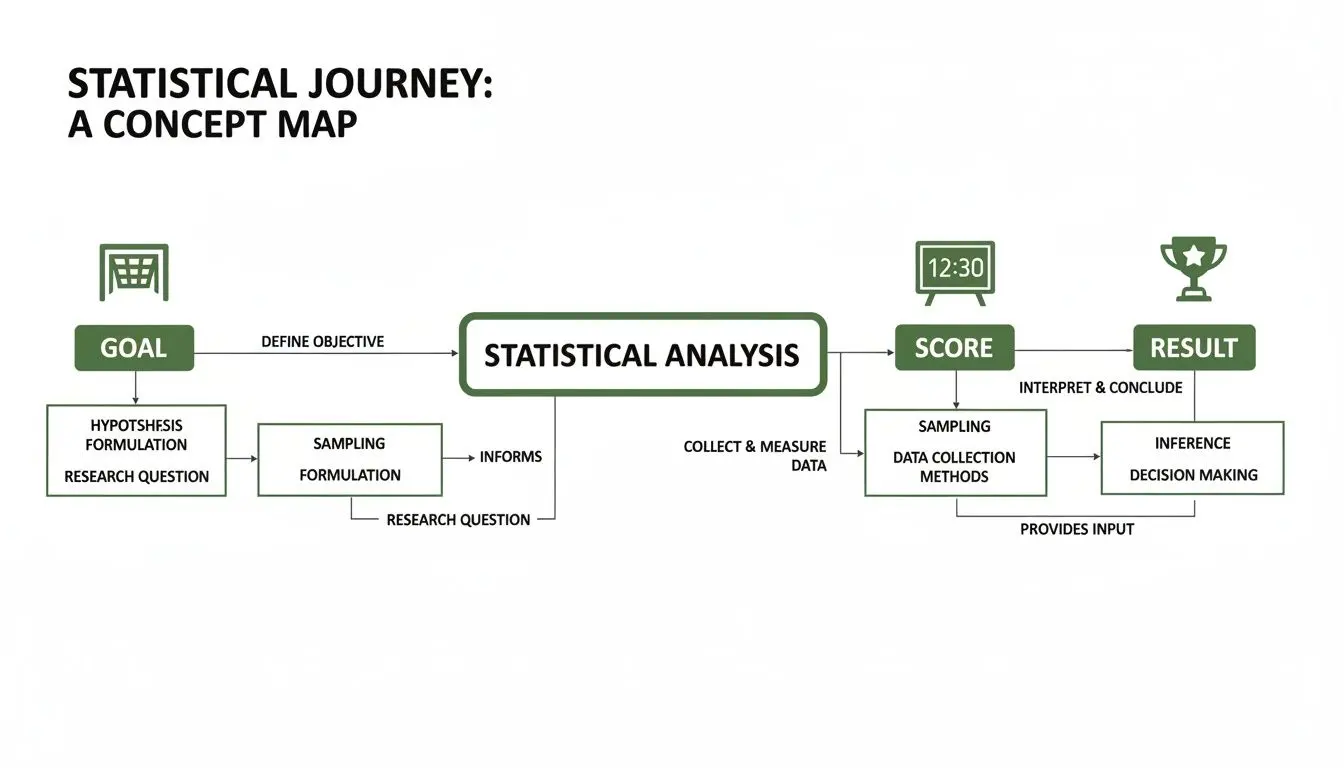
As you can see, reaching a winning result is a process. Setting a clear goal (which includes your confidence level) is the first step toward earning that trophy.
Finding the Right Balance: The Trade-Offs
Choosing your confidence level involves a delicate balancing act. There's no single "correct" answer, as the right choice depends entirely on your specific goals, resources, and risk tolerance. This table breaks down the key trade-offs you'll need to consider.
Confidence Level Trade-Offs in A/B Testing
| Factor | Lower Confidence (e.g., 90%) | Higher Confidence (e.g., 99%) |
|---|---|---|
| Risk of False Positives | Higher. You have a 10% chance of declaring a winner that isn't actually better. | Lower. You have only a 1% chance of making this mistake. |
| Test Duration & Sample Size | Shorter. You can reach conclusions faster with less traffic. | Longer. You need significantly more data (and time) to prove a result. |
| Risk of False Negatives | Lower. You are more likely to spot a real, even if small, improvement. | Higher. You might miss a genuine winner if the effect isn't large enough. |
| Best For | Early-stage ideas, low-risk changes, or when speed is the top priority. | High-stakes decisions, mission-critical pages (like checkout), or when the cost of a mistake is huge. |
Ultimately, this choice is about aligning your statistical rigour with your business strategy. A lower confidence level lets you test more ideas quickly, while a higher level ensures that the changes you implement are almost certainly positive.
Balancing Type I and Type II Errors
Every time you run an A/B test, you're walking a tightrope between two potential types of errors. The confidence level you choose gives you direct control over one of them, so it's crucial to understand what you're juggling.
-
Type I Error (False Positive): This is when your test results shout, "We have a winner!" but they’re wrong. You’ve found a difference that isn't actually there. The danger? You roll out a new "improvement" that either does nothing or, even worse, hurts your conversions. A 95% confidence level directly addresses this by capping your chance of a Type I error at 5%.
-
Type II Error (False Negative): This is the one that got away. A genuine, valuable improvement existed in your test, but your results failed to detect it. You mistakenly call the test inconclusive and shelve a winning idea, missing out on the potential uplift. This often happens when a test lacks statistical power, usually because the sample size was too small.
A Type I error costs you money by implementing a loser. A Type II error costs you opportunity by missing a winner.
Your confidence level is where you strategically decide which risk worries you more. A higher confidence level protects you from false positives but demands more patience and traffic. If you're not careful, it can also increase your risk of a false negative unless you run the test for much longer to compensate. You can explore how these concepts fit together in a complete A/B test definition.
In the end, you can't eliminate risk entirely. The goal is to make a deliberate, informed choice about it. For most businesses, the industry-standard 95% confidence level strikes a sensible balance—it protects you from the vast majority of false positives without grinding your experimentation to a halt. It provides a reliable framework for making profitable decisions based on data you can actually trust.
Alright, enough with the theory. The best way to really get your head around confidence levels is to see them in action during a real A/B test. This is where the statistical jargon translates into actual business growth.
Let's say you're running marketing for an e-commerce brand. Your main job is to lift sales, and you’ve got a hunch that the blue "Add to Basket" button on your product pages is feeling a bit tired. You reckon a more vibrant green button might create a stronger pull, getting more people to click.
This is a perfect scenario for an A/B test. You decide to run an experiment:
- Variant A (The Control): Your original blue button.
- Variant B (The Challenger): The new green button.
Using an A/B testing tool like Otter A/B, you set up the test to split your website traffic down the middle. Half your visitors will see blue, the other half will see green. Crucially, before you hit 'go', you set your confidence level at 95%, which is the gold standard for most tests.
Analysing the Results
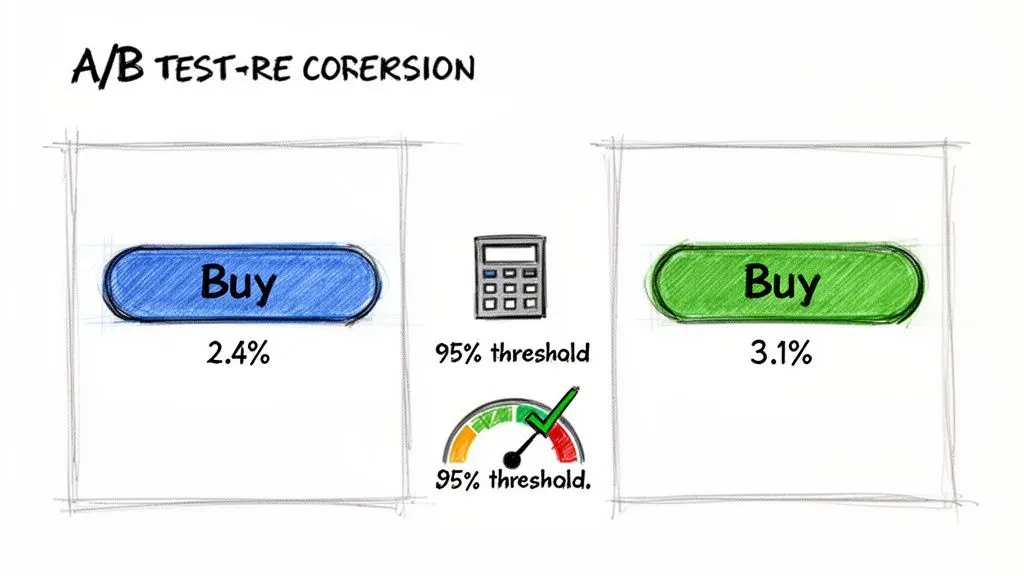
You let the test run for two weeks, gathering data from thousands of visitors. When you check the dashboard, the numbers are in. The control (blue button) has a conversion rate of 2.4%, while the new challenger (green button) is sitting at 3.1%.
At first glance, green seems like the clear winner. But is that uplift genuine, or just random luck? This is exactly where the confidence level comes into play. In the background, your testing tool runs a statistical test (like a z-test) to compare the performance of both variants against that 95% confidence threshold you set.
The tool isn’t just asking, "Which button got more clicks?" It's asking, "Is the difference between these two buttons big enough that we can be 95% confident it wasn't a fluke?"
In this scenario, the tool's calculations confirm the result has reached statistical significance. The performance boost from the green button is strong enough to meet your standard of proof. You now have a clear, data-driven signal to act on.
Making a Confident Decision
Because the test cleared your 95% confidence level, you can make your next move without second-guessing yourself. You have solid statistical evidence that the green button really does drive more conversions. The risk of this being a false positive (a Type I error) is a slim 5%.
With that assurance, you roll out the green button to 100% of your audience. A few months down the line, you see a sustained lift in your site's overall conversion rate, which feeds directly into your revenue.
This simple story shows why understanding confidence levels is so powerful. While modern tools do all the heavy lifting with the maths, getting the concept gives you the power to trust the data. It helps your team move past gut feelings and focus on what really works, making decisions that lead to real, measurable growth.
Common Mistakes When Interpreting Confidence
Getting your head around what a confidence level means is a big first step. But just as crucial is understanding what it doesn’t mean. There are a few common misconceptions that can cause teams to misread their A/B test results, pop the champagne on false victories, and ultimately make some poor business decisions.
Let's clear up the biggest one right away.
The most widespread mistake is thinking a 95% confidence level means there’s a 95% chance your new variant is the winner. It feels right, but it's a subtle and important misinterpretation. The confidence isn't in a single result; it's in the method you're using.
Think of it this way: a 95% confidence level isn’t a promise that this specific test is correct. It’s a promise that your overall testing process is reliable, and that if you ran one hundred similar tests, the method would lead you to the right conclusion 95 times.
The Danger of Stopping a Test Too Early
Another costly mistake is what’s known as “p-hacking” or just peeking at your results too often. This is the temptation to watch a test in real-time and stop it the second it crosses that 95% confidence threshold. It’s easy to see why you’d want to declare a winner and move on, but doing this massively increases your risk of a false positive.
This kind of false positive is also called a Type I error. We have a whole guide dedicated to it, which you can read here: what is a Type I error.
Statistical results swing back and forth, especially in the first few days of a test before you have enough data. If you stop the test during a random upward spike, you can easily make a losing variant look like a clear winner. You have to let tests run for their planned duration to ensure your results are genuinely trustworthy and not just a product of random chance.
This is the exact same discipline that makes official statistics so valuable. In that world, the 95% level represents the long-run standard for how often their methods capture the true value. Yet, trust is fragile. A 2023 NatCen survey found that 24% of the UK public distrusted official statistics, often due to a belief that the numbers were being manipulated.
It’s precisely this need for unbiased rigour that led us to build Otter A/B on frequentist z-tests—a method designed to give you a straight, trustworthy answer without the temptation to peek. You can find out more about the public confidence in official statistics and why methodological transparency is so important.
Making Data-Driven Decisions With Confidence
Getting your head around the confidence level isn't just for statisticians. For anyone running a business online, it’s the crucial difference between making a guess and making a sound decision. This is how you turn a spreadsheet full of numbers into a reliable roadmap for growth.
At the end of the day, it all boils down to a trade-off. The relationship between your confidence level, your sample size, and your tolerance for risk is direct. If you want to be more certain, you'll need more data. It's a simple price to pay to protect your business from acting on a false alarm.
Empowering Your Team Through Clarity
The good news is that you don't need a degree in statistics to run great A/B tests. Modern tools are built to handle the heavy lifting, giving you clear answers based on proven statistical models.
When a platform like Otter A/B calls a winner at a 95% confidence level, it’s not just an opinion—it's a statistically sound verdict. It means you can roll out your change knowing there's only a very small, pre-agreed chance you’re making the wrong call. This clarity helps shift team discussions away from gut feelings and toward evidence.
By grasping these core statistical concepts, you equip yourself to ask smarter questions, design better experiments, and challenge results with confidence. You move from being a passenger in your testing programme to being the pilot.
Ultimately, this understanding changes everything. You stop launching website updates and simply hoping they work. Instead, you develop a repeatable process for discovering what your customers truly respond to, building a culture where every major decision is backed by solid data.
Your A/B Testing Questions, Answered
Let's tackle some of the most common questions that come up when people start working with confidence levels in their A/B tests.
What’s a Good Confidence Level for an A/B Test?
For almost every scenario, 95% is the gold standard. Think of it as the default setting for a reason. It strikes the perfect balance between being confident enough in your results and actually finishing a test within a reasonable timeframe.
You could push for 99% confidence, but that extra certainty comes at a high price. You'd need a much larger sample size, often meaning your test would have to run for weeks or even months longer. On the flip side, dropping to 90% gets you results faster, but you're accepting a 1 in 10 chance that your "winner" is actually a fluke. Most businesses find that risk is just a bit too high.
Can I Change My Confidence Level Mid-Test?
Absolutely not. This is one of the cardinal rules of experimentation. You must never change statistical parameters like your confidence level, sample size, or test duration after an experiment is live.
Why? Because doing so is a form of "p-hacking" or "data peeking," and it completely undermines the statistical integrity of your results. To get a trustworthy outcome, you have to commit to your settings before you press go. It's this pre-commitment that makes the final numbers meaningful.
Does a 95% Confidence Level Mean My Variant Is the Winner?
This is where a lot of people trip up, and it's a critical distinction to make. A 95% confidence level does not mean there's a "95% chance that variant B is better than variant A."
Instead, the confidence is in your testing methodology. It means that if you were to run this exact same experiment over and over again, your statistical method would point you to the correct conclusion 95% of the time. It's a statement about the long-term reliability of your process, not a guarantee about any single result.
Ready to stop guessing and start making data-driven decisions? With Otter A/B, you can run statistically sound experiments without the headache. Discover how our flicker-free A/B testing platform can help you grow your business with confidence. Start your free trial today.
Stop guessing
Ready to start testing?
Set up your first A/B test in under five minutes. No credit card required.
- 14-day free trial
- No credit card required
- Cancel anytime