Knowing The Limit: how many cta is too many?
Uncover data-driven insights to decide how many cta is too many. Optimize your website's CTAs for maximum conversion in 2026. Get expert tips & examples!
Most advice on how many cta is too many starts and ends with a neat rule: one page, one action. That rule is useful right up until it isn't.
A homepage often needs to help a new visitor understand the offer before asking for commitment. A product page may need one decisive action and one lower-friction route for buyers who aren't ready yet. A blog post may need to support reading first, then subscription or product discovery later. The core problem isn't the raw number of buttons. It's whether the page creates a clear path without making people stop and think too hard.
That's why rigid CTA advice regularly breaks down in practice. UK audiences are heavily multichannel and research-driven, moving between search, social, websites, and devices before acting, which makes the simplistic one-CTA rule less useful for earlier-stage content, as noted by The Essential Agency's discussion of UK CTA behaviour. Strong conversion work starts with clarity, hierarchy, and intent. Then it moves into testing.
If you want a broader framework for that process, Otter A/B's guide to conversion rate optimisation best practices is a useful companion. The important point is simpler: don't count buttons first. Decide what action matters most, what supporting action is acceptable, and whether your page makes that hierarchy obvious.
The Myth of the Magic Number
The internet loves certainty. Marketers ask a clean question, and they want a clean answer back. How many CTAs should a page have? One. Maybe two. Never more than three. That style of advice spreads because it's easy to remember.
It's also incomplete.
A CTA strategy fails long before the button count becomes the problem. It fails when the visitor can't tell what matters most. A page with one weak CTA can underperform just as badly as a page with five competing ones. A page with two carefully organised actions can outperform both.
Why the simple rule keeps failing
The strongest rule of thumb is still that fewer, clearer asks usually convert better than a crowded interface. But that doesn't mean every page should behave like a stripped-down landing page. Some pages exist to close. Some exist to educate. Some need to do both.
That is where teams frequently get stuck. They ask, “How many CTAs can we get away with?” The better question is, “What action should dominate this page, and what other action, if any, supports that goal without stealing attention?”
Practical rule: If a user has to compare your CTAs before choosing one, the page has already become harder to use.
Count matters less than hierarchy
A short product page with one bold “Start free trial” button and a quieter text link for “See pricing” can feel focused. A hero section with “Book demo”, “Start free trial”, “Learn more”, “Contact sales”, and “Watch video” can feel noisy even if each option is defensible in isolation.
That's why experienced CRO teams don't stop at best practices. They treat heuristics as a starting point, then validate them with behaviour and test results. The number is not the strategy. The hierarchy is.
Understanding the Core Conflict of Clarity vs Choice
A cluttered CTA strategy creates the same feeling as a menu with too many dishes. A few clear options help people move. Too many options make them pause, scan, compare, and postpone.
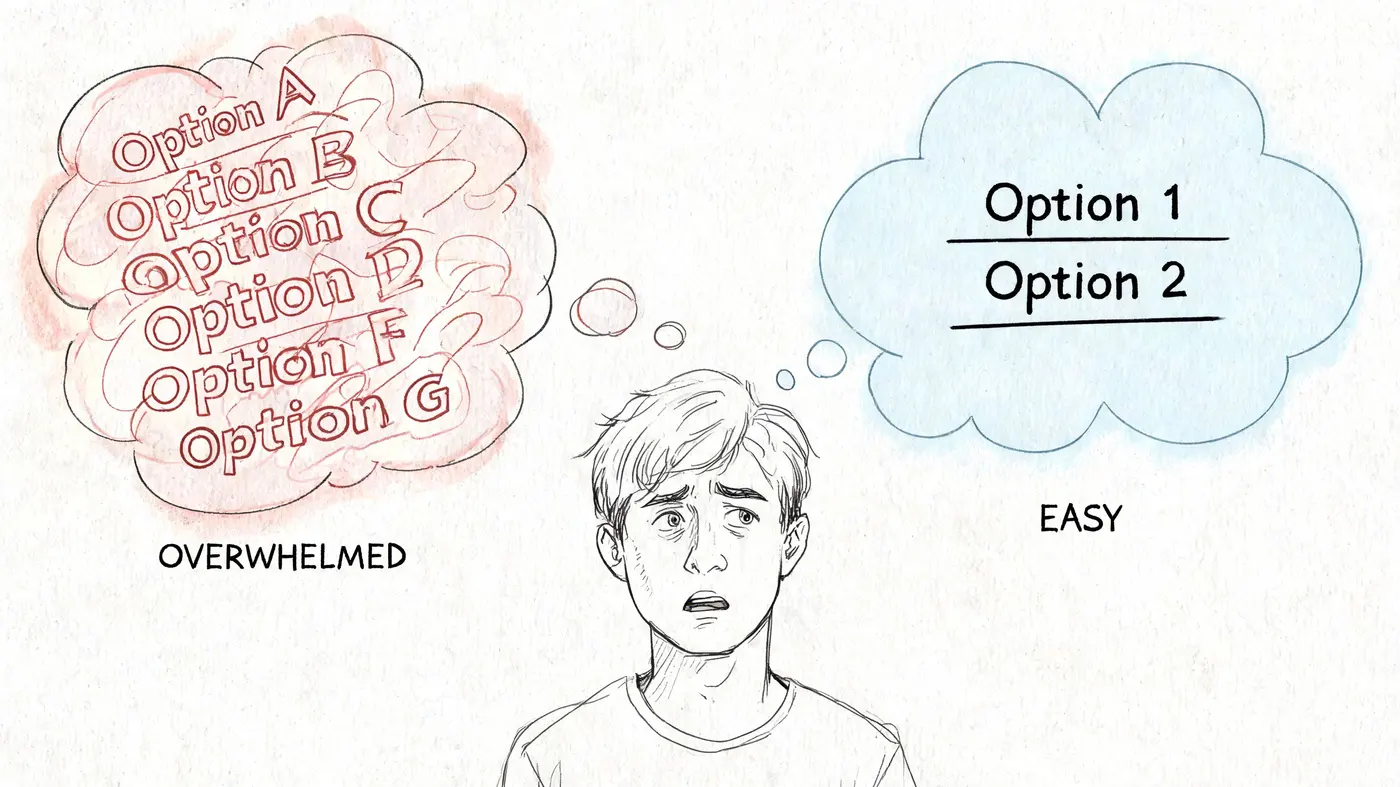
That pause is expensive. It introduces friction where the page should feel obvious.
What cognitive load looks like on a page
Users rarely analyse a page the way the business does. They don't admire the careful internal politics behind every button. They scan, look for cues, and decide whether the next step feels easy.
When several CTAs ask for different outcomes, the visitor has to do extra work:
- Interpret the options. Are these steps, alternatives, or distractions?
- Estimate risk. Which one commits me to something?
- Predict value. What happens if I click this one instead of that one?
- Delay the choice. If it's unclear, leaving is easier.
The cost of that confusion shows up clearly in email data. Wordstream reported that emails with one call-to-action can increase clicks by over 371% and sales by around 1,617%, cited in HubSpot's summary of CTA performance research. A web page is not an email, but the lesson carries over well. Diluted attention weakens response.
If you want to see where confusion is happening on page, visual tools matter. Heatmaps and click maps can reveal whether users ignore your main CTA, spread clicks across low-value actions, or get drawn to the wrong element. Otter A/B's explainer on heat maps on websites is useful for diagnosing that behaviour.
Primary CTA and secondary CTA are not equals
Most high-performing pages use a primary CTA and, where needed, a secondary CTA. Those two elements should not compete on the same visual level.
A practical distinction looks like this:
| CTA type | Purpose | Visual treatment | Example |
|---|---|---|---|
| Primary CTA | Drives the page's main conversion goal | Highest contrast, most prominent placement | Start free trial |
| Secondary CTA | Supports hesitant or earlier-stage users | Lower visual weight, often text link or outlined button | See how it works |
The mistake is not having two CTAs. The mistake is presenting both as if they matter equally.
When two buttons shout at the same volume, users stop hearing either one clearly.
Repetition is different from adding options
There's also an important distinction between repeating the same CTA and introducing new ones. Repeating the same ask lower on a long page usually helps. Adding new asks with different goals usually hurts.
That's why CTA decisions should begin with one simple discipline: define the single action the page exists to drive. Everything else must support that action or get out of the way.
Four Factors That Determine Your Ideal CTA Count
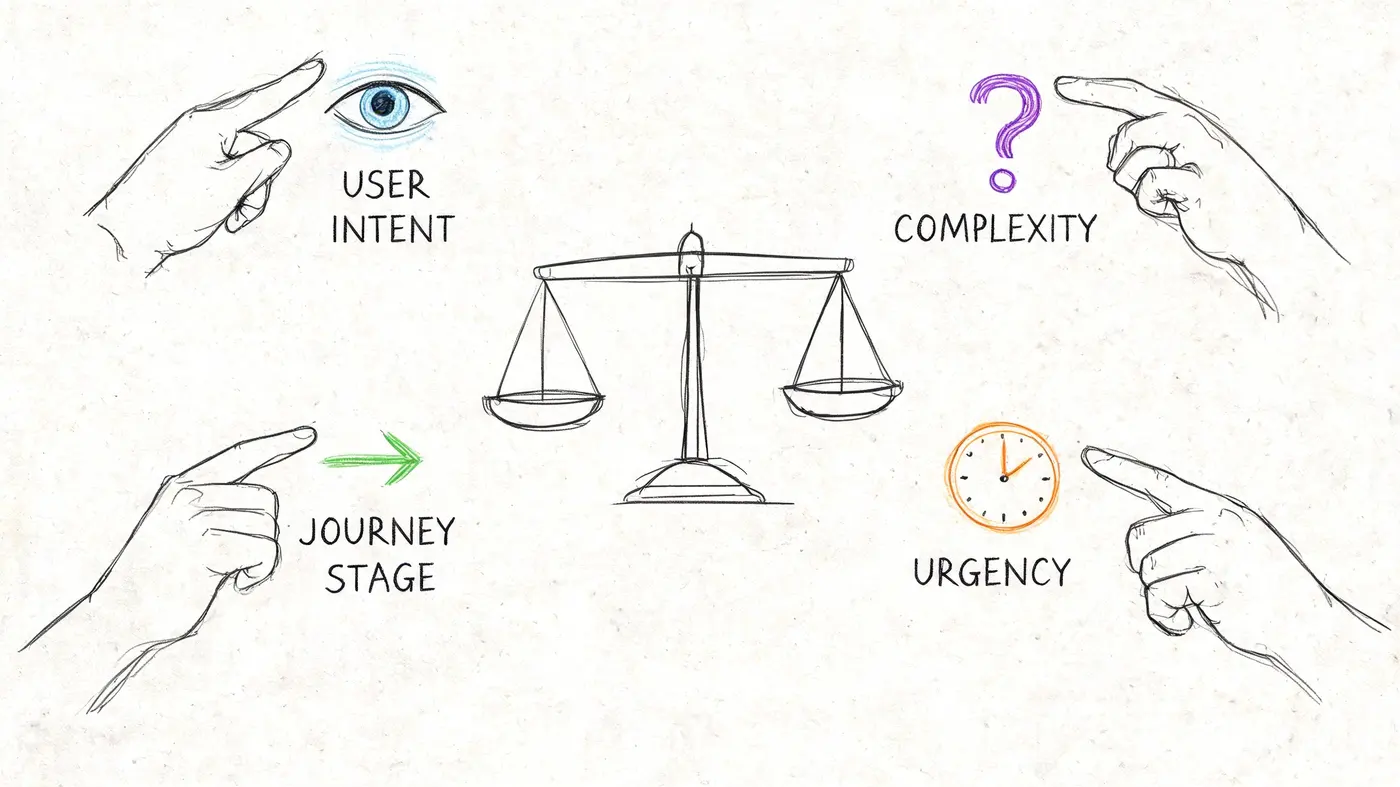
The right CTA count isn't random. It usually comes down to four variables that shape how much choice a page can support before clarity starts to break.
Litmus guidance, cited by Campaign Monitor, advises marketers to focus on one or two CTAs to keep the message significant because too many links can dilute the offer. The core issue is content hierarchy and cognitive load, as explained in Campaign Monitor's CTA guidance.
Factor one is page goal
A page built to close a specific action should usually be tighter than a page built to educate.
A dedicated trial page, lead-gen landing page, or add-to-basket page has one obvious job. It doesn't need many distinct asks. The more direct the goal, the lower the tolerance for choice.
An educational resource is different. A guide, comparison article, or category page often needs to help the user orient first. In those cases, a softer supporting action can help rather than hurt.
Factor two is user intent
Traffic source changes CTA tolerance fast. Someone clicking a branded search ad for a specific product usually arrives with stronger intent than someone reading a top-of-funnel article.
That difference matters because user readiness affects what counts as friction.
- High-intent traffic often responds best to a single dominant action.
- Mid-intent traffic may need one main CTA plus one softer path.
- Low-intent traffic often needs guidance more than pressure.
A “Book a demo” button can work well on a pricing page and underperform badly on an early-stage explainer page. The button text isn't always the issue. The mismatch between intent and ask is.
Factor three is information hierarchy
You can include more than one CTA without creating chaos, but only if the hierarchy is unmistakable. Many pages fail at this point. Teams add a secondary CTA, then style it almost identically to the primary one.
That creates competition instead of guidance.
Here's a simple hierarchy model:
| Element | Primary CTA | Secondary CTA |
|---|---|---|
| Colour | Strong contrast | Lower contrast |
| Size | Larger | Smaller |
| Placement | Earlier and repeated | Nearby, but less dominant |
| Copy | Direct and outcome-focused | Exploratory or lower commitment |
Factor four is page complexity
Long pages can carry repeated CTAs because the user needs multiple opportunities to act. That is not the same as needing multiple different asks.
A long-form sales page may repeat the same “Start your trial” button throughout. That still counts as one strategic CTA. A concise hero section with four unrelated buttons can feel overloaded in seconds.
Field note: The more compact the page, the less room you have for multiple distinct actions before the interface starts to feel crowded.
A useful working checklist looks like this:
- Name the primary conversion goal. If the team can't agree on it, the page won't communicate it.
- Map expected intent. Cold traffic needs orientation. Hot traffic needs a clean path.
- Design hierarchy before copy tweaks. Users notice visual weight before they read button labels.
- Separate repetition from variety. Repeating one ask is often fine. Adding new asks changes the decision model.
This is why “how many cta is too many” can't be answered with a single universal number. It depends on what the page is trying to do, who is arriving, and how clearly the design ranks the available actions.
CTA Heuristics for Common Page Types
Best practice is easier to apply when you stop treating every page the same. A homepage doesn't behave like a pricing page. A blog post shouldn't be forced into the same CTA structure as a campaign landing page.
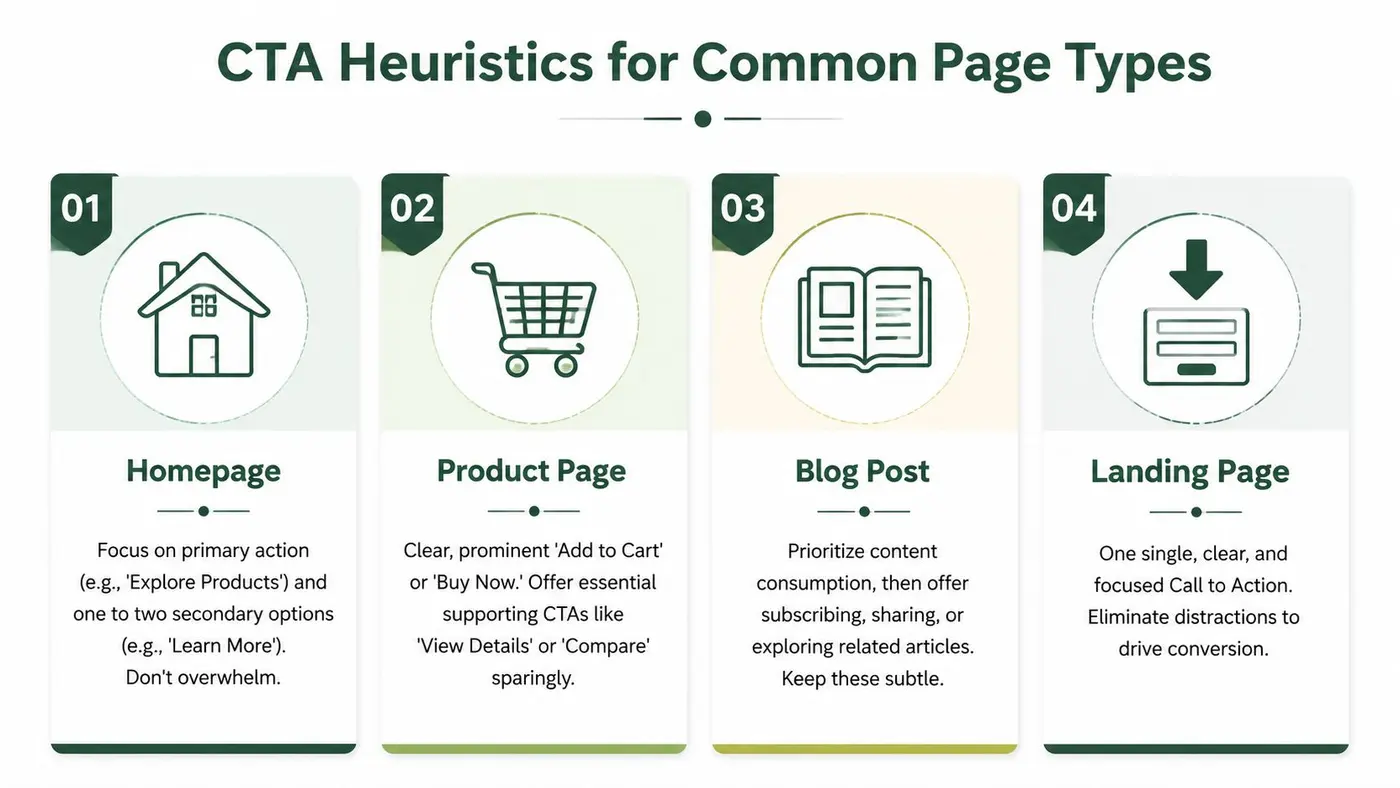
Act-On's guidance provides a strong starting benchmark: landing pages and product pages typically contain 1–3 CTAs, while most blogs contain 1–2, as outlined in Act-On's CTA recommendations. The warning built into that guidance matters more than the range itself. The point where CTAs start competing is the point where the page shifts from conversion asset to navigation hub.
Homepage
A homepage usually has to do two jobs at once. It must orient new visitors and move ready visitors forward. That means one dominant CTA often works best, with limited support for exploration.
A practical homepage setup often looks like this:
- Primary CTA such as “Explore products”, “Start free trial”, or “Get a quote”
- Secondary CTA like “See how it works” or “View pricing”
- Avoid stacked hero buttons for every department, audience, and use case
The homepage is also where ad message match can break. If your paid traffic lands here, align the CTA language with the promise in the ad. If you're refining ad-side messaging too, this round-up of effective calls to action for ads is useful because it shows how CTA wording changes with intent and format.
Product or service page
Teams often overcomplicate what should be simple. A product page usually exists to move the visitor towards one commercial step.
The winning pattern is often straightforward:
| Good structure | Risky structure |
|---|---|
| One bold purchase or trial CTA | Several equal-weight options |
| Optional lower-friction support link | Multiple primary-looking buttons |
| Supporting proof around the CTA | Competing paths above the fold |
If the page sells one offer, the CTA should feel decisive. “Add to basket”, “Book consultation”, or “Start free trial” should dominate. A secondary action can exist, but it should not rival the main path visually.
Blog post
Blogs require more restraint than is often realized. The content is the product in that moment. Interrupt it too aggressively and the CTA becomes friction rather than momentum.
A blog post generally works best with:
- One main conversion action that relates to the topic
- Contextual internal links that help readers continue research
- Subtle placement so the article remains readable
The most common mistake is turning the article into a mini homepage. Newsletter signup, demo request, ebook download, product CTA, sales CTA, and social follow can all seem reasonable in isolation. Together they weaken the post.
Pricing or comparison page
Pricing pages are tricky because they often present several plans, each with its own button. That does not automatically mean you have too many CTAs. If all buttons support the same overall action and the plans are clearly organised, users can still find their way around the page without confusion.
The challenge is prioritisation. If every plan looks equally ideal, the page asks the visitor to do the business's segmentation work.
A pricing page can have several buttons and still feel focused if the decision frame is clear. It becomes cluttered when every option carries equal visual urgency.
A few practical rules help:
- Highlight one recommended option if there's a natural fit for most buyers.
- Keep tertiary links quiet. “Contact sales” should not overpower self-serve sign-up if self-serve is the main model.
- Use comparison aids. Tables, labels, and supporting copy reduce uncertainty better than extra buttons do.
These are heuristics, not laws. They're useful because they reduce obvious mistakes. They're not enough to settle the question on their own.
How to Find Your Optimal CTA Count with A/B Testing
Heuristics are where CTA strategy starts. A/B testing is where it becomes reliable.
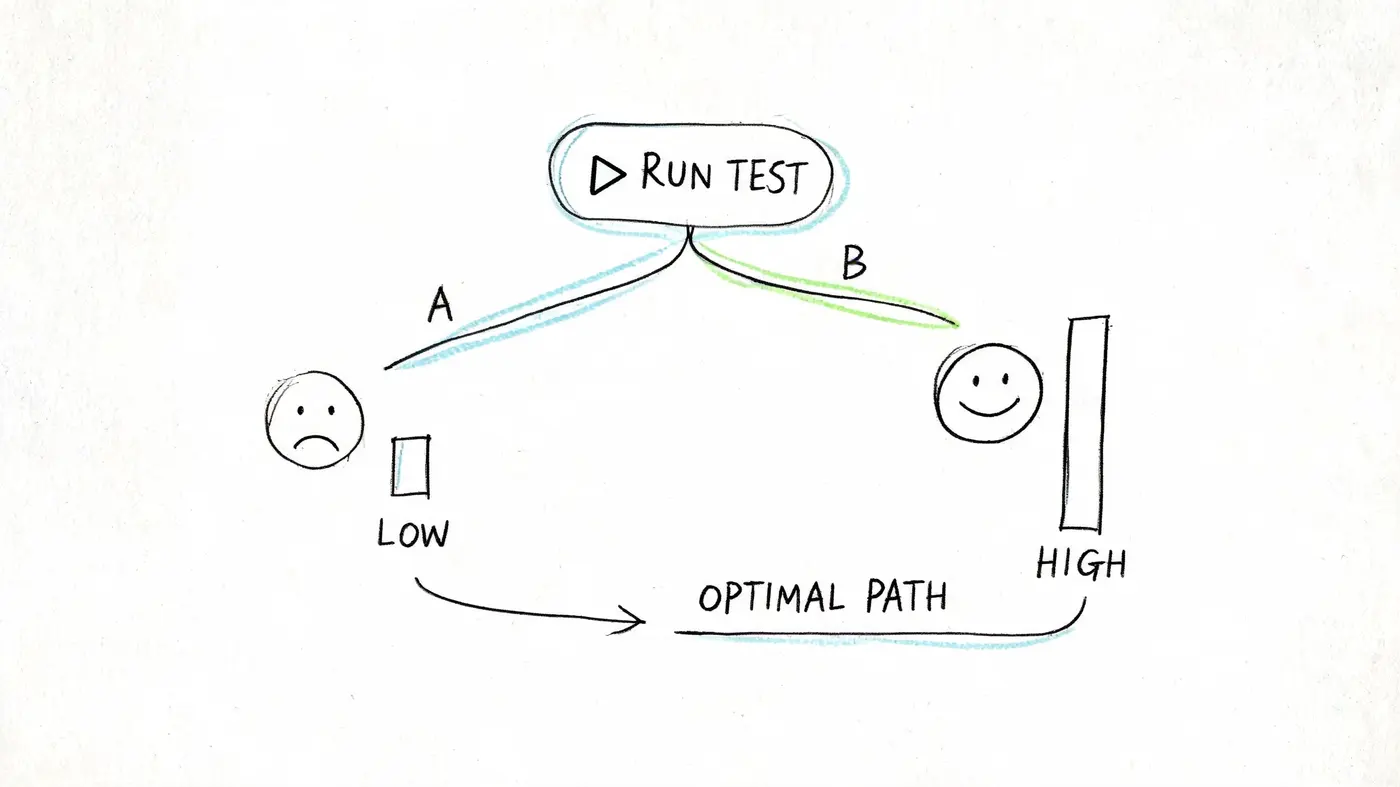
VWO's CTA optimisation guidance makes the key point clearly: experts commonly recommend one primary CTA per page, with secondary CTAs only if they are clearly subordinate, and the only way to confirm whether that hierarchy works for your audience is by A/B testing size, colour, and placement, as covered in VWO's guide to CTA optimisation.
Start with a real hypothesis
Most CTA tests fail before launch because the team tests random design ideas instead of a business question.
A proper hypothesis sounds like this:
- Adding a secondary “Book a demo” CTA to the product page will increase total qualified conversions without reducing free-trial starts.
- Removing tertiary links from the hero will increase clicks on the main CTA.
- Repeating the same primary CTA lower on a long page will improve completions from engaged scrollers.
That structure matters because it tells you what success means before the data starts coming in.
Test count, not just button colour
Teams often test cosmetic variables because they're easy to launch. But if you're trying to answer how many cta is too many, the core test should compare CTA structures.
A practical testing sequence looks like this:
-
Control
One primary CTA only. -
Variant A
One primary CTA plus one clearly subordinate secondary CTA. -
Variant B
One primary CTA repeated through the page, with no additional distinct asks. -
Variant C
Existing multi-CTA layout, but with hierarchy tightened through size, colour, and placement.
This lets you separate two very different issues: whether extra options help, and whether your existing issue is visual hierarchy rather than count.
Track the right metrics
A page can win on clicks and still lose on business value. If you only measure click-through rate, you can reward curiosity instead of conversion quality.
Track at least these metrics:
| Metric | What it tells you |
|---|---|
| Primary CTA click-through rate | Whether the main action attracts attention |
| Secondary CTA click-through rate | Whether supporting actions are being used |
| Final conversion rate | Whether clicks become meaningful outcomes |
| Revenue per variant | Whether the winning version improves commercial value |
| Average order value | Whether CTA structure changes purchase quality |
Tool selection is vital here. Platforms differ in what they can measure. Some only tell you which button got more clicks. Others connect the experiment to downstream revenue. Otter A/B, for example, lets teams test CTA variants, split traffic precisely, and track purchases, average order value, revenue per variant, and revenue trends over time, which is useful when the primary question is not “Which button got more clicks?” but “Which CTA setup improved the business outcome?”
If you need a more general primer on experimentation discipline, ECORN's CRO insights offer a helpful explanation of how to frame tests and avoid common errors.
Don't ignore sample size
One of the fastest ways to misread CTA tests is to call a winner too early. A few days of movement can be noise. A dramatic early swing can reverse.
Before you trust a result, calculate the traffic you need. Otter A/B's guide on how to calculate sample size is useful here because sample size is what separates disciplined experimentation from excited guesswork.
Testing rule: If your team can't say what metric decides the winner and how much data is enough, the test isn't ready.
Read behaviour, not just winners
A/B testing CTA count is not only about naming a winner. It's about understanding why one structure worked better.
Look at patterns such as:
- Primary clicks falling while secondary clicks rise. The added option may be cannibalising the main path.
- More total clicks but weaker final conversion. The extra CTA may attract low-intent behaviour.
- Stable conversion with higher average order value. A secondary comparison or pricing path may be helping users self-qualify.
- No significant difference. The page might not have a CTA-count problem at all.
That last result matters. Sometimes teams spend weeks arguing about button count when the actual issue is offer clarity, message match, trust signals, or mobile usability.
The practical answer to CTA quantity isn't a slogan. It's a test plan, a clear hierarchy, and a decision based on outcome data.
From Guesswork to Growth Start Testing Your CTAs
The question isn't whether one CTA is always right or whether two CTAs are always safe. The question is whether your page gives visitors a clear next step that fits their intent.
The patterns are consistent enough to give you a starting point. Most pages need one primary CTA. Some benefit from a secondary path. Problems usually begin when distinct CTAs compete for equal attention, especially on high-intent pages. But a starting point is not proof.
That's where disciplined testing changes the quality of your decisions. Instead of debating button count in meetings, build a hypothesis, run the experiment, and judge the result by conversions, revenue, and user behaviour. If you're collecting ideas for broader optimisation work around messaging and site action prompts, this guide to tactics for better website visitor action is worth reading alongside your CTA tests.
Stop asking for a magic number. Start measuring what your audience responds to.
Run a simple CTA test on Otter A/B. Compare one primary CTA against a primary-plus-secondary version, track the result against conversions or revenue, and use the winner to guide the next iteration. That's how you find the actual limit.
Stop guessing
Ready to start testing?
Set up your first A/B test in under five minutes. No credit card required.
- 14-day free trial
- No credit card required
- Cancel anytime