Definition of Personalization: A CRO Guide
Explore the definition of personalization in our 2026 guide. Learn the types, benefits, and how to test and measure its impact on conversion rates.
You're probably dealing with a version of this already.
Your team has traffic coming in from paid search, email, organic, maybe affiliates. The landing pages are decent. Product pages are clear enough. Cart abandonment isn't catastrophic. But one problem keeps showing up in review meetings: the experience still feels generic.
A first-time visitor from a branded search sees the same homepage modules as a returning customer. Someone browsing women's trainers gets the same promotional banner as a shopper looking at formal shoes. A repeat buyer lands on site and has to start from scratch again. Then someone says, “We need more personalisation.”
That's usually the moment the room gets fuzzy. Some people mean adding product recommendations. Some mean segmented email flows. Some mean changing hero banners by audience. Some mean AI. In practice, if the team can't define personalisation properly, it won't implement it properly, and it definitely won't measure it properly.
For CRO teams, the definition of personalization matters because personalisation only earns its place when it improves conversion rate, average order value, revenue per visitor, or retention. Otherwise, it's decoration.
What Is Personalisation Really
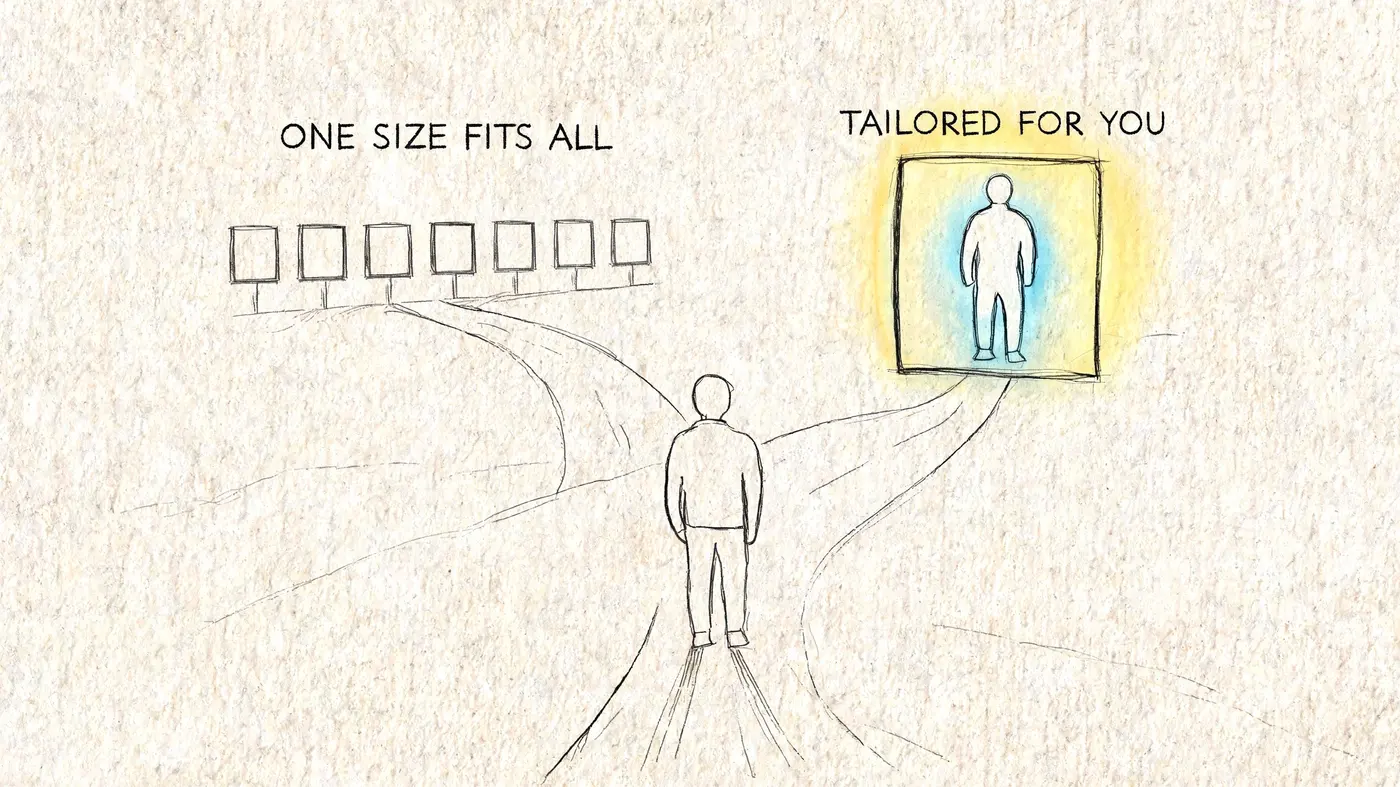
A generic shopping experience treats every visitor as if they arrived with the same intent. A useful personalised experience does the opposite. It uses what the business knows, or can reasonably infer, to make the next step easier for that specific person.
That might mean showing different content to a new visitor than to a returning customer. It might mean surfacing products based on current browsing behaviour. It might mean changing a promotional message by location, device, loyalty status, or previous purchases. The important part is that the experience adapts to context instead of forcing everyone through one fixed journey.
The modern definition
In practical terms, personalisation is the use of customer data to tailor messages, offers, content, and journeys to individual preferences or behaviours instead of broadcasting one generic experience to everyone.
That sounds straightforward, but marketing and product teams frequently underestimate the operational side. Personalisation isn't just copy that feels more relevant. It's a decisioning system. The site, app, email platform, recommendation layer, and analytics setup all need enough reliable data to decide what to show, to whom, and when.
For marketers, that shifts the definition of personalization away from a creative tactic and towards an execution model. The question stops being “can we personalise this page?” and becomes “what signal justifies changing this experience, and how will we measure whether that change improves business outcomes?”
Why the definition matters
A weak definition creates weak implementation. That's one reason the gap between what brands think they're doing and what customers feel is so large. 85% of companies believe they provide personalised experiences, but only 60% of customers agree. That 25-point gap tells you most businesses are still mistaking basic targeting for genuine relevance.
Practical rule: If the visitor can't tell why the experience is more useful, it probably isn't personalisation. It's just variation.
A CRO lens helps here. Good personalisation doesn't aim to impress. It aims to remove friction. It helps a visitor find the right category faster, reduces irrelevant offers, highlights the next action, or shortens the path to purchase.
That's also why “hello first name” personalisation is rarely enough. Customers now expect consistency across touchpoints. If the website, email, offer logic, and timing all feel disconnected, the experience still reads as generic.
The best definition is the one your team can execute: personalisation is a testable way to make the customer journey more relevant for a defined audience using available data and measurable business goals.
Personalisation vs Customisation
A lot of teams use these terms as if they mean the same thing. They don't.
Customisation is user-led. The customer tells you what they want, then the product or experience changes accordingly. Think saved size preferences, dashboard settings, notification controls, or choosing categories in an onboarding flow.
Personalisation is system-led. The business uses observed or inferred signals to adjust the experience without waiting for the user to configure everything manually.
The simplest way to think about it
Customisation is a tailor taking your measurements after you specify the fit, fabric, and cut.
Personalisation is a stylist laying out options based on what you've worn before, what you're browsing now, and what usually suits similar shoppers.
Both can be useful. They solve different problems.
Personalisation vs. Customisation at a Glance
| Attribute | Personalisation | Customisation |
|---|---|---|
| Control | Mainly controlled by the system | Mainly controlled by the user |
| Data source | Behavioural, transactional, contextual, inferred signals | Explicit preferences chosen by the user |
| User effort | Low | Higher |
| Speed | Immediate once rules or models are active | Depends on user input |
| Typical examples | Product recommendations, location-based banners, returning visitor content | Saved filters, account settings, chosen interests |
| Main risk | Feels intrusive if poorly handled | Feels cumbersome if too much setup is required |
| CRO impact | Can reduce friction quickly across large audiences | Can improve relevance for engaged users who opt in |
The privacy line matters
This distinction matters even more in the UK because personalisation often relies on inference, not just explicit user input. A useful definition has to include the control trade-off. The Information Commissioner's Office emphasis on transparency about data use, discussed in this overview of personalisation meaning, is central here. Unlike pure customisation, where the user is fully in charge, personalisation uses data signals to make decisions on the user's behalf.
That's where relevance can drift into discomfort.
If a shopper saves their shoe size and wants product recommendations based on it, that's expected. If a site appears to know something sensitive or unexpected, trust drops fast. The issue isn't only legal compliance. It's whether the customer feels the logic is fair, understandable, and proportionate.
Personalisation works best when the customer can recognise the value exchange.
What works in practice
The most effective ecommerce teams usually combine both approaches:
- Use customisation for preference capture: Let users save sizes, categories, store locations, or communication choices.
- Use personalisation for journey optimisation: Adapt page content, sorting, promotions, and recommendations based on observed intent.
- Keep the source of relevance obvious: If you're recommending products because of previous browsing, make that logic feel expected rather than mysterious.
When teams skip that last point, they often create “clever” experiences that test badly. Not because tailoring is wrong, but because opaque tailoring creates hesitation.
The Business Case for Personalisation
Most stakeholders don't need another lecture on relevance. They need to know whether personalisation improves commercial performance.
It can. McKinsey's overview of personalisation reports that it can reduce customer acquisition costs by as much as 50%, lift revenues by 5% to 15%, and increase marketing ROI by 10% to 30%. That's why serious growth teams don't treat personalisation as a design flourish. They treat it as a revenue lever.
Why those gains happen
The mechanism is simple. A more relevant experience tends to reduce friction. When friction drops, more people move forward.
That shows up in the metrics CRO teams already care about:
- Conversion rate: Shoppers find the right product, offer, or message faster.
- Average order value: Better recommendations and smarter merchandising can increase basket size.
- Revenue per visitor: More relevant journeys improve the value of each session, not just the final conversion rate.
- Acquisition efficiency: Paid traffic performs better when landing experiences match intent more closely.
The CRO view of personalisation
The wrong way to justify personalisation is to say it “improves engagement”. That's too vague.
The better argument is operational. If paid search drives visitors into a category page, and you can tailor that page by audience intent, stock context, previous browsing, or loyalty status, you're improving the odds of a purchase. If returning customers see products, bundles, or replenishment prompts that fit their history, you're improving the odds of repeat revenue.
Commercial test: If a personalised change doesn't have a plausible route to better conversion, AOV, RPV, or retention, it probably doesn't deserve development time.
This is also why personalisation belongs in the same planning conversation as lifecycle strategy. If you're thinking about repeat purchase economics, retention timing, and post-purchase merchandising, this guide on maximizing customer lifetime value for D2C brands is useful context. Personalisation becomes more valuable when you connect it to the full customer relationship, not just the first conversion.
What business leaders usually miss
Teams often assume the upside comes from advanced AI. Sometimes it does. Often it doesn't.
A basic personalised experience can outperform a more complicated one if it aligns closely with intent. Showing relevant categories to a first-time visitor from a campaign, suppressing irrelevant offers for existing customers, or changing messaging for location-specific delivery constraints can all move core metrics without requiring a massive stack.
What matters is not how advanced the logic sounds. What matters is whether the experience becomes easier to buy from.
Key Personalisation Types and Techniques
Not all personalisation is equally mature. Some forms are simple to launch and easy to test. Others need stronger data pipelines, tighter governance, and better measurement discipline.
The easiest way to think about the sector is as a progression from broad rules to individual decisioning.
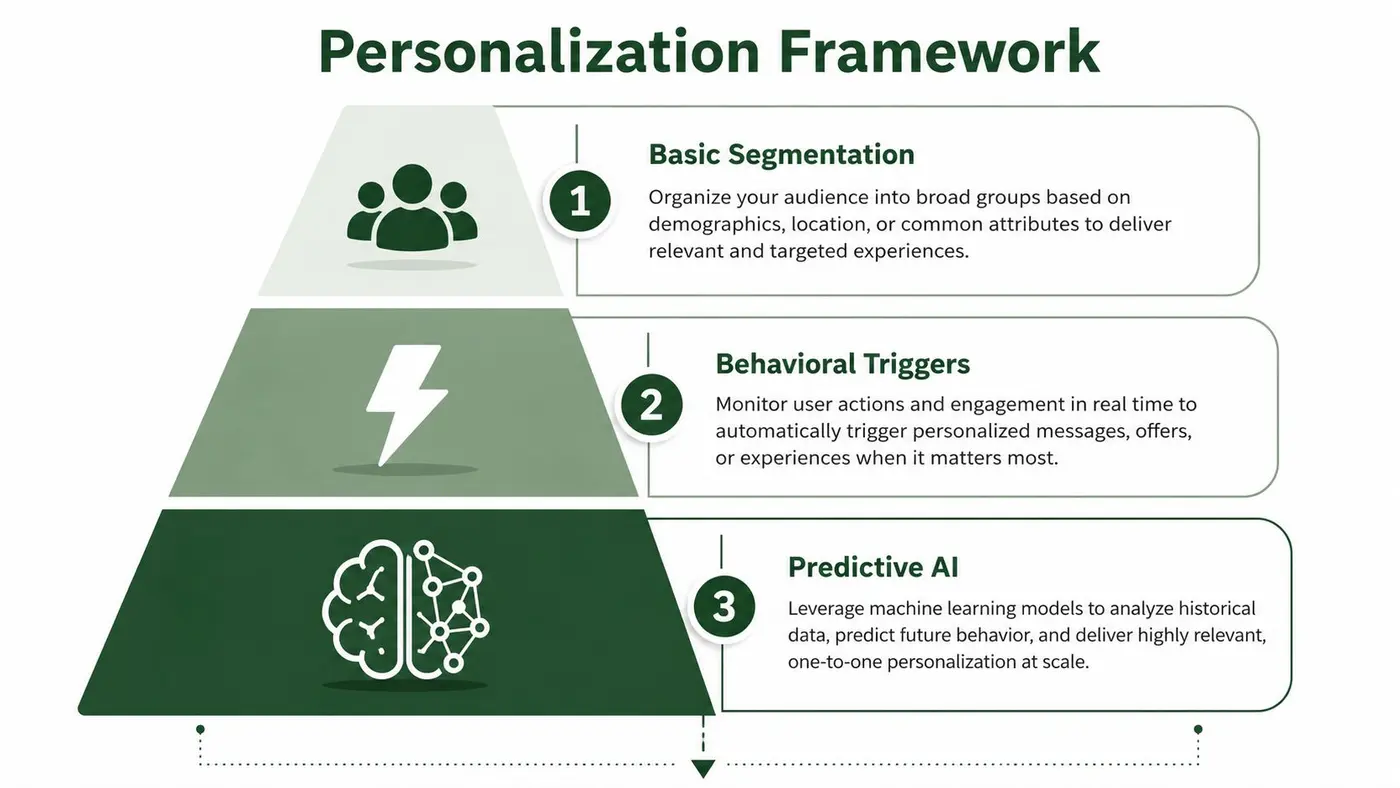
Basic segmentation
The logic is explicit and the operational risk is low, making it the ideal starting point.
Examples include:
- New vs returning visitors
- Mobile vs desktop users
- Location-based messaging
- Traffic source variations
- Customer vs non-customer experiences
These changes usually affect page copy, banners, navigation emphasis, or offer visibility. They aren't glamorous, but they're practical. If mobile shoppers need reassurance on delivery and desktop shoppers need richer comparison content, that's a valid use of personalisation.
This layer works best when the team can explain the logic in one sentence. If it takes a long workshop to describe the segment, it's probably too messy to manage.
Behavioural triggers
The next step uses observed behaviour rather than static audience labels.
Now the experience changes because the visitor viewed a category, added to basket, returned to a PDP, or showed repeated interest in a product family. Consequently, onsite recommendations, recently viewed modules, cart reminders, and dynamic merchandising become more valuable.
In ecommerce, behavioural personalisation often drives more impact than broad demographic tailoring because it reflects current intent. Someone who just browsed trail running shoes is giving you a stronger signal than someone who merely fits a broad age bracket.
A useful example is onsite recommendation logic. “Bestsellers” is generic. “Related to what you're viewing now” is behavioural. “Based on your previous purchases and current browsing session” moves further towards a meaningful personalised experience.
For teams looking at practical ecommerce implementations, this breakdown of personalization in e-commerce gives a good operational view of how these layers show up on real storefronts.
Predictive AI
At the most advanced end, personalisation becomes individual-level decisioning. Optimizely defines advanced personalisation as predicting the next best experience using analytics and machine learning to adapt offers dynamically in real time.
That changes the job of the team. You're no longer only writing fixed rules such as “show X to returning visitors”. You're feeding a system with signals, then letting models rank products, offers, or content based on predicted intent.
The more advanced the system, the more disciplined measurement has to become. Better automation doesn't remove the need for testing. It increases it.
This is also where many businesses overreach. Predictive systems need strong inputs. Poor event tracking, fragmented identities, stale catalogue data, or weak experimentation discipline can make an advanced setup look intelligent while underperforming.
If you want a broader practitioner view of where machine learning fits into modern marketing programmes, leveraging AI predictive analytics is worth reading.
What usually works best
In live programmes, the strongest results often come from layering these methods rather than jumping straight to AI:
- Start with clear segments.
- Add behavioural rules tied to meaningful actions.
- Introduce predictive logic only when the data quality is dependable.
- Test every layer against a control.
That last point is what separates personalisation from guesswork.
How to Measure and Test Personalisation Efforts
Most personalisation programmes fail in one of two ways. They either never get implemented because the team overcomplicates the data problem, or they get launched without a measurement plan and turn into a collection of unproven ideas.
For CRO teams, there's a better approach. Treat every personalisation idea as a hypothesis.
Start with a testable hypothesis
A weak personalisation brief sounds like this: “Let's tailor the homepage for returning users.”
A stronger brief sounds like this: returning visitors who already know the brand don't need the same introductory messaging as first-time visitors, so replacing generic acquisition content with category shortcuts or recently viewed products should increase progression to product pages and improve purchase rate.
That gives the team something to test. It also forces clarity on audience, mechanism, and expected business outcome.
Good hypotheses usually specify:
- Audience: Who should see the change
- Signal: Why this audience qualifies
- Experience change: What will be different
- Primary metric: Conversion rate, revenue per visitor, AOV, or another business metric
- Guardrail metric: Bounce rate, page speed, or another signal that catches downside risk
Use a control group or you're guessing
Personalisation often feels intuitively right. That's exactly why it needs experimental discipline.
If you show a personalised variant to everyone in a segment, you won't know whether the logic improved performance or whether the segment would have converted anyway. A control group solves that. Some eligible users see the standard experience, others see the personalized one, and the team compares outcomes.
That's how personalisation becomes part of conversion optimisation rather than a set of assumptions dressed up as customer centricity.
Testing rule: Never ask whether a personalised idea sounds relevant. Ask whether it beats the baseline.
Measurement depends on data quality
Technically, many programmes break at this point. Dynamic Yield's guide explains personalisation as a data-integration problem that depends on unified customer profiles and high-quality event streams. If the signals feeding your decision engine are fragmented or delayed, the output won't be reliable.
That matters even more in UK environments shaped by consent requirements and tighter control over identifiers. Teams can't assume they'll have perfect tracking everywhere. So the practical standard is simpler: use clean first-party signals, define audiences carefully, and only personalise where the input data is trustworthy enough to support decisioning.
Pick metrics that reflect business value
It is common for many teams to get distracted by soft metrics. Click-through rate can help diagnose behaviour, but it shouldn't be the only evidence.
For onsite personalisation, useful metrics usually include:
- Conversion rate when the objective is purchase completion
- Revenue per visitor when the variant could affect both conversion and basket value
- Average order value when cross-sell or bundle logic is involved
- Progression metrics such as PDP views or basket starts when the test sits higher in the funnel
If you're planning segmented tests and need the maths right before launch, this guide on how to calculate sample size is a practical reference. Personalisation tests often split audiences into smaller groups, so underpowered experiments are a common failure point.
Statistical discipline matters
You don't need every marketer to become a statistician, but the team does need basic discipline. Run the test long enough. Avoid calling winners too early. Make sure traffic allocation is clean. Check that the audience definition matches the implementation. Confirm that the variant didn't break layout, tracking, or performance on important templates.
The short video below is a useful reminder that measurement only works when the targeting logic and the test design stay aligned.
Watch site performance as closely as uplift
A personalised experience that slows the site can cancel out its own gains. This shows up all the time with heavy third-party scripts, client-side flicker, or recommendation widgets that arrive too late in the session to influence behaviour cleanly.
That doesn't mean you should avoid personalisation. It means implementation quality is part of the experiment. If a variant creates layout shift, delays rendering, or behaves inconsistently across devices, you're not only risking lower conversions. You're contaminating the test itself.
A sound personalisation programme is really a loop:
- Identify a high-intent audience.
- Define a clear hypothesis.
- Run against a control.
- Measure business metrics.
- Keep only what beats the baseline.
That's what turns personalisation from a buzzword into an optimisation practice.
Common Pitfalls and Best Practices
The biggest mistake teams make is assuming personalisation is automatically good. It isn't. Bad personalisation can confuse users, slow pages, create false confidence in reporting, and damage trust.
Common pitfalls
Some issues show up again and again:
- Over-personalising too early: Teams build intricate audience trees before proving any simple use case.
- Using weak signals: If the data is incomplete, duplicated, or stale, the experience becomes inconsistent.
- Crossing the comfort line: Tailoring that feels opaque or overly intrusive can hurt confidence instead of helping conversion.
- Skipping controls: Once a personalised idea goes live without a baseline, nobody can tell whether it helped.
- Ignoring operational cost: Every segment, rule, and dependency adds maintenance overhead.
Better ways to run the programme
The strongest teams keep the programme simpler than they could.
- Start with intent-rich use cases: Returning visitors, product viewers, basket abandoners, and loyalty cohorts are often easier to justify than abstract personas.
- Make relevance obvious: Users should understand why they're seeing a recommendation, message, or shortcut.
- Protect trust: Be clear about data use and stay inside expected, consent-aware first-party boundaries.
- Measure revenue impact, not just clicks: A recommendation block that gets attention but lowers basket quality isn't a win.
- Review performance regularly: Rules that made sense months ago may stop being useful as product mix, seasonality, or traffic sources change.
Good personalisation is disciplined restraint. It changes only what the available evidence can support.
One more point matters for CRO teams. Personalisation should sit inside the same optimisation framework as page experiments, funnel improvements, and merchandising tests. It shouldn't become a separate universe with looser standards. If your team needs a solid baseline process, these conversion rate optimization best practices are a good anchor.
Personalisation is best understood as a system of hypotheses. Some will win. Some won't. The teams that grow revenue from it are the teams willing to test that objectively.
If you want to run personalisation ideas as proper experiments instead of one-way launches, Otter A/B gives teams a fast way to test headlines, CTAs, layouts, and customized experiences without adding heavy site bloat. It's built for marketers and CRO specialists who want clean measurement, quick setup, and revenue-focused results.
Stop guessing
Ready to start testing?
Set up your first A/B test in under five minutes. No credit card required.
- 14-day free trial
- No credit card required
- Cancel anytime