Development of Marketing Strategy: A Practical Framework
Learn the practical development of marketing strategy from research to execution. This guide provides a step-by-step framework, templates, and KPIs for 2026.
You've probably been handed a brief that sounds simple and feels loaded: “Put together the marketing strategy.” What usually follows is a rush to open a slide deck, build a tidy framework, and try to answer every question at once. Audience, channels, budget, messaging, KPIs, reporting, buy-in. By the end, you've produced a document that looks complete and already feels outdated.
That's where many teams go wrong. They treat the development of marketing strategy as a one-time planning exercise, when in practice it works better as an operating system for decision-making. A useful strategy doesn't try to predict everything. It creates a way to learn quickly, allocate resources deliberately, and improve performance without losing focus.
Beyond the Document: What a Modern Marketing Strategy Is
A new manager often assumes the job is to write the perfect plan. The true job is harder and more useful. You need to build a system that helps the business make better choices under uncertainty.

The development of marketing strategy has always changed with the tools available to marketers. In the UK, a major turning point came in 1955, when television viewing exceeded radio listening for the first time in Britain, which pushed brands to rethink audience, timing, and channel mix with a far more measurable mindset, as noted in the history of marketing in Britain. That shift still matters because modern strategy is shaped by the same core reality: once a channel becomes measurable, expectations rise.
A static strategy fails for a simple reason. Markets move, teams learn, channels behave differently than planned, and customer response rarely follows the neat path shown in planning workshops. If your strategy only tells people what to do, it won't survive first contact with the quarter.
What strategy looks like in practice
A working strategy usually has four traits:
- It makes choices: It names the audience you'll prioritise, the position you'll defend, and the channels you won't chase.
- It connects to numbers: Not invented certainty, but clear objectives and a review rhythm.
- It guides execution: Campaigns, landing pages, email flows, and offers all trace back to the same logic.
- It keeps learning: It treats testing and refinement as part of strategy, not a clean-up task at the end.
A strategy that can't change its mind when evidence changes isn't a strategy. It's a script.
That matters whether you run a mature demand generation function or need to build a startup marketing strategy from scratch. The shape differs. The principle doesn't. Good strategy gives your team a repeatable way to decide what to test, what to scale, and what to stop.
Laying the Foundation: Audits, Goals, and Budgets
Most weak strategies fail before they reach the market. The issue isn't creativity. It's that the team skipped the groundwork and started with tactics.
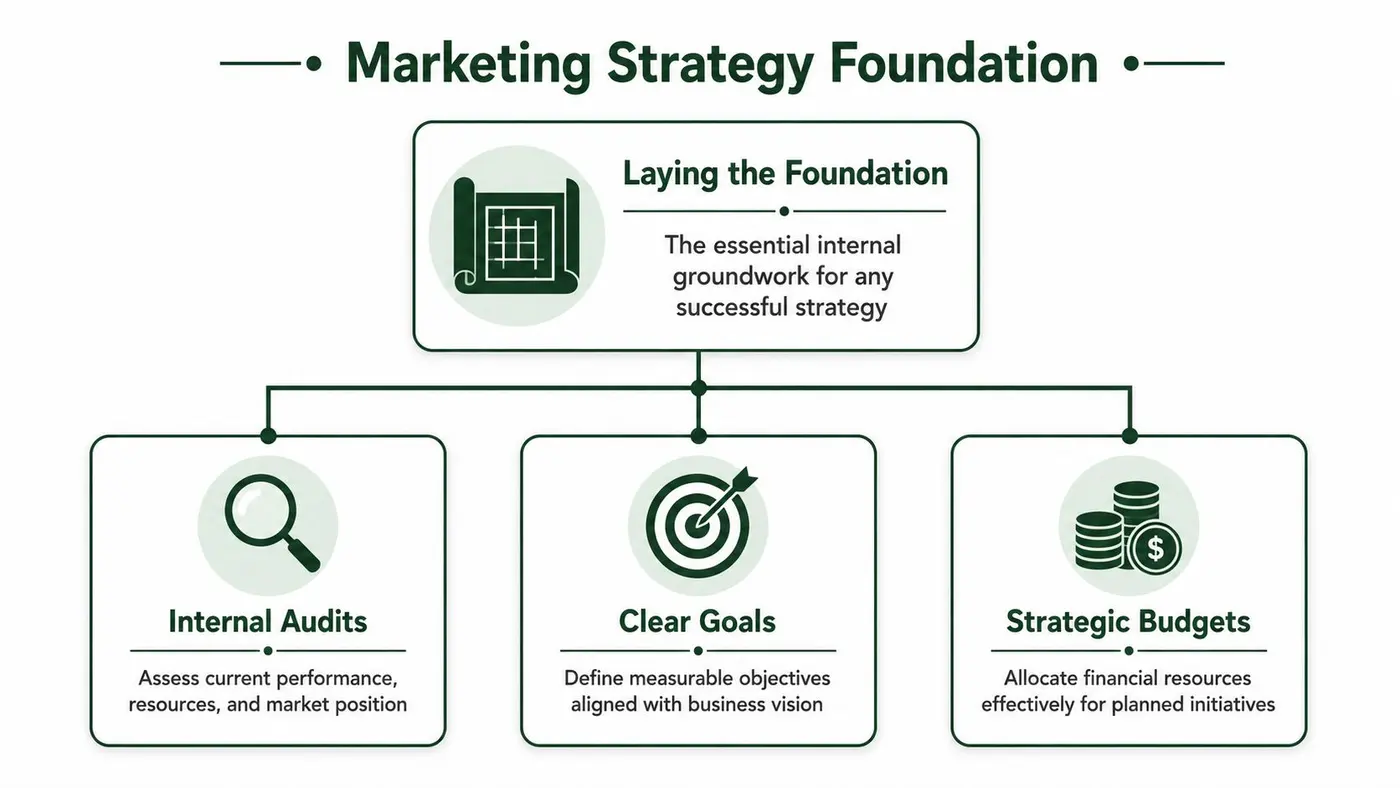
A reliable sequence is to audit your current state, set measurable objectives, define target segments, document positioning, analyse competitors, then select and refine programmes through KPI review, which aligns with the Business Queensland planning framework. Even if you're not in Queensland, the method transfers well because it forces the team to move from diagnosis to action in the right order.
Start with an honest audit
An audit isn't a decorative SWOT slide. It's a review of what the team can do, what's working, and where the bottlenecks sit.
Look at three layers.
-
Performance
- Which channels generate qualified demand
- Where conversion drops
- Which campaigns keep getting renewed despite weak results
- Whether reporting reflects business outcomes or vanity metrics
-
Operational reality
- Team capability
- Approval bottlenecks
- Content production speed
- CRM hygiene
- Analytics reliability
- Landing page ownership
-
Commercial context
- Sales cycle shape
- Product complexity
- Margin constraints
- Seasonality
- Regional differences in demand
A practical audit includes both data and friction. If paid search looks fine on paper but the team takes weeks to launch a landing page update, that delay belongs in the strategy discussion.
Set goals that force prioritisation
Most marketing goals are too broad to govern action. “Increase awareness” and “drive growth” sound fine in a board room and collapse in execution. Better goals tell the team what success looks like and what trade-offs they're allowed to make.
Use goals that answer these questions:
- What business outcome matters most
- Which part of the funnel marketing owns
- What time horizon applies
- How progress will be reviewed
- What you will deprioritise while pursuing it
For example, if the business needs stronger pipeline quality, your strategy should not reward the team for maximising low-intent lead volume. If retention matters, acquisition metrics shouldn't dominate every review.
Practical rule: If a goal doesn't change budget allocation, channel choices, or team behaviour, it isn't strategic enough.
Build the budget from decisions, not hope
Teams often ask for budget too early. Don't start with “How much can we spend?” Start with “What must be true for this strategy to work?”
That changes the conversation. Budget becomes a resource plan tied to execution requirements:
- Channel investment: Media, sponsorships, partnerships, content distribution
- Capability investment: Freelancers, specialists, analytics support, design, CRO
- Infrastructure investment: CRM cleanup, attribution tooling, consent management, testing tools
- Flexibility reserve: A small portion kept back for experiments, response to market shifts, or scaling what works
A useful budget has two parts. One covers committed programmes. The other protects learning. Teams that spend every pound before launch usually end up defending bad decisions because they've left themselves no room to adapt.
What works and what doesn't
| Approach | What usually happens |
|---|---|
| Budget based on last year's channel split | Old habits survive, even when market conditions change |
| Budget based on strategic objectives and delivery constraints | Trade-offs become visible early |
| Goals tied to business outcomes | Reporting improves and conversations get sharper |
| Goals built around channel activity alone | Teams optimise motion, not impact |
If you're leading the first full strategy cycle for your team, this foundation work is where credibility is won. Not through polish. Through clarity.
Mapping the Terrain: Audience, Competitors, and Channels
Once the internal picture is clear, the next risk appears. Teams jump from “Who do we want?” to broad personas that could describe half the market. That's how strategy gets diluted.
Audience definition needs more texture than age band, job title, or company size. It should tell you what problem the buyer is trying to solve, what makes them hesitate, what information they trust, and what conditions shape their decision.
Go past demographics
Broad segmentation creates broad messaging. Broad messaging creates average performance.
For smaller UK audiences, it's more useful to look at practical indicators that change behaviour, such as regional context, digital access, and spending sensitivity. That's one reason strategy work improves when teams move beyond generic persona exercises and consider underserved submarkets with more care, as discussed in this piece on identifying overlooked market segments in the UK.
A better audience model usually combines:
- Need state: What triggered the search or purchase
- Context: Industry, region, maturity, budget pressure, urgency
- Behaviour: Research habits, objections, buying sequence
- Constraint: Procurement, internal approval, technical fit, trust threshold
For a SaaS company, this often means segmenting by workflow pain and adoption readiness rather than just firm size. If that's your world, this guide on marketing for SaaS is a useful example of how segment logic changes channel and message choices.
Treat privacy as a strategic constraint
A lot of strategy advice still says “use analytics” as if access to user data is unlimited and trust is stable. It isn't. In the UK, 49% of adults are concerned about how companies use their data, which means privacy and consent shape how targeting, attribution, and lead capture should work from the start, according to this discussion of underserved market challenges and trust.
That has practical consequences:
- First-party data matters more: You need clear value exchange when asking for details.
- Consent design matters: Forms, chat, downloads, and sign-up flows should explain why data is being collected.
- Attribution gets messier: You won't always get a clean user-level story across channels.
- Trust affects conversion: Aggressive capture tactics often hurt long-term performance.
If your team uses conversational capture on-site, it helps to understand the mechanics of consent and fields before implementation. This guide on FOMOchat help collecting visitor information is useful because it shows the practical side of gathering visitor data without treating it like a free-for-all.
If customers are cautious about their data, your strategy can't rely on friction-heavy forms and vague promises. It has to earn disclosure.
Analyse competitors for weakness, not just presence
Competitor analysis becomes wasteful when teams produce feature grids and stop there. You don't need a museum of rival screenshots. You need to know where they're predictable, overcommitted, or vague.
Look for gaps such as:
- They all sound the same
- They target the same obvious audience
- They overuse one acquisition channel
- Their claims are broad but unsupported
- Their buying journey is slow or confusing
- Their content educates badly or assumes too much prior knowledge
That gives you something actionable. Maybe the market leader is loud but generic. Maybe niche competitors serve one vertical well but ignore adjacent segments. Maybe everyone is running capture-heavy campaigns while underinvesting in trust-building content. Those are strategy openings.
Defining Your Stance: Positioning and Core Messaging
Research doesn't create advantage by itself. It only gives you the confidence to choose. Positioning is that choice.
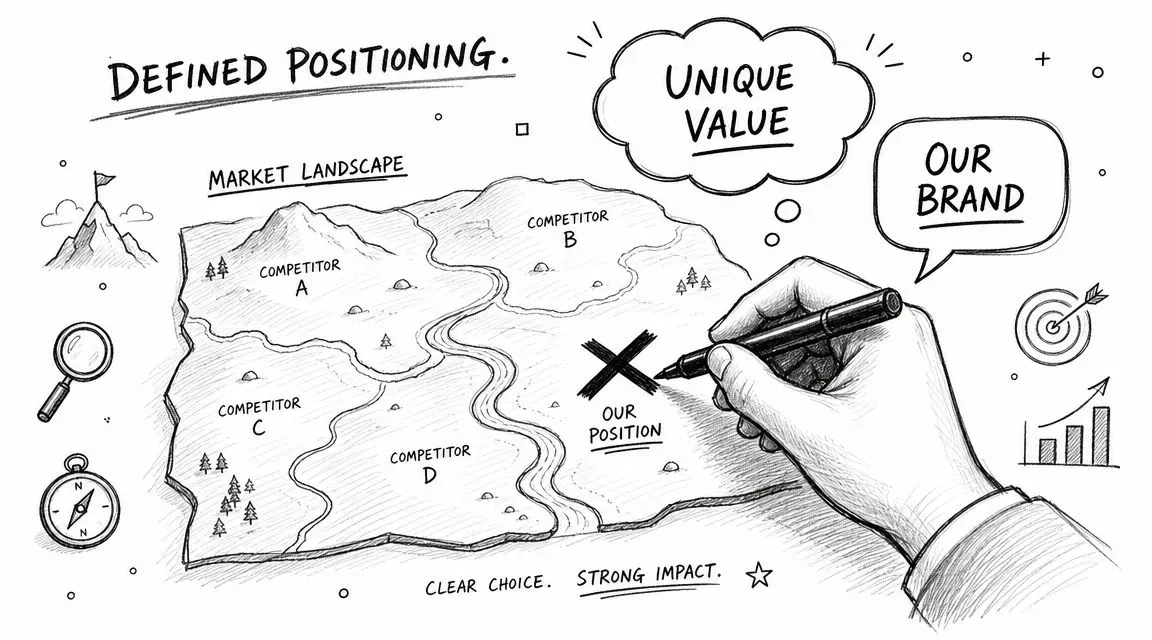
Many teams make positioning more mystical than it is. In practice, it's a disciplined answer to four questions: who you serve, what category you're in, why you're different, and why someone should believe you.
Build a positioning statement you can actually use
A practical template looks like this:
For [target audience], [brand] is the [category or frame of reference] that helps them [primary outcome] because [distinctive benefit or proof].
That's not customer-facing copy. It's an internal decision tool. It helps the team reject muddled campaigns before they go live.
For smaller UK audiences, this discipline matters even more. Standard personas often flatten important differences. Regional conditions like digital access and spending sensitivity can change what buyers care about and how they interpret value, which is why broad demographic assumptions tend to underperform in more specific markets.
Turn positioning into a messaging hierarchy
Once the position is set, messaging needs structure. Without it, every team writes from scratch and drift starts immediately.
A useful hierarchy usually includes:
- Core message: The one idea the brand wants to own
- Pillar messages: The main supporting themes, often tied to benefits or use cases
- Proof points: Evidence, examples, product details, customer signals
- Channel adaptations: Website hero copy, ad angles, nurture email themes, sales enablement lines
Many managers realise they don't have a messaging problem. They have a source-of-truth problem.
If you need a practical model, this guide to an example value proposition is helpful because it shows how to articulate benefit, audience, and differentiation in a way the rest of the team can reuse.
What consistency really means
Consistency doesn't mean every asset sounds identical. It means the same strategic claim survives translation across formats.
A homepage headline can be direct. A paid social ad can be sharper. A sales deck can be more detailed. But all three should reinforce the same stance.
Here's a useful explainer to support that work:
A quick messaging test
Before approving any message, ask:
- Is this clearly for the audience we chose
- Could a competitor say this without sounding false
- Does it express a benefit the buyer values
- Can the product or team back it up
If the answer to the second question is yes, the message is too generic.
Message check: Strong messaging narrows. Weak messaging tries to sound relevant to everyone and becomes memorable to no one.
Activating Your Strategy with Measurement and Experimentation
The development of marketing strategy becomes real not when the plan is approved, but when the team starts running work against it, measuring response, and changing course based on evidence.
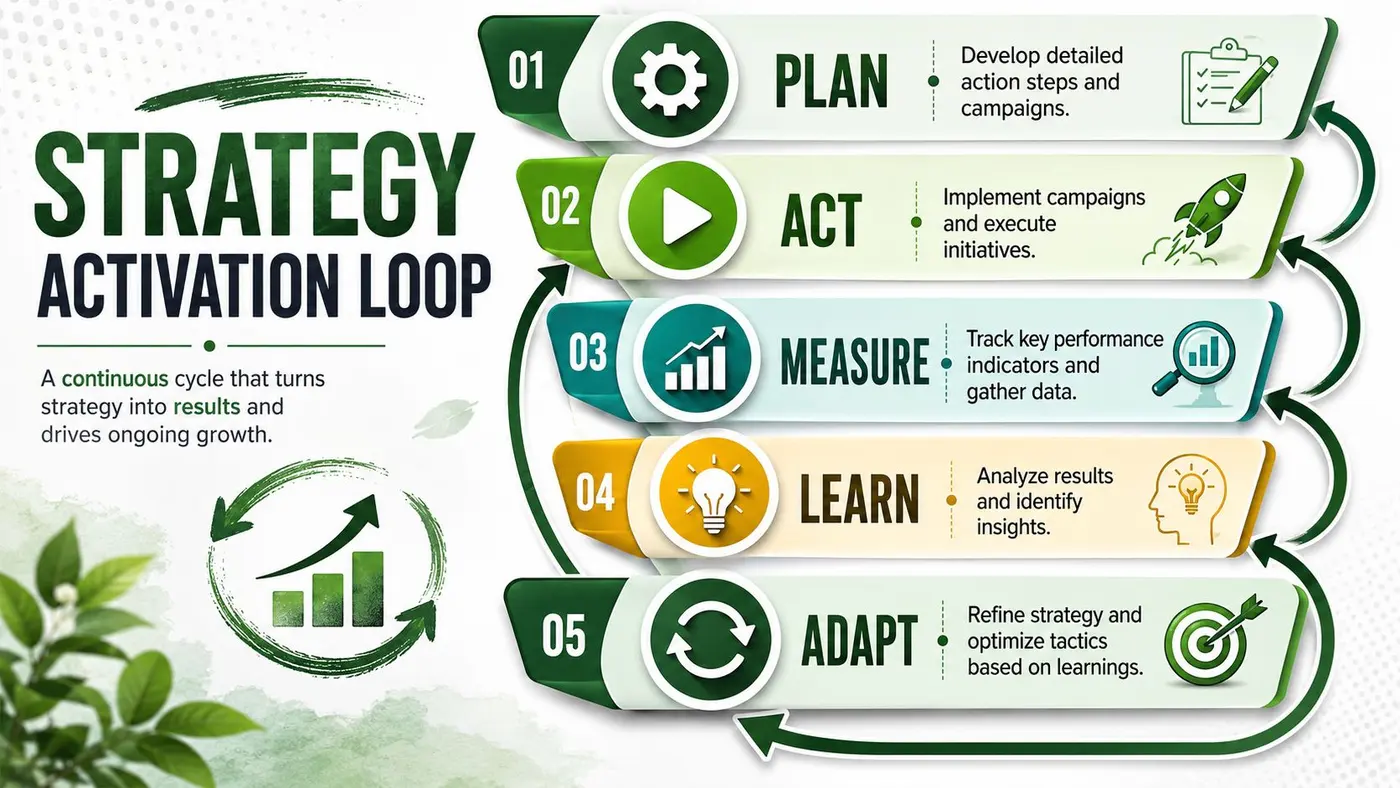
A strong strategy needs a tactical rhythm. Not a bloated annual calendar with every asset mapped in advance. A smaller set of priorities works better: quarterly themes, a handful of key initiatives, named owners, clear dependencies, and a review cycle that forces decisions.
Build a roadmap that leaves room to learn
The easiest way to kill a strategy is to over-plan it. Teams lock in too many campaigns, stack dependencies too early, and leave no space for iteration.
A better roadmap separates work into three buckets:
- Committed programmes: Core campaigns or channels that must run
- Improvement work: Conversion, messaging, lifecycle, reporting, sales enablement
- Experiments: Focused tests of assumptions around audience, offer, creative, landing page flow, or capture friction
That final bucket isn't optional. Every strategy rests on assumptions. Which message will resonate. Which CTA will convert. Which page structure will reduce hesitation. Which offer deserves paid distribution. If you don't test those assumptions, you're not developing strategy. You're defending guesses.
Pick KPIs that match the job
Measurement breaks when every team reports the same metrics regardless of objective. Awareness work, conversion work, and retention work need different lenses.
| Strategic Goal | Example KPIs | Example Tools |
|---|---|---|
| Awareness | Branded search trend, reach, engaged site visits, content consumption quality | Search Console, analytics platform, social platform reporting |
| Lead generation | Form submissions, qualified enquiries, meeting requests, lead quality notes from sales | CRM, marketing automation, form analytics |
| Conversion | Landing page conversion rate, checkout completion, CTA click-through, revenue per variant | A/B testing platform, analytics platform, ecommerce reporting |
| Retention | Repeat purchase behaviour, product usage milestones, reactivation response, churn signals | CRM, lifecycle platform, product analytics |
| Messaging validation | Scroll depth, CTA interaction, page engagement, assisted conversions | Heatmaps, session tools, analytics platform |
The most useful KPI set is small enough to govern action. If a dashboard has everything, it governs nothing.
This is also where a clear North Star metric helps. It won't replace supporting KPIs, but it can stop teams from optimising disconnected channel metrics that never add up.
Make experimentation part of the strategy, not a side project
CRO gets treated as tactical polish far too often. In reality, it's one of the cleanest ways to improve strategic judgement. Testing doesn't just lift pages. It tells you whether your assumptions about value, friction, and intent are correct.
Examples of strategy-level questions that testing can answer:
- Does a pain-led headline outperform a benefit-led one?
- Does a narrow audience message beat a broad category claim?
- Does removing a form field improve lead quality or only increase low-intent volume?
- Does a pricing page need more reassurance, less detail, or a different CTA path?
- Do buyers respond better to proof early or after the value proposition?
If your team wants a current practical read on experimentation thinking, this roundup of 2026 CRO strategies is worth reviewing for tactical ideas you can adapt into your operating cadence.
One tool option in this workflow is Otter A/B, which lets teams test headlines, CTAs, layouts, and revenue-linked goals on websites. Used properly, a tool like that doesn't replace strategy. It helps validate whether the strategy is being expressed in the right way on the page.
The page is where strategy meets reality. Buyers don't convert because the positioning document was smart. They convert because the experience made the value clear and the next step felt credible.
Run a review loop with teeth
A real review process asks three questions:
- What happened
- Why do we think it happened
- What decision follows
That last question matters most. If reporting ends with observation, strategy stalls. Reviews should end in one of four decisions: scale, refine, pause, or stop.
Over time, this creates a better organisation, not just better campaigns. Teams learn to separate opinion from evidence. They stop repeating work that looks busy and start investing in what survives scrutiny.
Securing Buy-In and Driving Cross-Functional Alignment
A strategy can be perfectly reasoned and still fail if nobody uses it. Adoption is part of the work.
Leadership doesn't need every research detail. They need a case they can repeat. Sales doesn't need a philosophy of segmentation. They need to know who marketing is targeting, what message is being pushed, and how handoff quality should improve. Product doesn't need channel plans. They need to understand which customer problems are now central to the go-to-market motion.
Present the strategy as a set of choices
Buy-in gets easier when you frame the strategy around decisions, not documentation.
Use a one-page summary that answers:
- Where we are now
- What we are trying to achieve
- Who we are prioritising
- How we are positioned
- Which channels and programmes we'll back
- How success will be measured
- Which assumptions we'll test first
That format keeps the discussion grounded. It also makes disagreement more useful. People can challenge a decision, not just say the plan feels incomplete.
Prepare for the objections that always come
Most objections fall into familiar buckets:
-
“Why aren't we targeting everyone?”
Because strategy requires focus, and broad targeting usually weakens message-market fit. -
“Why are we changing the channel mix?”
Because channel selection should follow audience behaviour and measurable outcomes, not habit. -
“Why are we spending time on testing?”
Because untested assumptions become expensive very quickly once media, creative, and engineering time are committed. -
“Why doesn't this dashboard show everything?”
Because teams need decision metrics first, not metric overload.
Reinforce the plan after launch
Most internal communication fails because it happens once. Strategy needs repetition.
Use monthly reviews, campaign kick-offs, sales feedback loops, and simple written updates to keep everyone aligned. Repeat the same core message. Show what changed. Explain why. Make it normal for the plan to evolve when evidence improves it.
A strategy becomes real when other teams can explain it without opening your slide deck.
If you want the strategy to live beyond a planning workshop, give the team a working loop: clear choices, measurable outcomes, active experiments, and regular decisions. That's the difference between a document people admire and a system people use.
If your strategy needs a practical experimentation layer, Otter A/B is built for testing the on-page decisions that shape conversion: headlines, CTAs, layouts, and user flows. It gives marketing, product, and CRO teams a lightweight way to turn strategic assumptions into measurable tests, then share the results with stakeholders in a format they can use.
Stop guessing
Ready to start testing?
Set up your first A/B test in under five minutes. No credit card required.
- 14-day free trial
- No credit card required
- Cancel anytime