How are KPIs Measured: Drive Business Growth
Discover how are KPIs measured with actionable strategies. Learn to select, track, and visualize key metrics for growth & smarter decisions.

Measuring your Key Performance Indicators (KPIs) well goes far beyond staring at a spreadsheet once a quarter. When done right, it's a living, breathing process that connects your biggest business goals directly to the data you're collecting every single day.
So, how are KPIs really measured? The short answer is by choosing the right metrics for your goals, setting realistic targets, and then using the right tools—like real-time analytics dashboards—to see what’s actually moving the needle.
The Modern Framework for Measuring KPIs
Let's get practical. The way smart businesses measure KPIs in 2026 has completely shifted away from dusty, static reports. It's now a responsive system that gives you an immediate, visual read on performance. The goal is to turn raw numbers into clear actions that improve your business.
To do this effectively, you need to understand the two different kinds of indicators you'll be working with.
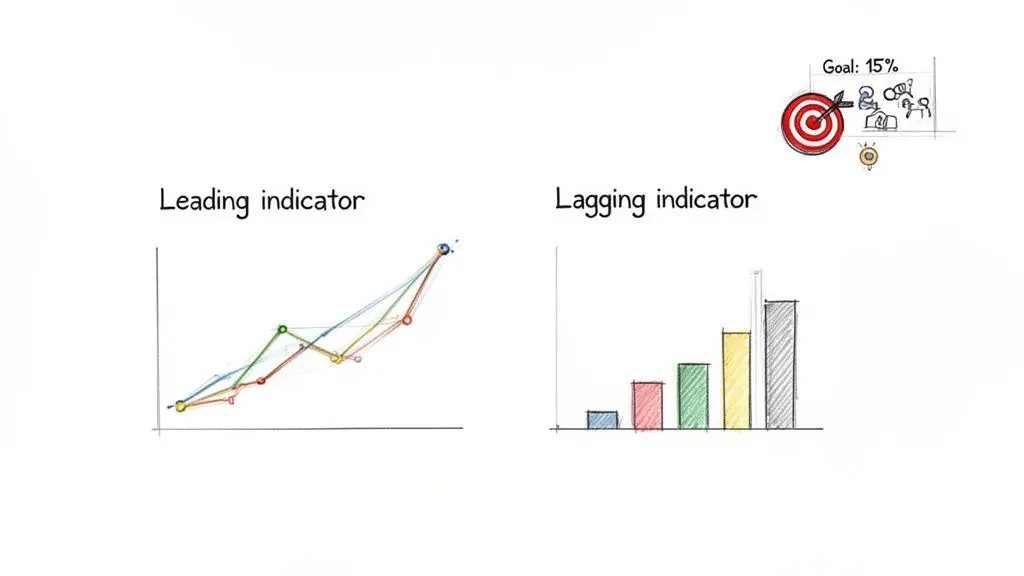
- Leading Indicators: These are your crystal ball. They’re predictive metrics that give you a hint about future results. Think of things like daily website traffic, the number of newsletter sign-ups, or free trial starts. A sudden drop here can warn you of trouble ahead. If you're looking for more ideas, exploring other key visitor statistics for your website can give you a fuller picture.
- Lagging Indicators: These metrics look in the rear-view mirror. They measure past performance, like last quarter's revenue or the annual customer churn rate. They're essential for confirming whether your big-picture strategies actually paid off.
A solid measurement framework always balances both. You use leading indicators for quick, in-the-moment adjustments and lagging indicators to prove your long-term strategy is sound.
From Manual Reports to Live Dashboards
The real game-changer has been the move from monthly sales reports to live, interactive dashboards. Imagine seeing your conversion rates, customer satisfaction scores, and revenue per visitor update in real time. That’s the heart of modern KPI measurement.
The magic happens when you can clearly connect an action to an outcome. For instance, seeing that a simple A/B test on your checkout page directly lifted your average order value by 8% is incredibly powerful. You've stopped just tracking data and started making decisions with it.
This whole process can be broken down into a simple, continuous cycle: set your goals, track the data, and then take action based on what you learn.
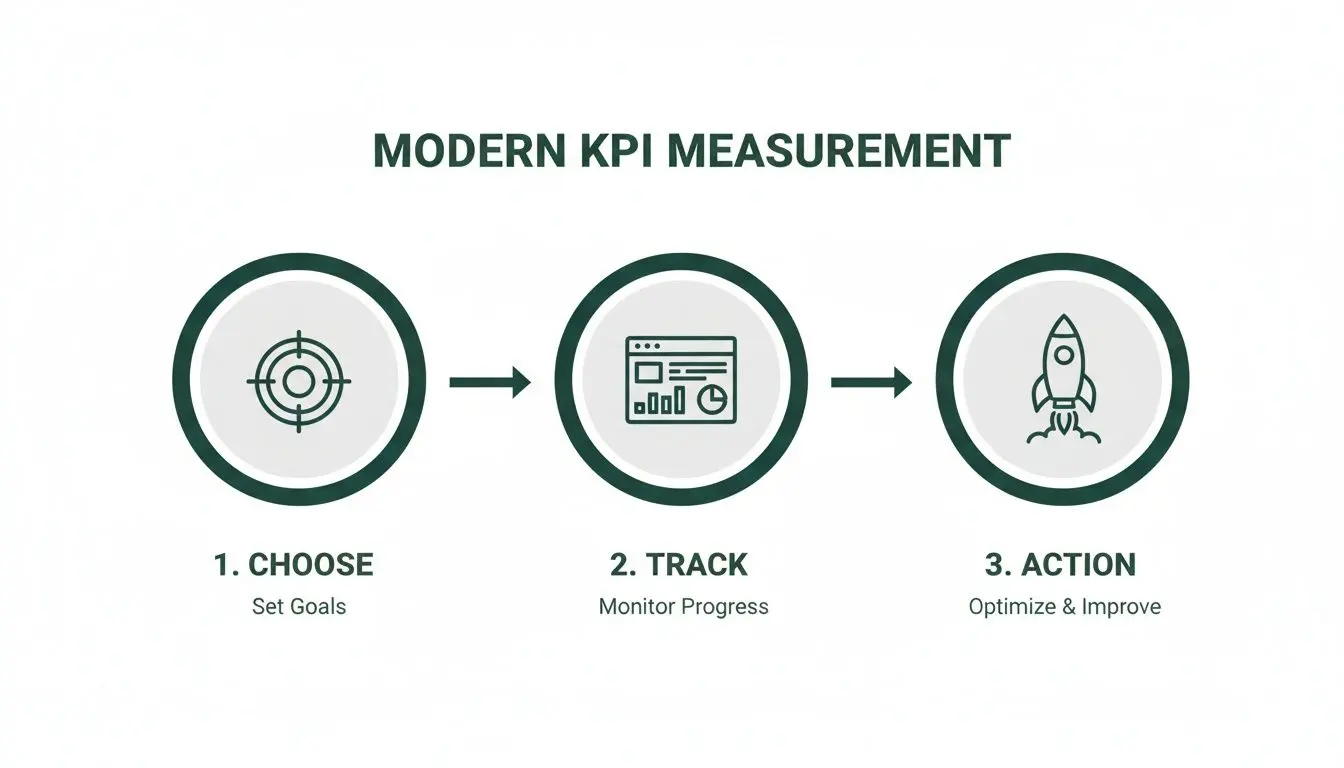
As the infographic shows, this isn't a one-and-done setup. It’s a loop. In the UK, this approach is fuelling a massive e-commerce market, which saw online retail sales hit an incredible £118.9 billion back in 2023.
What’s more, a UK government report revealed that 68% of SMEs using A/B testing platforms saw a 15-25% uplift in conversion rates precisely because they were measuring their KPIs so closely. It proves that what gets measured truly gets managed.
Core KPI Types and Their Purpose
To help you get started, it's useful to think about KPIs in categories. Each one serves a different purpose in telling the story of your business performance. The table below summarises the main types you'll encounter.
| KPI Category | What It Measures | UK E-commerce Example |
|---|---|---|
| Financial KPIs | The financial health and profitability of the business. | Net Profit Margin, Customer Acquisition Cost (CAC) |
| Customer KPIs | Customer satisfaction, loyalty, and value. | Customer Lifetime Value (CLV), Net Promoter Score (NPS) |
| Process KPIs | The efficiency and effectiveness of internal operations. | Average Order Fulfilment Time, Shopping Cart Abandonment Rate |
| Marketing & Sales KPIs | The performance of marketing campaigns and the sales funnel. | Conversion Rate, Cost Per Lead (CPL), Return on Ad Spend (ROAS) |
Choosing a balanced mix from these categories ensures you have a holistic view of your business, covering everything from cash flow to customer happiness. This is the foundation for a truly data-informed strategy.
Defining Your Goals and Selecting the Right KPIs
Let's be honest, you can't measure what you haven't defined. It’s the first, and frankly, the most common hurdle I see teams stumble over. The whole game of measuring performance starts by drawing a straight, solid line from your biggest business goals to the numbers you watch every day.
A fuzzy objective like ‘increase sales’ is a non-starter. It’s a wish, not a target. It gives your team no real direction and no finish line to cross. The trick is to sharpen those ambitions into something concrete you can actually act on.
From Vague Goals to Actionable Targets
The old-school SMART framework is still a gold-standard for this very reason—it forces clarity. Suddenly, ‘increase sales’ transforms into something tangible: ‘Increase average order value by 15% in Q3 by testing new upsell placements on the product page’. See the difference? Now we have a what, a how much, and a when.
This kind of focus immediately tells you which KPIs are worth tracking. For that specific goal, you'd be looking at:
- Average Order Value (AOV): This is your main event, the primary KPI you're aiming to move.
- Upsell Click-Through Rate: A crucial leading indicator. It tells you early on if your new placements are even catching anyone's eye. There are nuances to how you calculate click-through rate.
- Overall Conversion Rate: Your guardrail metric. This ensures your brilliant upsell idea isn't accidentally tanking your overall sales.
Applying this thinking cleans up your dashboard instantly. Instead of a cluttered mess of vanity metrics, you get a tight, focused set of numbers, where each one has a job. When you're just starting, it's vital to grasp the essential KPI in ecommerce that applies to your business model.
A great KPI is one that directly influences a core business outcome, like revenue or customer loyalty. If a metric doesn't connect to the bottom line, it's not a 'Key' Performance Indicator—it's just a metric.
Creating Your KPI Hierarchy
It helps to think about your metrics in layers. At the very top, you have your big-picture, strategic KPIs—things like Customer Lifetime Value (CLV). These are lagging indicators; they tell you the result of past actions and reflect the overall health of the business.
Sitting just below them are the operational metrics. These are your leading indicators—the day-to-day numbers that you can directly influence, which in turn push the top-level KPIs in the right direction.
For an e-commerce store, a simple hierarchy might look like this:
- Strategic KPI: Increase Customer Lifetime Value (CLV) by 20% over the next 12 months.
-
Operational Metrics:
- Repeat Purchase Rate
- Average Time Between Purchases
- Customer Satisfaction Score (CSAT)
This structure gives you a clear line of sight. You know that improving your operational metrics is how you’ll hit your strategic goal. Every number has a purpose. This approach is gaining serious ground; a recent 2025 Chartered Institute of Marketing report found that 73% of growth marketers in the UK now measure metrics like Net Promoter Score (NPS) at least quarterly, confirming the tight link between customer sentiment and long-term retention. You can read more about these findings on data-driven decisions on qlik.com.
Getting Your Hands Dirty: Building a Solid KPI Tracking System
You’ve got your goals and you know which KPIs you’re chasing. Now for the practical part: building the system that actually collects the data. This is where your strategy gets real. Think of it as the plumbing of your analytics – without it, nothing flows. A proper tracking setup is the only thing standing between user behaviour on your site and the numbers you see in your reports.
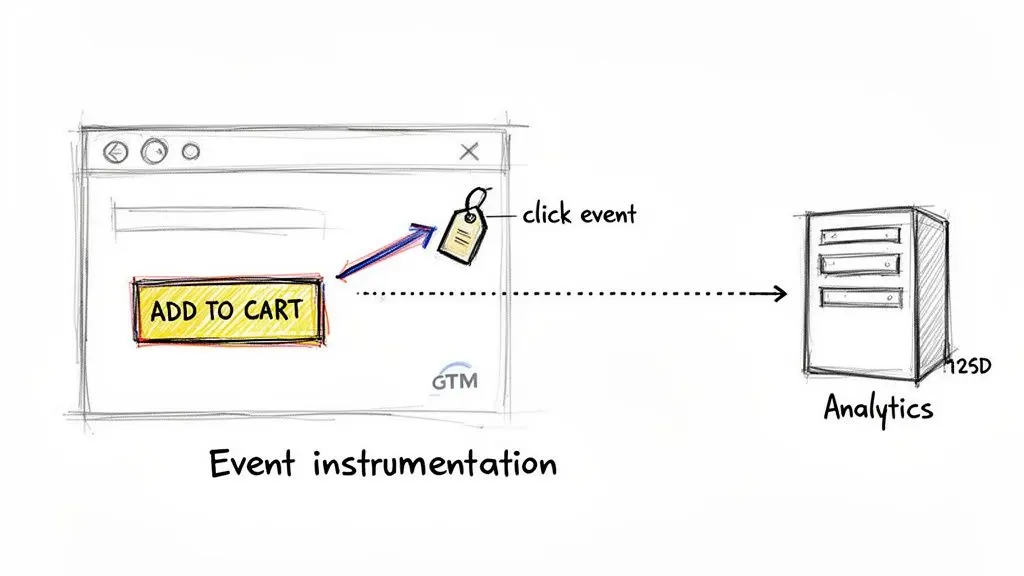
At the core of all this is something called event instrumentation. It sounds a bit technical, but the concept is simple. It just means you’re flagging specific user actions on your website so your analytics tools know to pay attention to them. It’s like putting little digital tripwires on the most important buttons and links.
These actions, which we call ‘events’, can be anything that shows a user is engaging or moving towards a purchase. For example:
- Hitting the ‘Add to Cart’ button
- Signing up for your newsletter
- Watching more than 75% of a product video
- Downloading a case study
Without tracking these specific moments, you're flying blind. Sure, you might know your overall traffic, but you won't have a clue how many people are taking the crucial steps that actually lead to a sale.
A Real-World E-commerce Example
Let’s bring this to life. Picture your online store, a UK-based Shopify site selling handcrafted leather goods. One of your key performance indicators is the ‘Add to Cart Rate’. To measure it, you need a reliable way to count every single time a visitor clicks that button.
This is where a tool like Google Tag Manager (GTM) becomes your best friend. GTM is a fantastic bit of kit that lets you manage and deploy all your tracking code from one place, without having to bother a developer every five minutes.
Instead of a rigid, step-by-step process, think of it like this: First, you go into GTM and tell it what to look for. You’d set up a "trigger" that fires only when someone clicks on the specific ‘Add to Cart’ button on your product pages. Then, you create a "tag"—in this case, for Google Analytics 4 (GA4)—that sends a little signal, or an event, every time that trigger is fired. You might name this event add_to_cart.
The final piece of the puzzle is telling GA4 that this event matters. Inside your GA4 account, you simply find the add_to_cart event and flick a switch to mark it as a conversion. Just like that, you've turned a simple click into a measurable business goal. What used to be a complex coding task is now something you can sort yourself in an afternoon.
The most useful data is never an accident. It comes from deliberately designing a system to capture the exact actions that answer your most important business questions.
Connecting Events to Goals in A/B Testing
This same foundation of event tracking is absolutely vital for A/B testing. When you run an experiment using a tool like Otter A/B, you have to tell it what you’re trying to achieve—what the "win" condition is. That goal is almost always tied directly to one of the events you’ve set up.
Say you’re testing two different headlines on a product page. Your goal is to get more people to add the item to their basket. The success of your test will be measured by comparing how many times the add_to_cart event fires for users who see your new headline versus those who saw the original. This direct link between an action and a business outcome is precisely what makes experimentation such a powerful way to move your KPIs in the right direction.
So, the data is rolling in. Your tracking is set up, events are firing correctly, and the numbers are appearing in your analytics dashboard. Great. But this is where the real work begins.
Having data is one thing; knowing what to do with it is something else entirely. We need to move from simply collecting metrics to calculating KPIs with confidence, especially when making big decisions based on that information.
It all starts with getting the maths right.
Calculating Your Core KPIs
Before diving into complex analysis, you need to have a rock-solid grasp of the fundamental KPI calculations. These are the bread and butter of any e-commerce or growth team, giving you a quick-glance view of your store's performance.
Below are the key formulas you'll find yourself using day in and day out.
Essential KPI Formulas for E-commerce Teams
This table is your quick-reference guide. Mastering these simple formulas is the first step towards truly understanding your business's health.
| KPI Name | Calculation Formula | What It Tells You |
|---|---|---|
| Conversion Rate | (Conversions / Visitors) * 100 | The percentage of visitors who complete a desired goal. |
| Average Order Value (AOV) | Total Revenue / Number of Orders | The average amount customers spend per transaction. |
| Revenue per Visitor (RPV) | Total Revenue / Total Visitors | The average revenue generated by each person visiting your site. |
These calculations give you the 'what'. But to get to the 'why'—and to trust your results—you need another layer of analysis, particularly when you're running experiments.
Why Statistical Significance is Non-Negotiable
When you run an A/B test, you're looking for a winner. But how can you be sure the uplift you're seeing isn't just a random fluke? That's where statistical significance comes in. It's the safety net that prevents you from making costly business decisions based on noise.
Think of it this way: you test a new headline and your conversion rate inches up slightly after a few hours. It’s tempting to call it a win and roll it out, right? Not so fast. Without statistical confidence, you're essentially gambling.
Most professional A/B testing platforms, Otter A/B included, operate at a 95% confidence level. This means if the tool declares a winning variation, there’s a 95% probability that the result is genuine and not just random chance. It leaves only a tiny 5% risk that you're seeing a false positive.
A proper testing engine rigorously calculates the probability that your observed results could have happened by chance alone. Only when that probability dips below an accepted threshold (like 5%) can you confidently say, "Yes, this change genuinely improved performance." If you want to go deeper, our guide on what a confidence interval in statistics means for your tests is a great resource.
This disciplined approach is what separates the pros from the amateurs. Top UK digital agencies, for instance, measure everything against A/B test outcomes. One report found that the average ROI for web optimisation was an impressive 4.2:1, and teams using sophisticated platforms saw returns that were 28% higher.
Knowing your formulas is crucial, but being able to trust the numbers is what unlocks real growth. By mastering the basic maths and applying statistical rigour, you can stop guessing and start making data-driven decisions that actually move the needle. A great next step is to learn how to calculate customer retention rate, a key metric for long-term success.
Visualising and Reporting on Your KPIs
All that hard work measuring and calculating KPIs can fall completely flat if you just dump the numbers into a spreadsheet. Raw data rarely sparks inspiration or drives anyone to act. This is where the magic happens: translating your findings into clear, compelling visual stories that actually make a difference.
Ultimately, your data is only as good as your ability to communicate it. Effective reporting is what turns your insights into real influence.
The key is to think like a storyteller. You’re not just presenting numbers; you’re building a narrative. Different chart types are your tools for telling different parts of that story. A line chart, for instance, is perfect for showing a trend over time, like tracking your Revenue per Visitor from one month to the next. But if you want to compare distinct categories, like the performance of different traffic sources, a bar chart is your best bet.
Designing Dashboards That Tell a Story
I've seen it time and again: a dashboard crammed with dozens of metrics that just creates a wall of noise. An effective dashboard is the complete opposite. It’s clean, focused, and answers specific business questions at a glance.
Think about the different stories you need to tell. A report for an A/B test has a very different purpose from a weekly team performance review.
-
A/B Test Summary: This needs to be laser-focused. You want to show the original and the variant side-by-side, making it immediately obvious what changed. Your primary goal (like Conversion Rate), the uplift, and the statistical significance level should be front and centre. It's also smart to include secondary metrics, such as
Average Order Value, to show the full impact on the business. -
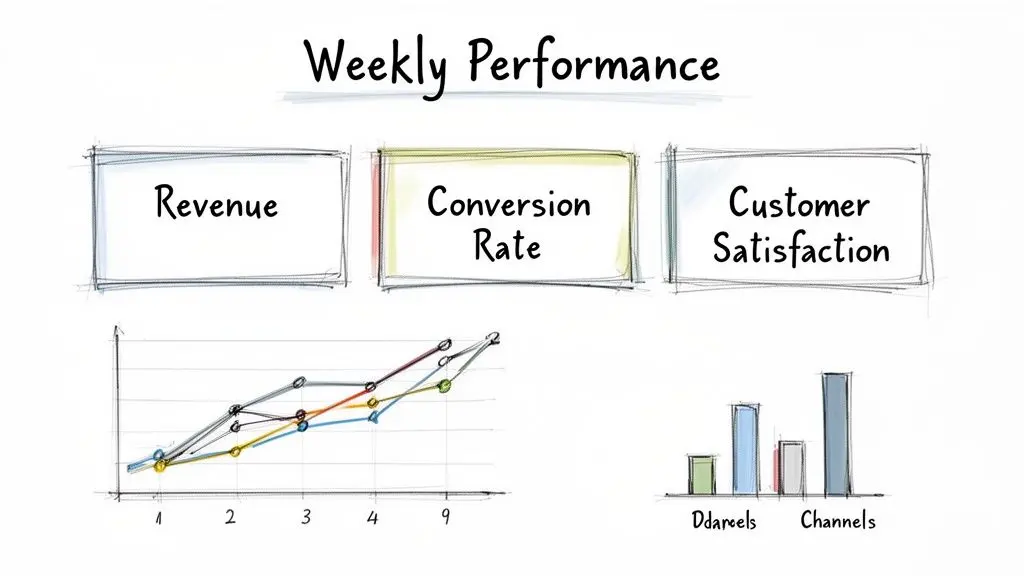
Weekly Performance Dashboard: This is more of a health check. It should feature a mix of leading indicators (like weekly sessions or cart abandonment rate) and lagging ones (like total revenue). This combination gives a complete picture of what’s happening in your operations right now.
The golden rule is to tailor the information to who's looking at it. Your CEO doesn't need a granular breakdown of click-through rates on every ad campaign. They need the big-picture summary of how your experiments are moving the needle on overall revenue. Your marketing team, on the other hand, lives for that detail; it’s what they need to optimise their work.
A great report doesn’t just show what happened; it provides a strong point of view on what to do next. It transforms you from a data reporter into a strategic advisor, building trust and demonstrating value.
Tools for Transparent and Professional Reporting
For those of us working at digital agencies or as consultants, reporting is everything. It's how we prove our worth and maintain a transparent, healthy relationship with our clients. Thankfully, modern tools have made it easier than ever to create professional reports that make data easy to digest.
Platforms like Otter A/B have built-in features for this, allowing you to create password-protected reports that you can share with a simple link. Stakeholders get a live, clear view of experiment results without being swamped by technical jargon.
Turning your carefully measured KPIs into a powerful communication tool is what closes the loop. It justifies your strategy and provides the fuel for the next round of data-driven decisions.
Putting It All Together: Your KPI Questions Answered
Once you start tracking KPIs in the wild, you'll inevitably run into some practical roadblocks. Getting the details right is what separates a dashboard that just sits there from one that actively drives your business forward.
Let's tackle some of the most common questions that come up. Think of this as the advice I give my own team when we're deep in the data.
How Often Should I Be Looking at My KPIs?
The honest answer? It depends entirely on what you're measuring. The biggest mistake I see is people checking everything, all the time. That's a recipe for knee-jerk reactions to normal fluctuations.
A much better approach is to match your review cadence to the metric's purpose.
-
Operational KPIs: These are the pulse of your day-to-day business. Think
daily website traffic,add-to-cart rates, or thecost per clickon a live ad campaign. A weekly team review is perfect for these. It’s frequent enough to catch problems early but not so frequent that you’re reacting to noise. -
Strategic KPIs: These are the slow-moving giants that show long-term health, like Customer Lifetime Value (CLV) or market share. Reviewing these monthly or quarterly makes far more sense. It gives your big-picture strategies the time they need to actually bear fruit.
When it comes to A/B tests, you'll be watching the data accumulate until you hit statistical significance. The trick is to resist the temptation to call it early based on a good or bad day. Let the numbers tell the full story.
What's the Real Difference Between a KPI and a Metric?
This is a fundamental point that trips a lot of people up, but it's crucial for staying focused. Put simply: all KPIs are metrics, but not all metrics are KPIs.
A metric is just a number you can count. Your business generates hundreds of them—visitors, bounce rate, time on page, you name it. They’re just data points.
A Key Performance Indicator (KPI), on the other hand, is a metric you’ve specifically selected because it directly measures how you’re performing against a critical business goal. It’s a metric with a mission.
For example, 'website visitors' is a metric. It's just a number. But 'conversion rate of website visitors from organic search' is a KPI. Why? Because it specifically measures the success of your SEO strategy, which is a key objective.
Zeroing in on KPIs is how you separate the signal from the noise. It stops you from drowning in data and helps you focus on what actually moves the needle.
My KPIs Aren't Improving. What Now?
First of all, don’t panic. A flat or dipping KPI isn't a failure—it's a signal. It’s your data telling you that something in your strategy or execution needs another look. It's a chance to get smarter.
Your job is to play detective and find the root cause. I’m a big fan of the 'Five Whys' technique for this. Imagine your conversion rate has dropped.
- Why is it down? Because traffic from our main ad campaign has fallen off a cliff.
- Why did traffic drop? The click-through rate on the ads is now really low.
- Why is the CTR low? The creative has been running for six weeks straight. People are probably tired of seeing it.
- Why didn't we change it? We didn't have a creative refresh scheduled.
- Why wasn't it scheduled? It wasn't part of our team's standard campaign checklist.
See what happened? We went from a vague problem ("low conversions") to a specific, fixable issue. This gives us a clear hypothesis to test: "If we launch fresh ad creative, our conversion rate will bounce back." Now you have a clear action, and you can use A/B testing to prove it works.
At Otter A/B, we help you turn these kinds of insights into measurable action. Our platform is built for running A/B tests on your ideas, tracking the real impact on revenue and other vital metrics, and giving you statistically sound results you can act on with confidence. Start your free trial today and make every decision a data-driven one.
Stop guessing
Ready to start testing?
Set up your first A/B test in under five minutes. No credit card required.
- 14-day free trial
- No credit card required
- Cancel anytime