What Is Average Order Value? Boost AOV in 2026
Learn what is average order value (AOV), how to calculate it, and its importance. Get actionable tactics & A/B testing examples to boost revenue.
In May 2026, UK ecommerce average order value reached £131.84, up 0.86% year over year from £130.72. Average order value means the average amount customers spend each time they place an order on your website, and if your traffic is growing but revenue feels stubborn, this is usually the metric that explains why.
A familiar pattern shows up in almost every ecommerce team. Sessions are up. Conversion rate looks decent. The ad account isn't on fire. Yet revenue doesn't move as much as it should, or margin gets squeezed because too many orders are small, heavily discounted, or expensive to fulfil.
That's why AOV matters. It's the lever that helps you earn more from the customers you already convinced to buy. For a busy ecommerce manager, that's often a better place to look than piling more spend into acquisition or chasing tiny conversion gains that don't change total revenue enough.
Understanding Your Most Powerful Sales Metric
AOV tends to get treated like a side metric. In practice, it sits right beside traffic and conversion rate as one of the few numbers that directly shape revenue.
You can see the pressure in the UK market. The UK remains the largest e-commerce market in Europe, with 59 million users in 2025 spending an average of £2,600 per person annually online, and over 90% of UK internet users already purchase online, according to Signifyd's UK State of Commerce Report. In a market that mature, small shifts in basket value matter because there's less easy growth left from getting more people online.
The practical version of this looks simple. Two stores can convert the same share of visitors, but the one that gets customers to buy one extra item, choose a better bundle, or upgrade to a higher-value product usually wins.
Practical rule: If revenue is flat while traffic and conversion are healthy, check basket value before you blame acquisition.
AOV also forces cleaner thinking about customer quality. A campaign that brings in lots of low-value orders can look fine in platform reporting but still weaken the business. A campaign that brings in fewer but larger baskets may create more room for fulfilment, paid media, and retention to work.
That's also why the definition of AOV changes a bit by business model. A service business may think about packages, retainers, or booked project size rather than physical baskets. If that's closer to your world, this guide on AOV for service businesses is useful because it shows how the same principle applies beyond standard ecommerce checkouts.
How to Calculate Average Order Value
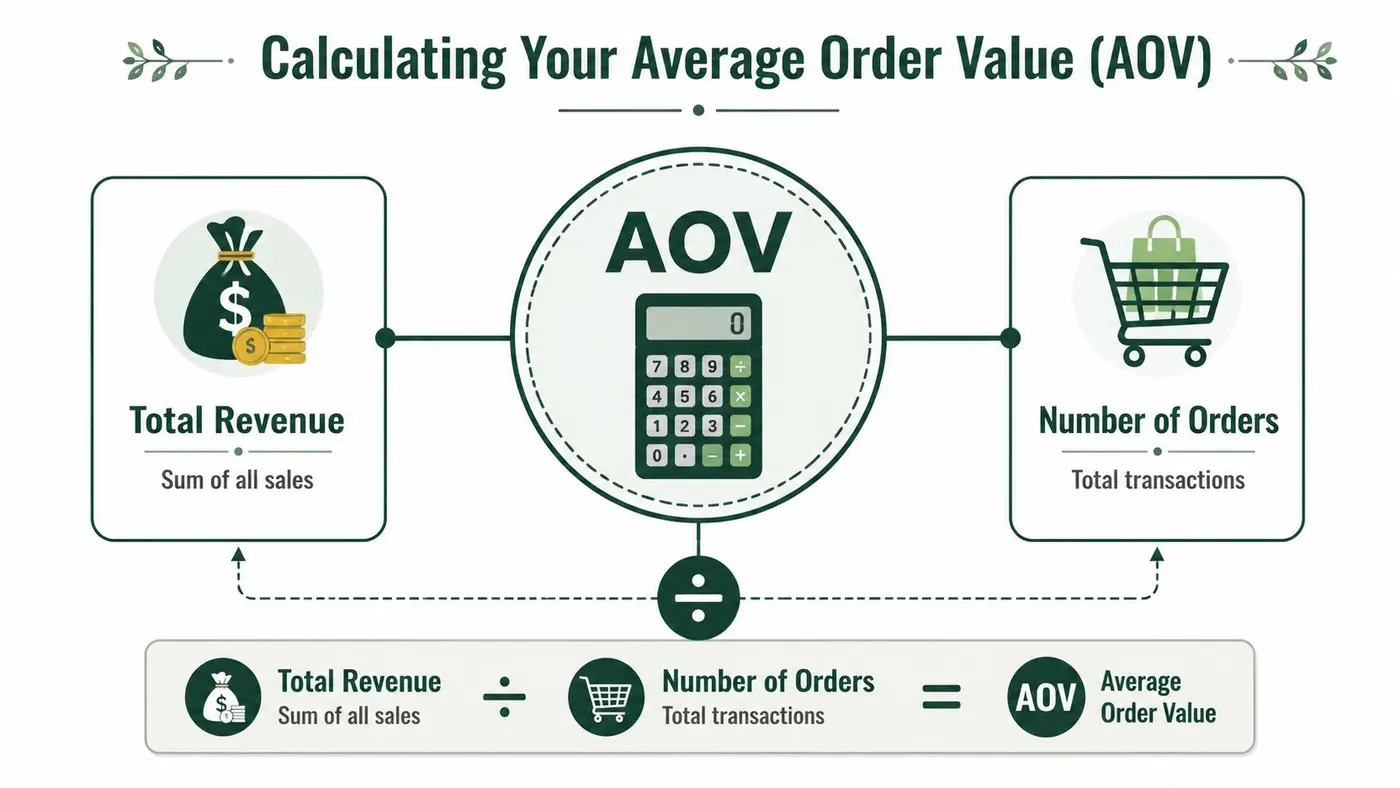
The basic formula is straightforward:
Average Order Value = Total Revenue ÷ Number of Orders
If your store made £20,000 from 200 orders in a given period, your AOV would be £100. That's the clean starting point, and it's enough to get a directional read on how much customers spend per transaction.
The formula most teams stop at
The problem is that many teams calculate AOV once, celebrate when it rises, and never ask what's inside the number.
That's where gross AOV and net AOV matter.
- Gross AOV uses order revenue before you properly account for discounting and returns.
- Net AOV gets closer to what the business keeps from those orders after those distortions are reflected.
This distinction matters more than most articles admit. In 2025, the UK E-Commerce Market reported a gross AOV of US$145–US$150, but that figure drops materially once discounts and returns are deducted to calculate net AOV, as shown in ECDB's UK transactions sample data.
Why gross AOV can fool you
Take a clothing retailer running aggressive promotions. The checkout value might look strong because customers add multiple items to hit a perceived deal. On paper, gross AOV rises. But if a chunk of those orders comes from discount-led baskets and a meaningful share gets returned, the business hasn't improved the way the dashboard suggests.
That's why I treat gross AOV as a merchandising signal, not a final success metric.
Gross AOV tells you what customers agreed to buy at checkout. Net AOV tells you more about what that behaviour was actually worth.
A simple comparison helps:
| Metric | What it shows | Common problem |
|---|---|---|
| Gross AOV | Checkout basket size before the full effect of discounts and returns | Can overstate success |
| Net AOV | More realistic retained value per order | Harder to calculate, but more useful |
| Conversion rate | Share of visitors who bought | Misses order quality |
What to track in practice
Most ecommerce managers should calculate AOV at more than one level:
- Store-wide AOV for an overall trend line
- Category-level AOV to spot where larger baskets naturally happen
- Channel-level AOV to see which acquisition sources bring valuable customers
- Net AOV for financial decision-making
If you're asking what is average order value in a way that helps the business, this is the answer: it's not just an average. It's a lens on basket quality, promotional efficiency, and whether your growth is real or cosmetic.
Why AOV Is a Critical E-commerce KPI
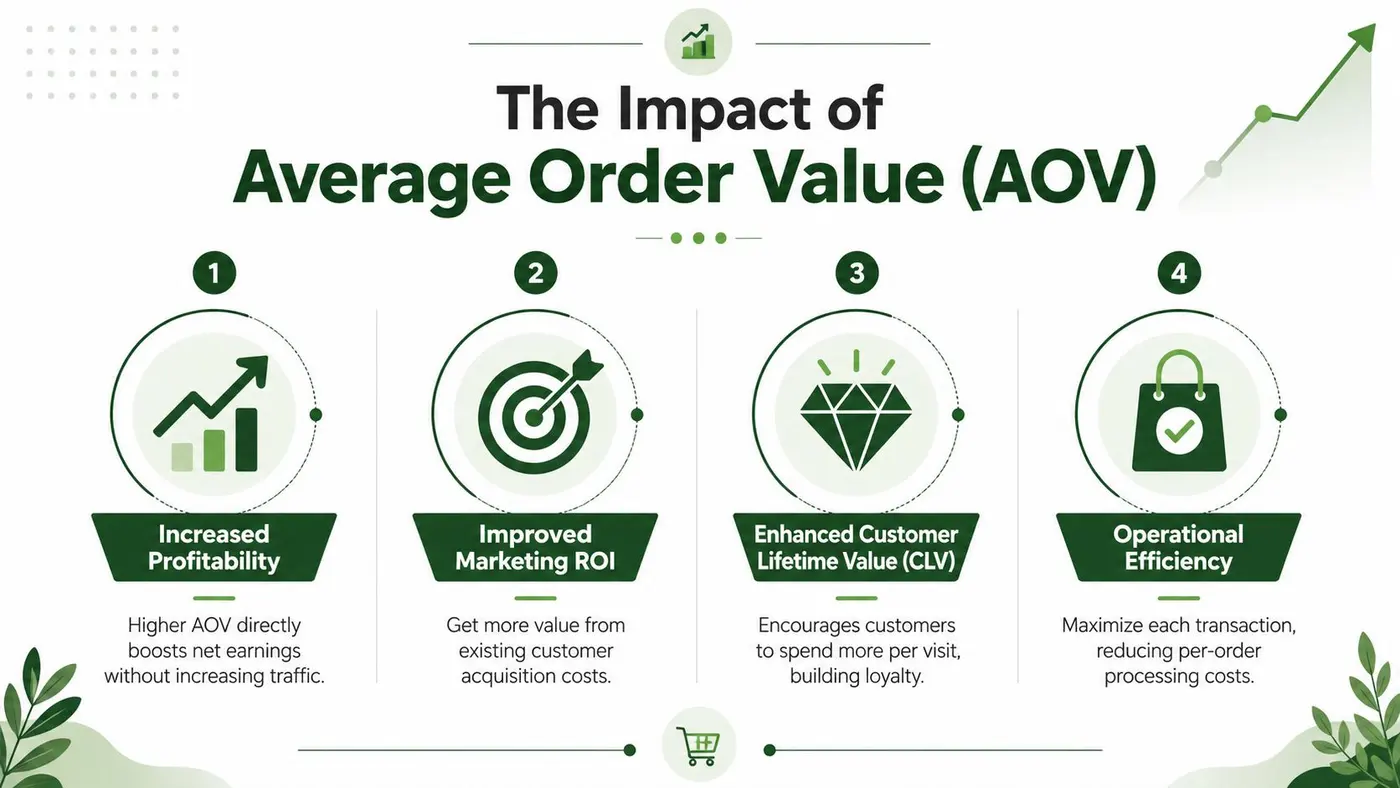
AOV earns its place as a core KPI because it changes the economics of the whole business. If customers spend more each time they buy, you don't need every gain to come from extra traffic or a higher conversion rate.
For UK merchants, there's a useful benchmark here. In May 2026, the UK ecommerce market's average order value reached £131.84, a 0.86% year-over-year increase, according to IRP Commerce's UK ecommerce market data. That number won't tell you whether your store is healthy on its own, but it gives you a reference point for how much value UK checkouts are generating in the market.
It improves the quality of every order
AOV matters because each order carries overhead. Payment processing, fulfilment effort, packaging, support, and warehouse handling don't disappear just because a basket is small.
When AOV rises for the right reasons, each transaction can carry more of that fixed effort. That usually gives the team more room to spend on acquisition, absorb operational friction, or protect margin during promotional periods.
It changes how you judge marketing
A paid social campaign with a low AOV can be expensive even if it converts well. An email campaign with a stronger basket can be more useful than its click volume suggests. This is why serious teams stop reading channel performance through conversion rate alone.
AOV also sharpens decision-making around offers. If a campaign drives lots of first purchases but they're tiny, heavily discounted, and unlikely to repeat, the headline volume can hide weak underlying economics.
A conversion is only good if the order is worth having.
It connects directly to longer-term value
AOV isn't the same as customer lifetime value, but the two are closely connected. Customers who buy broader routines, better bundles, or premium configurations often behave differently from one-product buyers. They tend to show stronger intent, and they give retention teams more to work with.
That's one reason segmentation matters. A store-wide average can hide useful patterns.
Segment AOV before you act on it
Instead of asking whether your AOV is good, ask where it is good.
Useful cuts include:
- New vs returning customers to see whether first orders are too shallow
- Paid vs owned channels to compare basket quality
- Mobile vs desktop because merchandising space changes behaviour
- Product category to find natural bundling opportunities
- Promotion vs non-promotion periods to separate true demand from discount dependency
A simple working table helps teams avoid vague analysis:
| Segment | What you're looking for |
|---|---|
| New customers | Whether the first purchase is large enough to justify acquisition cost |
| Returning customers | Whether repeat buyers deepen their spend over time |
| Paid traffic | Whether campaigns bring valuable baskets, not just cheap conversions |
| Product category | Which assortments naturally support larger orders |
The reason AOV belongs on the KPI dashboard isn't that it sounds financially impressive. It belongs there because it tells you whether the business is extracting enough value from the buying intent it already created.
Actionable Strategies to Increase Your AOV
Most AOV advice is too generic to be useful. “Try bundling” or “offer free shipping” isn't wrong, but those tactics work only when the offer fits how people shop your catalogue.
The better way to approach AOV is to turn each tactic into a testable hypothesis: if we change this part of the buying journey, will customers build a better basket without hurting too much conversion quality?
Start with tactics that change buying behaviour
Some of the most reliable AOV levers are still the classic ones, but execution matters.
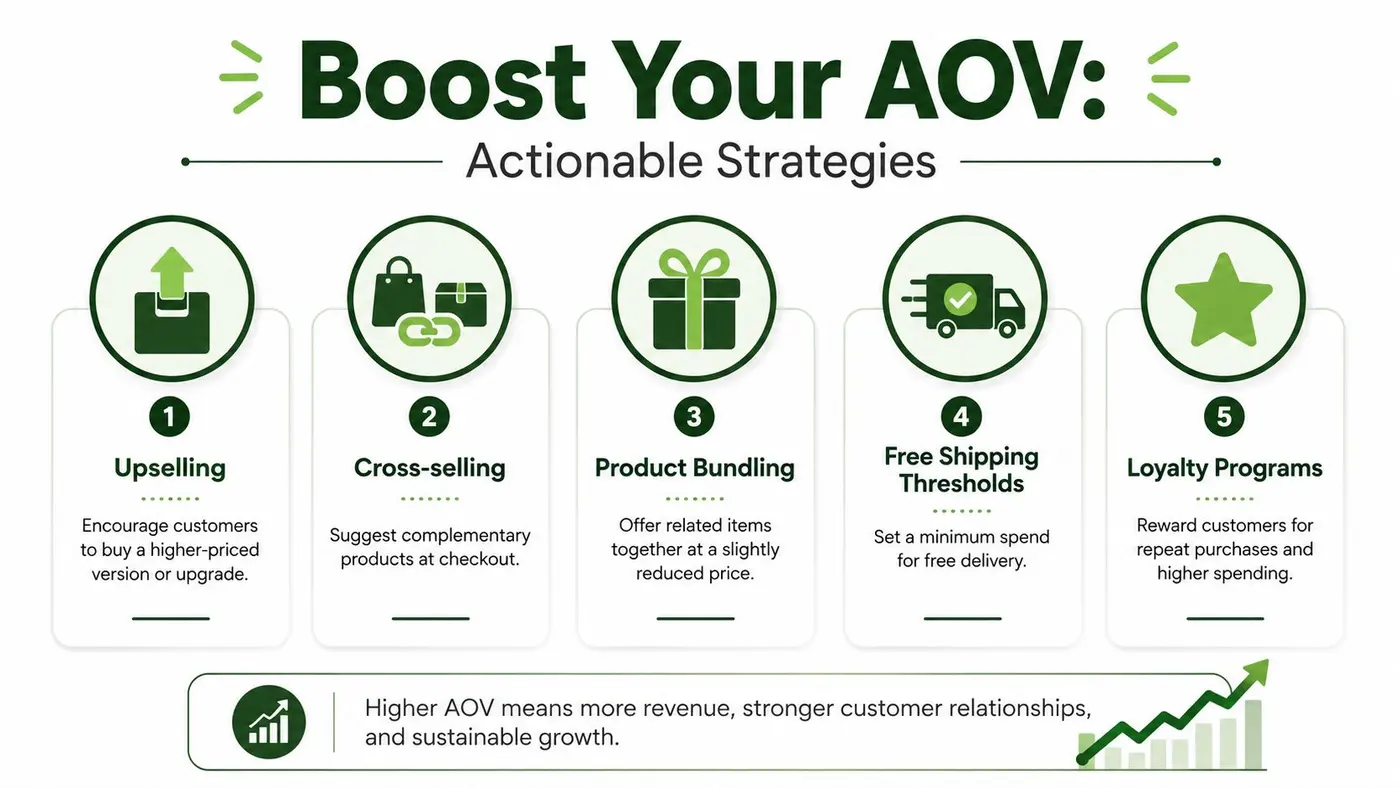
- Bundling related products works when the bundle removes effort. Skincare routines, meal kits, home office setups, and camera accessories all make sense because the shopper already expects multiple items to work together.
- Cross-selling complements works best when the add-on is obviously useful at the moment of decision. A charger with a device, refills with a starter product, or protective care with a premium item all feel natural.
- Upselling to a better version works when the comparison is clear. If the higher-priced option looks arbitrary, customers ignore it. If the upgrade solves a visible problem, they'll consider it.
- Volume discounts help when replenishment is normal. They often fail for discovery products where people don't yet trust the item enough to buy more than one.
- Free shipping thresholds create a goal. Done well, they nudge a customer to add one more item. Done badly, they just give away margin on orders that would have happened anyway.
If your team is deciding where cross-sell ends and upsell begins, this breakdown of cross-selling vs up-selling is useful because the placement and messaging are different even when both increase basket size.
A quick visual refresher helps when you're mapping offers across the funnel:
Use psychology, not just mechanics
A tactic works when it matches the shopper's mental state.
A free shipping threshold works because it gives the customer a visible finish line. A bundle works because it simplifies choice. A post-purchase add-on works because the buyer has already committed and can now evaluate an extra item with less friction.
That also means some popular tactics backfire.
What often fails: adding noisy product recommendations everywhere. If every page screams “you may also like”, shoppers learn to ignore the modules.
Use fewer offers, placed with intent. Product page recommendations, cart add-ons, and post-purchase offers each serve a different job. Don't make them compete.
Add modern payment levers to the test queue
One area many generic AOV articles miss is payment design. Industry reporting indicates that integrated lending and insurance payment options are a key trend for increasing both conversion rates and AOV in the UK in 2026, according to Osome's review of UK ecommerce trends.
That doesn't mean every store should bolt financing onto every product page. It means merchants selling higher-consideration products should test whether payment flexibility changes basket composition. Some categories benefit because customers feel comfortable stepping up to a better model, adding protection, or buying a fuller package in one transaction rather than delaying the decision.
Build tactics around your catalogue type
Different catalogues respond to different AOV plays:
| Catalogue type | Better AOV play | Usually weaker play |
|---|---|---|
| Consumables | Multi-buy offers, subscriptions, replenishment bundles | Premium upsells too early |
| High-ticket considered goods | Financing visibility, protection add-ons, curated bundles | Blanket discounting |
| Fashion and style-led products | Outfit bundles, matching accessories, threshold nudges | Forced volume discounts |
| Specialist hobby products | Expert kits, compatibility cross-sells | Generic recommendation carousels |
A loyalty mechanic can also help, but only if it rewards spend in a way customers understand. “Spend more, gain more value” is cleaner than a complicated points scheme no one can decode.
The common thread is simple. Don't ask, “How do we force a higher basket?” Ask, “What extra purchase would feel helpful, logical, and low-friction in this moment?”
Testing and Measuring Your AOV Optimisation Efforts
AOV strategy without testing is guesswork. Teams often roll out bundles, free shipping bars, financing messages, or cart add-ons and then judge success by feel. That's how weak ideas survive for months.

The most common mistake is measuring only conversion rate. That sounds sensible until you run a test that lowers conversion slightly but increases basket quality enough to generate more revenue overall. If you stop at conversion rate, you kill a winner.
Revenue per variant beats surface metrics
Say you test a new bundle on a product page. Fewer people may buy because the offer asks for a bigger commitment. But the buyers who do convert may spend more, choose better combinations, and produce stronger order economics.
That's why ecommerce experiments need at least three readings side by side:
- Conversion rate
- AOV
- Revenue per variant or revenue per visitor
Without that third view, you can't tell whether a lower-converting variant is more valuable.
If a test reduces conversion but lifts revenue, the test didn't fail. Your reporting did.
What a good AOV test looks like
A disciplined AOV test usually has a narrow scope and a clear commercial hypothesis.
For example:
-
Hypothesis
Showing a curated bundle above the add-to-cart button will increase basket value more effectively than showing related products lower on the page. -
Primary business readout
Revenue per variant, not just conversions. -
Supporting metrics
AOV, attach rate for the additional items, and any obvious checkout friction signals. -
Guardrails
Watch for signs that the variant creates confusion, discount dependency, or weak order quality.
Before launching any bundle test, it also helps to get the operational side right. Merchandising teams often underestimate fulfilment complexity, stock coordination, and packaging implications. This guide on operational prep for e-commerce bundles is worth reviewing because even a smart front-end offer can fail if operations can't support it cleanly.
Choose test size with care
AOV tests often need patience because monetary outcomes can be noisier than binary conversions. If you set expectations too aggressively, you'll either stop early or chase random movement.
That's where planning matters. A useful starting point is understanding minimum detectable effect, because it helps teams decide whether a test is realistically sized for the change they expect to see.
Use tools that report business outcomes, not just clicks
This is also where Otter A/B fits naturally for ecommerce teams. It's a lightweight website testing platform that tracks purchases, average order value, and revenue per variant alongside conversion metrics, which is what you need when the goal isn't just more orders but better ones.
The practical standard is simple:
| Test type | Weak success metric | Better success metric |
|---|---|---|
| Bundle placement | Click-through rate | Revenue per variant |
| Cart upsell | Acceptance rate | Net effect on order value and checkout completion |
| Payment messaging | CTA clicks | Order value quality plus completed purchases |
| Free shipping threshold copy | Banner engagement | Basket lift without excess margin loss |
Good experimentation protects you from false positives in both directions. It stops you from celebrating a test that boosts conversion while shrinking order value. It also stops you from rejecting a test that creates fewer, better orders.
Turning AOV Insights into Sustainable Growth
AOV becomes useful when you stop treating it as a dashboard number and start treating it as a revenue system. First, measure it properly. Then separate gross from net thinking. Then identify where bigger baskets come from, and test whether you can create more of them without degrading the business elsewhere.
That's the difference between cosmetic optimisation and durable growth. Cosmetic optimisation inflates checkout value with blunt discounts, cluttered upsells, or offers that look good in a report but don't hold up after returns and fulfilment costs. Durable growth comes from better basket design, cleaner merchandising, and disciplined testing.
There's also a wider payoff. Teams that get good at AOV usually get better at customer quality, merchandising, and retention because they stop chasing shallow wins. That's especially true when they connect order value thinking to broader customer economics, including customer lifetime value.
If you're asking what is average order value, the simplest answer is still true: it's the average amount a customer spends per order. The more useful answer is this: it's one of the clearest signals of whether your ecommerce engine is producing real commercial value from the demand you already have.
If you want to move from tracking AOV to testing it properly, Otter A/B gives ecommerce teams a straightforward way to experiment with bundles, upsells, headlines, and checkout messaging while measuring conversion rate, average order value, and revenue per variant in one place.
Stop guessing
Ready to start testing?
Set up your first A/B test in under five minutes. No credit card required.
- 14-day free trial
- No credit card required
- Cancel anytime