Cross Selling vs Up Selling
Cross selling vs up selling - Master cross-selling vs up-selling with our 2026 guide. Get frameworks, UX examples, and testing tips to maximize your revenue
Independent industry research suggests cross-selling can contribute 10%–30% of e-commerce revenues, while effective upselling and cross-selling can lift average order value by 10%–40%. In the UK, that matters because internet sales accounted for 26.5% of total retail sales in February 2024, making these tactics far more than minor merchandising tweaks in a digital channel of real scale, as noted in this ecommerce revenue analysis.
That's the essential frame for cross selling vs up selling. The question isn't which one sounds smarter in a strategy deck. It's which one increases revenue without damaging conversion, margin, or the customer experience on a mobile screen.
Many organizations already understand the textbook definitions. Fewer know how to test these tactics properly. They launch a “Frequently Bought Together” module, add a premium option to the PDP, and judge success on clicks. That's not enough. A useful test programme looks at basket composition, order quality, returns risk, and whether the offer helps the customer complete a better purchase or only adds friction.
Why Mastering Sales Tactics Matters More Than Ever
The UK ecommerce market is large enough that small changes in basket value can have an outsized commercial effect. When online retail already represents a meaningful share of total spend, recommendation logic, offer design, and checkout merchandising stop being cosmetic decisions and become revenue decisions.
Cross selling and up selling matter because they work on traffic you already paid for. If acquisition costs are rising, the cleanest profit lever is often better monetisation of existing visits, not more visits. That's why mature CRO teams treat these tactics as part of the purchase journey, not as a bolt-on widget installed by an app.
Why the stakes are higher now
Two things have changed. First, buyers are more accustomed to digital merchandising. Second, retailers have more pressure to prove incremental revenue from every page element. That changes how you should approach the problem.
A bad recommendation does three things at once:
- It distracts from the main conversion goal by adding choice at the wrong moment.
- It dilutes intent when the shopper hasn't yet committed to the core product.
- It flatters vanity metrics because clicks can rise while revenue quality falls.
Practical rule: Judge these tactics by business outcome, not by interaction rate alone.
The strongest operators don't ask, “Should we add cross-sells?” They ask tighter questions. Should this category push add-ons or premium upgrades? Should the offer appear on the PDP, in-cart, or after purchase? Should mobile visitors see a simpler module than desktop users? Those are the decisions that turn a generic tactic into a controlled revenue lever.
Cross-Selling and Upselling Clearly Defined
Cross-selling and upselling are often used together, but they solve different commercial problems.
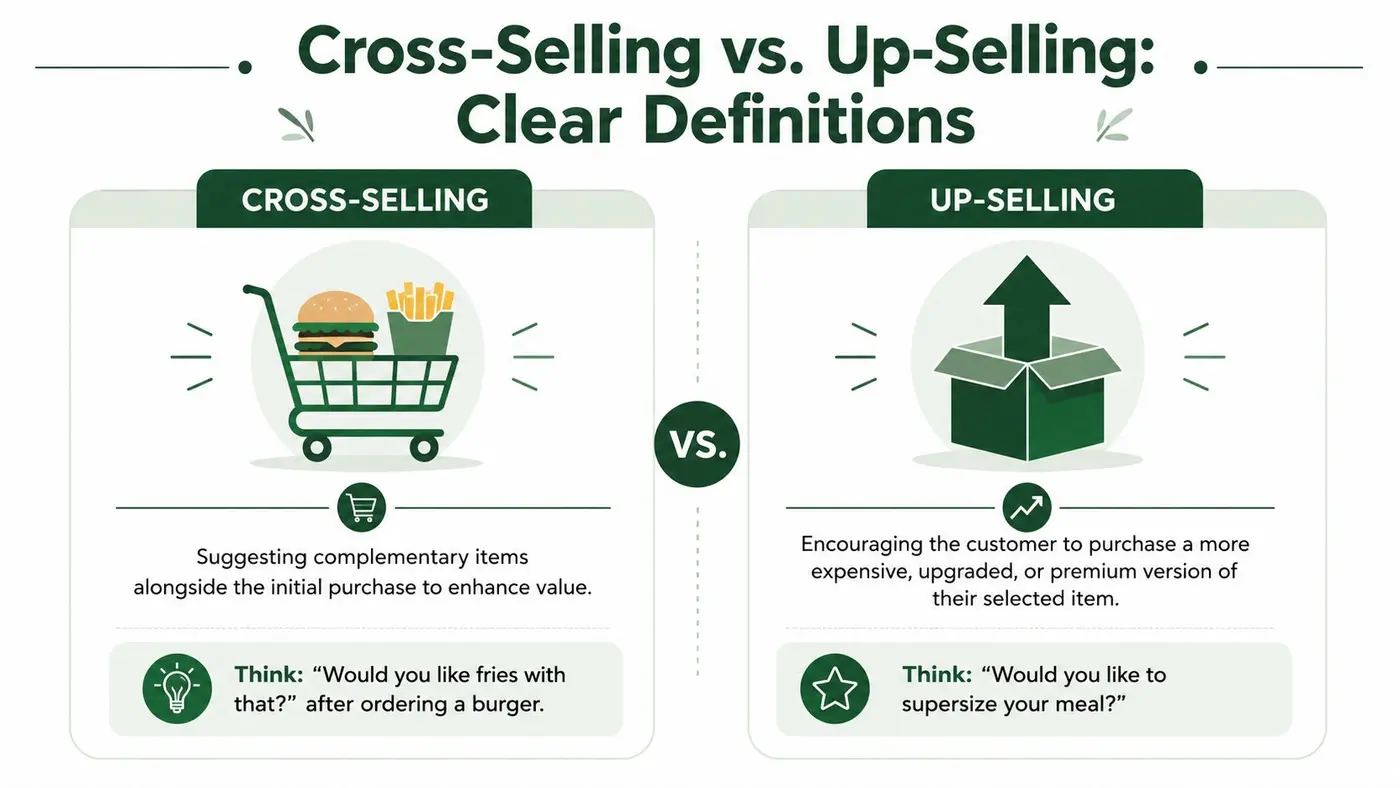
Cross-selling adds something complementary to the main purchase. If a shopper buys a camera, a memory card or carry case is a cross-sell. The main item stays the same. The basket gets broader.
Upselling upgrades the original choice. If that same shopper is considering an entry-level camera and you persuade them to choose the better model, that's an upsell. The basket doesn't necessarily gain more items. The core item changes to a higher tier.
The simplest way to remember the difference
A fast-food analogy still works because it maps cleanly to ecommerce behaviour.
- Cross-sell: “Would you like fries with that?”
- Upsell: “Would you like the large meal instead?”
That distinction is structural, not semantic. Cross-selling adds complementary items, while upselling upgrades the original purchase, and that distinction has become much more commercially important as UK online retail's share of sales grew from 18.5% in 2019 to 26.5% in February 2024, as covered in this explanation of the distinction.
Why this matters in digital retail
In stores, a sales assistant can read hesitation and adapt in real time. Online, the interface has to do that work. The page has to decide whether to widen the basket or move the customer to a better option.
That changes how teams should build experiments:
- Cross-sells need complementarity. The added item should make the original purchase more complete.
- Upsells need a clear upgrade path. The premium option should feel like a better fit, not a random price jump.
- Placement changes meaning. The same offer can help on a cart page and hurt on a PDP if intent is weaker there.
If you get that wrong, you don't just lose attachment revenue. You can also lower primary conversion.
A Head to Head Comparison of Core Differences
The fastest way to evaluate cross selling vs up selling is to compare them against the business problem you're trying to solve. They aren't interchangeable. One widens the order. The other shifts the order upwards.
Cross-Selling vs. Upselling At a Glance
| Criterion | Cross-Selling | Upselling |
|---|---|---|
| Primary objective | Increase basket breadth | Increase product tier or order value through upgrade |
| Product relationship | Complementary items | Better version of the same core choice |
| Best customer state | Already committed to the main item | Still evaluating which version best fits needs |
| Common placements | PDP, cart, checkout, post-purchase | PDP, plan comparison, cart |
| Main risk | Distraction and clutter | Price resistance or perceived pushiness |
| Strongest success signal | Relevance of the add-on pair | Acceptance of the upgraded option |
| Typical commercial upside | More items per order | Higher-value core purchase |
| Profitability caution | Add-ons can increase fulfilment complexity | Premium choice may convert fewer shoppers |
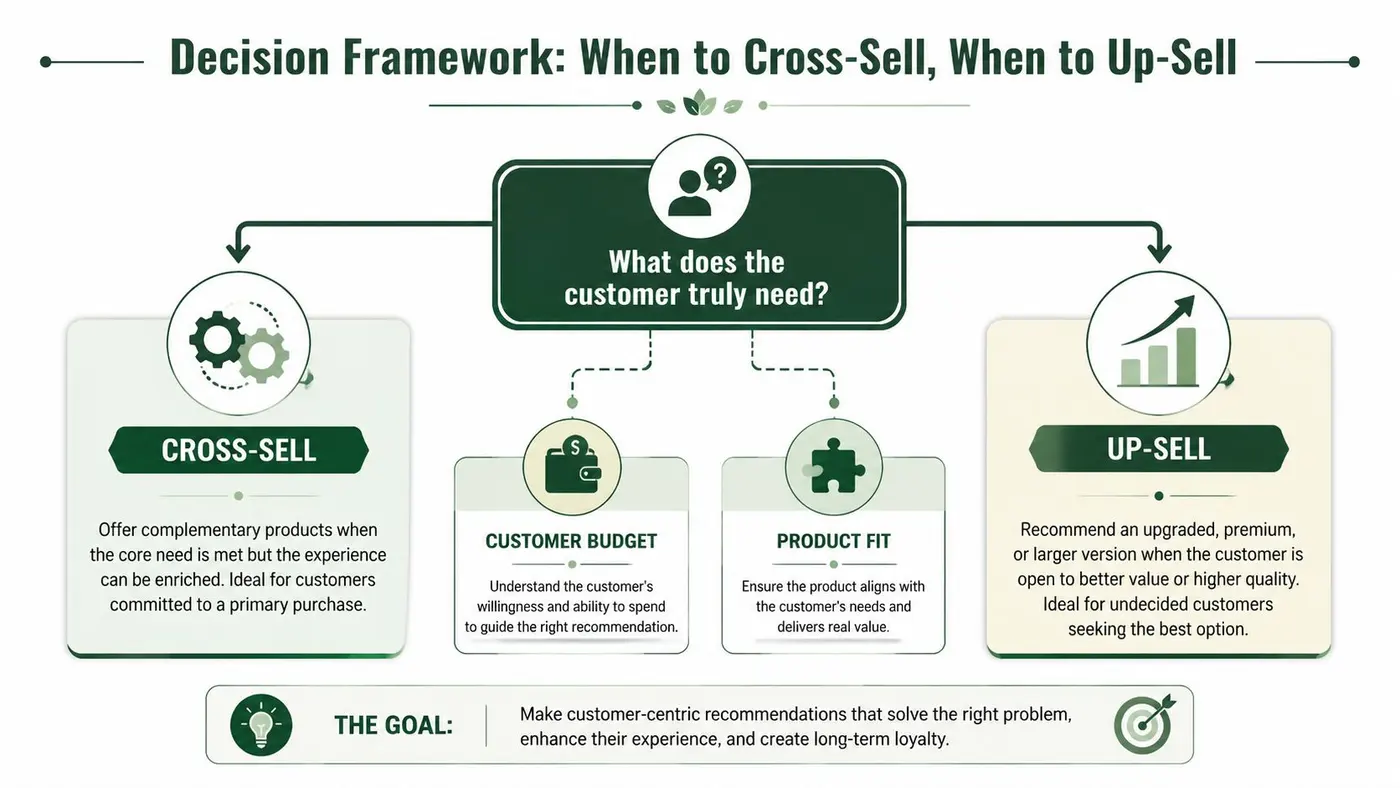
The most important practical difference is motivation. Cross-sells work when the customer's core decision is already settled and you can improve the overall purchase with a useful addition. Upsells work when the customer is still deciding what “good enough” looks like and can be convinced that the higher tier is the smarter choice.
What each tactic is optimising for
Cross-selling usually targets basket size. Upselling usually targets value per item. That sounds simple until you get into margin, discounting, and returns.
A frequently missed issue in UK ecommerce is that higher AOV doesn't automatically mean more profitable growth, especially in categories where return behaviour is a serious drag on realised revenue. That's why the harder question isn't “which tactic raises the basket?” but “which one survives after return risk, delivery cost, and promotions are accounted for?”, a point raised in this discussion of profitability trade-offs.
If your category has heavy returns, treat reported AOV as provisional until you've looked at net revenue and contribution margin.
The customer psychology is different
Cross-sells feel helpful when they remove friction. Think chargers, cases, refills, accessories, care products. The customer reads them as completion aids.
Upsells rely on contrast. The premium version needs a credible reason to exist. Better materials, more storage, stronger warranty, extra features, better value over time. If the difference isn't clear, the offer feels like a pure price push.
When teams want a more detailed external perspective, I often recommend they compare cross-selling and upselling side by side before designing experiments. It helps clarify when a category naturally supports one model better than the other.
A Decision Framework for When to Use Each Tactic
The right choice depends less on preference and more on the shape of your catalogue, your audience, and the moment in the journey.
Use upselling when the product ladder is obvious
Upselling is strongest when shoppers can see a clean hierarchy. Basic, better, premium. Small, medium, large. Standard, pro, enterprise. If the upgrade path is muddy, don't force it.
Good upsell conditions include:
- Clear feature progression so customers understand why the premium option costs more.
- Low cognitive load where differences can be grasped quickly on mobile.
- Meaningful customer benefit such as durability, capacity, speed, or convenience.
Upsells also work well when customer hesitation is about choosing the right version, not whether to buy at all. In those moments, a smart upgrade path can reduce uncertainty.
Use cross-selling when affinity is strong
Cross-sells need evidence of real complementarity. The added item should complete use, reduce future hassle, or improve the outcome of the main purchase.
That usually means:
- Functional add-ons such as parts, accessories, protection, or consumables
- Routine pairings that customers expect to buy together
- Category logic that's easy to grasp without explanation
A useful commercial lens here is customer lifetime value. If you're choosing between immediate basket gain and longer-term account value, it's worth grounding the decision in customer lifetime value thinking, especially for repeat-purchase categories.
The UK constraint most teams underweight
A key challenge is deciding which tactic fits a privacy-constrained, mobile-first UK buying journey. With third-party cookies being phased out, stricter consent expectations, and mobile dominating online activity, the design question is often whether the recommendation can work with limited tracking and limited screen space, as discussed in this overview of cross-sell and upsell context.
That changes execution:
- Keep mobile modules compact. A carousel with two strong options usually beats a sprawling recommendation grid.
- Don't depend on over-personalisation. Category logic and cart context often outperform elaborate targeting when consent is patchy.
- Protect checkout momentum. If the offer delays completion, move it later in the journey.
The best recommendation is often the one that asks the customer to make one easy decision, not three extra ones.
UX Patterns and Copywriting That Converts
The best-performing patterns don't just display more products. They make the next decision easier.
Cross-sell patterns that help rather than interrupt
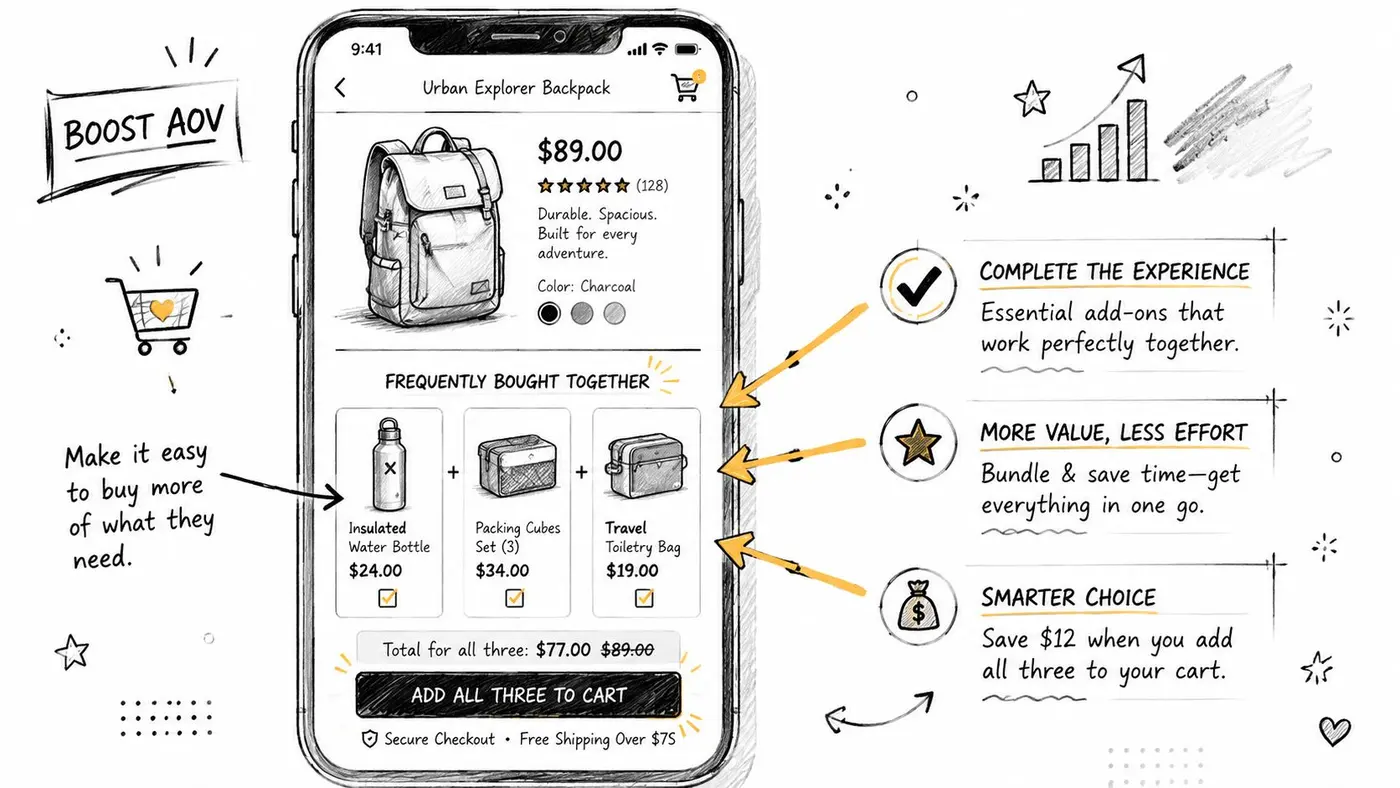
The most reliable cross-sell layouts are tightly connected to the shopper's current task.
- Frequently bought together modules work when the bundle is coherent and the add-ons are low-friction.
- Cart add-ons perform well when they solve a practical omission.
- Post-purchase recommendations are useful when the initial transaction is complete and urgency is gone.
The mistake I see most is overpopulation. Teams add too many products, too many badges, and too many price messages. A cross-sell module should feel curated, not dumped in from a feed.
For PDP teams refining the page around those offers, NanoPIM's PDP optimization tips are a useful reference because they focus on product detail page clarity rather than gimmicks.
Upsell patterns that reduce uncertainty
Upsells convert best when the premium option is easy to compare against the default.
Good patterns include:
| Pattern | Why it works |
|---|---|
| Side-by-side comparison | Makes value differences visible quickly |
| Default-plus-premium selector | Keeps the current choice anchored while showing the upgrade |
| “Best value” plan framing | Helps shoppers interpret the middle or premium option |
| Feature callout near CTA | Connects the upgrade to the purchase moment |
Copy matters just as much as layout. “Upgrade to premium” is weak because it asks for more money without context. “Choose the version with more storage for longer trips” is stronger because it ties the upgrade to use case.
Copy formulas that usually beat generic sales language
For cross-sells:
- Complete the purchase with…
- Pairs well with…
- Don't forget…
- Add for easier setup/use/protection
For upsells:
- Choose [premium option] for [specific benefit]
- Better for [use case]
- Most popular for [type of buyer]
- Get more [capacity/features/convenience]
If you need to strengthen those messages, social proof can support the decision. This guide to social proof messaging is useful when you want recommendation copy to feel credible rather than promotional.
Helpful copy answers “why this?” in plain language. Pushy copy just repeats “buy more”.
How to Test and Measure Your Strategy with Otter A/B
Most recommendation programmes fail in measurement before they fail in design. Teams test a widget, check click-through rate, and assume they've learned something useful. They haven't, not unless the clicks translated into better orders.
Start with one clean test question
A proper experiment isolates one meaningful decision. Examples:
- Should this PDP show a premium upgrade or a complementary add-on?
- Is the cart the right placement for accessories, or does post-purchase work better?
- Does a single recommended item outperform a bundle?
- Does direct savings language beat utility-led copy for the upsell?
Those are good tests because they reflect a real trade-off. You're not just changing colours. You're choosing which revenue mechanism works better for a given context.
Measure recommendation quality, not just interaction
For cross-selling, the strongest signal is product affinity, not generic conversion rate. A recommendation is considered strong when the lift ratio exceeds 3x, and teams should track click-through rate, add-to-cart attribution, and the AOV of orders that include a recommended item. Well-tuned systems can increase AOV by 10–25% on orders that include a recommended product, according to this guidance on cross-sell and upsell analytics.
That's the right mindset for experimentation. Don't ask whether users interacted with the module. Ask whether the module changed order quality.
A practical scorecard usually includes:
-
Primary metric
Revenue per visitor, revenue per session, or net revenue per order. -
Secondary metric
Average order value and attachment behaviour. -
Guardrail metrics
Primary conversion rate, checkout completion, and any operational metric that could reveal hidden damage.
Don't launch a test without a sample size plan
One of the most common mistakes is ending tests too early because a variant “looks ahead”. That's how teams ship noise.
Before you run any serious experiment, calculate expected traffic and duration using a proper sample size approach. If the test can't reach a credible conclusion in a sensible timeframe, simplify it. Narrow the audience, reduce the number of variants, or focus on the highest-volume category first.
A weakly powered test doesn't save time. It wastes it.
For cross selling vs up selling, the highest-value test is often a direct A/B comparison on the same page template within the same category. That controls for intent better than comparing different product types and gives you a cleaner read on which tactic creates more revenue for that context.
Your Implementation Checklist for Driving Revenue
Teams usually don't need more ideas. They need a tighter operating checklist.
The checklist
-
Audit your catalogue first
Identify where products have clean upgrade ladders and where they have obvious companion items. Don't force an upsell into a flat category or a cross-sell into a weak pairing. -
Choose the commercial objective
Decide whether you're trying to grow basket breadth, push higher-tier choices, or protect margin quality. That choice determines the tactic. -
Map placements by intent
Use PDPs for consideration, carts for practical add-ons, and post-purchase for lower-pressure recommendations. -
Design for mobile restraint
Keep modules compact, scannable, and easy to dismiss. If the recommendation overwhelms the page, it's hurting. -
Write copy that explains value
Cross-sells should feel useful. Upsells should make the upgrade logic obvious. -
Measure the right outcome
Track revenue impact, not just clicks. If the category has return risk, review net performance after fulfilment data becomes available. -
Test one strategic question at a time
Compare offer type, placement, number of products shown, and copy framing separately. -
Use platform-specific best practice where needed
If you're implementing recommendation modules in Shopify, this walkthrough on implementing Shopify product recommendations is a practical reference for getting the mechanics right.
The best cross selling vs up selling strategy is rarely universal across a store. Apparel, electronics, beauty, supplements, and SaaS all behave differently. Strong teams accept that early and build a repeatable testing system instead of looking for one permanent winner.
Otter A/B helps teams test ideas like cross-sells, upsells, recommendation placement, and offer copy against real business metrics, not just surface clicks. If you want a lightweight way to run experiments and track revenue impact, Otter A/B is worth a look.
Stop guessing
Ready to start testing?
Set up your first A/B test in under five minutes. No credit card required.
- 14-day free trial
- No credit card required
- Cancel anytime