SDLC and Agile: A Practical Guide for Modern Teams
Understand the relationship between SDLC and Agile. Learn how to integrate iterative workflows, CI/CD, and A/B testing to deliver better products faster.
You're probably dealing with a familiar mess. One side of the team wants tighter process, more sign-off, and fewer production surprises. The other side hears that and assumes slower releases, bloated documentation, and product decisions that arrive too late to matter.
That tension usually gets framed as SDLC versus Agile. In practice, that's the wrong question.
Modern teams don't choose one and abandon the other. They use the Software Development Life Cycle as the operating structure, then use Agile to run that structure in smaller, faster learning loops. That matters even more when product, engineering, and CRO all need to work from the same delivery rhythm. Shipping code isn't enough. Teams also need to validate whether what shipped improved user behaviour, conversion, or revenue.
Why SDLC and Agile Are Not Enemies
Teams often talk about SDLC as if it means rigid waterfall, and Agile as if it means speed with no guardrails. Neither view is useful.
The SDLC is the lifecycle of software delivery. Work still has to move through planning, analysis, design, coding, testing, deployment, and maintenance. Agile doesn't remove those stages. It changes how teams move through them.
The false choice that slows teams down
A lot of delivery pain comes from picking the wrong extreme.
If you over-rotate towards traditional phase gates, you get long requirement cycles, delayed feedback, and testing that happens too late. If you over-rotate towards loose sprint activity with weak governance, you get motion without clarity. Teams stay busy, but releases still stall when integration, assurance, or stakeholder approval catches up.
What works is simpler. Keep the lifecycle. Make the execution iterative.
Practical rule: If your team still plans, designs, builds, tests, deploys, and supports software, you are using an SDLC. The real question is whether you run that lifecycle in one large batch or in repeated small batches.
That distinction matters because Agile performs best when it sits inside a structured delivery system. A 2026 industry survey on Agile SDLC reported that 39% of Agile project users achieved the highest average project performance rate, with an overall project success rate of 75.4% among respondents using Agile project management.
What modern teams actually do
Strong teams rarely say, “We replaced SDLC with Agile.” They say things like:
- Product leaders keep roadmap intent, governance, and prioritisation clear.
- Engineering leaders shorten delivery cycles without dropping quality controls.
- CRO teams turn release ideas into testable hypotheses instead of opinion-driven backlog items.
That blend is the answer to SDLC and Agile. Governance gives teams control. Agile gives them speed and feedback. Together, they reduce the risk of building the wrong thing slowly or the right thing carelessly.
Understanding the SDLC Framework and Agile Principles
The easiest way to understand SDLC and Agile is to separate structure from execution.
The SDLC is the map. Agile is how the team travels.
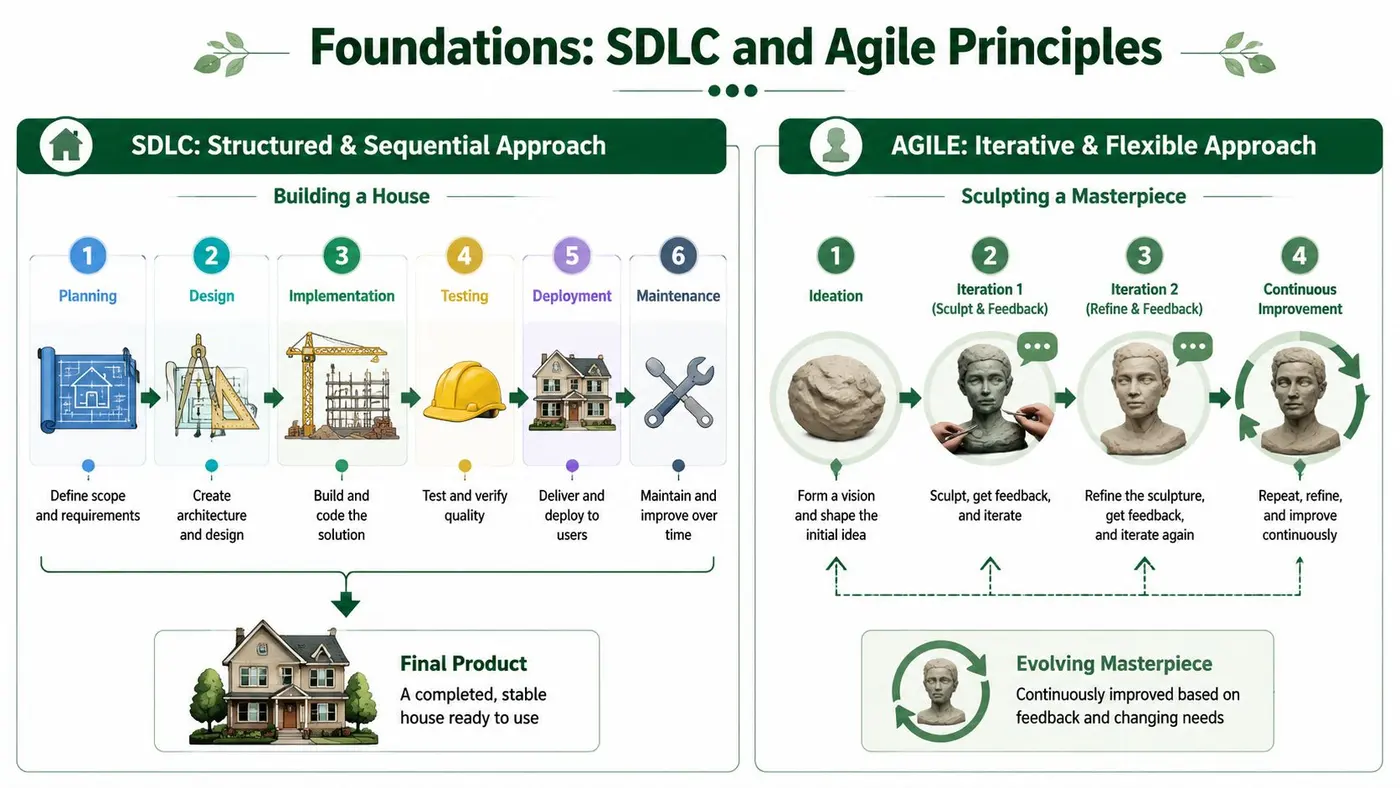
SDLC is the blueprint
Think of the SDLC like building a house. You still need a site plan, architectural decisions, construction work, inspections, handover, and ongoing repairs. Software has the same logic. The names vary slightly by organisation, but the sequence is familiar: planning, analysis, design, coding, testing, deployment, and maintenance.
That structure matters because software delivery has dependencies. Security review, compliance checks, release readiness, rollback planning, and support ownership don't disappear just because a team uses Scrum or Kanban.
Agile is the working method
Agile changes the cadence. Instead of trying to define everything upfront and release in a single large event, teams work in shorter cycles, get feedback early, and adjust before costs rise.
In practice, organisations have increasingly used Agile as a way to run SDLC phases in smaller increments, with feedback and reprioritisation built in. Agile typically uses 2–4 week sprints and continuous stakeholder feedback to reduce long release cycles, as described in AWS guidance on the software development lifecycle.
Agile isn't anti-process. It's anti-delay.
Why this distinction matters in day-to-day work
When teams confuse Agile with the absence of structure, they skip essential work. Design gets rushed. QA gets deferred. Documentation gets reconstructed after the fact. Releases become fragile.
When teams confuse SDLC with heavyweight sequencing, they trap learning at the end. Product doesn't learn until after development is complete. CRO doesn't get room to test alternatives. Engineering discovers integration issues when the release window is already under pressure.
A healthier model looks like this:
- The SDLC defines what must happen
- Agile defines how often and how quickly it happens
- Delivery teams break lifecycle work into smaller releasable units
- Stakeholders review evidence continuously instead of waiting for a final handoff
That's the practical meaning of SDLC and Agile working together. One gives order. The other gives adaptability.
Mapping Agile Practices to SDLC Phases
Once teams stop treating SDLC and Agile as competing models, the mapping becomes straightforward. Every SDLC phase still exists. Agile distributes the work across repeated cycles instead of one long chain.
The practical mapping
Here's a working translation that most product and engineering teams can use.
| Traditional SDLC Phase | Equivalent Agile Practice(s) | Core Purpose |
|---|---|---|
| Planning | Product vision, roadmap framing, backlog creation, sprint planning | Align on goals, scope direction, and delivery priorities |
| Analysis | Discovery work, user research, backlog refinement, acceptance criteria definition | Clarify user needs and define what good looks like |
| Design | UX/UI design, technical design sessions, architecture reviews, story-level design | Decide how the increment should work before coding begins |
| Implementation | Sprint execution, pair programming, code reviews, task boards | Build working software in small increments |
| Testing | Automated tests, exploratory QA, acceptance testing, definition of done checks | Verify quality before and after code is merged |
| Deployment | Release pipelines, staging review, release approvals, production rollout | Move validated changes into live environments safely |
| Maintenance | Monitoring, incident review, bug fixing, backlog updates, optimisation | Improve, support, and extend the product after release |
What changes in an Agile SDLC
The biggest shift is timing.
In a traditional waterfall setup, a team might complete most analysis before design starts, finish most design before coding starts, and leave most testing until the end. In an Agile SDLC, those activities happen continuously at different levels of detail.
For example:
- A product manager may define strategic goals for a quarter, but story-level requirements are refined sprint by sprint.
- A designer may set a broader pattern library once, then design individual flows just before implementation.
- Engineers may run automated and manual checks throughout development rather than waiting for a final QA phase.
What gets better and what can go wrong
This model works well because it lowers rework. Teams validate assumptions earlier, spot delivery risk sooner, and can change course while the cost of change is still manageable.
It fails when teams pretend the mapping exists but don't support it operationally.
Common examples include:
- Backlog refinement with no real analysis. Tickets enter sprints with vague outcomes.
- Design as a one-off handoff. UX disappears after initial mocks.
- Testing squeezed into the end of a sprint. QA becomes a bottleneck instead of a shared practice.
- Deployment treated as an ops event. Releases depend on heroics, not readiness.
If your sprint contains coding but not meaningful planning, testing, and release preparation, you haven't compressed the SDLC. You've only compressed the schedule.
For product, engineering, and CRO leaders, this mapping is useful because it shows where each function plugs in. Nobody is outside the lifecycle. They're contributing to different parts of it at different points in the same loop.
Practical Integration with CI/CD and QA
The reason modern Agile SDLC can move quickly without becoming reckless is automation. Without it, short iterations create more meetings, more merges, and more release anxiety. With it, short iterations become easier to manage.
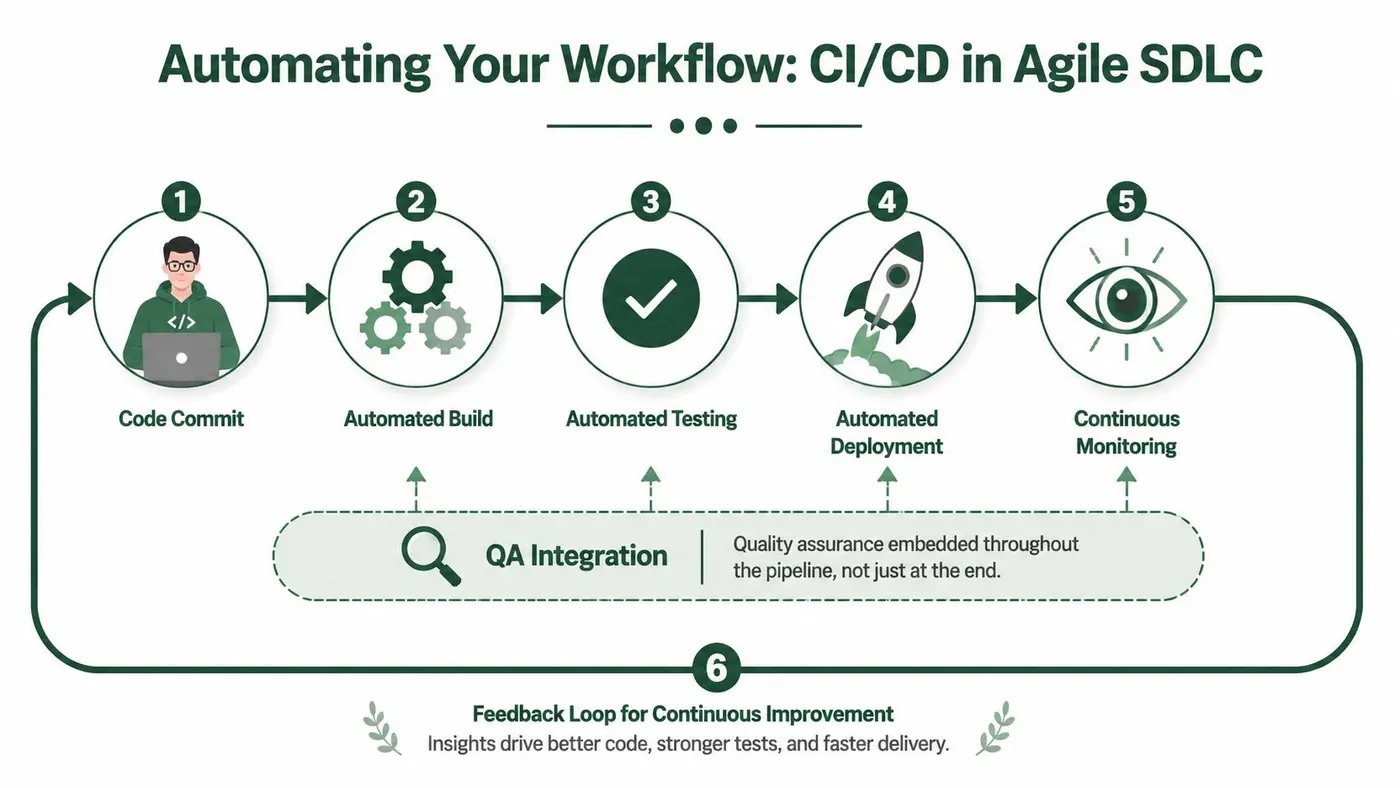
CI/CD is the delivery engine
Continuous integration means code changes are merged and checked regularly. Continuous delivery means those validated changes can move towards production in a controlled, repeatable way.
UK software teams that adopt Agile typically pair short iterations with CI/CD and automated testing to reduce release risk. Embedding these feedback loops enables faster issue detection and smoother releases, as outlined in Splunk's SDLC guidance.
That's not just an engineering convenience. It changes release behaviour across the organisation.
- Product gets faster confirmation that work is shippable.
- Engineering catches defects closer to the change that caused them.
- CRO teams can run experiments sooner because release cycles become less fragile.
QA has to move left
In older delivery models, QA often sits near the end. The team builds for weeks or months, then hands everything to testers. That approach doesn't survive well in Agile delivery.
Quality has to begin earlier and run continuously. That means:
- automated checks at build and merge time
- test cases considered during story definition
- acceptance criteria written clearly enough to verify
- exploratory testing focused on edge cases and behaviour, not just regression chores
A useful primer on release mechanics is this guide to what a deployment is, especially for teams trying to connect delivery language across product and engineering.
After the basics are in place, it helps to see the workflow visually.
What good integration looks like
A practical Agile SDLC pipeline usually includes several habits working together:
- Small batch changes that are easier to review and isolate
- Automated build checks that fail fast when dependencies or syntax break
- Test automation covering core user journeys and critical integrations
- Release discipline including staging review, rollback planning, and monitoring
- Post-release observation so teams catch regressions before users escalate them
The trade-off is real. Building this foundation takes effort. Teams have to invest in test stability, pipeline maintenance, and engineering discipline. But the alternative is worse. Fast sprint cadence without CI/CD usually creates delayed instability, not faster delivery.
Weaving Experimentation into the Agile SDLC
A lot of teams say they're iterative when they really mean they release often. That's not the same as learning quickly.
The stronger model is to treat backlog items as hypotheses, not just features. That's where SDLC and Agile become especially useful for product and CRO teams.
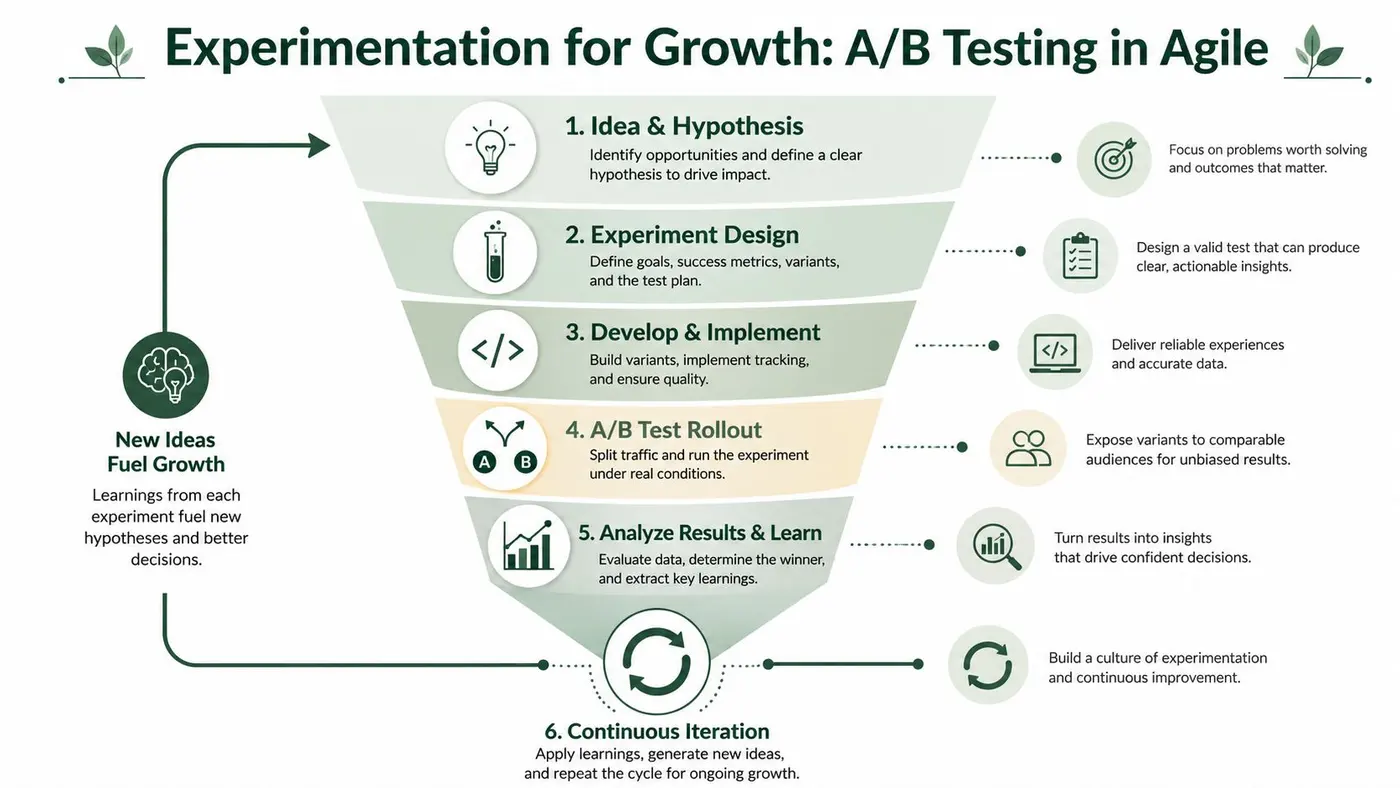
From feature requests to testable hypotheses
A traditional backlog item often sounds like this: “Add a new checkout CTA” or “Redesign the pricing page header.”
A better backlog item sounds like this: “We believe a clearer CTA or a different pricing explanation will increase progression through the funnel.” That phrasing changes the work. Now product has a theory, engineering has a bounded implementation task, and CRO has a measurable outcome to validate.
Experimentation belongs inside the lifecycle:
- planning identifies a business question
- analysis frames the user problem
- design creates variants
- implementation builds the experience
- testing validates technical correctness
- deployment releases the experiment
- maintenance includes learning review and follow-up action
What this changes for sprint work
When teams integrate experimentation into the Agile SDLC, sprint planning gets sharper.
Instead of debating opinions, the team asks:
- What user behaviour are we trying to change?
- What evidence would prove the change worked?
- Do we need a permanent feature, or should we test first?
- What should happen next if the experiment underperforms?
Many teams struggle with the trade-off between short Agile iterations and the need for evidence-based outcomes. The practical answer is to use metrics such as deployment frequency, lead time for change, and user-impact measures tied to conversion and revenue, as discussed in this guide to Agile delivery metrics.
For ecommerce and product teams, this becomes even more concrete when running a Shopify theme split test. The important part isn't the platform. It's the operating model. Build a variant, release it safely, measure the result, and feed that learning straight back into prioritisation.
The fastest team isn't the one shipping the most tickets. It's the one reducing uncertainty the quickest.
What works better than feature-first delivery
Experimentation inside the SDLC works when teams keep the loop tight:
- Start with a clear hypothesis
- Ship the smallest credible change
- Measure business impact, not just release completion
- Decide whether to expand, revise, or stop
What doesn't work is bolting A/B testing onto the end of delivery as a marketing afterthought. If the experiment isn't part of planning, design, QA, and release readiness, it usually arrives too late or with poor instrumentation.
Roles and Responsibilities in a Modern Team
Process problems are often role problems in disguise. Teams say they want better flow, but the actual issue is unclear ownership. Product thinks engineering owns feasibility and outcomes. Engineering thinks product owns clarity. CRO gets invited after launch and is expected to produce insight from whatever shipped.
A modern Agile SDLC needs shared collaboration, but it also needs clear boundaries.
Product owns intent and prioritisation
Product management should own the why and the what matters now.
That includes shaping the roadmap, turning strategy into backlog priorities, defining acceptance criteria with enough clarity, and making trade-offs visible before the sprint begins. Product also has to protect the team from fake urgency. If everything is top priority, teams lose sequencing discipline and quality drops.
In iterative, user-centred delivery environments, clear roles matter even more. The UK public sector's GDS Service Standard requires teams to work in evidence-led phases such as discovery, alpha, beta, and live rather than locking requirements upfront, as summarised in Atlassian's SDLC overview. That model depends on continuous validation of user needs, not one-off specification.
Engineering owns delivery quality and technical execution
Engineering owns the how.
That doesn't just mean coding. It includes architecture decisions, testability, CI/CD reliability, code review standards, observability, and release safety. Mature engineering teams don't just take tickets and implement them. They challenge weak assumptions, surface delivery risk early, and help shape smaller, safer increments.
A useful pattern for leaders trying to create a collective genius team is to design collaboration around decision rights, not just meeting cadence. That keeps autonomy high without making ownership blurry.
CRO owns evidence and learning quality
CRO or growth specialists should own the learning layer.
They help frame hypotheses, identify where user friction is likely, define success measures, and interpret experiment results in a way that informs the next sprint. They shouldn't be treated as a reporting function after release. Their value is upstream. They sharpen what the team chooses to build in the first place.
A healthy team split often looks like this:
- Product decides what problem is worth solving now
- Engineering decides how to build and release it safely
- CRO decides how to validate whether the change improved outcomes
When those responsibilities overlap well, teams stop arguing about process labels and start making better decisions.
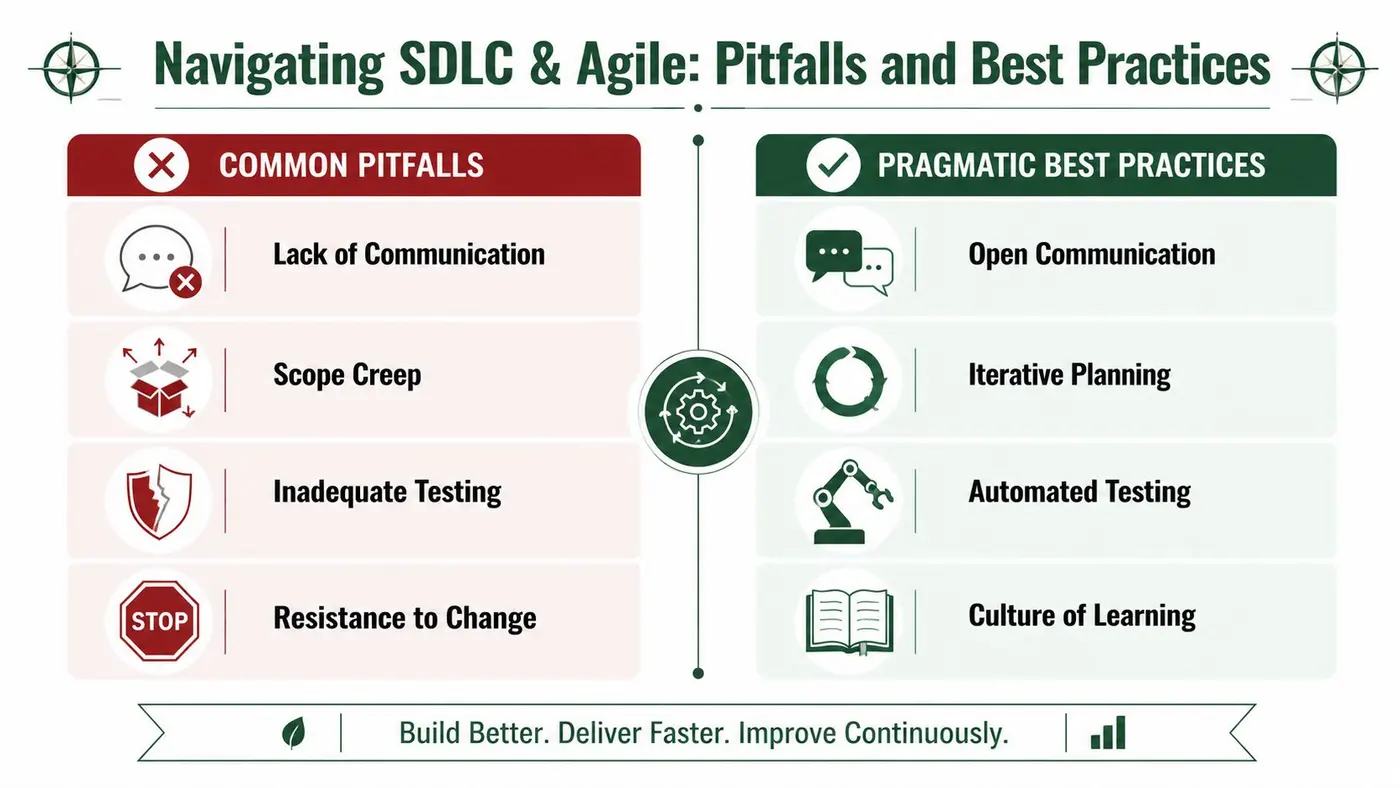
Common Pitfalls and Pragmatic Best Practices
Most failures in SDLC and Agile adoption aren't caused by choosing the wrong framework. They come from shallow implementation.
Teams use Agile language but still behave like waterfall. Or they chase sprint speed so aggressively that quality, learning, and maintainability fall behind.
The patterns that usually break delivery
A few warning signs show up repeatedly:
- Ceremonies without clarity. Teams run planning, stand-ups, and retrospectives, but stories still enter development half-defined.
- Speed over readiness. Features are declared done before instrumentation, QA, or rollout safeguards are ready.
- Experimentation without discipline. Variants go live, but nobody agrees on the hypothesis, success criteria, or follow-up decision rule.
- Testing as a final checkpoint. Teams still treat QA like a late-stage gate instead of a delivery habit.
- Operational debt ignored. Build pipelines, flaky tests, and release friction pile up until every sprint slows down.
A strong safeguard is to include lightweight release confidence checks such as smoke testing before broader rollout. It won't solve structural delivery problems by itself, but it catches obvious breakage before users do.
The practices worth keeping
If you want SDLC and Agile to work together, these habits pay off:
- Keep the backlog decision-ready. Don't pull vague work into a sprint and hope discussion will save it.
- Protect engineering time for non-feature work. CI/CD upkeep, test reliability, and refactoring are delivery capacity, not overhead.
- Define learning goals alongside delivery goals. Every significant change should answer a question, not just add output.
- Make release quality visible. Done should include test status, deployment readiness, and monitoring expectations.
- Close the loop after launch. Review what changed in user behaviour, not only whether the ticket shipped.
Good Agile doesn't remove discipline. It moves discipline closer to the work.
The teams that get this right don't obsess over methodology branding. They build a structured lifecycle, run it iteratively, and tie delivery to evidence.
If your team wants to connect release speed with measurable conversion impact, Otter A/B gives product, engineering, and CRO teams a lightweight way to run experiments directly inside the delivery loop. It's built for fast implementation, clear reporting, and data-driven decisions without adding heavy process.
Stop guessing
Ready to start testing?
Set up your first A/B test in under five minutes. No credit card required.
- 14-day free trial
- No credit card required
- Cancel anytime