Customer Lifetime Value a Guide to Sustainable Growth
Understand customer lifetime value (CLV) with our guide. Learn to calculate, measure, and increase CLV to drive sustainable business growth and retention.
You launch an A/B test on a landing page. Sign-ups go up. The dashboard looks healthy. The team celebrates because conversion rate moved in the right direction.
Then the next few weeks tell a different story.
Those new sign-ups don't activate properly. They buy once and disappear. Support gets noisier. Paid acquisition looks efficient on the surface, but the customers coming through that “winning” variant don't behave like the customers you want more of.
That's the point where customer lifetime value stops being a boardroom metric and starts becoming a practical growth metric.
The front of the funnel is already tracked with obsessive precision. Click-through rate, cost per click, form completion rate, checkout conversion. Those numbers matter, but they can still lead you into bad decisions if you treat the first conversion as the finish line. A variant that produces more first purchases can still damage the business if it attracts low-fit customers, trains buyers to wait for discounts, or pushes the wrong offer too early.
For growth teams, the ultimate question isn't “did this page convert?” It's “did this change create better customers?”
Beyond the First Conversion
A test ships on Friday because checkout conversion is up 12%. By Tuesday, the picture changes. Average order value is softer, support tickets are climbing, and the cohort from the winning variant is already showing weaker repeat behaviour.
That is a familiar CRO failure mode. The experiment improved the local metric and hurt the business.
The pattern usually starts with a reasonable change. A stronger discount, a more aggressive CTA, a simplified sign-up flow, less friction before the first purchase. Each of those can lift conversion. Each can also change the kind of customer you bring in, the expectations you set, and the margin you keep after the sale.
When a win isn't really a win
Teams see this in different ways depending on the model:
- Lead generation sites get more form fills, but pipeline quality drops once sales starts qualifying leads.
- Ecommerce brands lift first-order conversion, but the new cohort buys on promotion and rarely returns at full price.
- Subscription products increase trial starts, but trial-to-paid conversion and retention weaken.
- Apps and SaaS teams remove onboarding steps, but more low-intent users enter the product and never reach activation.
The common mistake is treating the first conversion as proof of value creation.
A better rule is simple. If a test can change who converts, not just how many people convert, the success metric needs a value layer. That is the practical job of customer lifetime value. It gives growth teams a way to judge whether a change improved customer quality, not just conversion rate.
This matters most in testing programs that run fast. A team using a platform like Otter A/B can launch experiments across landing pages, pricing, onboarding, and offer presentation in quick cycles. That speed is useful only if the scorecard is tied to business outcomes. Otherwise, the team gets better at producing wins that finance and retention teams would never choose.
What sustainable growth teams do differently
Teams that use CLV well bring it into weekly decisions, not quarterly reporting. They use it to decide:
- Which acquisition channels deserve more budget
- Which offers attract customers who return
- Which onboarding paths create second and third purchases
- Which pricing or promo tests raise revenue now but lower value later
- Which apparent winners should be rejected
That changes how experiments are designed. Instead of asking only whether Variant B lifts conversion, the team asks a harder question: does Variant B produce a cohort worth more after 30, 60, or 90 days?
For retail and omnichannel businesses, that distinction matters because the customer relationship rarely ends at the first digital touchpoint. People browse on mobile, buy in store, reorder by email, and come back through paid search weeks later. If measurement stops at the first online conversion, the testing program will overvalue easy wins and undervalue the experiences that create repeat demand.
CLV turns that into something testable. It connects front-end changes to downstream outcomes like repeat purchase rate, retention, contribution margin, and payback period. That is how growth teams move beyond vanity wins and start choosing experiments that improve the business, not just the dashboard.
What Exactly Is Customer Lifetime Value
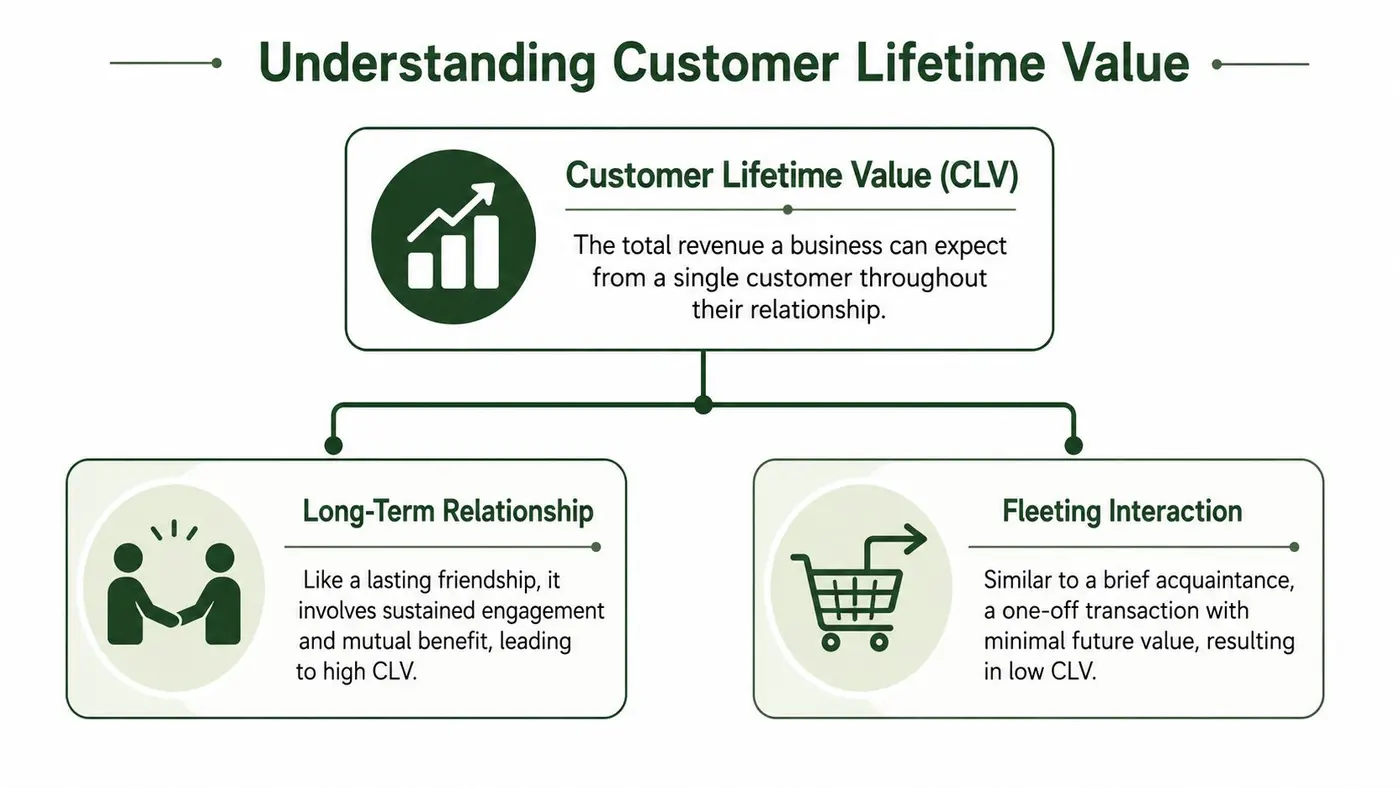
Customer lifetime value is the total revenue or profit you expect from a customer across the whole relationship, not just the first order.
The simplest way to think about it is this. A single purchase is like a brief conversation. It tells you someone showed up once. A long customer relationship is more like a strong professional partnership. The value comes from repeated trust, repeated transactions, and a longer period of engagement.
The three parts that make CLV useful
You don't need a complex model to understand the core mechanics. At a working level, customer lifetime value rests on three inputs.
Average purchase value
This is the typical amount a customer spends when they buy.
AOV matters because some experiments increase conversion by lowering order quality. A discount banner, a weak bundle, or a badly placed promo code can push more people through checkout while reducing the value of each transaction.
Purchase frequency
This is how often the customer comes back and buys again.
For many businesses, especially stores with repeat demand, this matters more than the first order. A customer who buys modestly but keeps returning can be more valuable than a one-off big spender.
Customer lifespan
This is how long the relationship lasts.
It's the part teams often underweight because it's slower to observe. But lifespan is where retention, support, product quality, fulfilment, and brand experience all show up in one number.
Why the concept became so important
Customer lifetime value became more useful when businesses could finally measure customer behaviour at the individual level across digital channels. Industry guidance now formalises CLV as total revenue or profit across the full relationship, commonly calculated as average transaction value multiplied by purchase frequency and customer lifespan. That shift from single-sale thinking to lifetime economics is one of the big milestones in how modern marketing matured, and it also matters because CLV varies sharply by sector, so a financial services or B2B company may target a very different level from an ecommerce brand, as outlined in NetSuite's guide to customer lifetime value.
A business that understands only the first transaction understands only the start of the customer relationship.
What CLV is not
CLV is not a vanity metric. It is not just “total historic spend” pasted into a dashboard. It is not helpful if nobody uses it to make trade-offs.
Used properly, it answers practical questions:
- Can we afford to pay more for this acquisition channel?
- Should we push this discount harder, or is it attracting low-value customers?
- Does this onboarding change improve long-term behaviour, or just short-term completion?
- Which first product creates the best future customer?
That's why good CLV work isn't just finance analysis. It sits right in the middle of CRO, retention, and product decisions.
How to Calculate Customer Lifetime Value
A team launches an A/B test that lifts conversion rate by 12%. The dashboard looks great. Six weeks later, finance is asking why repeat rate is down and margin is worse.
That is the gap CLV closes.
For growth teams, CLV is not just a board-level KPI. It is the number that tells you whether a test, channel, or onboarding change creates better customers or just more first orders. If you want CLV to shape bidding, merchandising, and experiments, you need a calculation method that is simple enough to use and strict enough to trust.
Historical CLV
Historical CLV measures value from behaviour that has already happened. It is the faster way to get a working baseline, and for many teams it is the right place to start.
The common formula is:
Customer lifetime value = average purchase value × purchase frequency × customer lifespan
For an ecommerce business, that usually means:
- Average purchase value = total revenue ÷ total orders
- Purchase frequency = total orders ÷ total customers in a defined period
- Customer lifespan = average active duration before churn or inactivity
Multiply those inputs and you have a top-line historical CLV.
Use that number carefully.
A revenue-only CLV is useful for comparing cohorts, acquisition channels, and first-product paths. It is less useful for deciding how much you can spend to acquire the next customer. If one cohort buys high-return items, relies on discount codes, or creates more support cost, revenue will flatter the result.
Example
Say you sell refill-based household products. Customers acquired through paid social buy a discounted starter pack and many never come back. Customers who start with a full-price bundle from organic search reorder every two months. Historical CLV will show that difference quickly, which makes it useful for channel reviews and post-purchase experiment analysis.
It also has a clear limitation. It looks backward. If your pricing, product mix, or acquisition strategy changed this quarter, older cohorts can distort the picture.
Predictive CLV
Predictive CLV estimates future value based on early signals and cohort patterns. This is the version growth teams need when they are making live decisions instead of monthly reports.
Inputs often include recency, second-order speed, first product purchased, discount use, subscription take-up, support burden, and acquisition source. The model can get technical, but the business question stays simple: based on customers like this one, what future cash flow is realistic?
That matters for experimentation. A checkout test might reduce immediate AOV but increase second purchase rate. A welcome-flow change might lower first-week revenue and still produce a better customer by day 90. If your team treats CLV as a north star metric for growth experiments, predictive CLV becomes a direct input for test evaluation rather than a lagging finance report.
Analysts often build these forecasts from cohort behaviour over time, not static account averages. Teams that want a better grasp of trend shifts, seasonality, and repeat-purchase patterns can review time series forecasting techniques.
Historical and predictive are different tools
| Aspect | Historical CLV | Predictive CLV |
|---|---|---|
| Basis | Past observed customer behaviour | Forecast of likely future behaviour |
| Best use | Reporting, channel review, cohort comparison | Budgeting, bidding, prioritisation, experiment readouts |
| Strength | Easy to calculate and explain | Better for forward-looking decisions |
| Weakness | Slow to reflect change | Sensitive to model and data quality |
| Good fit | Stable businesses with enough history | Teams making active acquisition, pricing, and retention bets |
The practical answer is usually to use both. Historical CLV validates what has already happened. Predictive CLV helps you decide what to do next.
The part teams often miss
Many CLV models stop at revenue. That is fine for a rough benchmark. It is not enough for budgeting or test decisions.
A useful CLV model should state:
- whether the number is revenue or gross profit
- whether VAT is included or excluded
- how you handle returns, fulfilment, service, and payment costs
- whether future value is treated in nominal or discounted terms
- whether newer cohorts are separated from older ones with very different buying conditions
Those choices change decisions. A cohort with higher AOV can still be worse for the business if it comes with heavier discounting, more returns, or weak repeat behaviour.
What to include before you trust the number
Pressure-test the inputs before CLV goes into acquisition targets or A/B test scorecards:
- Margin reality. Revenue does not equal value if variable costs are high.
- Discount dependency. Promo-led customers can inflate conversion while weakening payback.
- Cohort recency. Last quarter's customers may not behave like last year's.
- Churn definition. Be clear about when a customer is considered inactive.
- Time horizon. Use a window that fits your buying cycle, not an arbitrary 12 months.
The best CLV model is not the fanciest one. It is the one your growth lead, finance lead, and product team will all use to make the same decision.
That is the standard to aim for if you want to connect experiments in tools like Otter A/B to real business impact.
Why CLV Is Your Businesss True North Star
A paid social campaign beats its CPA target. Conversion rate is up. The dashboard looks strong by Friday. Then 90 days pass and those new customers have low repeat purchase rates, heavy promo use, and high support costs. Growth did happen. Value did not.
That gap is why CLV deserves more weight than acquisition metrics on their own. It shows whether new demand turns into durable profit, not just more first orders.
CLV changes how you read CAC
CAC without CLV creates bad confidence. Teams end up rewarding channels that buy cheap conversions instead of customers who stay, buy again, and contribute margin over time.
The reverse happens too. A channel can look overpriced on first purchase economics and still be the right call if it brings in customers with stronger retention, higher expansion potential, or lower service burden. That is the practical use of a CLV:CAC ratio. It gives marketing, finance, and product a shared way to judge whether acquisition spend is creating a business asset or just renting short-term revenue.
Benchmarks can help, but they are not the point. The point is decision quality. If one audience segment converts 20% worse and delivers meaningfully higher 6-month value, a growth team should often accept the weaker front-end rate and invest there anyway.
Retention improves the quality of growth
CLV pulls attention to the part of the funnel where economics usually improve fastest. After the first purchase, small fixes can change payback in ways top-line reporting misses.
The wins are rarely glamorous:
- fixing onboarding friction
- tightening the first-to-second purchase path
- improving replenishment or reorder timing
- reducing avoidable support contacts
- increasing product adoption in the first 30 days
Those changes matter because they raise the value of customers you already paid to acquire. For teams working on repeat purchase programmes, ecommerce marketing automation systems can help operationalise that work across post-purchase messaging, reminders, and retention flows.
What CLV does inside the business
CLV is a strong operating metric because it forces trade-offs into the open.
Marketing can no longer call a campaign efficient if it fills the CRM with low-quality buyers. Product teams can see whether adoption work improves long-term account value, not just activation. Finance gets a clearer view of payback and budget tolerance. CRO teams get a better standard for judging tests.
That last point matters. If an A/B test lifts conversion by pushing a deeper discount, extending a free trial to the wrong users, or attracting buyers who never come back, the test did not create much value. It shifted revenue timing. Teams using experiment platforms need a scorecard that can separate those outcomes.
A north star metric that drives better growth decisions should help teams rank wins, not just report them. CLV does that well because it connects campaign quality, product experience, retention, and margin in one number.
Conversion rate tells you how efficiently you create customers. CLV tells you whether those customers were worth creating in the first place.
That is why CLV is the true north star. It does not replace conversion metrics. It puts them in order and makes them testable against business impact.
Actionable Strategies to Increase Your CLV
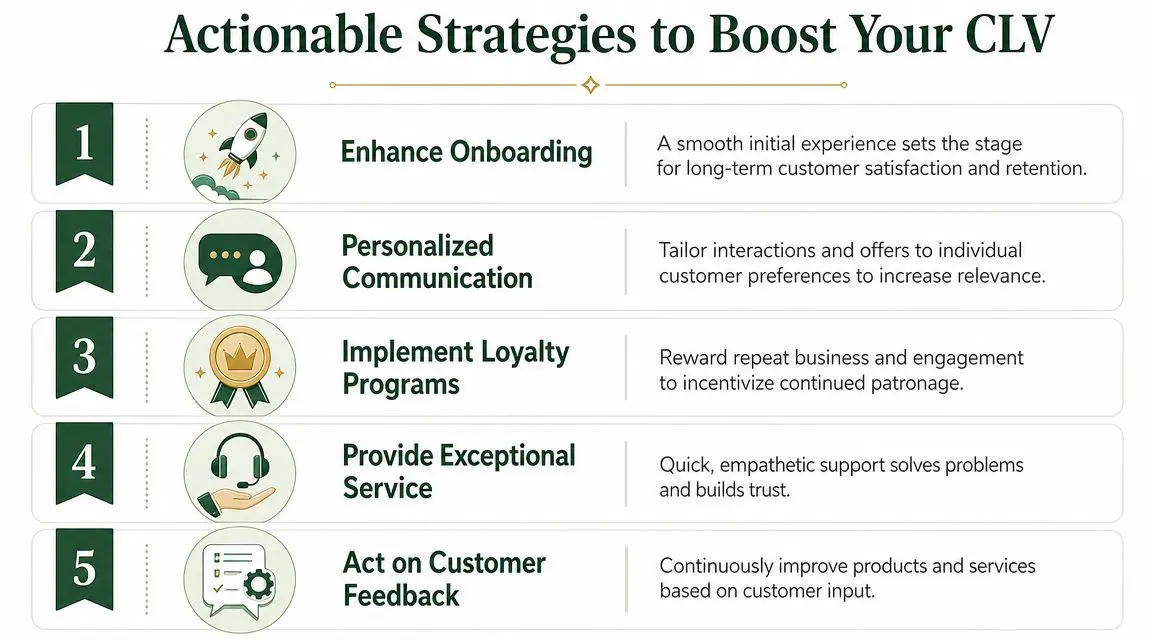
The fastest way to improve customer lifetime value is to stop treating it as one metric. It's a bundle of levers. Raise order value, increase purchase frequency, or extend customer lifespan, and CLV improves.
That means tactics should map back to the component they change.
Start with the first post-purchase experience
A lot of businesses spend heavily to get the first order, then go quiet at the point where the relationship should deepen.
That's a mistake. The first post-purchase period shapes repeat behaviour more than most campaign teams admit. If shipping updates are confusing, setup is clumsy, or value isn't realised quickly, lifespan weakens before your retention programme even starts.
Focus on:
- Onboarding clarity. Show the customer how to get value fast.
- Expectation setting. Delivery, returns, renewal terms, and support paths should be obvious.
- Second-purchase prompts. Don't wait for the customer to remember you.
For teams building repeat purchase flows, this practical guide to ecommerce marketing automation systems is useful because it shows how automation can support retention rather than just pushing more broadcasts.
Increase frequency without training discount dependence
There's a bad way to raise repeat purchase rate. It's to rely on constant discounts. That often teaches customers to delay buying until the next offer appears.
A stronger approach is relevance.
Better lifecycle messaging
Use email, SMS, and on-site prompts based on replenishment timing, product usage rhythm, or lifecycle stage. A customer who has likely run out of a consumable needs a different message from someone who bought once out of curiosity.
Smarter cross-sell paths
Cross-sells work when they solve the next obvious problem. They fail when they feel like merchandising clutter. The first product should guide the next recommendation.
Service that removes friction
Support isn't separate from CLV. Slow replies, awkward returns, and inconsistent help all shorten lifespan. Great service often looks unglamorous, but it protects future revenue.
A deeper look at customer retention management is useful here because retention doesn't happen through campaigns alone. It also depends on process, support, and operational follow-through.
Customers rarely describe their reason for leaving as “low lifetime value”. They describe missed expectations, poor fit, bad support, or a weak product experience.
Here's a useful explainer on retention-focused growth:
Raise order value carefully
Not every AOV increase is healthy. Some offers lift basket size while making future purchasing less likely.
The better moves tend to look like this:
- Bundling with logic. Pair items that belong together, not random accessories.
- Threshold incentives. Encourage a larger basket without destroying margin.
- Tiered loyalty structures. Reward continued engagement, not just one big purchase.
- Premium positioning. Help customers choose the right option for their use case instead of defaulting them to the cheapest product.
Use feedback as a retention input
Customer feedback is often trapped in support tools and survey dashboards. Growth teams should use it more aggressively.
Look for recurring signals tied to future value:
- Feature confusion can hurt activation and repeat usage.
- Fulfilment complaints can damage second-order intent.
- Mismatch between promise and reality usually leads to churn.
- Frequent pre-sale objections can reveal poor targeting or weak messaging.
If the same complaint keeps appearing, that isn't just a service issue. It's a CLV problem.
CLV Measurement and Tracking Best Practices
A single CLV number for the whole business isn't enough. It hides too much.
The useful version is segmented, time-based, and tied to decisions you can change.
Cohorts tell you what averages hide
The most practical way to track customer lifetime value is through cohort analysis. Group customers by a shared starting point, then watch how their value develops over time.
You can build cohorts by:
- Acquisition month
- Channel
- First product purchased
- Landing page or offer
- Discount exposure
- Region or customer type
This makes it easier to answer questions that matter in practice. Did customers acquired during a sale behave differently from customers acquired through organic search? Did a new onboarding flow create better repeat buyers? Did customers who started with one product line become stronger long-term customers than those who started with another?
Segment by controllable factors
You don't need perfect modelling to make CLV useful. You need segmentation that leads to action.
A good operating view often includes:
| Segment | What to look for |
|---|---|
| Channel | Which source brings higher-value customers over time |
| First purchase | Which opening product creates stronger repeat behaviour |
| Offer type | Whether discounts pull forward weak demand or attract strong-fit buyers |
| Device or experience | Whether UX changes affect later value, not just first conversion |
This is also where attribution gets more difficult. UK marketers now have to work in a more consent-led environment, and that affects CLV modelling for newer cohorts. The core issue is no longer only “which channel acquired the customer?” but also “how confident are we that the model still reflects reality when attribution is partial and cookie signals are degraded?”, a challenge discussed in Bazaarvoice's guide to increasing customer lifetime value.
Best practice in messy real-world conditions
Privacy changes don't make CLV impossible. They just make lazy certainty impossible.
That means your tracking approach should include:
- First-party data discipline. CRM, order history, login data, support activity, and email engagement matter more now.
- Model confidence checks. Treat newer cohorts carefully if measurement conditions changed.
- Consistent cohort windows. Compare like with like.
- Decision-grade reporting. Focus on trends strong enough to change spend, UX, or product decisions.
If your team is revisiting how it credits channels and touchpoints, this guide to attribution modelling is a helpful companion because attribution logic directly shapes how you interpret cohort value.
In modern growth work, the challenge isn't collecting every signal. It's knowing which missing signals matter enough to change the decision.
Connecting AB Tests to CLV with Otter AB
Customer lifetime value becomes operational for growth teams.
Most A/B programmes still optimise for the nearest measurable event. Clicks, sign-ups, starts, checkouts. Those metrics are useful, but they can hide trade-offs that matter far more. A variant can lower immediate completion while increasing average order value, purchase quality, or downstream revenue. If you only judge the test on completion rate, you can ship the wrong experience.
That's why experiment design should include business metrics close enough to observe but meaningful enough to reflect long-term value.
For ecommerce and growth teams, that usually means tracking things like:
- Revenue per variant
- Average order value
- Purchase rate
- Revenue trend by test experience
A good example is an upsell or bundle test. One version of the page might produce slightly fewer completed checkouts because it adds more decision friction. But if the customers who do convert buy a better initial mix and enter the relationship with higher value, the trade-off may be worth it. You only see that if the test framework goes beyond raw conversion rate.
That's the practical shift. CLV may still take time to fully mature, but its drivers don't. You can test first-order value, product mix, offer quality, and post-purchase behaviour now. That turns customer lifetime value from a lagging KPI into something your CRO programme can influence deliberately.
If you want to run experiments against revenue, purchases, and average order value instead of stopping at conversion rate, Otter A/B gives growth teams a lightweight way to connect page changes to real business outcomes. It's built for fast website testing without the usual implementation drag, so you can learn which variants create better customers, not just more clicks.
Stop guessing
Ready to start testing?
Set up your first A/B test in under five minutes. No credit card required.
- 14-day free trial
- No credit card required
- Cancel anytime