Marketing on a Website: A Tactical Playbook for 2026
A step-by-step guide to marketing on a website. Learn to define your audience, drive traffic with SEO, optimise conversions, and measure what matters.
You launched the site. The homepage looks polished, the product pages are clean, and the copy finally says what you meant. Then the first full week passes and almost nothing happens. A few visits. A couple of form fills. No real pattern. No clear reason to invest more.
That's the point where most founders realise a website isn't a finished asset. It's a working system. Marketing on a website means building that system so traffic arrives, intent gets captured, and visitors move towards revenue instead of bouncing after a quick look.
The mistake is treating traffic, conversion, and retention as separate jobs. They're connected. If your SEO brings the wrong audience, your conversion rate suffers. If your landing pages are weak, paid spend becomes expensive. If your email follow-up is generic, you keep buying the same customers again and again.
Beyond the Launch a Framework for Website Growth
A website with zero promotion is a brochure. A website with traffic but no conversion path is a leak. A website that converts once but never brings people back is an acquisition treadmill.
The cleaner way to think about marketing on a website is through three operating stages:
- Attract the right visitors
- Convert them into leads or customers
- Retain them so each acquisition becomes more valuable
That sounds obvious, but the focus often remains on the first stage because traffic is easy to see. Sessions go up, impressions rise, social posts get engagement, and everyone feels busy. Revenue usually lags because the middle of the system is weak.
Awareness needs channel fit
In the UK, 98% of internet users aged 16–64 used a search engine in 2024, while 85% used social networks, 78% watched online video, and 74% used email according to these UK digital marketing figures. That matters because people rarely discover a site through one touchpoint. They search, scroll, watch, compare, and only then click through.
So the acquisition question isn't “which channel should we use?” It's “which mix gets qualified people onto the right page?”
For an early-stage business, that often means:
- Search for demand capture: Build pages around what buyers already want.
- Social for distribution: Put your message in front of relevant audiences consistently.
- Video for explanation: Use product demos, walkthroughs, and founder-led content.
- Email for owned follow-up: Turn one visit into an ongoing relationship.
If you want a practical companion to that thinking, this guide on actionable ecommerce growth tips is useful because it keeps the focus on commercial outcomes rather than channel theatre.
Conversion is where marketing becomes measurable
Traffic has value only when pages help visitors act. That means every important page needs a job. A homepage should route. A landing page should persuade. A product page should reduce doubt. A checkout should remove friction.
Practical rule: If a page has no primary conversion goal, it's probably absorbing budget without returning much.
A simple framework for building the overall system is to define one core action for each traffic source, then map the next step after that. Search visitors might go to a category page. Paid social traffic might land on a focused campaign page. Email subscribers might go to a bundle or offer page. That's how strategy becomes execution.
A useful reference point for that planning process is this piece on developing a marketing strategy, especially if you need to turn broad ambition into channel-specific work.
Retention makes acquisition cheaper over time
Founders often ask when retention should start. The answer is immediately. The first purchase, lead, or sign-up should trigger a next interaction. If it doesn't, you're paying to rent attention instead of building an asset.
The strongest website growth systems don't stop at “got the click”. They keep asking what happens after the conversion.
Laying the Foundation Defining Your Audience and Message
Most weak campaigns have the same root problem. The team started producing content, buying traffic, or redesigning pages before they got clear on who the site was for.
Audience definition isn't a branding exercise. It's operational. It affects page structure, copy, offer design, keyword targeting, ad creative, and email sequencing. If you skip it, every channel feels harder than it should.
Build a persona you can actually use
You don't need a giant slide deck full of demographics. You need a working profile that helps you make better decisions on the site.
Use a simple persona template like this:
- Role or situation: Are they a founder, marketer, operations lead, buyer, or end user?
- Primary problem: What are they trying to fix right now?
- Urgency trigger: Why are they looking now instead of later?
- Decision criteria: What do they care about most, such as speed, cost, ease of use, trust, or flexibility?
- Objections: What would stop them from converting?
- Discovery channels: Do they search, ask peers, browse social, read newsletters, or compare vendors directly?
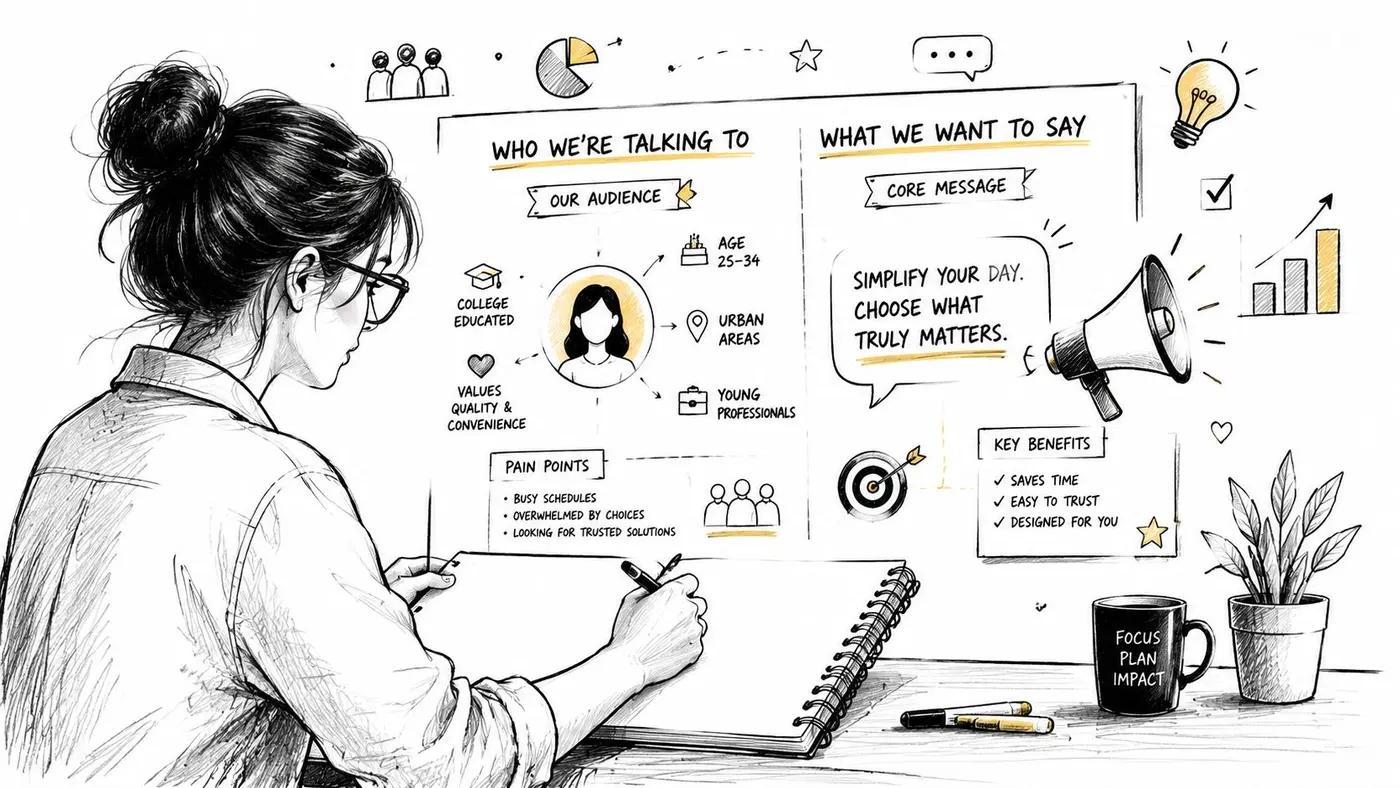
What matters is behavioural clarity. “Small business owner” is too broad to guide copy. “Founder of a new ecommerce brand who needs first-sale traction without hiring a full marketing team” is far more useful. That person has a different set of fears, timelines, and questions.
Turn persona insight into a sharp value proposition
Once you understand the buyer, your unique value proposition should answer three things fast:
| Element | Question it answers | Example format |
|---|---|---|
| Problem | What pain are you solving? | “Stop wasting paid traffic on pages that don't convert” |
| Outcome | What better state do they want? | “Turn more visits into measurable sales” |
| Reason to believe | Why should they trust you? | “Clear testing, cleaner tracking, and faster implementation” |
A good UVP doesn't try to say everything. It says the most important thing to the most relevant buyer. Then the rest of the page supports it.
Here's a practical shortcut. Read your homepage hero and ask whether a new visitor could answer these questions within seconds:
- Who is this for?
- What does it help me do?
- Why is this meaningfully different?
- What should I do next?
If the answer is no, the issue usually isn't design. It's positioning.
The clearer your audience is, the less copy you need. Clarity compresses explanation.
Match message to page intent
Not every page needs the same tone or promise. A homepage should orient. A product page should reduce uncertainty. A pricing page should justify commitment. A blog post should meet search intent first and introduce your solution second.
That's where many first website marketing plans go wrong. Teams write one general brand message and paste it everywhere. Visitors don't convert because the page speaks in company language instead of buyer language.
A better working method is this:
- Homepage: Broad promise and directional CTAs
- Landing pages: One audience, one problem, one action
- Product pages: Features translated into outcomes
- Blog content: Problem-led education tied to the next step
- Email capture forms: Specific reason to subscribe
If the audience is mixed, split the pathways. Don't force one message to carry every buyer segment. The easiest conversion win is often helping the right person identify the right route faster.
Driving Sustainable Traffic with SEO and Content
Paid traffic can create demand quickly, but SEO and content build compounding reach. They also improve the quality of everything else you do because keyword research exposes how buyers describe their problems in their own words.
That matters more than is generally understood. Good SEO isn't stuffing phrases into headings. It's using search intent to decide what pages your site needs, what each page should promise, and how visitors should move through the site after they arrive.
A useful way to visualise the process is this:
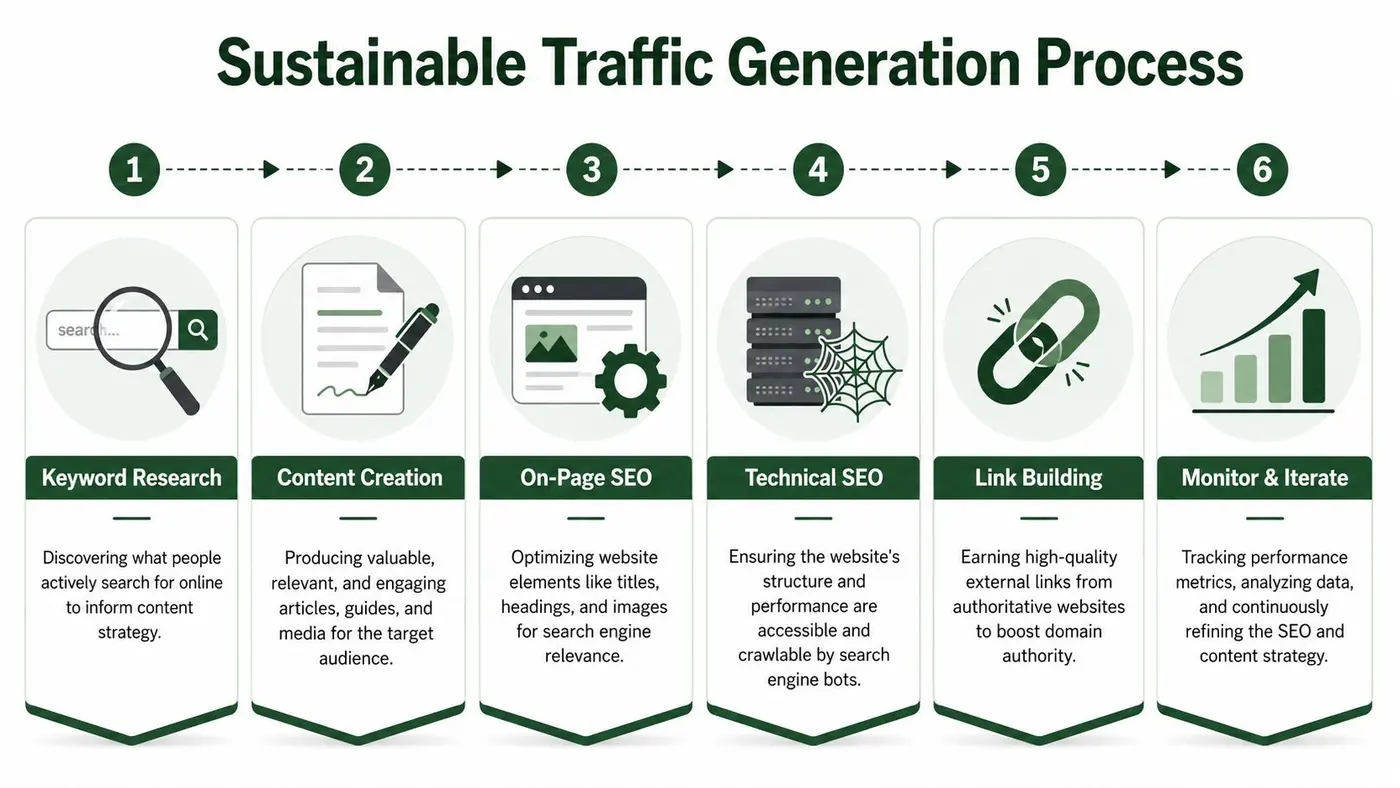
Search demand should shape your content plan
UK businesses already use a layered acquisition approach. The ONS reported that in 2023 22.7% of UK businesses had paid for online advertising in the previous 12 months, up from 19.2% in 2021. The same survey found 29.0% advertised on social media, 9.0% used pay-per-click advertising, and 7.9% used search engine optimisation, as summarised in these UK social media and digital channel statistics. The practical takeaway is that your website won't grow from one channel alone. SEO works best as a durable layer inside a broader stack.
Start with keyword groupings, not isolated ideas. Instead of publishing random posts, organise topics around commercial relevance.
For example, if you sell subscription coffee, the cluster might look like this:
- Core commercial page: Coffee subscription plans
- Comparison page: Whole bean vs ground coffee subscriptions
- Educational article: How to choose a coffee subscription
- Problem-led article: Why supermarket coffee goes stale faster
- Retention content: How to store coffee beans properly
This model helps search engines understand the site's depth; even more, it helps visitors keep moving instead of hitting a dead end.
Topic clusters beat isolated blogging
A lot of startup content programmes fail because they publish disconnected articles with no pathway to conversion. Traffic appears, but it's hard to convert because the page doesn't connect to a buying journey.
Use a simple content hierarchy:
- Pillar page for the main commercial theme
- Supporting articles for related questions and comparisons
- Internal links that pull readers towards product, demo, or sign-up pages
- Refresh cycles to improve pages that already show traction
If budget is tight, don't try to out-publish larger competitors. Focus on relevance, intent, and page quality. This round-up of cost-effective SEO strategies is a useful reference if you need to prioritise organic work without turning it into a full editorial operation.
Here's a short explainer worth watching before you build out the process:
On-page SEO is where intent meets execution
Once you know the topic, the page has to do its job clearly. That means:
- Title and heading alignment: The page should confirm the searcher is in the right place.
- Structured subheadings: Help readers scan and help search engines parse the page.
- Useful internal links: Route visitors to deeper information or a relevant action.
- Commercial bridges: Don't force the sale early, but don't hide the next step either.
Publish fewer pages if you need to. Just make sure each one can rank, persuade, and hand the visitor to a sensible next action.
The best SEO pages don't stop at discovery. They support conversion by matching the query, building trust, and making the next click obvious.
Turning Visitors into Customers with Conversion Optimisation
A lot of founders still treat conversion optimisation as a later-stage tactic. It isn't. If you're paying for traffic, investing in content, or asking sales to send prospects to the site, CRO belongs in the core operating model from day one.
The reason is simple. For UK e-commerce, the benchmark to beat is an average e-commerce conversion rate under 2%, and HubSpot reports that conversion rate optimization is the second-most-used optimization technique among marketers in its marketing statistics round-up. When the baseline is that low, even small wins matter.
That's why marketing on a website shouldn't be framed as “how do we get more visitors?” but “how do we turn more of our existing intent into revenue?”
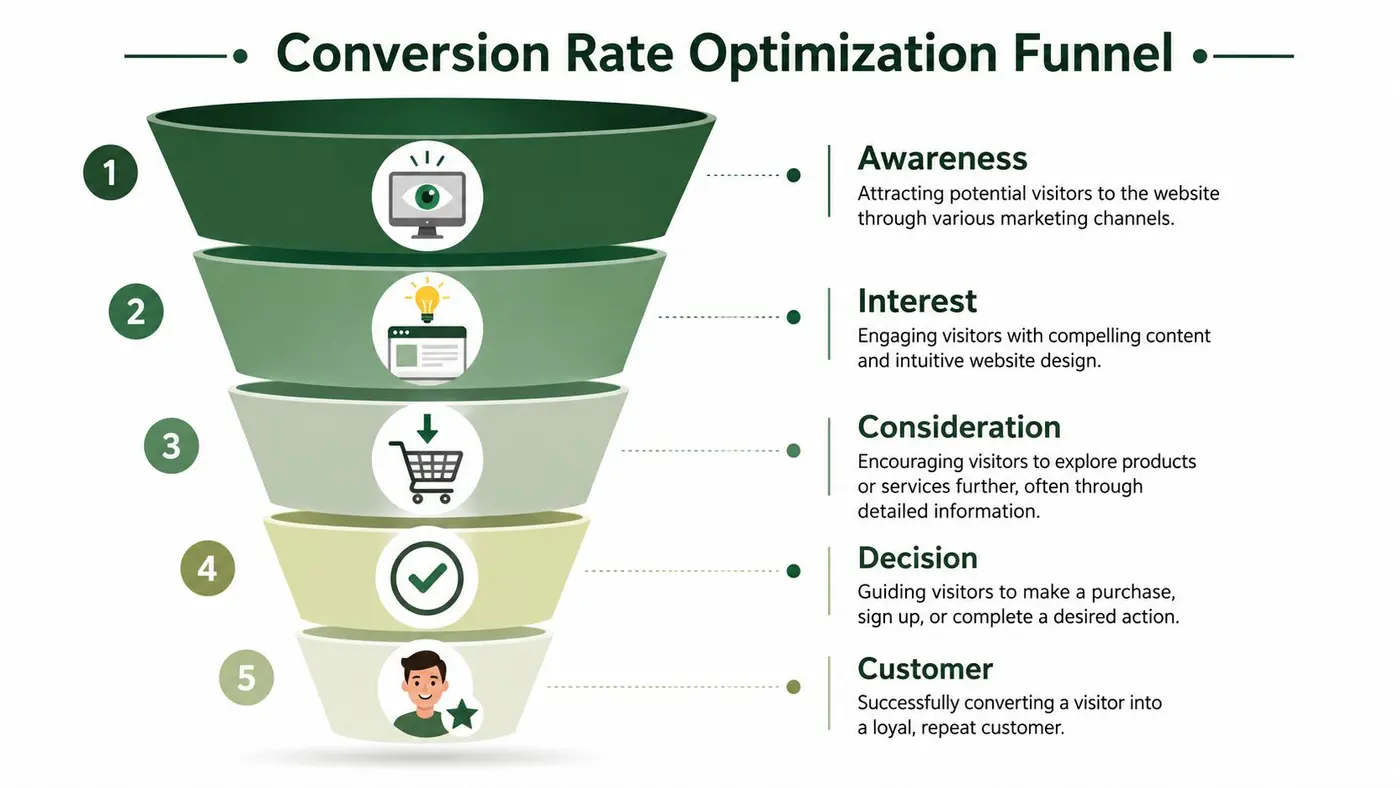
What CRO changes in practice
Without CRO, teams redesign pages based on opinion. Someone prefers a different headline. Someone else wants a shorter form. The founder wants the CTA moved higher. That usually creates motion, not learning.
A conversion programme replaces opinion with a simple discipline:
| Step | What happens | What to watch |
|---|---|---|
| Observe | Review page behaviour, drop-offs, and conversion paths | Look for friction, not guesses |
| Hypothesise | Write one clear reason a change might improve outcomes | Tie it to a specific page and action |
| Test | Create a control and variant | Change one meaningful thing at a time |
| Measure | Judge the result on business impact | Favour revenue and completed conversions |
| Roll out or reject | Keep winners, archive losers | Learning matters even when a test loses |
A practical example is a product page CTA. “Learn more” often underperforms because it asks for low-commitment curiosity rather than a commercial step. A stronger CTA might frame the outcome more clearly. But don't assume. Test it.
Run tests that affect buyer confidence
The highest-value tests usually sit on pages where intent is already present. Start there before you experiment with blog layouts or cosmetic homepage tweaks.
Good early test areas include:
- Hero headlines: Does the opening promise match what buyers care about most?
- Primary CTA copy: Is the action clear, specific, and appropriate to intent?
- Pricing presentation: Do plan names, feature order, or billing explanations create hesitation?
- Product detail pages: Are key objections answered near the point of decision?
- Checkout flow: Are there unnecessary fields, distractions, or trust gaps?
A useful filter: Test anything that changes clarity, motivation, or friction. Ignore tweaks that only change aesthetics.
One option for implementation is Otter A/B's guide to conversion rate optimization, especially if you want a practical explanation of how experimentation fits into website growth. Tools in this category let teams create variants for headlines, CTAs, layouts, and other page elements, then compare outcomes against defined goals.
Judge winners by commercial impact, not applause
Clicks can mislead. So can time on page. A variant might increase engagement while reducing completed purchases because it distracts people from the action that matters.
The discipline is to choose success metrics that reflect the page's real job. On a lead-gen page, that may be qualified form submissions. On an ecommerce page, it may be purchases, average order value, or revenue per visitor. On a trial page, it may be activated sign-ups rather than raw starts.
That's the unique angle many teams miss. A/B testing isn't something you layer on after the marketing plan is built. It should shape the plan itself.
If you know you'll test offers, headlines, layouts, forms, and onboarding steps continuously, your website marketing becomes less about launching “the right page” and more about running a system that gets more accurate over time.
Building Relationships with Email and Retention Marketing
Once someone has visited your site, clicked around, and shown interest, the worst move is making them start from scratch the next time they think about your category. Retention marketing fixes that by creating an owned line of communication.
Email remains one of the most practical channels for this because it doesn't depend on rented reach. You already know from the broader channel mix that email sits alongside search, social, and video in how people encounter brands. The key is using it with intent rather than sending generic campaigns whenever the team remembers.
Start with one good reason to subscribe
Most list-building forms are too vague. “Join our newsletter” is about as persuasive as “stay in touch”. People subscribe when the exchange is concrete.
Offer something tied to the visitor's immediate problem:
- For B2B services: A checklist, template, or buyer guide
- For SaaS: A setup guide, benchmarking worksheet, or use-case series
- For ecommerce: A first-order incentive, product quiz result, or care guide
- For agencies or consultants: A teardown, audit framework, or planning worksheet

Placement matters too. Add the form where interest is strongest. That could be beneath a useful article, inside a comparison page, during checkout, or on an exit-intent prompt. A site-wide popup with no context often generates lower-quality sign-ups.
Use a simple welcome sequence
You don't need a huge automation map to get value. A three-part welcome sequence is enough to start:
- Email one: Deliver the promised resource and restate the main value proposition.
- Email two: Teach something useful that helps the subscriber make progress.
- Email three: Present the next commercial step, such as a product, demo, category, or offer.
Each email should move the relationship forward. Don't cram every feature, testimonial, and product angle into the first message. Earn the next open.
A practical detail that often gets ignored is send timing. It won't rescue a weak message, but it can help with visibility and consistency. This breakdown of optimal newsletter sending times is worth checking when you start building a regular send rhythm.
Email works best when it continues the conversation the visitor was already having on the site.
Retention starts before the second purchase
Retention marketing isn't only for existing customers. It starts as soon as someone gives you permission to follow up. That means your website should actively capture intent and route it into a sequence that educates, reassures, and nudges.
A useful mental shift is this. Instead of asking, “How do we get more traffic next month?” ask, “How do we extract more value from the traffic we already earned?” That's often the cheaper move and the faster one.
Creating Your Marketing Roadmap and Measurement Plan
A website marketing plan becomes useful when it turns into a sequence of decisions. Founders rarely need more tactics. They need the right order.
The first ninety days should focus on building a measurable system, not trying every channel at once. That means setting the foundations, shipping a manageable content and conversion plan, and reviewing results on a fixed cadence.
A practical 90-day rollout
The easiest way to lose momentum is to launch too many moving parts at the same time. Roll channels out in layers.
Days 1 to 30
- Clarify audience and offer: Tighten personas, rewrite your core message, and align key pages to one primary action.
- Set up tracking properly: Check events, forms, purchases, and campaign tagging before scaling anything.
- Audit top pages: Homepage, core landing pages, pricing, product pages, and checkout should all have clear next steps.
Days 31 to 60
- Build search-led content: Publish your first cluster around a commercially relevant topic.
- Improve on-page paths: Add internal links, stronger calls to action, and cleaner page hierarchy.
- Launch your first test: Start with one high-intent page and one meaningful hypothesis.
Days 61 to 90
- Add retention flows: Capture email leads and trigger a welcome sequence.
- Expand acquisition carefully: Layer paid search, paid social, or partner activity once the site can convert.
- Review attribution and learning: Decide what to scale, pause, or retest.
UK website-marketing teams should treat data accuracy and tracking hygiene as a primary control layer, and industry guidance warns that inconsistent monitoring and “set it and forget it” reporting are common pitfalls in this marketing execution guidance. That's why a measurement plan has to exist before growth spend increases.
What to measure and how to organise it
Not every metric deserves equal attention. Track the numbers that map to business outcomes and review them often enough to catch problems before a month disappears.
| Channel / Activity | Primary Metric | Example Tools |
|---|---|---|
| Organic search content | Qualified visits to commercial pages | Google Search Console, GA4 |
| Paid acquisition | Cost per conversion | Google Ads, Meta Ads |
| Landing page optimisation | Conversion rate | GA4, heatmaps, testing tools |
| Product and checkout tests | Purchases or lead completions | Ecommerce platform analytics, GA4 |
| Email capture | Subscriber sign-up rate | Klaviyo, Mailchimp, ConvertKit |
| Retention campaigns | Repeat purchase or return visits | CRM, email platform reporting |
| Attribution review | Assisted conversions by channel | attribution modelling guidance, GA4 |
Keep the operating model simple
The teams that improve fastest usually do a few things consistently:
- They use naming conventions: Campaigns and UTMs stay organised.
- They build alerts: Sudden drops in leads, purchases, or key events get noticed quickly.
- They review on a cadence: Weekly checks for operational issues, monthly reviews for strategic decisions.
- They treat experiments as ongoing work: Not one-off redesign projects.
Clean data beats complicated dashboards. If tracking is wrong, the rest of the plan turns into guesswork.
A good roadmap should make your next action obvious. If the site gets traffic but few conversions, prioritise CRO. If the site converts but traffic is thin, build acquisition. If customers buy once and disappear, fix retention. Keep the system balanced and the decisions get easier.
If you want to make marketing on a website more measurable, Otter A/B gives teams a way to test headlines, CTAs, and layouts against real business outcomes instead of relying on opinion. It's a practical fit for marketers who want experimentation built into the workflow, not left on the backlog.
Stop guessing
Ready to start testing?
Set up your first A/B test in under five minutes. No credit card required.
- 14-day free trial
- No credit card required
- Cancel anytime