Customer Retention Management Meaning Explained for 2026
Understand the true customer retention management meaning. This guide explains the strategies, metrics, and tactics that reduce churn and grow revenue.
Customer retention management means systematically turning one-time buyers into repeat customers and maximising their lifetime value. It matters because the probability of selling to an existing customer is 60% to 70%, compared with 5% to 20% for a new customer, and returning customers spend 67% more than first-time customers.
That's why customer retention management isn't just “keep customers happy” in some vague, brand-friendly sense. It's a measurable operating system for growth. You track who stays, who leaves, who buys again, who complains, who renews, and who drifts away. Then you build interventions around those signals before revenue leaks out.
Many organizations mishandle this in one of two ways. They either treat retention as a marketing campaign, usually a loyalty email and a discount, or they treat it as a customer service issue and hope support can clean up the damage. In practice, retention only works when product, marketing, support, and commercial teams share the same view of customer value and the same rules for action.
What Is Customer Retention Management
Analysts often frame retention as one of the fastest ways to improve profit. The operational question is simpler. Do you have a system that shows which customers are likely to stay, which are drifting, and what your team will do about it?
Customer retention management is that system. It is the operating model a business uses to keep revenue in the customer base by increasing repeat purchases, renewals, ongoing usage, and expansion over time. The work is structured, measured, and assigned to owners. It turns retention from a vague goal into a repeatable process.
A useful definition starts with scope. Retention management covers four jobs at once:
- define what “retained” means for your business model and time period
- measure customer behavior against that definition
- identify the signals that predict churn, downgrade, or inactivity
- trigger the right intervention before the revenue is lost
That distinction matters in practice. Loyalty is a result. Retention management is the mechanism behind it. A customer can like your brand and still fail to renew because onboarding stalled, usage dropped, or procurement got involved late. A retention programme has to catch those moments early enough to change the outcome.
This is why the word management matters. Management means ownership, reporting cadence, decision rules, and trade-offs. If repeat purchase rate drops in e-commerce, the team needs to know whether the problem sits in product quality, delivery experience, pricing, or reorder timing. If renewals slip in SaaS, someone needs a clear rule for when low usage becomes an account risk and what action follows.
The strongest retention teams do not run isolated “save” campaigns. They build a loop. Measure behavior, flag risk, act on the signal, then check whether the action improved retention or just delayed churn. Without that loop, businesses usually collect customer data but fail to turn it into revenue protection.
Practical rule: If a team cannot define retention, assign an owner, and name the trigger for action, it does not have retention management. It has scattered customer initiatives.
That is the core meaning of customer retention management. It is not a loyalty scheme, a support function, or a quarterly email programme. It is a measurable operating system for protecting and growing customer value over time.
The True Meaning of a Retention-First Mindset
A retention-first business behaves less like a hunter chasing the next sale and more like a grower protecting yield over time. Acquisition still matters, but the operating question changes from “How do we get more customers in?” to “How do we make each customer more likely to stay, buy again, and become more valuable over time?”
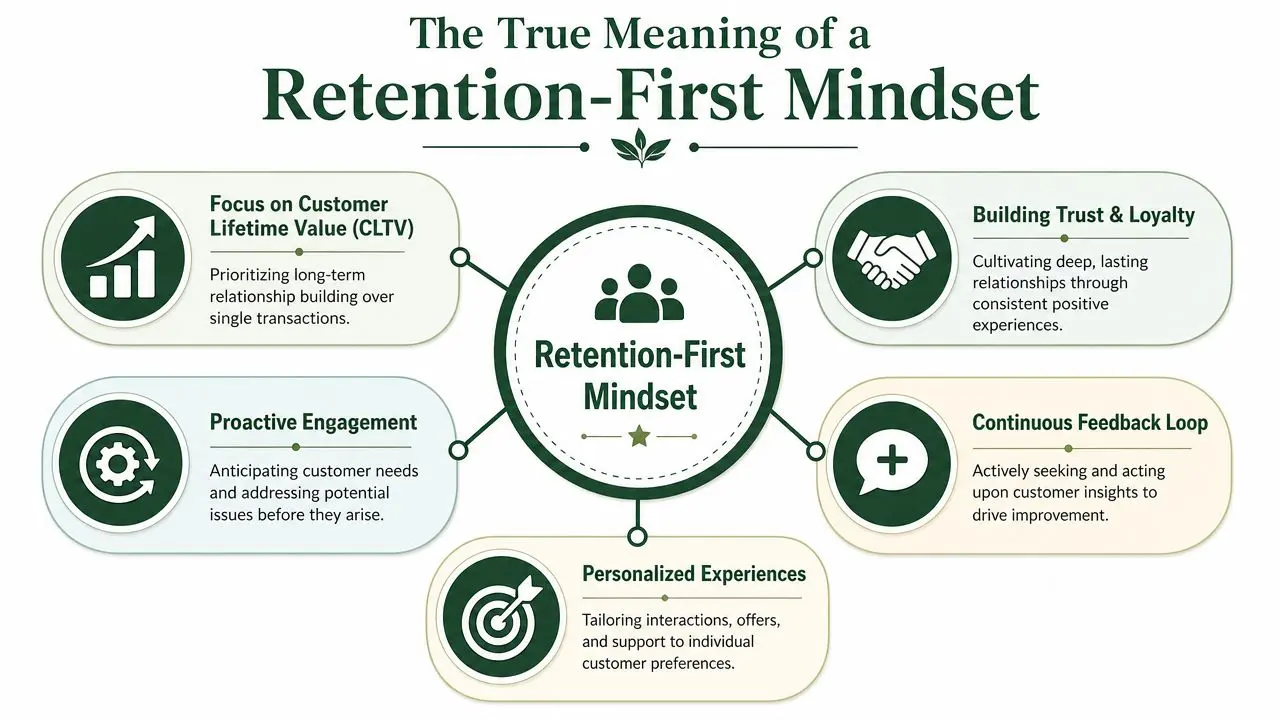
A lot of generic advice oversimplifies this. It treats retention as if every business measures it the same way. They don't. In UK businesses, retention is increasingly tied to multi-metric tracking across repeat purchase rate, churn, and lifetime value rather than a single definition. In a services and subscription-heavy economy, retention can mean renewal, repeat usage, or reactivation depending on the business model, which is why a one-line definition usually isn't enough (IBM on customer retention).
Different models need different retention logic
An e-commerce team usually thinks in repeat orders, lapsing buyers, reorder windows, and category frequency. A SaaS team watches renewals, usage depth, onboarding completion, and expansion revenue. A services firm may care more about account continuity, complaint handling, and contract renewal quality.
That changes what “good retention management” looks like.
- For e-commerce, a weak second-order rate often tells you more than an overall retention headline.
- For subscriptions, early cancellation and failed renewal events usually matter more than broad satisfaction messaging.
- For services, complaint resolution and post-purchase experience often decide whether the customer stays.
Retention-first changes daily decisions
A retention-first mindset shows up in ordinary operational choices:
- Product teams reduce friction in onboarding instead of adding features that look impressive in demos.
- Marketing teams segment existing customers by lifecycle stage instead of sending the same promotional push to everyone.
- Support teams log complaints and reasons for contact in a way that the wider business can use.
- Commercial teams prioritise revenue at risk, not just pipeline at the top of the funnel.
Retention isn't a department. It's the shared discipline of noticing risk early and responding before value disappears.
When people ask about the customer retention management meaning, this is usually the missing piece. It isn't just keeping customers satisfied. It's building a company that notices the moments that predict churn and treats those moments as operational triggers.
Why Retention Management Drives Business Growth
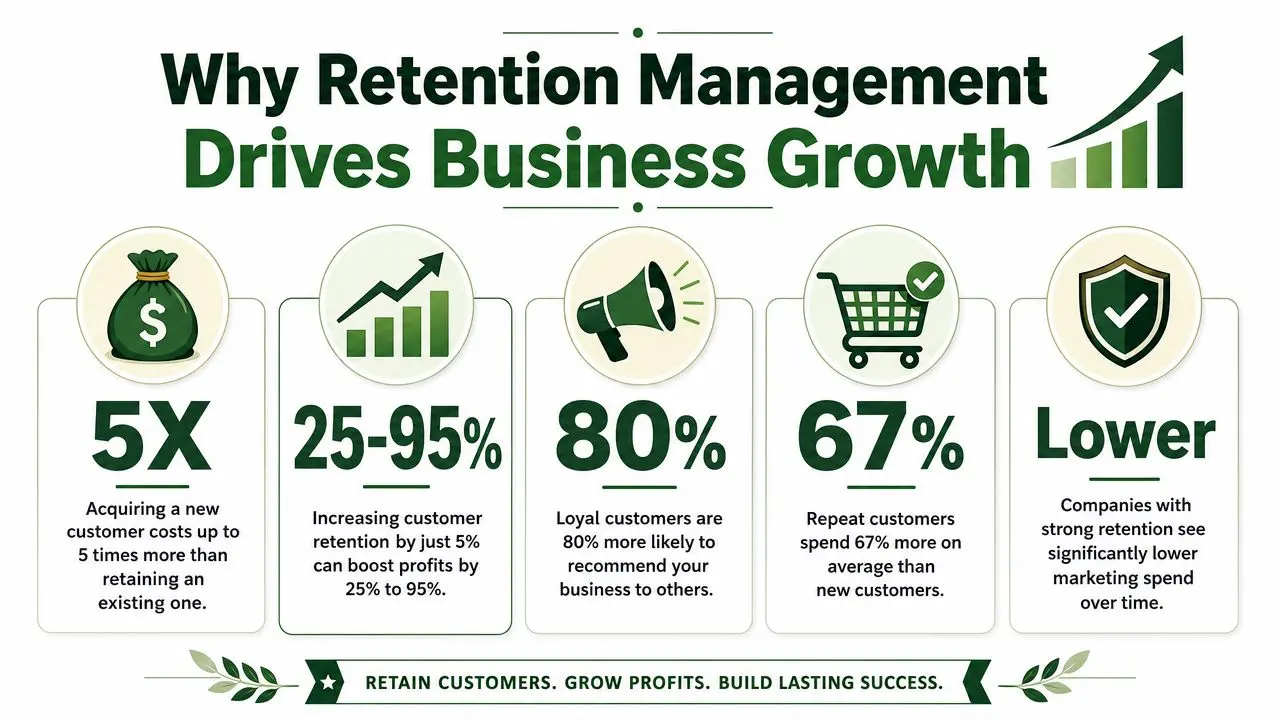
Retention earns budget when teams stop talking about “engagement” and start talking about revenue quality. Existing customers are easier to convert, often more profitable to serve, and more likely to buy again without forcing the business into constant acquisition spend.
The commercial case is straightforward. The probability of selling to an existing customer is 60% to 70%, compared with only 5% to 20% for a new customer. Returning customers also spend 67% more than first-time customers (customer retention statistics). Those are not small efficiency gains. They change how a sensible growth team allocates time and budget.
Growth gets stronger when revenue repeats
A business with weak retention has to replace lost revenue before it can grow. That creates hidden drag. Teams celebrate new customer wins while ignoring the cost of refilling a leaky bucket.
A business with strong retention works differently:
- Revenue compounds, because retained customers keep buying or renewing.
- Margins improve, because servicing an existing customer often takes less effort than winning a new one.
- Forecasting becomes cleaner, because repeat behaviour is easier to model than first-time acquisition spikes.
Here's a useful explainer if you want a broader visual overview of how retention supports growth and loyalty:
Retention protects growth when acquisition gets expensive
Many teams only become interested in retention when paid acquisition loses efficiency. By then, they're usually reacting too late. The better move is to treat retention as the stabiliser of the whole growth model.
What works is focusing on the customer moments with economic weight:
- The first successful use
- The second purchase
- The renewal decision
- The first support failure
- The point where usage drops or contact goes silent
What doesn't work is mistaking visible activity for retention progress. More email sends, more points in a loyalty scheme, or more “check-in” calls don't mean much unless they move customer behaviour in the right direction.
A retention programme should increase the share of customers who stay valuable, not just the share who receive messages.
The Core Components of a Retention System
A retention system has four moving parts. Strategy, processes, people, and tools. If one is weak, the rest won't carry it for long.
Strategy and decision rules
Start with a commercial definition, not a branding one. Decide what retention means in your model. Is it repeat purchase, subscription renewal, reactivation, reduced complaint-led churn, or expansion revenue from retained accounts? The answer determines what events you track and what interventions you build.
Good strategy also forces trade-offs. You probably can't save every at-risk customer, and you shouldn't try. Focus first on segments with meaningful revenue at risk, clear behavioural signals, and realistic chances of staying if you intervene.
Processes that turn signals into action
Most retention programmes fail at the handoff between insight and action. Teams can see the problem, but nothing happens quickly enough to change the outcome. That's why retention needs explicit workflows.
A practical process usually includes:
- Signal capture, such as complaints, failed payments, low usage, missed milestones, or service contacts
- Trigger logic, so the business knows what action follows each signal
- Ownership, with one team or named person responsible for the response
- Review loops, so you can see whether the intervention reduced churn or just created extra activity
In the UK, this operational discipline also matters from a governance perspective. Regulatory frameworks such as the Financial Conduct Authority's Consumer Duty push firms to prove they deliver good outcomes across the customer lifecycle, which makes systematic complaint handling and post-purchase satisfaction monitoring part of effective retention management rather than a nice extra (Consumer Duty and retention management).
People and team design
Retention rarely sits neatly in one department. Marketing can drive lifecycle messaging. Customer success can manage renewals and expansion. Support often sees the earliest churn signals. Product controls many of the friction points that push customers out.
That means someone needs to coordinate the system. In smaller firms, that may be a growth lead or CRM manager. In larger teams, it may sit across lifecycle marketing, customer success, and operations.
If retention is everyone's job but no one owns the operating rhythm, churn wins.
Tools that support the loop
You don't need an elaborate stack to start. You do need a usable one. A basic setup often includes a CRM, support platform, analytics layer, and messaging tool. Businesses with community-heavy or decentralised products may also need specialised workflows for optimizing Web3 customer experience, where support, CRM, and community signals often overlap.
For website-level experimentation inside the retention journey, teams sometimes add tools such as Otter A/B to test onboarding pages, account-area messaging, renewal prompts, or post-purchase flows against conversion and revenue outcomes.
Measurable KPIs to Track Retention Success
Retention metrics should tell an operator where revenue is slipping before the finance team sees it in next quarter's numbers. A dashboard that only reports a headline retention rate is too blunt to manage from.
Start with a simple question set. Are customers staying long enough to recover acquisition cost? Which cohorts are weakening? Which accounts are still active but showing early signs of lower value?
The baseline formula is straightforward:
(customers at end of period minus new customers during the period) divided by customers at the start, multiplied by 100
That adjustment matters. Without it, new acquisition can hide an existing churn problem and make retention look healthier than it is.
A practical dashboard usually tracks four core measures together:
| Metric | What It Measures | Simplified Formula |
|---|---|---|
| Customer Retention Rate | Share of customers kept over a period | (Customers at end of period minus new customers) / customers at start × 100 |
| Churn Rate | Share of customers lost over a period | Lost customers / customers at start × 100 |
| Repeat Purchase Rate | Share of customers who buy more than once | Repeat customers / total customers |
| Customer Lifetime Value | Revenue generated across the customer relationship | Average revenue per customer × average lifespan, or a margin-based variant |
These metrics work as a system. Retention rate shows whether customers stay. Churn rate shows how fast they leave. Repeat purchase rate shows whether behavior is becoming habitual. LTV tells you whether the relationship is economically worth keeping.
Top-line averages are only the starting point.
Segment the numbers by cohort, acquisition channel, plan type, first purchase month, or onboarding path. That is usually where the real operating insight sits. A blended 85 percent retention rate can still hide a weak paid social cohort, a poor-fit entry plan, or an onboarding flow that loses customers in the first 30 days.
This is also where retention stops being a loyalty discussion and becomes a growth system. If one cohort retains well and expands, put more budget into acquiring similar customers. If another cohort stays but never increases spend, fix pricing, packaging, or product adoption before pouring more demand into the top of the funnel.
Metrics only matter if they trigger a decision:
- Falling retention with stable repeat purchase rate often points to a contract, renewal, or service issue affecting a specific segment.
- Healthy retention with weak LTV usually means customers remain active but do not adopt higher-value products, features, or purchase frequency.
- Strong average retention with poor early cohort curves usually means one mature segment is masking recent deterioration.
- High NPS with rising churn often means customers like the brand but are not getting enough practical value to stay.
For subscription businesses, outside benchmarks can help you improve subscription retention without confusing a company-specific issue with a category-wide pattern. Tools built to improve subscription retention are useful for checking whether churn is concentrated in early lifecycle, renewal windows, or particular segments.
Satisfaction metrics belong on the scorecard too, but they need context. NPS on its own rarely explains revenue movement. Use it as a leading indicator alongside churn, retention by cohort, and expansion data. If your team needs a consistent method, this guide on how to calculate Net Promoter Score correctly is a practical reference.
The standard to aim for is simple. Every KPI on the dashboard should map to an action, an owner, and a review cadence. If it does not change a decision, it does not belong in the retention operating system.
Effective Retention Tactics and Examples
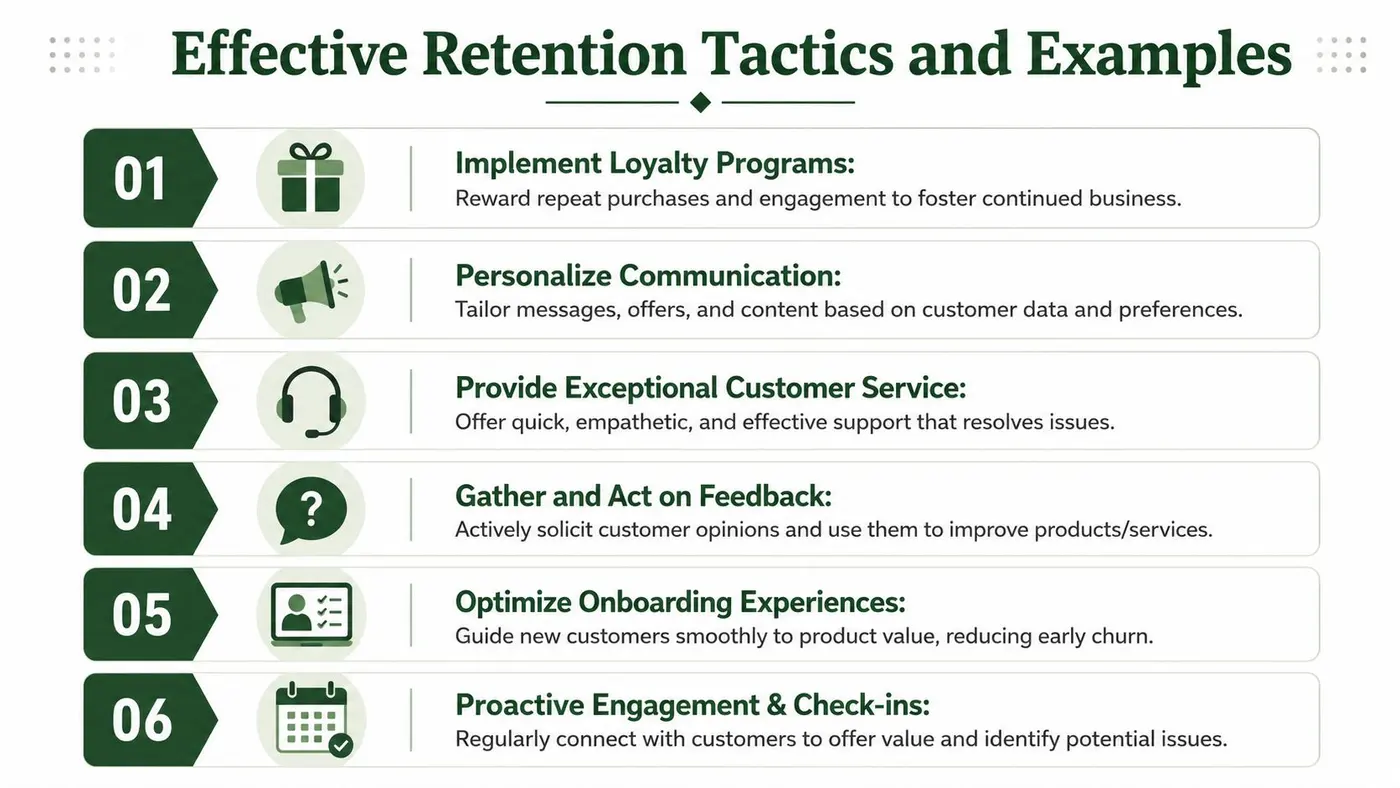
The best retention tactics match the customer stage. A new customer needs confidence and momentum. An active customer needs reasons to keep engaging. A lapsed customer needs a well-timed reason to return. Treating all three groups the same usually produces noise, not retention.
For new customers
The first job is reducing the gap between purchase and value. That's where many retention programmes prove ineffective. The customer said yes once, but the business never helped them succeed quickly enough to justify a second yes.
Tactics that usually work:
- Onboarding sequences tied to milestones. Don't send generic welcome emails. Send messages based on what the customer has or hasn't done.
- Early support outreach after friction events. Failed setup, abandoned activation, or a complaint in the first days should trigger human review.
- Clear next-step messaging on-site. Post-purchase pages and account areas should guide the customer to the next valuable action.
For e-commerce brands, this often overlaps with personalized content and offer strategy. If you're refining how product recommendations, messaging, and lifecycle communication work together, this piece on personalization in e-commerce is a useful complement.
For active customers
Once customers are engaged, retention becomes a rhythm problem. You want relevant contact, not constant contact.
Examples include:
- Loyalty or reward structures that reinforce repeat behaviour
- Behaviour-based cross-sell that follows demonstrated interest instead of broad catalogue promotion
- Feedback loops after support interactions, fulfilment issues, or product usage milestones
- Proactive service messages before common renewal or reorder drop-off points
One practical mistake shows up often in email-heavy programmes. Teams design thoughtful retention campaigns, but poor deliverability means the customer never sees them. If email is central to your lifecycle motion, it's worth checking the common causes behind inbox placement issues with this guide on how to stop email from going to spam in Gmail.
The tactic isn't the strategy. A loyalty programme without segmentation often rewards customers who would've bought anyway.
For lapsed customers
Win-back only works when the message matches the reason the customer left. Discounting everyone is usually the lazy option. Some customers left because of price. Others left because onboarding failed, support disappointed them, or the product no longer fit the job.
A stronger win-back flow asks:
- What signal suggested disengagement
- What likely caused it
- What offer or message addresses that cause
- Whether returning customers then behave like healthy cohorts or just churn again
That last part matters. A reactivated customer isn't automatically a retained customer.
How to Implement Your Retention Programme
A retention programme becomes manageable when you build it in sequence rather than trying to launch everything at once.
Step one to step three
Start by auditing your current state. Pull baseline data for retention, churn, repeat purchase, complaints, and customer value. Then identify where customers drop off. For one business, it may be after the first order. For another, it may be the first renewal cycle or the first unresolved support issue.
Next, define retention by business model. Don't let different teams use different meanings. Once that's clear, segment your customers by lifecycle stage and value. The most useful segmentation usually combines behaviour with revenue importance.
If you need better ways to gather structured feedback while building those segments, a strong set of customer satisfaction survey questions helps uncover the operational reasons behind churn and repeat buying behaviour.
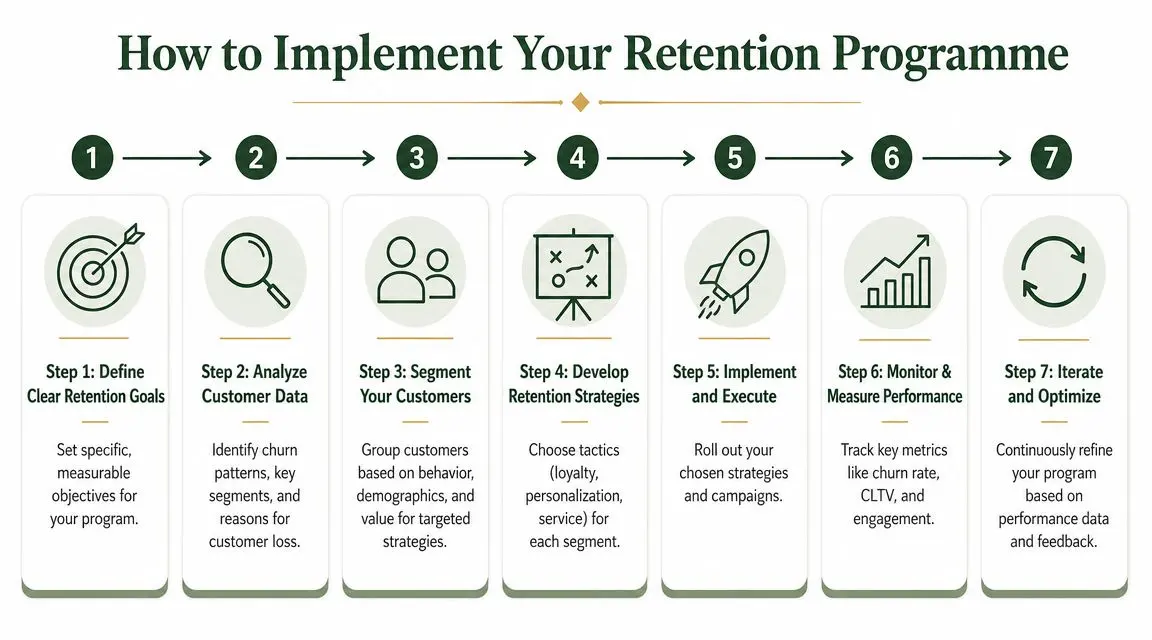
Step four to step seven
Choose a small number of interventions first. One onboarding fix, one active-customer engagement play, and one win-back programme is usually enough to start. The point is to build a working loop, not a giant retention calendar.
Then put reporting around the programme. Review performance by cohort, not just in aggregate. For UK firms, the most effective retention management involves modelling lifetime value using cohort-based retention curves so teams can prioritise interventions on the segments with the highest expected revenue at risk. In that model, small retention lifts in high-value cohorts can produce outsized profit effects (cohort-based retention curves and LTV prioritisation).
Finally, create a review cadence. Monthly works for many subscription and digital businesses because it surfaces cancellations, renewals, and repeat buying patterns early enough to intervene. In each review, ask:
- Which cohort weakened
- Which signal appeared before the drop
- Which intervention ran
- What changed after the intervention
Retention improves when teams run the same cycle repeatedly. Measure, diagnose, act, review, and adjust.
Otter A/B helps teams test the on-site parts of retention that often get ignored, such as onboarding copy, account-area prompts, renewal messaging, and post-purchase flows. If you want a lightweight way to connect experiments to conversion and revenue outcomes, Otter A/B is built for that kind of practical optimisation.
Stop guessing
Ready to start testing?
Set up your first A/B test in under five minutes. No credit card required.
- 14-day free trial
- No credit card required
- Cancel anytime