False Positive Rate: Your Guide to A/B Testing Errors
Don't let a high false positive rate ruin your A/B tests. Learn what Type I errors are, how they skew results, and how to control them for real CRO wins.

You’re probably in the middle of this problem already.
A test in Shopify, WooCommerce, or Webflow looks good. The dashboard says the new CTA is winning. The team starts planning the rollout. Design marks the old version as outdated. Paid traffic gets pointed at the “winner”. Then, a few weeks later, business performance looks oddly flat.
That’s the moment many teams realise an uncomfortable truth. A result can be statistically significant and still be the wrong business decision.
The issue is often the false positive rate. In plain English, that means your test told you there was a real improvement when there wasn’t. For an e-commerce team, that isn’t a minor maths error. It can mean wasted build time, false confidence, missed test opportunities, and changes pushed live that never deserved the traffic.
The A/B Test Win That Never Was
A familiar pattern plays out in many CRO programmes.
A team tests a homepage button, product page layout, or checkout message. After a short run, one variant pulls ahead. The result looks convincing enough, so the team declares a win and ships it. Stakeholders feel good because the process looked data-led.
Then the lift disappears.
The most frustrating part is that nobody acted irrationally. The team did what most modern growth teams are told to do. Test ideas, follow the data, move quickly. The trouble is that not every apparent winner is a true winner.
A false positive is the silent version of a bad decision. It doesn’t announce itself with a warning. It arrives disguised as proof.
Why this hurts more than people expect
When a team accepts a false positive, the damage spreads beyond one experiment:
- Design time gets spent badly: Designers polish and scale a change that didn’t improve anything.
- Developers implement the wrong thing: Engineering work goes to rollout, QA, and cleanup instead of better experiments.
- Roadmaps get distorted: A fake win can send the next month of optimisation in the wrong direction.
- Trust in experimentation drops: Stakeholders start saying “testing doesn’t work” when the actual problem was weak statistical discipline.
A false positive doesn’t just waste one test. It changes what your team believes about your customers.
That’s why smart marketers need to treat false positives as an operating risk, not a technical footnote. You’re not trying to win a stats exam. You’re trying to make sure the changes you ship improve conversion, revenue, or average order value when they reach your real traffic.
What Is the False Positive Rate in A/B Testing
Your team runs a checkout test. The reporting tool shows a winner at 95% confidence. The change gets approved, rolled out, and added to next quarter’s roadmap. A few weeks later, conversion rate looks flat.
That gap between the test result and the actual business outcome is where the false positive rate matters.
The false positive rate is the chance that a test reports a win when no real improvement exists. In A/B testing, the variant looks better than the control, but the difference came from random variation rather than a genuine shift in customer behaviour.

The fire alarm analogy
An A/B test works like a smoke alarm. When it goes off, it is signaling a possible problem or change worth attention.
- If there is a real fire and the alarm sounds, the alert was correct.
- If there is no fire and the alarm still sounds because someone burnt toast, that is a false positive.
A test result can behave the same way. Your tool flags a winner, but nothing meaningful changed. The alarm was triggered by noise.
Many testing tools use a 95% confidence threshold. Under the standard setup, that usually means accepting about a 5% false positive risk for a single test. If you want a clearer explanation of what that threshold means in practice, this guide to testing statistical significance is a useful companion.
Where teams get confused
“95% confidence” sounds more certain than it is.
Marketing teams often hear that phrase as “we are 95% sure this version is better.” A safer working interpretation is simpler. You are allowing a small chance that the result is a false alarm.
That trade-off is normal. No e-commerce team can remove uncertainty completely. The problem starts when a significant result gets treated like permanent truth, especially if people are checking results every day or running several variants at once.
Why real traffic makes this harder
Textbook examples assume clean, stable conditions. Real stores do not behave that way.
Traffic mix shifts. Promo periods distort buying behaviour. Returning visitors show up more than once. Teams also peek at results before the sample is mature, then stop the test the moment a result looks good. Each of those habits makes false positives more likely in practice than the headline threshold suggests.
For e-commerce teams, that is the business version of a smoke alarm that becomes easier to trigger during busy trading periods. The alert still looks official. The signal is less trustworthy.
Type I versus Type II in plain language
These labels sound technical, but the business meaning is straightforward:
| Term | Plain-English meaning | Business version |
|---|---|---|
| Type I error | You think there’s an effect when there isn’t | You ship a fake winner |
| Type II error | You miss a real effect | You leave a good idea on the table |
For CRO teams, Type I errors usually create the bigger operational mess. A missed improvement hurts. A fake win burns design time, engineering effort, analyst attention, and stakeholder trust, all while teaching the team the wrong lesson.
How False Positives Sabotage Your Conversion Goals
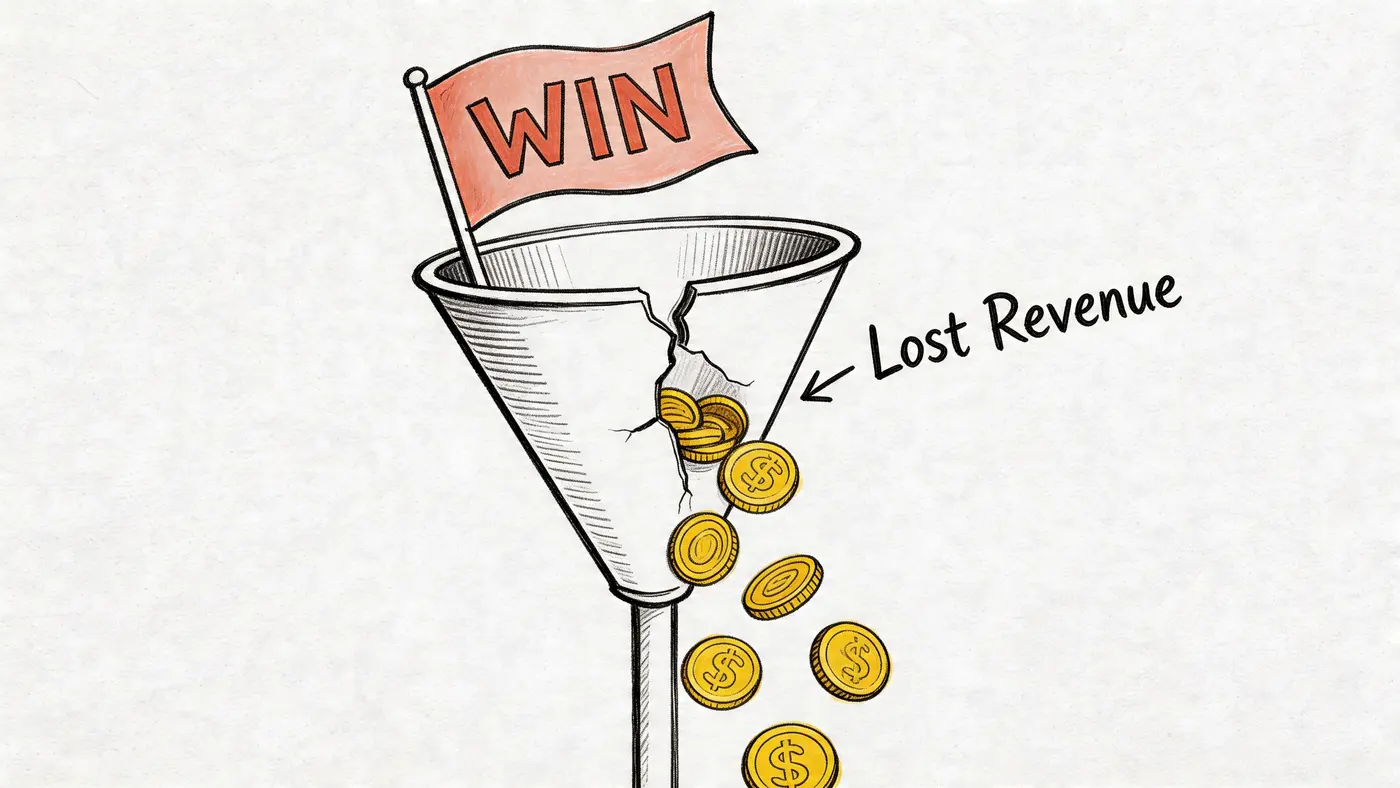
A team sees a test win on Monday, ships it by Friday, and reports an uplift in the next trading meeting. Two weeks later, revenue looks flat, checkout completion slips, and nobody can explain why. That is what a false positive does in practice. It turns random noise into a roadmap.
A false positive changes more than a dashboard. It changes what your team builds, what gets funded, and which ideas get dropped.
The first hit is wasted execution
The fire alarm analogy fits here. If the alarm goes off when there is no fire, people still stop what they are doing, leave their desks, and treat it as urgent. A false positive creates the same kind of scramble inside a CRO programme.
Once a test is labelled a winner, teams usually act fast:
- Developers implement the variant across templates or push it live sitewide.
- Design updates follow so the new version works across devices, states, and edge cases.
- Analysts and marketers report the win and turn it into a story about what customers “prefer”.
- Better ideas wait because the team believes the problem has already been solved.
That cost is real even when the shipped change is neutral. If the variant performs worse, you pay twice. First to roll out the change. Then to discover, diagnose, and reverse it.
E-commerce metrics can fool you
For online stores, false positives get especially expensive when teams focus on revenue metrics. Conversion rate is noisy enough. Revenue per visitor and average order value usually swing even more because basket size, product mix, discounting, and traffic quality all move around at once.
Seasonal promotions make that harder to read. A payday spike, a bank holiday offer, or an email campaign can make one variant look stronger when the lift came from timing rather than the page itself. Researchers discussing false positive behaviour in noisy settings describe how unstable conditions can make misleading signals more likely, which is exactly the problem e-commerce teams face during promotions and trading peaks.
A short-term bump can look persuasive. It can still be the wrong lesson.
The hidden cost is bad learning
The biggest risk is not only shipping one weak change. It is teaching the business the wrong rule.
Suppose a product page test appears to win. The team rolls that layout out across more categories. Paid media sends more traffic to it. Merchandising adjusts copy to match it. Stakeholders start asking for “more of the winning format.”
If the original result was false, the business has now scaled a mistake.
That creates three separate costs:
- Resources go into a change with no real return.
- Promising alternatives are ignored because the team thinks it already has the answer.
- Performance can fall while reports still frame the change as a success.
That third outcome is what makes false positives so dangerous for CRO. They do not always mean “no difference.” Sometimes the test crowns a loser.
Peeking makes fake wins easier to believe
Here, business pressure collides with statistics. A merchandiser wants an answer before the next campaign. A product owner checks the dashboard every morning. A stakeholder asks whether the uplift is “holding.” If the team keeps looking and stops the moment the graph turns green, chance gets many more chances to impersonate a win.
The same pattern appears in small, fast tests on forms and checkout steps. Teams often test labels, field order, optional fields, or progress indicators because those changes feel quick to ship. A guide like A/B testing forms for better conversions is useful for spotting test ideas, but those micro-conversion experiments still need disciplined stopping rules. Otherwise a random wobble in form starts or submissions gets mistaken for insight.
Use ranges, not victory laps
One practical way to calm the room is to look at the uncertainty around the result, not only the headline winner. A result with a wide possible range should trigger caution, especially if the business is about to commit design and engineering time based on it. This explainer on what is a confidence interval in statistics shows why that range matters.
A narrow range gives a team more confidence that the observed effect is close to the truth. A wide range means the result can still move around a lot. For an e-commerce team deciding whether to ship, that difference affects inventory planning, campaign messaging, development effort, and revenue forecasts.
The Compounding Danger of Multiple Experiments
The single-test false positive rate is only the starting point.
Most serious CRO teams don’t run one tidy experiment at a time. They test headlines, checkout tweaks, pricing messages, category pages, and forms across different parts of the site. They also compare more than one variant inside the same experiment. That’s where the risk compounds.
Why more testing creates more false winners
If one test carries some chance of a false alarm, then a batch of tests gives you more opportunities for a false alarm to appear.
It’s a bit like checking many raffle tickets. The more tickets you hold, the higher the chance one of them matches. In experimentation, the “prize” can be a misleading winner.
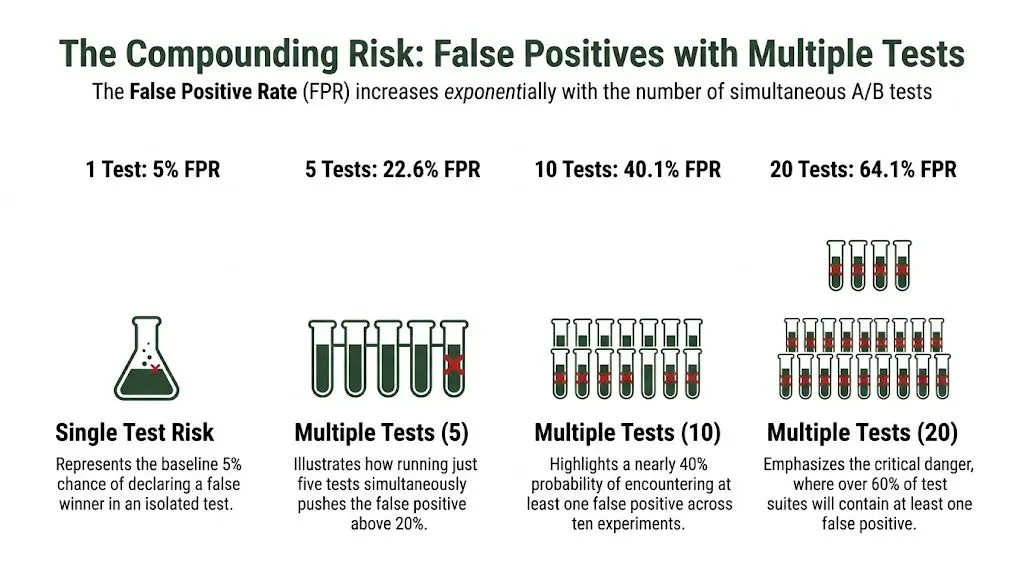
A verified benchmark from a discussion of the false positive rate makes the risk clear. Running 20 concurrent A/B tests at a standard 95% confidence level gives you a 64% chance of at least one false positive winner, calculated as 1 - 0.95^20. The same source notes that UK ASA-endorsed guidance recommends adjustments so teams don’t make misleading performance claims from uncorrected multi-test programmes.
What that looks like in practice
Here’s the intuition:
| Number of tests | Chance of at least one false positive |
|---|---|
| 1 test | 5% |
| 5 tests | 22.6% |
| 10 tests | 40.1% |
| 20 tests | 64.1% |
Those figures come from the same mathematical idea. Each extra test increases the chance that one apparent win is just luck.
For marketers, the takeaway is blunt. If your team runs a busy experimentation calendar without adjusting for multiple tests, your programme can become a machine for finding fool’s gold.
Multiple variants count too
This doesn’t only apply to separate experiments on separate pages.
If you run one control against several variants, you’re still making multiple comparisons. A homepage test with several headlines, several CTA styles, and a promotional badge can produce enough comparisons to raise your odds of a false winner even if the dashboard presents it as one neat experiment.
More shots on goal can produce more learning. They can also produce more false confidence.
Why this matters for reporting
The reporting problem is easy to miss.
A team might say, “We ran lots of tests this quarter and found several significant wins.” That sounds disciplined. But if those tests weren’t corrected for multiplicity, some of those wins may be the false positives you should expect from running many comparisons.
That’s why statistical rigour isn’t anti-growth. It protects your programme from mistaking volume for insight.
Four Practical Tactics to Control False Positives
You can’t remove uncertainty from experimentation. You can make it manageable.
The strongest CRO teams don’t try to create perfect certainty. They build habits that make false positives less likely and less damaging.
Set sample size before launch
“Run it for two weeks” isn’t a statistical plan. It’s a calendar decision.
A better approach starts with the effect size that would matter to the business. Verified guidance from VWO’s explanation of understanding false positive rate notes that, for fixed-horizon tests, targeting a minimum detectable effect of 10% at 80% power and applying Benjamini-Hochberg at q=0.05 has been shown to cut false alarms by 40% in multi-variant tests.
That means the team agrees in advance what size of change is worth caring about, then gathers enough data to judge it properly.
If you skip this step, you invite two bad habits. Declaring winners too early, and running tests that never had enough power to answer the question.
Write the rules down before you peek
Many false positives come from decision drift, not bad intent.
The test starts with one primary metric. Midway through, that metric looks weak, so someone points to add-to-cart rate. Later, the mobile segment looks promising. Then a shorter date range gets mentioned because “that was before the campaign changed”.
That’s how teams talk themselves into a win.
A pre-test plan doesn’t need to be complicated. It just needs to state:
- The hypothesis
- The primary metric
- Any secondary metrics
- The audience or segments
- The stopping point
- What would count as success
The best time to decide what counts as evidence is before the evidence arrives.
Correct for multiple comparisons
Once your programme grows, this becomes essential.
A/B testing borrowed this lesson from fields where repeated testing can create lots of false discoveries. A practical correction such as Benjamini-Hochberg helps control the false discovery rate when you run many comparisons. It’s often easier for business teams to live with than ultra-conservative methods that sharply reduce sensitivity.
A simple mental model helps. If your team opens many doors, correction methods help stop you from calling the first noisy room a breakthrough.
Stop peeking without a rule
Peeking is one of the most common causes of inflated false positives.
The pattern is familiar. Someone checks the dashboard each morning. On day three the result hits significance. The team gets excited and calls the test. If they had waited, the result might have drifted back to neutral.
That behaviour changes the actual error rate, even when the dashboard itself is technically correct. The tool reports what the data currently says. Teams create the problem when they keep checking for a lucky moment to stop.
Two safer ways to handle stopping
One option is the fixed-horizon route. Pick the sample size and stop only when you reach it.
The other is a sequential approach designed for repeated looks. The same VWO resource notes that sequential probability ratio testing can reduce the false positive rate to under 2% and produced 18% faster experiment resolution in Webflow and Shopify case studies. If your team is comparing frameworks, this overview of the difference between Bayesian and frequentist testing helps clarify why stopping rules matter so much.
A compact checklist
Before any experiment goes live, ask:
- Is the business effect worth detecting?
- Have we set a sample target rather than a vague duration?
- Do we know the primary metric?
- Are we correcting for multiple comparisons if needed?
- Have we decided how and when the test will stop?
That checklist looks simple because it is. Most of the cost of false positives comes from teams skipping simple discipline, not from teams lacking advanced maths.
How Otter A/B Helps You Test with Confidence
Good experimentation tools don’t remove the need for judgement. They make disciplined judgement easier.
Otter A/B uses a frequentist z-test engine and continuously calculates significance at a 95% confidence threshold. That’s useful because teams can see how a result evolves rather than waiting for a final export. Continuous visibility helps people spot unstable movements instead of treating the first promising swing as final truth.
Visibility is helpful, but discipline still matters
Live significance is powerful. It’s also dangerous if your team treats every dashboard check as an invitation to stop early.
That’s why the operating model matters as much as the interface. The platform can surface evidence quickly. Your team still needs a stopping rule, a defined primary metric, and a clear plan for handling multiple comparisons.
A verified principle from the clinical-statistics literature applies directly here. With 10 independent comparisons at a 5% significance level, the probability of at least one false positive rises to about 40%, and procedures such as Benjamini-Hochberg are used to control the false discovery rate. That principle became influential in UK academia and informed MHRA drug trial standards, as described in this article on multiple comparisons and false discovery control.
Where the platform fits in
For practical teams, that means:
- You can monitor significance continuously without losing sight of the need for disciplined stopping.
- You can run multiple variants while recognising that multiple comparisons increase false-positive risk.
- You can tie experiments to business outcomes like purchases, AOV, and revenue trends, while staying cautious with volatile secondary metrics.
- You can share results quickly and still insist on a more rigorous review before rollout.
If your team is also building research workflows around experiment interpretation, tools like Sharpmatter AI can help organise inputs and patterns around strategy work. The key point is that no analysis layer should tempt you to confuse a convenient narrative with a reliable result.
Otter A/B gives teams the instrumentation. Statistical rigour keeps that instrumentation honest.
From False Alarms to Real Growth
The false positive rate is one of the main guardrails in CRO.
If your team respects it, you make fewer expensive mistakes. You ship fewer fake wins. You protect engineering time, keep your roadmap cleaner, and build a testing culture people can trust.
The best growth teams aren’t the ones that celebrate the most winners. They’re the ones that can tell the difference between real signal and random noise, then act with confidence when the evidence is solid.
If you want a lightweight way to run website experiments without slowing down UX, Otter A/B gives you fast setup, clear significance tracking, revenue-focused reporting, and a simple workflow for testing headlines, CTAs, layouts, and more. Start free and build an experimentation programme based on real wins, not false alarms.
Stop guessing
Ready to start testing?
Set up your first A/B test in under five minutes. No credit card required.
- 14-day free trial
- No credit card required
- Cancel anytime