What Is Testing Plan? Components, Steps and Examples
What is testing plan? Learn its key components, how to write one, and how it guides experiment design and evaluation.
Your team has changed the checkout headline, and purchases appear to be rising. Marketing wants to roll it out, engineering wants to check the tracking, and the commercial director asks whether shoppers are spending less per order. Nobody agreed beforehand what would count as a win.
That's the situation a testing plan prevents. It gives everyone a shared way to judge a change before enthusiasm, deadlines or an encouraging dashboard influence the decision.
What a Testing Plan Is and Why It Matters
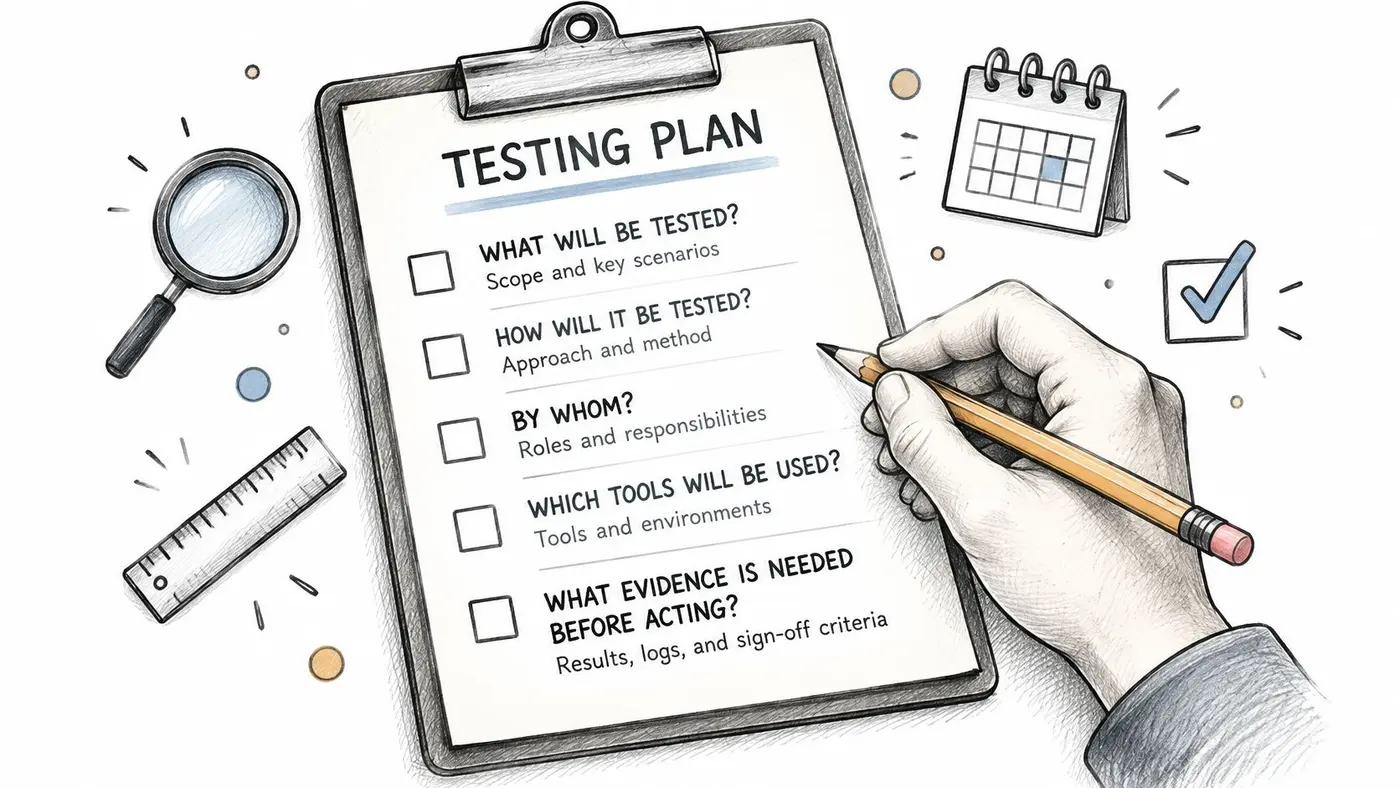
A testing plan is a written document that says what will be tested, how, by whom, with which tools, and what evidence is needed before anyone acts on the result. For that checkout headline, it would identify the versions being compared, the purchase metric, the checks required and the person authorised to approve release.
Think of a pilot's pre-flight checklist. Rather than relying on a general feeling that everything looks safe, the crew follows repeatable checks with clear responsibilities.
A plan isn't a test case or a report
A test case is an individual check, such as confirming that a purchase event fires after successful payment. A test report records what happened afterwards, including failures and unresolved risks. The plan sets the conditions under which those checks and results will be used.
Testing is a substantial organisational capability, not a final tick-box. The UK software-testing market estimate cited in KPMG's market insights put its value at £1.1 billion in 2023.
The term also has different meanings:
- Software test plan: Defines quality-assurance scope, environments, entry and exit criteria, and defect handling before release.
- Experiment plan: Fixes the hypothesis, measurement approach and stopping rules before an A/B test begins.
The rest of this guide applies the experiment version, while retaining the release safeguards that make software testing dependable.
For marketing, product, engineering and compliance, the practical benefit is an auditable explanation of why a test ran and why a change was approved. Every plan must answer: what are we testing, how will we judge it, and who signs off?
The Parts Every Testing Plan Needs
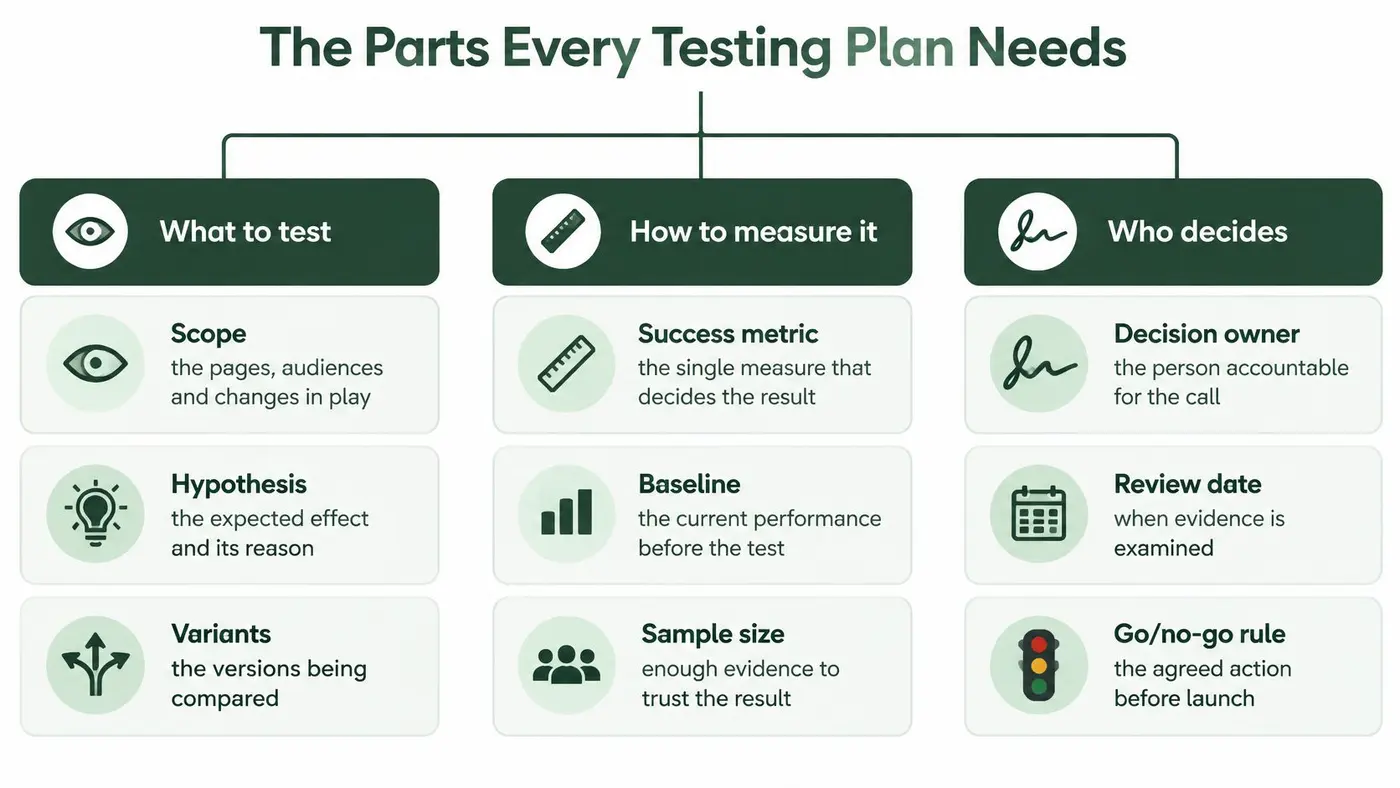
Organise the document around what to test, how to measure it, and who decides. These clusters keep a detailed plan readable without stripping out the information needed to make a decision.
Say a UK fashion shop wants to replace its checkout headline with wording that makes the delivery benefit clearer. The hypothesis isn't that the new wording is better. It's that shoppers will complete more purchases because they understand the delivery value sooner.
Testing plan components and worked example
Component Question it answers Example for a checkout headline test Scope What exactly is changing? Checkout headline only, desktop and mobile; current wording is the control Hypothesis What do we expect and why? A benefit-led headline lifts completed purchases because shoppers see delivery value sooner Primary metric What single number decides the test? Purchase conversion rate per eligible visitor Guardrail metrics What must not get worse? Average order value, page load time and payment-step error rate Audience and split Who sees the test, and how is traffic divided? Eligible UK checkout visitors, assigned equally and consistently between control and variant Sample size and duration How much data before a decision? Calculate from the shop's baseline, minimum detectable lift and chosen power; record the required sample and maximum end date Stop rule When do we ship, continue or stop? Ship only when the evidence threshold is met, guardrails hold and the lift clears the minimum business value Owner and sign-off Who is accountable and who approves? Growth lead owns the test; commercial director approves release Rollback condition What triggers reverting the change? Payment errors breach the agreed tolerance; checkout-blocking defects trigger immediate rollbackGuardrails protect against a misleading success. A headline might encourage account sign-ups while distracting shoppers from completing purchases. If the team only watches sign-ups, it could approve a commercially harmful change.
Measurement also depends on dependable technical checks. For engineering teams, Arch's guide to reducing flaky tests in CI is useful context for making automated checks trustworthy rather than dismissing intermittent failures.
Practical rule: Check every row against your own experiment before launch. An unanswered row is a gap in the decision, not missing paperwork.
Setting Decision Rules Before Results Arrive
Checking a conventional fixed-sample test every day and stopping at the first apparent winner increases the risk of a false positive. You can monitor operational health throughout, but that isn't permission to keep taking fresh opportunities to declare success.
Decision rules are easy to skip because they feel less urgent than building the variants. Write them before results arrive, when nobody has a favourite outcome to defend.
Agree what counts as enough evidence
For a frequentist comparison of conversion rates, specify the null hypothesis of equal rates, the alternative hypothesis and the significance threshold. In this example, use alpha 0.05, corresponding to a 95% confidence threshold, alongside the documented test and completion evidence described in Defra's quality-assurance standards.
The sample calculation needs:
- Baseline conversion: Your current rate for the eligible audience.
- Minimum detectable effect: The smallest improvement worth detecting.
- Statistical power: How likely the design is to detect that improvement when it exists.
- Allocation ratio: How visitors are divided between versions.
Smaller expected improvements need more observations. A subtle change on a low-traffic page may therefore be an unsuitable experiment, even if it's easy to build.
Also distinguish statistical significance from commercial significance. More purchases don't necessarily mean more revenue per visitor if average order value falls. Use a goal-setting framework to connect the primary goal to the business outcome before selecting the test.
Decision outcomes and the action each one triggers
Outcome Evidence the plan requires Decision Primary metric significant, guardrails stable, lift above minimum value Significance threshold met; guardrails within agreed range Ship the variant Primary metric significant, revenue per visitor falls Threshold met; revenue guardrail failed Don't ship; investigate Trend positive, sample size not reached Required sample per variant not collected; planned window remains open Keep testing Stop date reached, no significance Threshold not met at the planned analysis, or insufficient evidence collected Keep the current version and record the learning Tracking or consent data fails validation Data-quality check fails Pause and fix measurement before decidingAn inconclusive result isn't proof that the versions are identical. It means the experiment didn't establish the improvement required by the plan.
Protecting Accessibility and Privacy in Your Plan
The highest conversion rate doesn't automatically identify an acceptable winner. A variant can improve aggregate results while making checkout harder for people using a keyboard or screen reader.
That's why the plan needs release gates beyond commercial performance. These gates should block an otherwise attractive result when the implementation excludes users or mishandles their data.
Accessibility is a release condition
Check every variant for keyboard navigation, screen-reader comprehension, visible focus and usable touch targets. Run automated accessibility checks, then manually complete the important interactions with assistive technology.
The Home Office's quality-assurance principles recommend automated accessibility testing alongside checks involving target users, assistive technologies and browsers. Translate that approach into explicit acceptance criteria, rather than leaving accessibility to a general visual review.
Where it's lawful, ethical and meaningful, examine relevant audience segments. Don't collect sensitive information merely to make a more detailed experiment report.
Privacy decisions belong before launch
The ICO's guidance on cookies and similar technologies explains the requirements for clear information and active consent where consent is required. Don't assume that every experiment requires the same consent implementation, or that an exemption for statistical purposes covers advertising, profiling or personalisation.
Map the actual configuration:
- Data flow: Variant assignment, identifiers, browser storage, analytics calls and vendor sharing.
- Governance: Purpose, retention, data minimisation and access to purchase information.
- Visitor choices: Refusal, acceptance, withdrawal and the resulting measurement behaviour.
Use a consent-state test matrix to check those choices, with a privacy-approved fallback for visitors who decline. That fallback might mean excluding them from tracked experimentation rather than reconstructing their activity elsewhere.
Keep privacy and consent documentation beside the implementation specification. A lightweight script and fast page load don't establish compliance; a documented privacy review must approve the actual behaviour.
A Worked Testing Plan for an Online Shop
Say a UK homeware shop wants to test a more descriptive product-page call to action. The proposed button explains what shoppers will do next, rather than relying on a generic instruction.
For context, IRP Commerce's ecommerce market data recorded an average UK ecommerce conversion rate of 1.63% in October 2025. The shop should replace that reference with its own eligible product-page visitor baseline before calculating a real test.
Turn the idea into a runnable specification
For this hypothetical calculation, assume the shop's baseline matches that reference, and that visitors are independently and equally assigned. The figures below are planning assumptions and derived estimates, not reported results from a real shop.
Worked plan fields for the homeware product page test
Field Value for the homeware shop Baseline conversion Reference baseline above, replaced with the shop's own rate before launch Target lift Hypothetical 20% relative improvement, giving a target of approximately 1.96% Power and confidence Assumed 80% power at 95% confidence, alpha 0.05 Sample size Approximately 26,000 visitors per variant using a conventional two-sided proportions calculation Traffic and duration Assumed 2,000 eligible visitors daily per variant, giving approximately 13 days to collect the sample Primary metric Completed purchases per assigned product-page visitor; basket additions are a diagnostic step Guardrails Average order value and page speed Split, owner and approver Equal allocation; ecommerce manager owns the test; commercial director approves releaseThe hypothesis is straightforward: if the CTA makes the next step clearer, more eligible product-page visitors will complete a purchase because they understand the action.
In the hypothetical outcome, suppose the variant reaches 2.0% purchase conversion, the planned significance threshold is met and guardrails remain stable. That clears the assumed minimum lift, so the approver can authorise release. A fall in average order value beyond the agreed tolerance would still block it.
Judge the complete purchase journey, not just the button click.
Keep acquisition changes outside this experiment. If the team also wants to compare Facebook lead ads versus landing pages, Wojo Media's discussion belongs in a separate acquisition hypothesis, not bundled into the CTA test.
Use the ecommerce A/B test playbook to turn the shop's chosen hypothesis into a documented experiment.
How to Write and Launch Your Testing Plan
Write the answers into a shared document before configuring the live experiment. Defra's testing and assurance guidance connects testing to user needs, expected behaviour and service quality, including performance, resilience and security.
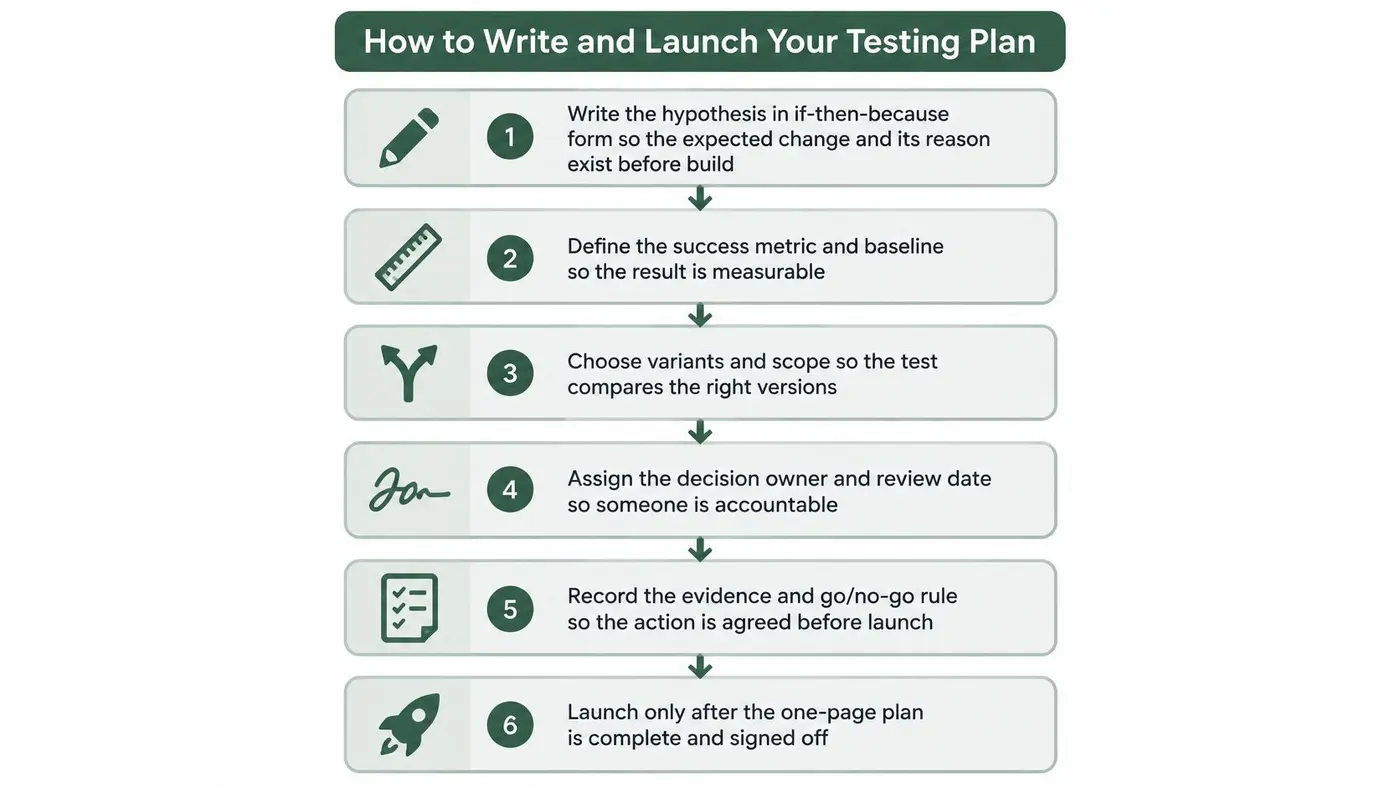
Use this workflow to keep preparation practical.
-
Write the hypothesis before building. Use an if-then-because sentence that names the change, expected outcome and reason. Writing it after seeing results turns an explanation into a retrospective justification.
-
Choose the primary metric and baseline. Use a stable trading period with the same audience definition you'll use during the experiment. A sale period can give you an unrepresentative starting point.
-
Set guardrail tolerances. Name the commercial and operational outcomes that would make an apparent win unacceptable. Replace vague wording such as acceptable speed with a documented measurement method and tolerance.
-
Define the audience and versions. Record targeting, allocation and assignment persistence, excluding internal staff and identifiable bots. Keep unrelated page changes out of the experiment so the comparison remains interpretable.
-
Assign dates and authority. Record the start, maximum end date, sample requirement, owner and approver. Specify how interruptions will be handled so nobody improvises an extension to rescue a promising trend.
-
Complete pre-launch QA. Check rendering on major browsers and a mid-range phone, purchase-event accuracy, assignment, accessibility and rollback. Don't let a desktop preview substitute for checking mobile checkout.
-
Date, approve and preserve the plan. Store the signed version somewhere the whole team can access. Log amendments rather than rewriting the rules after launch.
Make the setup match the document
We recommend running the sample size calculator before every launch to check whether available traffic can detect the improvement you care about. In Otter A/B, our free planning resources need no account, while the results page includes an executive summary stating whether to ship, keep testing or stop.
Preview every variant on the live site and confirm goals fire without contaminating results. Check that configured stop conditions match the approved document.
Use the video walkthrough alongside your written launch checks.
Testing Plan Checklist Before Launch
A completed document isn't necessarily a launch-ready experiment. The final review should establish whether another person could run the test, recognise a fault and make the agreed decision without asking the author what they meant.
Use the checklist as a handover, not a ceremonial approval. Ask the reviewer to locate the relevant evidence rather than confirm that each topic has a heading.
Check that the plan is executable
- The change is identifiable: The control and variant descriptions match the implementation, including mobile behaviour.
- The audience is reproducible: Targeting and exclusions can be checked against the configured rules.
- The measurement is traceable: The metric definition identifies the event, denominator, attribution window and treatment of repeat visitors.
- The evidence requirement is feasible: Expected eligible traffic can support the planned analysis within the available trading window.
- The safeguards have owners: Someone is responsible for monitoring commercial, technical, accessibility and privacy failures.
- The response is actionable: The team knows who pauses traffic, who investigates and who can authorise rollback.
- The approval is recorded: The named approver has accepted the specification and any residual risks.
Resolve gaps before inviting traffic
A useful final exercise is to give the reviewer a plausible problem: purchase events stop arriving, the variant wins on clicks but not orders, or a browser displays a broken payment button. They should be able to find the response in the document without negotiating a new rule.
Launch gate: If the reviewer has to invent the response, the plan isn't finished.
Keep supporting evidence with the plan, including QA results, tracking checks, approvals and known limitations. After the experiment, attach the outcome and reasoning so future teams can distinguish a tested conclusion from an unsupported assumption.
Write the plan for your next proposed change, give the approver a concrete decision to review, and launch only when the unresolved questions have owners and answers.
Otter A/B offers website experimentation tools and free calculators, generators and guides to help you turn a hypothesis into a decision-ready test. Visit Otter A/B to check your sample requirements, prepare your next experiment and put the agreed rules into practice.
Stop guessing
Ready to start testing?
Set up your first A/B test in under five minutes. No credit card required.
- 14-day free trial
- No credit card required
- Cancel anytime