What Is a Unique Visitor and Why It Misleads CRO Teams
Learn what is a unique visitor, how analytics platforms measure it, and why cookie loss and device switching distort your A/B test results.

A unique visitor is a distinct browser, cookie, or device identifier counted once in a reporting window, not a guaranteed count of individual people. In UK analytics, that distinction matters because the same person can be split across multiple unique visitors when identity breaks across devices, browsers, or consent states.
Most teams still talk about unique visitors as if the metric were a clean person-level census. It isn't, and that's where CRO decisions start to drift away from reality.
The Real Meaning Behind Unique Visitor
The popular shortcut is wrong. A unique visitor is not a guaranteed human headcount, it's a distinct identifier counted once inside a chosen reporting window, and Adobe Analytics defines it as the number of visitor IDs rather than a direct count of people (Adobe Analytics unique visitors).
That distinction sounds technical, but it changes how you read every report. If one person visits on a phone, then later on a laptop, the analytics system may treat those visits as separate identifiers, especially when cookies don't persist or the user changes browsers or devices. That means traffic can look broader than the actual audience.

Why the metric feels more precise than it is
The phrase “unique” encourages a person-level interpretation, but the underlying mechanism is identifier-based. Cookie systems can split the same individual into multiple unique visitors if they switch browsers, clear cookies, or move between devices, and that's exactly why the number can drift away from real audience size.
Practical rule: if you're using unique visitors as a proxy for reach, assume the number is directional, not exact.
That matters for budget allocation, audience sizing, and experiment planning. A campaign that looks large in unique visitors can still be smaller in actual human reach if identity resolution is weak. The gap is especially relevant on mobile-heavy journeys, where app and browser fragmentation can make one person appear as several identifiers.
For teams looking at website traffic alongside visitor behaviour, visitor statistics for websites uses the same core framing, distinct individuals are the goal, but the measurement is still mediated through identifiers.
Why CRO teams should care
CRO work depends on denominators behaving consistently. If the same person can be counted twice, sample sizing looks healthier than it really is, and variant performance can look cleaner than the underlying user reality supports. A unique visitor metric is useful, but only when you remember it's measuring identifier activity inside a date range, not a census of real people.
How Analytics Platforms Identify and Deduplicate Visitors
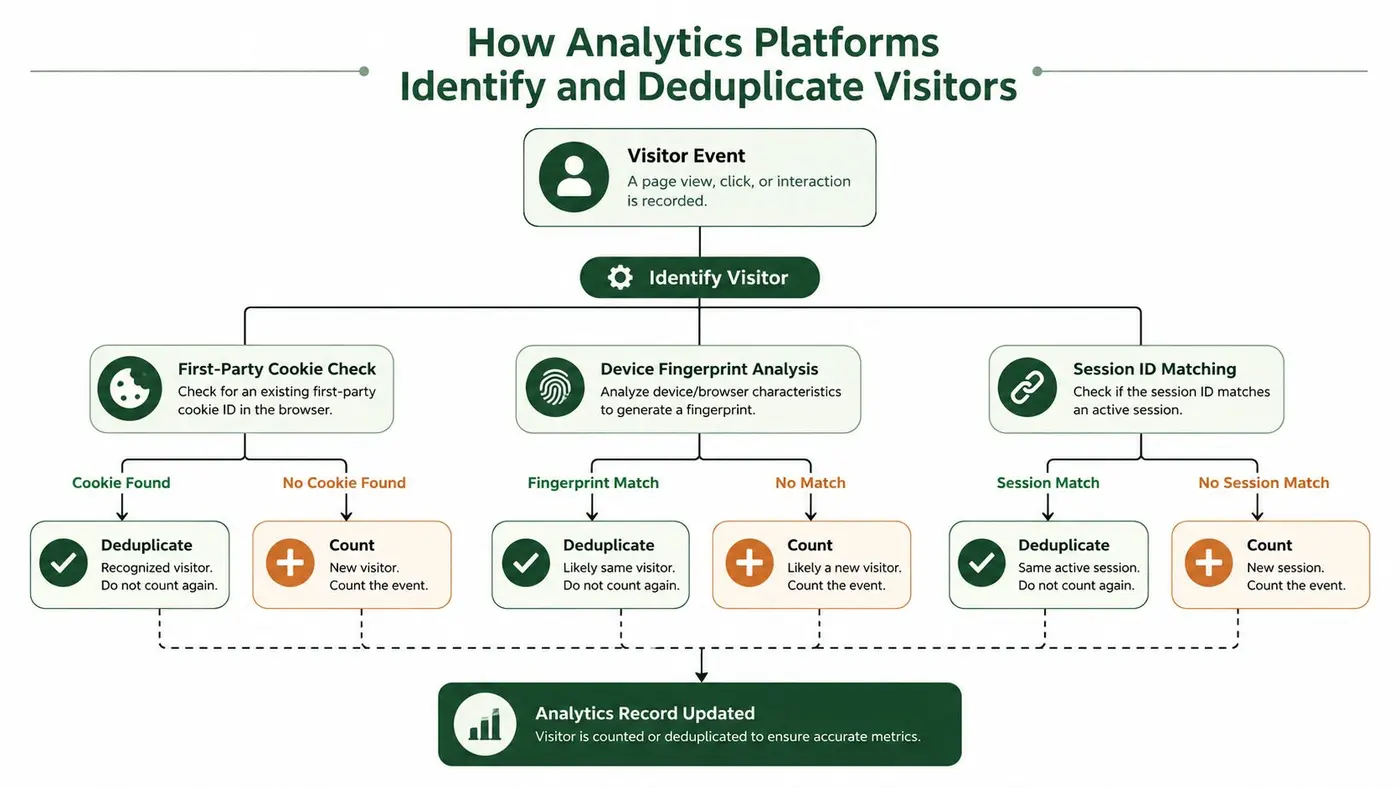
Analytics tools don't recognise people directly, they recognise patterns of identifiers. A platform sees an event, checks whether it has a matching browser cookie, device ID, or user ID, then decides whether to count that event as a returning identifier or a new one.
The main identification layers
First-party cookies are the standard starting point. They let a site recognise the same browser on return visits, but they only work as long as the cookie survives and the user keeps the same browser profile.
Device fingerprinting tries to infer identity from browser and device characteristics, but modern browser privacy protections make it less dependable than many teams assume. It can help in some contexts, but it's not a clean substitute for durable identifiers.
Logged-in user IDs are stronger because they tie activity to an authenticated account rather than a browser state. That's the closest many teams get to stable deduplication, but it only works when people sign in.
Browser storage and session IDs can help connect events within a visit, yet they don't solve cross-device duplication. They're useful for session continuity, not for a full person-level view.
Where deduplication breaks
A visitor can vanish from the identity chain when a cookie expires, when consent isn't granted, or when they move into a different browser environment. That's why deduplication is always conditional on the identifier rules a tool can see.
A clean report is often just a stable identifier at work.
For UK-facing reporting, Similarweb frames unique visitors by country and time period, which is helpful for market sizing and competitor benchmarking, but it also means the number only stays comparable when those filters stay constant (Similarweb unique visitors). Change the geography, the time window, or the identifier logic, and the reported count can move independently of actual demand.
That's why a traffic spike shouldn't be read in isolation. If cookie acceptance changes, if device mix shifts, or if cross-domain behaviour changes, the unique visitor total can move for reasons that have nothing to do with growth. CRO teams should always look at sessions and conversion rate beside the unique visitor figure before they assign cause.
Unique Visitor Versus Sessions and Pageviews
Teams often use unique visitors, sessions, and pageviews interchangeably, then wonder why their dashboards tell three different stories. They're not redundant metrics, they answer different questions.
A simple way to separate them
A unique visitor answers, “How many distinct identifiers did we see in this window?”
A session answers, “How many browsing visits started?”
A pageview answers, “How many pages were loaded?”
That means one shopper can create one unique visitor, multiple sessions, and many pageviews. If that shopper returns from a commute, a work laptop, and a home device, the unique visitor count may rise because the identifiers differ, while sessions and pageviews track the actual browsing activity more directly.
Comparing Core Web Analytics Metrics
| Metric | Definition | Strength | Weakness | Best Use Case |
|---|---|---|---|---|
| Unique Visitor | A distinct identifier counted once in a reporting window | Good for reach and audience sizing | Can overcount when one person uses multiple devices or browsers | Measuring audience reach |
| Session | One browsing visit or visit sequence | Better for engagement analysis | Doesn't show how many people you reached | Measuring visit frequency |
| Pageview | One page load | Shows content consumption | Not a people metric at all | Measuring content interest |
| Unique User | Often used interchangeably with unique visitor | Familiar to non-technical teams | Can hide the same identifier-based limitations | Stakeholder reporting |
If you're asking whether a campaign reached new people, unique visitors is the right lens. If you're asking whether the site held attention, sessions and pageviews tell you more. If you're asking whether an experiment improved behaviour, pair the traffic metric with conversion outcomes, not with reach alone.
Sample Calculations Showing Identity Fragmentation
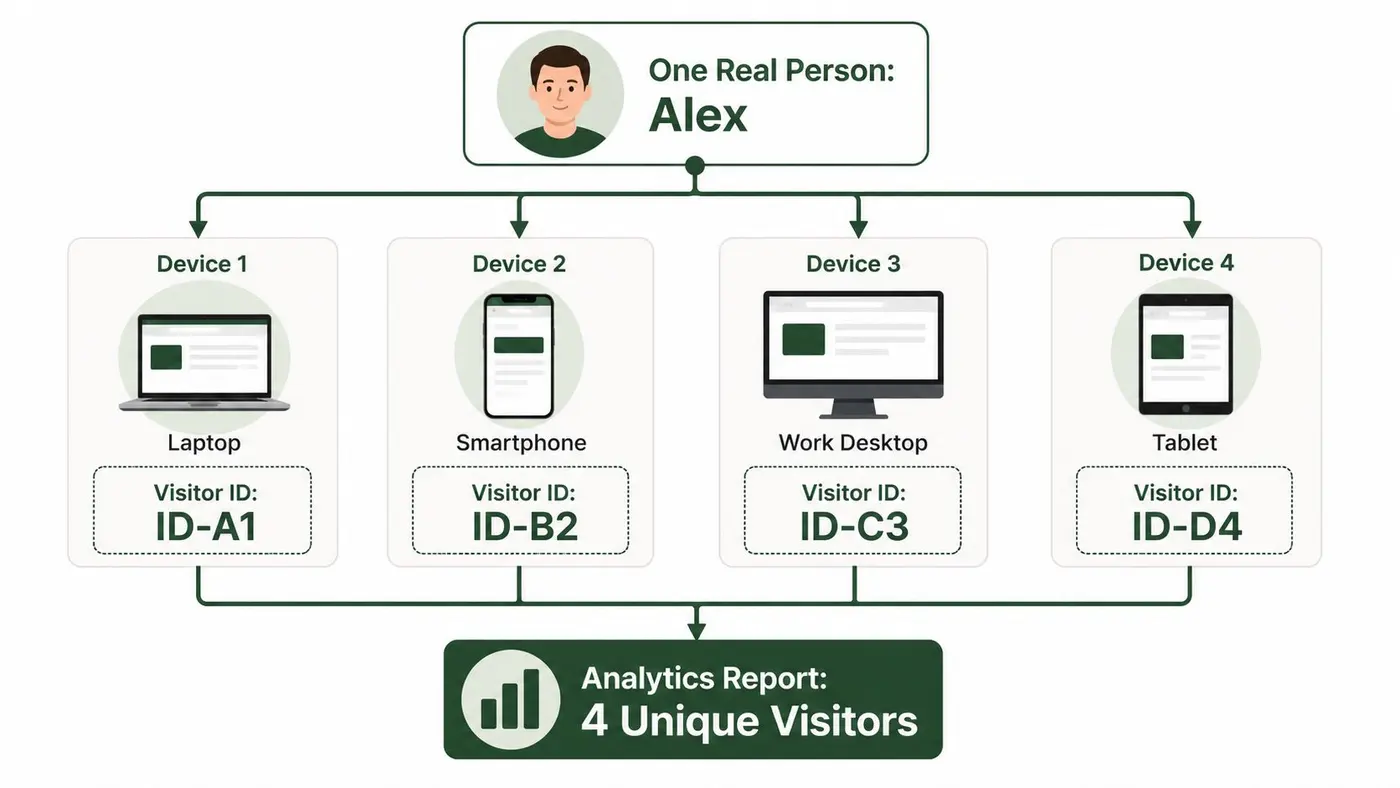
One real person can look like several unique visitors when their devices don't share an identifier. That's not a software bug, it's how browser-based measurement works.
A UK multi-device journey
A commuter starts on a phone during the train ride, checks the same site later on a work laptop, then completes the purchase on a home tablet. Each device can carry a different cookie or device ID, so the analytics system may count three unique visitors where there was only one person.
If the reporting window is one week, the platform sees three distinct identifiers inside that week. It deduplicates within each identifier, not across the human behind them, so the result is 3 unique visitors for what was really 1 person.
That inflation matters because it distorts reach and conversion maths at the same time. If you think three people reached the funnel and one converted, the interpretation feels very different from “one person used three devices and converted once.”
How the inflation compounds
The distortion gets larger as cross-device use rises. Ofcom reports that 98% of UK adults used the internet in 2024, and many households use multiple connected devices, which raises the chance that one person will be split across more than one identifier (Ofcom internet use in 2024).
Measurement rule: identity fragmentation doesn't just alter traffic totals, it also weakens the confidence you can place in any experiment denominator built from those totals.
For CRO teams, the useful question isn't whether unique visitor counts are “right” or “wrong.” The useful question is how much fragmentation your audience is likely to create, and whether that level of duplication is acceptable for the decision you're making. In a logged-in environment, you can collapse some of that duplication with a stronger user identifier. In anonymous traffic, you can't.
Privacy Regulations and Cookie Consent Impact on Counting
Privacy controls changed the way unique visitor counts behave. Consent banners, cookie refusal, and browser restrictions all reduce the continuity that analytics tools need to recognise the same identifier twice.
Consent changes the measurement, not just the compliance posture
When a user refuses cookies, the platform may lose the stable identifier it needs for deduplication. That can push the same person into new-visitor logic more often than a team expects, especially when sessions are separated by time or device.
Siteimprove warns that unique visitor metrics should be treated with caution because cookies are browser and device specific (Siteimprove unique visitor guidance). That caution is especially relevant in the UK because consent behaviour can change how much of the audience is visible to client-side analytics.
Why server-side thinking matters
Server-side tracking and first-party data strategies can help fill some of the gaps, but they don't erase the underlying measurement limits. They reduce reliance on fragile browser state, which makes reporting more stable, yet the same privacy and consent constraints still shape what gets observed.
Otter A/B's privacy and consent guidance is relevant here because experiment teams need to treat measurement design and compliance design as one system, not two separate tasks. If consent blocks tracking, the experiment may still run, but the visitor count behind it becomes less trustworthy.
If the identifier disappears, the count changes, even when the person didn't.
That's the core risk for UK traffic analysis. The business may read a shift in unique visitors as stronger demand or weaker acquisition, when the driver is changed visibility. CRO teams should treat consent banners and browser privacy settings as part of the measurement environment, not just the legal environment.
Interpreting Unique Visitor Data in Otter A/B Experiments
Unique visitor counts matter most when they feed experiments, because variant assignment only stays trustworthy if the identifier stays stable. Otter A/B uses traffic splitting and a frequentist z-test engine at a 95% confidence threshold, so the quality of the underlying visitor identity directly affects how fast and how safely a result can be read.
What to verify before trusting a winner
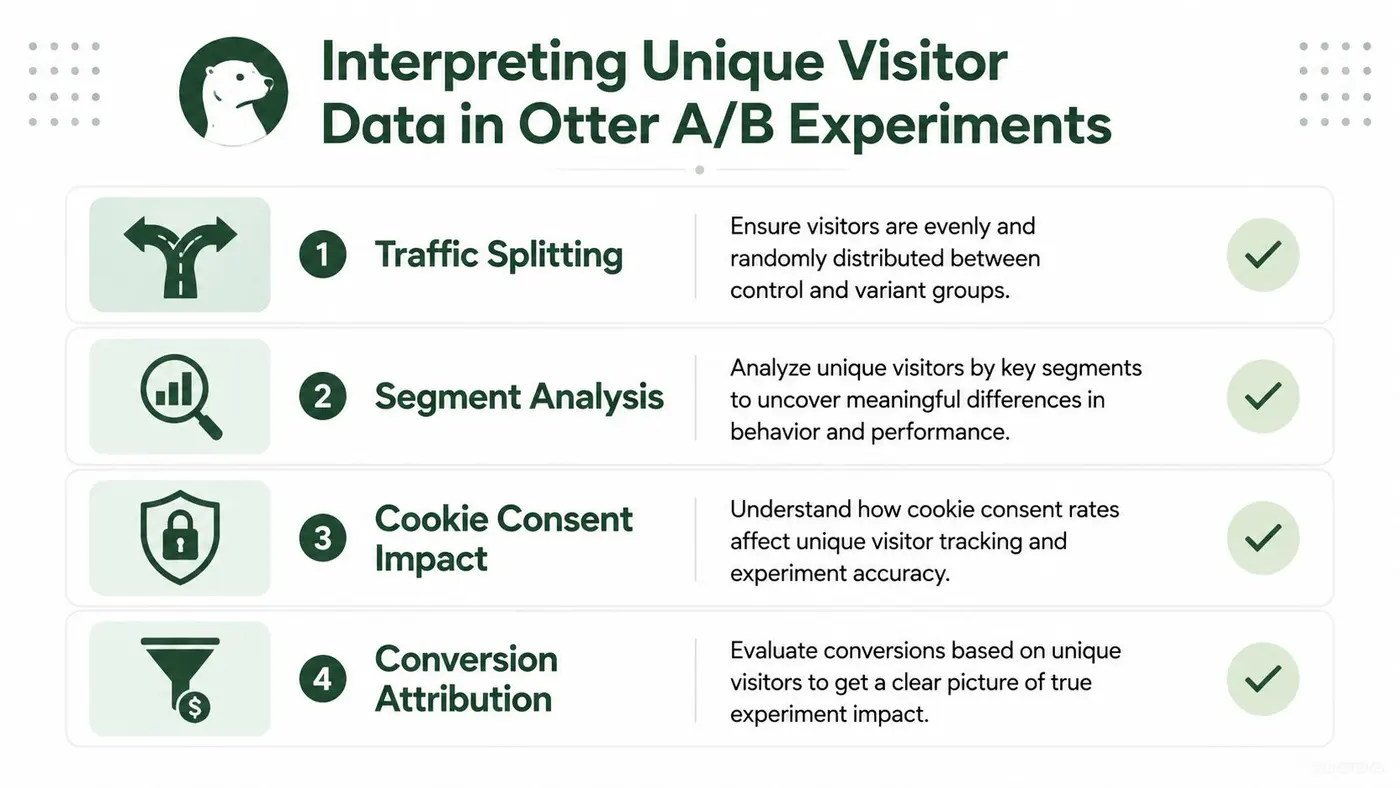
A/B tests should never rely on unique visitor counts alone. Check traffic splitting, then compare the visitor distribution with sessions and conversion data so you can spot imbalance early.
For teams building a structured testing programme, the article on growth experiments for startups is a useful companion because it frames experimentation as a process, not a single test result.
A practical reading order for experiment data
- Traffic Splitting: Confirm that both variants received traffic in the range you expected, and don't assume the unique visitor total tells the whole story.
- Segment Analysis: Look at device type, returning behaviour, and entry source, because identity fragmentation rarely affects every segment equally.
- Cookie Consent Impact: Check whether consent changes coincided with the test window, since consent refusal can alter the visible audience.
- Conversion Attribution: Read the result against purchases, average order value, and revenue per variant, not against visitor count alone.
The same discipline applies to Otter A/B's result analysis concepts, where the goal is to interpret outcomes with stable definitions rather than chasing a loud number. Otter A/B also tracks purchases, average order value, revenue per variant, and revenue trends, so the decision can rest on business outcomes instead of vanity traffic.
Presenting Unique Visitor Reports to Stakeholders
A CRO manager I'd trust won't walk into a leadership meeting and say the unique visitor count proves growth on its own. They'll show the number beside sessions, conversion rate, and revenue, then explain why the visitor figure may have moved because cookie consent changed, not because demand changed.
That framing protects trust. It also prevents the team from mistaking an identifier shift for a commercial win or loss.
How to talk about the number
Start with the definition stakeholders can repeat back: unique visitors are distinct identifiers seen in the reporting window. Then show the supporting metrics that tell the commercial story, especially when the unique visitor trend looks unusual.
A simple visual stack works better than a single headline number. Put unique visitors on top, then sessions, then conversion rate and revenue underneath, so the audience sees that traffic is only one part of the system.
The safest reporting language is honest and boring.
If a month's unique visitor count drops while sales hold steady, say the audience visibility changed before claiming the market shrank. If the count rises after a campaign, check whether sessions and conversion rate moved in the same direction before calling it a reach win.
The long-term goal is stakeholder literacy. Once leadership understands that unique visitor numbers are identifier-based and affected by privacy behaviour, they stop overreacting to every change in the traffic line and start asking better questions about business impact.
If you want to run experiments with cleaner traffic splits, stable reporting, and outcome metrics that go beyond visitor counts, take a look at Otter A/B. It's built to help teams test headlines, CTAs, and layouts while tracking the business numbers that matter, so you can judge winners without over-reading noisy unique visitor data.
Stop guessing
Ready to start testing?
Set up your first A/B test in under five minutes. No credit card required.
- 14-day free trial
- No credit card required
- Cancel anytime