Adaptive Testing Explained for Smarter Experiments
Learn what adaptive testing is, how it differs from fixed A/B tests, key algorithms and when to use adaptive testing for faster, smarter optimisation.
Your landing-page experiment has been running for several days. One headline is ahead, the team can see the gap in the dashboard, and yet everyone is told to wait until the fixed test window ends. During that wait, visitors keep seeing an experience that appears weaker, while the team collects more evidence about a decision it may already suspect.
That tension explains the renewed interest in adaptive testing. Instead of treating an experiment as a fixed journey from launch to final verdict, adaptive methods treat it as a continuous learning system. Traffic allocation changes as evidence develops, so the experiment can learn while reducing exposure to variants that appear less effective.
The important question isn't whether adaptive testing is automatically better. It isn't. The useful question is when speed of learning and reduced opportunity cost matter more than a clean, pre-planned validation result. A product team choosing a low-risk button label may reasonably value fast exploitation. A team approving a major pricing change may need a more controlled design and an auditable conclusion.
This guide builds that decision from the ground up. It explains how adaptive testing works, how it differs from fixed-horizon A/B testing, what the main algorithms do, and where implementation can fail. It also connects digital experimentation with UK education, where adaptive assessment has already operated across large national programmes, while recognising that scale brings serious requirements around item banks, security and governance.
Introduction to Adaptive Testing and Why It Matters Now
A growth team may see one variant drawing more sign-ups while still lacking enough evidence to satisfy its usual decision rule. Stopping immediately could turn a short-lived fluctuation into an expensive product choice. Waiting for the planned endpoint has a cost too, because potential customers continue to receive an experience that currently appears weaker.
Fixed-horizon testing addresses this uncertainty by setting the stopping point before launch. The team commits to a sample plan, keeps traffic allocation steady, and evaluates the result at the agreed endpoint. In a frequentist design, that discipline limits repeated peeking and reduces the temptation to call a winner because the latest results look favourable.
Adaptive testing treats the experiment as a continuous learning system. It monitors response data and adjusts which option receives the next visitor, learner, or candidate. A website test might send more traffic to a headline with the stronger current estimate while preserving exposure for alternatives. An educational assessment might select a harder or easier question after each answer.
The decision behind the method
The practical choice is between exploitation and certainty:
- Exploit early evidence: Give more users the experience that currently looks strongest, reducing the opportunity cost of sending traffic to weaker options.
- Preserve exploration: Keep testing alternatives so an early lead is not mistaken for a durable advantage.
- Protect validity: Match the design to the decision, particularly when the result supports a high-risk or externally scrutinised choice.
Otter A/B provides a useful context for this judgement. A low-risk interface change may justify acting on a promising direction sooner, especially when continued exposure to a weaker option has a clear business cost. A major pricing change, contractual decision, or other high-impact intervention may justify waiting for stronger statistical certainty, even if that delays exploitation.
UK education offers a practical reality check. Wales' personalised assessment programme used computer-adaptive delivery at national scale. In its first year, 268,000 learners completed the procedural numeracy assessment, representing 96% of the cohort in Years 2 to 9, according to the documented Welsh national assessment case study. The case study also reports completion comparable to earlier paper tests, showing that adaptive delivery can operate as a national service rather than remain a laboratory idea.
The method therefore depends on the decision, the cost of delay, and the consequences of being wrong. Adaptive allocation can act on early winners, while a fixed endpoint can provide the certainty a consequential decision requires.
What Adaptive Testing Really Means
A product team launches two onboarding paths. Early users favour one, but the team still needs to decide whether to send more traffic to it or keep exposure balanced until the evidence is clearer. Adaptive testing addresses that choice through a continuous feedback loop. It does not treat the planned endpoint as the only moment that matters.
A smart tutor follows a similar pattern. It asks a question, studies the answer, and chooses the next challenge. A correct answer can lead to a harder problem, while an incorrect answer can prompt an easier one that identifies the gap.
A navigation app also recalculates from live feedback. It responds to changing traffic instead of selecting one route and ignoring new conditions. Adaptive testing applies the same feedback loop to measurement or experimentation. Each observed outcome updates what the system does next.
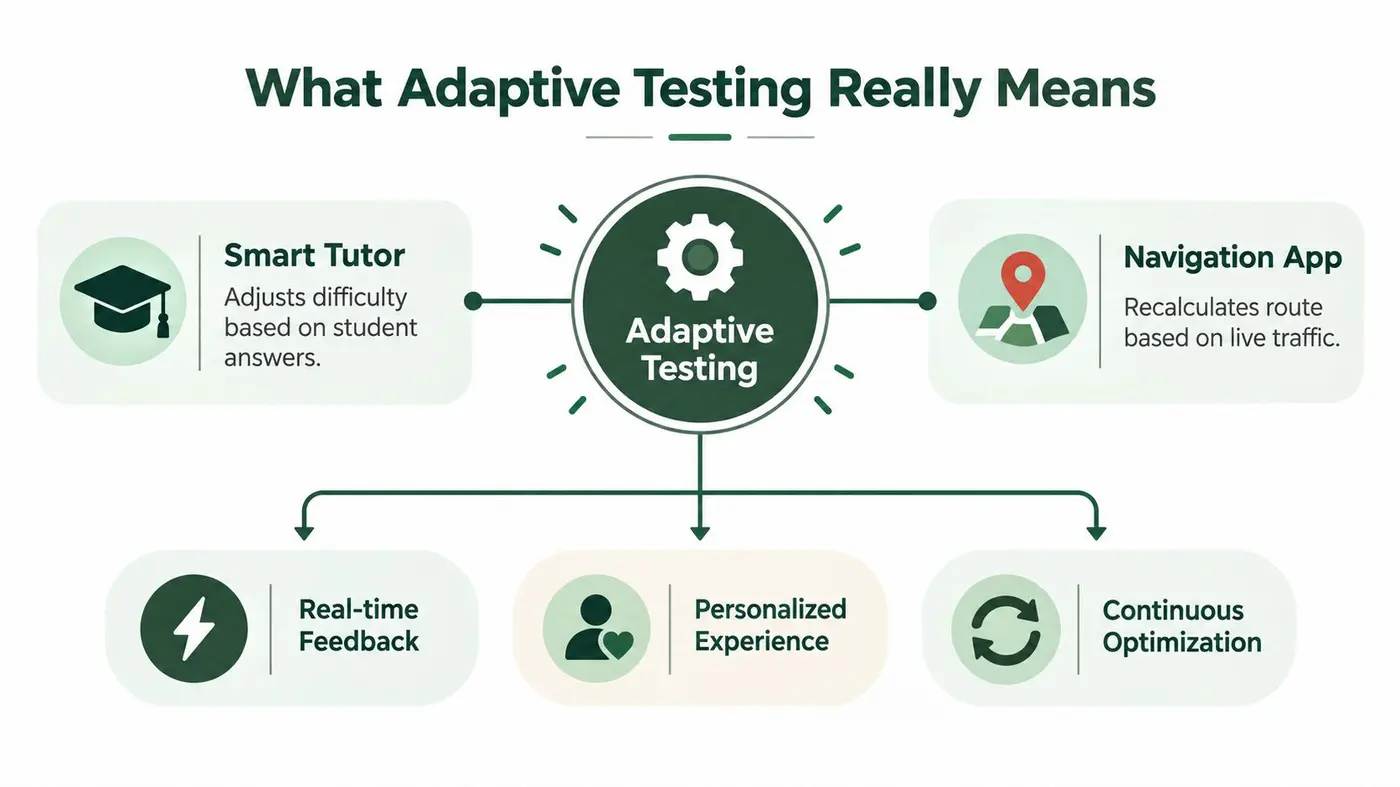
The feedback loop
A practical adaptive system usually performs four jobs:
- Start with a reasonable option. An assessment may begin with a mid-difficulty item. A website experiment may give each variant enough exposure to establish initial evidence.
- Observe the response. The system records an answer, conversion, completion, or another defined outcome.
- Update the estimate. It revises its view of learner proficiency or a variant's likely performance.
- Choose the next action. It selects a question, route, or variant that balances further exploration with the current best option.
UK guidance describes computer-adaptive assessment as a process in which later items become harder after correct answers and easier after incorrect answers, while the computer continually updates the proficiency estimate. The AQA introduction to adaptive testing explains that item difficulty and discrimination are established before live use. The algorithm is not improvising from a raw tally.
For marketers, the distinction is important. Sending more traffic to a leading variant does not by itself create a sound adaptive test. The system needs an allocation rule, a meaningful outcome, safeguards against excessive exploitation, and a statistical model that accounts for changing exposure.
Not just early stopping
Early stopping ends a test once a rule is met. Adaptive allocation changes what happens during the test. They can be used together, but they answer different operational questions.
Suppose an onboarding path leads after the first wave of users. An early-stopping rule might end the experiment and declare a winner. An adaptive approach can increase traffic to that path, preserve some exploration for alternatives, and keep updating the estimates. The team may exploit a promising direction sooner, while accepting that the final interpretation depends more heavily on the allocation algorithm and its assumptions.
The clearest mental model is:
Fixed testing asks, “Which result do we have at the planned endpoint?” Adaptive testing asks, “Given what we know now, what should we show next while continuing to learn?”
Adaptive allocation and statistical perspective are separate design choices. For a useful explanation of those perspectives, compare Bayesian and frequentist testing. Bayesian updating can support decisions based on current probabilities, while frequentist analysis focuses on evidence under a specified testing procedure. The practical choice is whether the team should act on a promising lead now or wait for stronger certainty before treating it as validated.
How Adaptive Testing Compares to Fixed Horizon A/B Testing
A product team has a promising onboarding variant, but the result is still uncertain. Sending more traffic to it could improve the experience sooner. Declaring it the winner too early could turn an early fluctuation into a costly rollout. Adaptive and fixed-horizon testing handle that tension differently.
A fixed-horizon A/B test keeps the traffic split stable while the planned sample accumulates. Before launch, the team defines the primary metric, sample requirement, and analysis rule. At the endpoint, it applies the selected statistical test. Otter A/B's significance testing approach uses a frequentist z-test with a 95% confidence threshold, designed to assess whether the observed difference is sufficiently incompatible with the null hypothesis under the test's assumptions.
Adaptive testing treats the experiment as a continuous learning system. Allocation changes as evidence develops. A variant that currently performs well may receive more visitors, while alternatives retain enough exposure to show whether the apparent lead persists. This supports early exploitation, but it also means the reporting model must account for changing exposure and the rules that directed traffic.
| Dimension | Adaptive Testing | Fixed Horizon A/B Testing |
|---|---|---|
| Primary objective | Learn and exploit during the experiment | Estimate performance at a planned endpoint |
| Traffic allocation | Changes in response to observed outcomes | Usually remains fixed according to the test plan |
| Stopping rule | May use ongoing decision criteria or continue learning | Defined before launch or tied to a planned sample |
| Statistical logic | Often uses posterior probabilities or exploration bounds | Often uses a pre-specified frequentist comparison |
| Visitor experience | Can reduce exposure to a currently weaker option | Preserves balanced exposure during the test |
| Interpretation | Depends on the allocation algorithm and reporting model | Easier to audit when the design is followed |
| Best fit | Lower-risk optimisation and continuous allocation | High-stakes decisions requiring definitive proof |
Why fixed horizons still matter
A fixed horizon gives stakeholders a stable comparison point and makes the analysis easier to reproduce. Stopping whenever a dashboard looks convincing can inflate false positives. Teams that inspect results repeatedly need a sequential design, not casual peeking. The guide to sequential testing explains why a defined stopping framework matters when results are reviewed continuously.
Adaptive testing is useful when the cost of showing a weaker option matters, outcomes arrive quickly enough to guide allocation, and the team accepts model-driven decisions. A fixed horizon fits decisions that support a major rollout, regulated work, a contractual commitment, or a claim stakeholders must audit closely.
The choice does not have to be permanent. A team can use adaptive allocation to learn which directions deserve attention, then run a controlled fixed-horizon test on a finalist. That separates learning quickly from proving carefully. Use adaptive testing to act on an early lead when the downside is limited. Wait for fixed-horizon evidence when certainty, auditability, and rollout risk matter more than immediate optimisation.
Core Algorithms Behind Adaptive Testing Explained Simply
Adaptive algorithms decide how much attention to give the option that currently performs best and how much to reserve for options that remain uncertain. The difference matters because adaptive testing is a continuous learning system. It can exploit an early lead when showing a weaker option carries a real cost, then keep exploring when the evidence is still too thin for a confident decision.
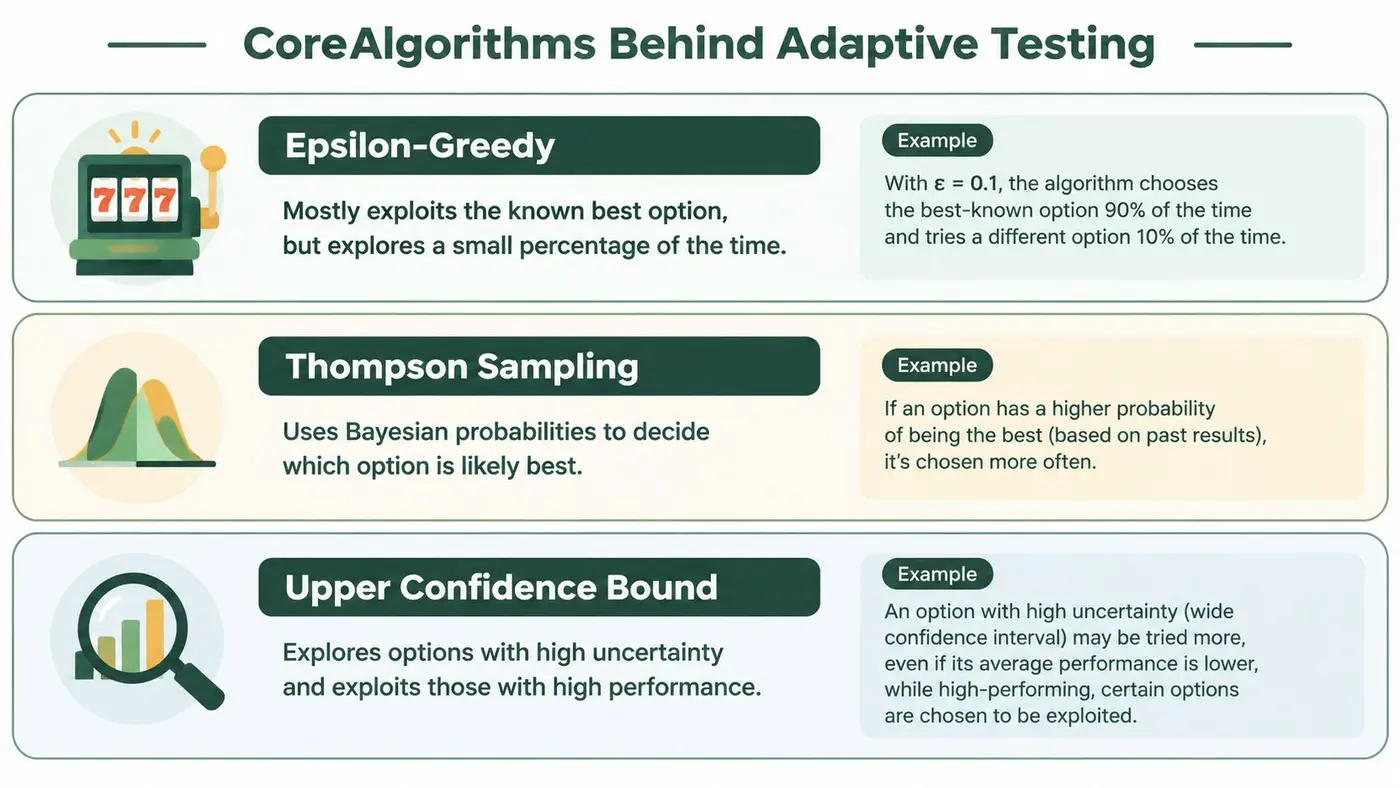
Epsilon-greedy
Epsilon-greedy uses an easy rule. Most traffic goes to the variant with the strongest observed result. A smaller share deliberately goes to other variants so the system can continue learning.
Three call-to-action labels might compete in a test. If “Start your free trial” leads after the early observations, the algorithm will usually route the next visitor there. Its exploration component still sends some visitors to the other labels. This makes the method straightforward to explain and implement, while putting real weight on the chosen exploration rate.
A rate set too high can keep sending traffic to weaker options after the learning value has declined. A rate set too low can let an early, noisy result determine allocation before the test has learned enough. Epsilon-greedy fits teams that want operational simplicity and can manage exploration with a clear policy.
Thompson Sampling
Thompson Sampling represents each variant with a probability-based belief about its likely performance. It samples from those beliefs to choose what appears next. A variant with a strong estimated conversion rate receives more traffic, while a less-tested variant can still receive attention if its possible upside remains credible.
A headline with a modest lead and substantial evidence may receive regular exposure. A newer headline with fewer observations can sometimes receive more traffic because its performance is still uncertain. The algorithm therefore adjusts the balance between exploiting a likely winner and exploring an unresolved possibility.
Thompson Sampling suits teams that want adaptive allocation without choosing one fixed exploration percentage. Its Bayesian output also needs careful explanation. The probability that a variant is best is not the same statement as a frequentist confidence result, so reporting language should match the method.
Upper Confidence Bound
Upper Confidence Bound, or UCB, applies optimism in the face of uncertainty. It evaluates observed performance alongside the uncertainty around that estimate. A variant can attract traffic because it performs well, or because the system has not gathered enough evidence to rule out a stronger result.
An onboarding experiment may compare an established path with a newer one. The established path can have the higher current rate, while UCB still tests the newer path if its upper confidence bound leaves room for meaningful improvement. As more evidence arrives, uncertainty narrows and allocation becomes increasingly driven by observed performance.
UCB is easy to describe, but its confidence calculation and tuning choices affect behaviour. It can suit experiments where exploration has strategic value and an early sample imbalance could otherwise bury a promising alternative. The multi-armed bandit explanation offers further context for these explore-versus-exploit strategies.
No algorithm repairs a weak experiment design. Each approach still needs a stable primary metric, credible variants, reliable tracking, and safeguards for changes in audience or context. The algorithm controls allocation. It does not decide whether a conversion matters to the business. When an early lead is useful for low-risk optimisation, adaptive allocation can act on it. When a rollout requires statistical certainty and close auditability, the team should wait for stronger evidence.
Benefits and Trade Offs You Must Weigh Before Switching
A product team sees one variant pull ahead early in an Otter A/B experiment. Adaptive testing can send more traffic toward that candidate while continuing to learn about the others. This turns experimentation into a continuous learning system, rather than a fixed-horizon comparison that treats every observation as equally valuable until the end. The benefit is lower opportunity cost, but the team gives up some simplicity and control.
Use early allocation when the decision is low risk and serving a likely winner has immediate value. Wait for stronger statistical certainty when the result will guide a broad rollout, affect a sensitive audience, or require close auditability. Adaptive testing helps with allocation. It does not remove the need for a stable primary metric, reliable tracking, or a clear stopping and rollout policy.
UK assessment shows why adaptation can be useful beyond website optimisation. Scotland's National Standardised Assessments use adaptive tests in literacy and numeracy to provide diagnostic information for teachers and progression data for policymakers. Wales' statutory personalised assessments in reading and numeracy use adaptive delivery across Years 2 to 9. The AQA overview of adaptive testing explains that changing item difficulty can support measurement across a wider ability range, while also creating comparability questions.
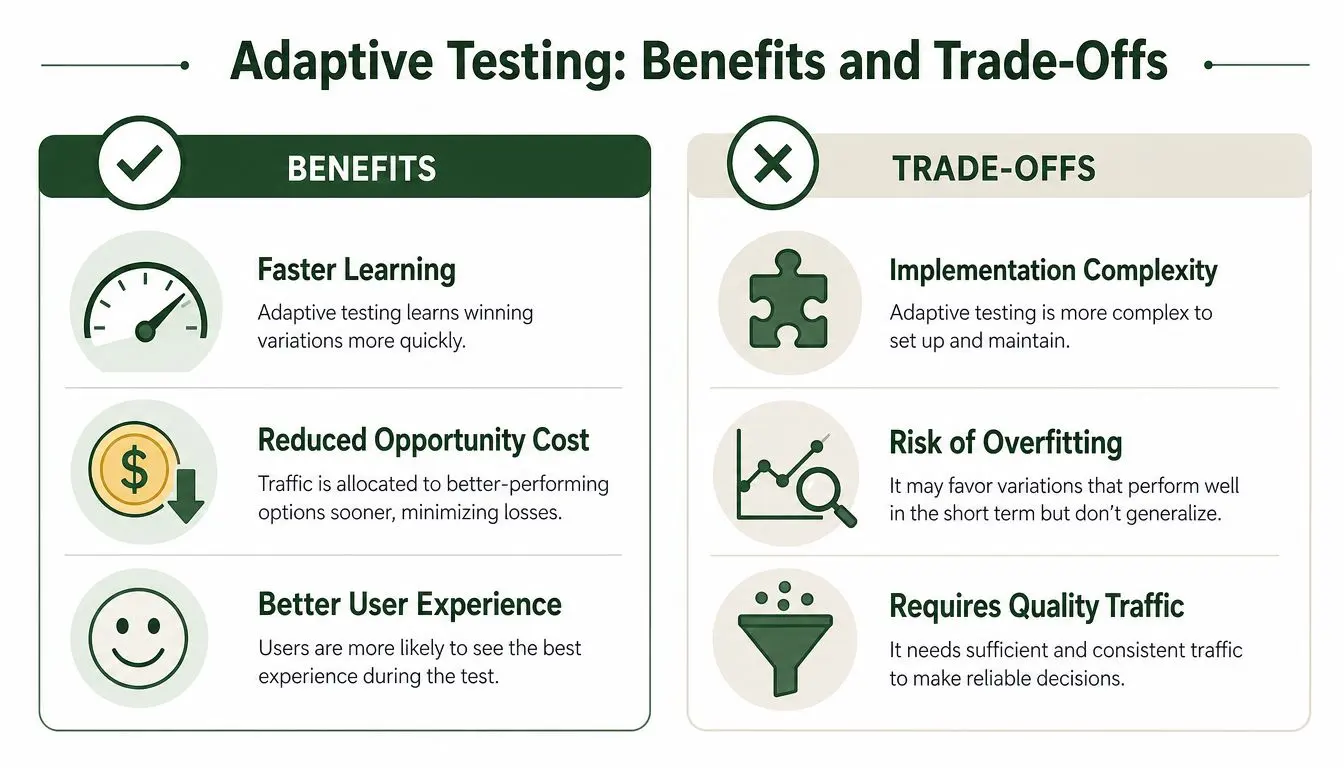
What you gain
- Faster learning: Allocation responds to new evidence instead of waiting for equal exposure.
- Lower opportunity cost: Fewer visitors may receive an option that appears persistently weaker.
- A more relevant experience: Users can receive the experience that currently fits their needs or behaviour best.
- Better range coverage: In assessment, targeted item selection can measure learners at different ability levels more effectively.
What you take on
The first cost is implementation complexity. Educational assessment depends on pretested and calibrated item parameters. Experimentation needs the equivalent: a dependable variant catalogue, stable event instrumentation, and an allocation engine that can separate genuine signal from noise.
Interpretation also becomes harder. Raw scores may not remain directly comparable when the system selects different questions or exposes variants at different rates. The AQA overview notes that raw scores are not comparable in the usual way and that adaptive testing does not suit every subject.
Governance adds another layer. The UK government's Curriculum and Assessment Review says evidence for wider implementation remains limited and that broad rollout would bring considerable delivery implications. In product work, those demands include security, audit trails, fairness checks, content coverage, and recovery plans when allocation behaves unexpectedly.
Business rule: Adopt adaptive allocation when the value of serving a likely winner during learning outweighs the value of a simpler, more controlled final comparison.
Real World Use Cases and Common Pitfalls to Avoid
A retailer tests two product-page headlines. One attracts more leads early, so an adaptive system increases its exposure while keeping the alternative in rotation. If the audience mix changes, the second headline can regain traffic. The experiment therefore works like a live allocation system, not a fixed contest in which every option receives identical traffic until the end.
That early allocation is useful when the cost of showing a weaker option is immediate and the outcome arrives quickly. It is less suitable when the team needs a defensible final comparison, or when a late conversion can reverse the initial result. In Otter A/B, the practical question is whether to act on a provisional winner during learning or wait for statistical certainty before committing.
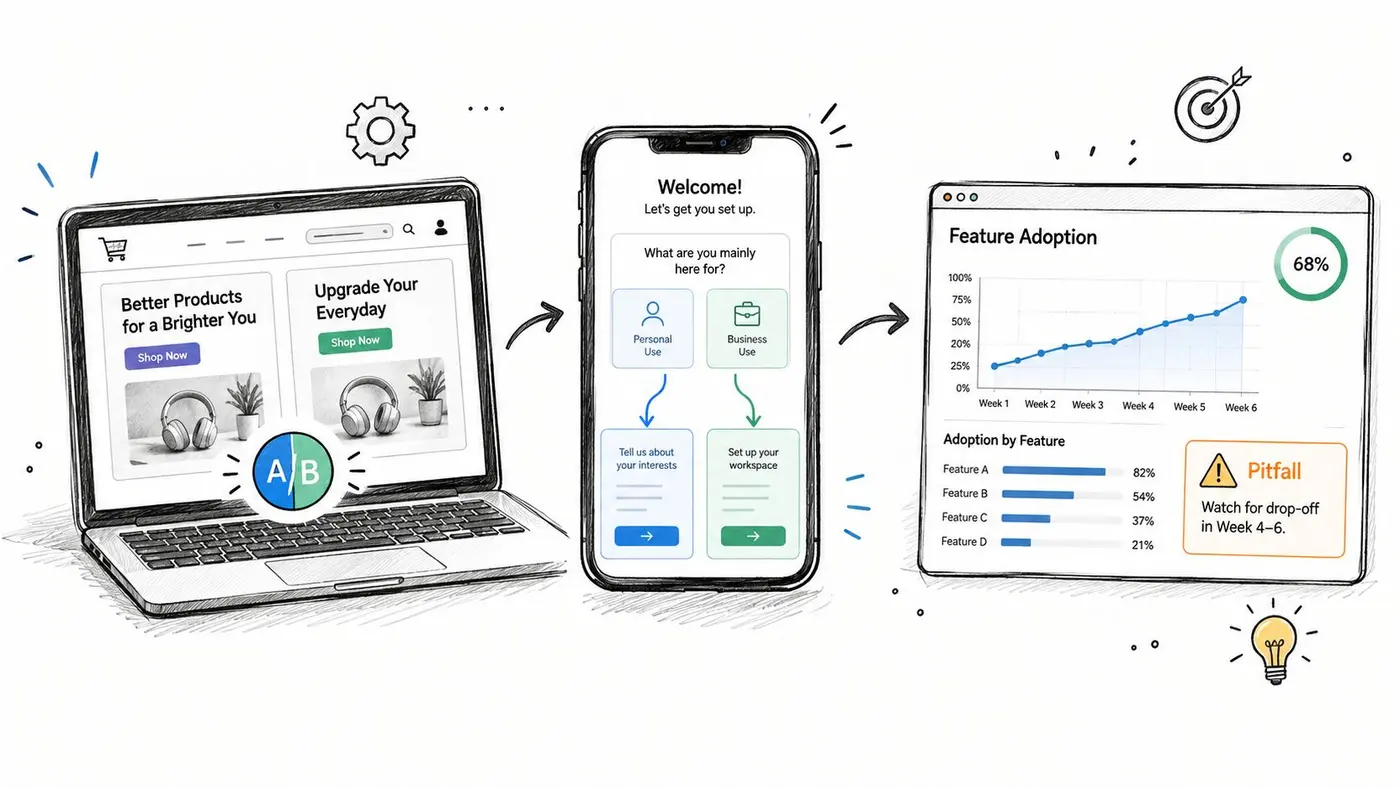
Product teams can apply the same pattern to onboarding. Several flows may guide new users toward their first successful action. The system can explore different sequences, observe activation, and favour the route that appears to move users toward the intended milestone. Feature adoption experiments can use similar logic to compare prompts, placements, or explanations that seek engagement.
Education offers a large-scale example. Wales' programme delivered a procedural numeracy assessment to 268,000 learners, reaching 96% of Years 2 to 9 learners in its first year, as described earlier in the Welsh programme case study. A University of Hertfordshire doctoral study documented a computer-adaptive test for computer science undergraduates, with scores from 320 participants highly correlated across test forms, according to the University of Hertfordshire research record.
Where teams get into trouble
A small or weak variant bank limits learning. Adaptive allocation cannot create meaningful differences from a few near-identical options. Assessment item banks need calibrated difficulty and discrimination. Marketing variants need distinct hypotheses and enough quality to justify continued exposure.
Over-exploitation creates a second risk. An early lead may reflect audience mix, novelty, or random variation. If the algorithm sends nearly all traffic to that option too soon, the team may miss a stronger choice for a valuable segment. Exploration needs to continue at a controlled level.
Dashboard visibility also needs a stopping rule. Adaptive allocation does not remove the need for monitoring, correction, or a clear decision policy. It may perform poorly for slow outcomes, metrics with substantial post-conversion lag, or assessments where item sequencing changes what is being measured.
Security and fairness require operational records. Different users seeing different experiences can reduce repetition while making debugging and stakeholder review harder. Keep allocation logs, preserve the original hypothesis, monitor segment behaviour, and record why exposure changed.
How to Adopt and Measure Adaptive Testing Successfully
A team is deciding whether to send more traffic to an early winner or wait for a fixed-horizon conclusion. The right choice depends on the decision, the risk of being wrong, and how quickly the outcome becomes visible. Start by defining the action the result will support, the acceptable downside of a wrong decision, and whether stakeholders need an auditable fixed-horizon result.
Use this checklist before implementation:
- Traffic quality: Can the experiment receive enough relevant responses for the system to learn without being dominated by noise or changing audiences?
- Variant depth: Do the alternatives represent meaningful hypotheses, rather than cosmetic changes competing for the same small effect?
- Risk tolerance: Is it acceptable to allocate more traffic to a provisional winner, or would balanced exposure protect the business better?
- Metric timing: Does the outcome arrive quickly enough to guide the next allocation?
- Proof requirement: Does the decision need a formal, pre-planned statistical conclusion?
Build the operating system
Define conversion events and revenue outcomes before launch. Track the primary metric with supporting measures, including purchases, average order value, revenue per visitor, and longer-term retention where relevant. A short-term lift can mislead if a variant attracts users who are less valuable later.
Connect the allocation logic to the delivery stack. Assignment, exposure, conversion, and exclusion events should remain consistent across browsers, devices, and returning sessions. Record which variant each person saw, when allocation changed, and which rule caused the change. These records make an adaptive system reviewable rather than opaque.
Review performance at regular intervals, while keeping the original hypothesis intact. Monitor overall results, important audience segments, technical errors, and signs that the system is exploiting too aggressively. If the outcome will determine a major rollout, follow adaptive exploration with a controlled validation phase. Early allocation helps learning and opportunity capture. The later validation phase tests whether the apparent advantage holds under balanced conditions.
Adaptive testing also needs ownership and governance. Set access controls, check data quality, version variants, prepare incident recovery, and name the person responsible for stopping the system. These controls matter because different users may receive different experiences, which can complicate debugging and stakeholder review.
Otter A/B provides website experimentation features including snippet-based setup, variant creation, conversion and revenue tracking, frequentist significance reporting at a 95% confidence threshold, and support for multi-armed bandit experiments through Bayesian reporting, as described in its experimentation platform overview.
The practical rule is clear. Use adaptive testing when continuous learning and live allocation are more valuable than equal exposure. Wait for fixed-horizon validation when certainty, comparability, and auditability carry greater weight. Treat the methods as complementary: exploit a credible early winner when the downside is limited, and wait when the decision is costly, slow-moving, or difficult to reverse.
Stop guessing
Ready to start testing?
Set up your first A/B test in under five minutes. No credit card required.
- 14-day free trial
- No credit card required
- Cancel anytime