Increasing Average Order Value: A Tactical Playbook
Start increasing average order value profitably. Our tactical guide covers diagnosis, bundling, thresholds, and how to run A/B tests with Otter A/B.
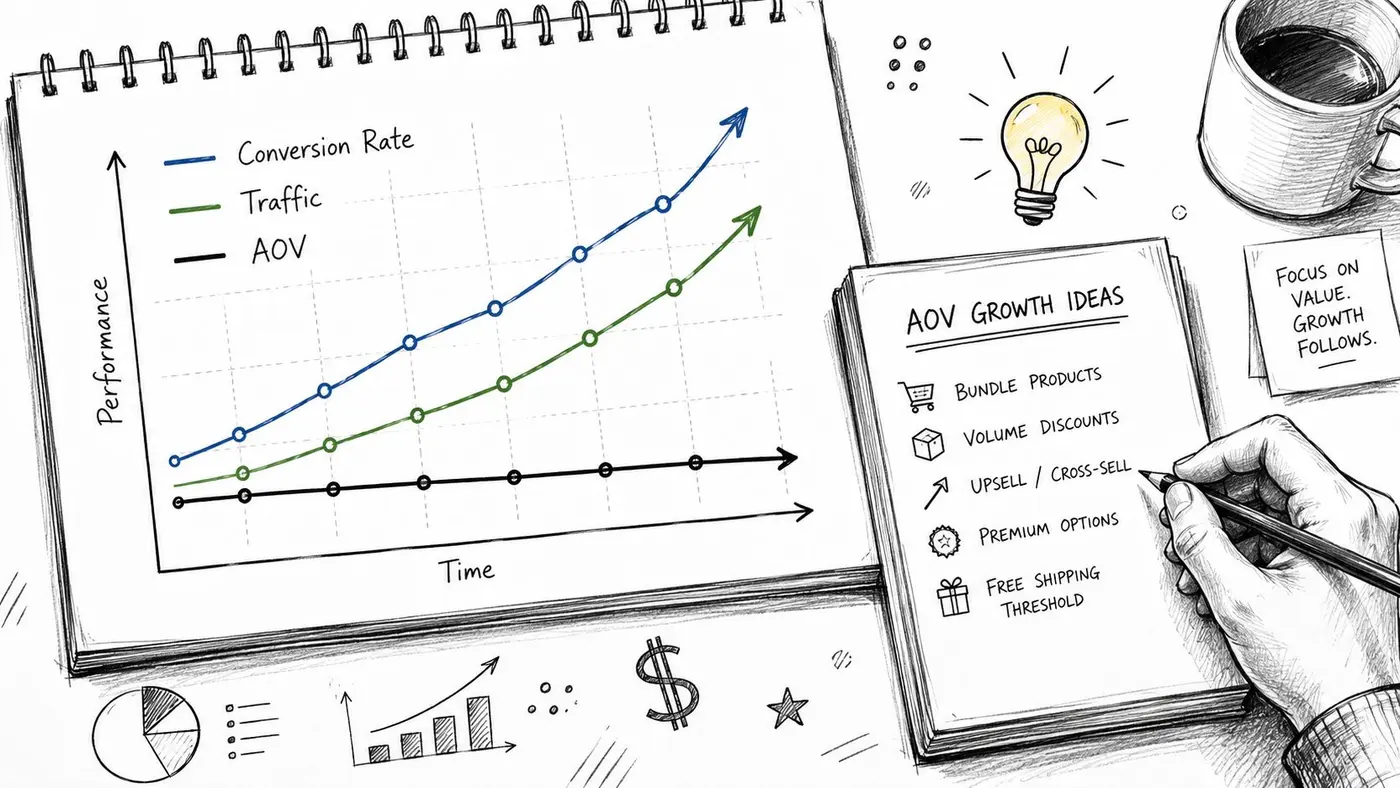
Your traffic looks fine. Conversion rate isn't the immediate problem. Orders are coming in. But average order value hasn't moved in months, and every meeting turns into the same suggestion list: add free shipping, launch a bundle, push an upsell.
That's where teams often make the wrong move. They chase a bigger basket number and forget to ask whether that basket is still worth having after discounting, shipping subsidy, and any drop in conversion. A higher AOV can still be a worse commercial outcome if margin gets squeezed or if too many shoppers walk away.
Beyond the Metric Why Profitable AOV Growth Matters
Most AOV advice is too shallow. It treats increasing average order value as an automatic win, when the harder question is whether the increase survives contact with your P&L.
A common example is the free-shipping threshold. It can work well. It can also train shoppers to pad the basket with low-margin items, or to hold off until a promotion appears. That trade-off is exactly what many tactic round-ups ignore. As Zip's AOV guidance points out, a frequently under-addressed question is whether raising AOV can destroy margin or backfire on conversion.
That's why I prefer to treat AOV as a profitability optimisation problem, not a merchandising vanity metric. Bigger orders are useful only when they create better economics overall. If your bundle shifts customers from full-price hero products into discounted kits, you may celebrate a higher basket while subtly lowering contribution per order.
What a strong AOV playbook actually protects
The right approach forces the team to check more than one number:
- Basket value: Did shoppers spend more per completed order?
- Conversion behaviour: Did more people finish checkout, or did the offer add friction?
- Margin quality: Did the extra item or incentive preserve enough commercial value to justify the change?
- Segment effect: Did the tactic help everyone, or only desktop, returning, or high-intent visitors?
Practical rule: Never approve an AOV tactic because it “feels smart”. Approve it because it improves revenue quality after the trade-offs.
If you want a useful companion read before building your own test queue, SelfServe's guide to higher AOV is worth reviewing because it gives a broad tactical backdrop. The missing layer, and the one that matters most in practice, is disciplined validation.
What usually works and what usually disappoints
In day-to-day CRO work, a few patterns repeat.
| Approach | What tends to happen |
|---|---|
| Relevant product suggestions | Often lifts basket value without needing more traffic |
| Sensible spend thresholds | Can nudge one more item into the cart |
| Blanket discounting | Often raises basket size while cutting too deeply into margin |
| Irrelevant add-ons | Add interface noise and weaken the buying path |
The point isn't to avoid AOV tactics. It's to stop treating all AOV growth as equal. Profitable AOV growth is slower, stricter, and much more defensible.
First Diagnose Your Current AOV Performance
Before changing a single message, offer, or layout, calculate the obvious baseline: revenue divided by orders. That's the clean starting point. But it won't tell you where the problem lies.
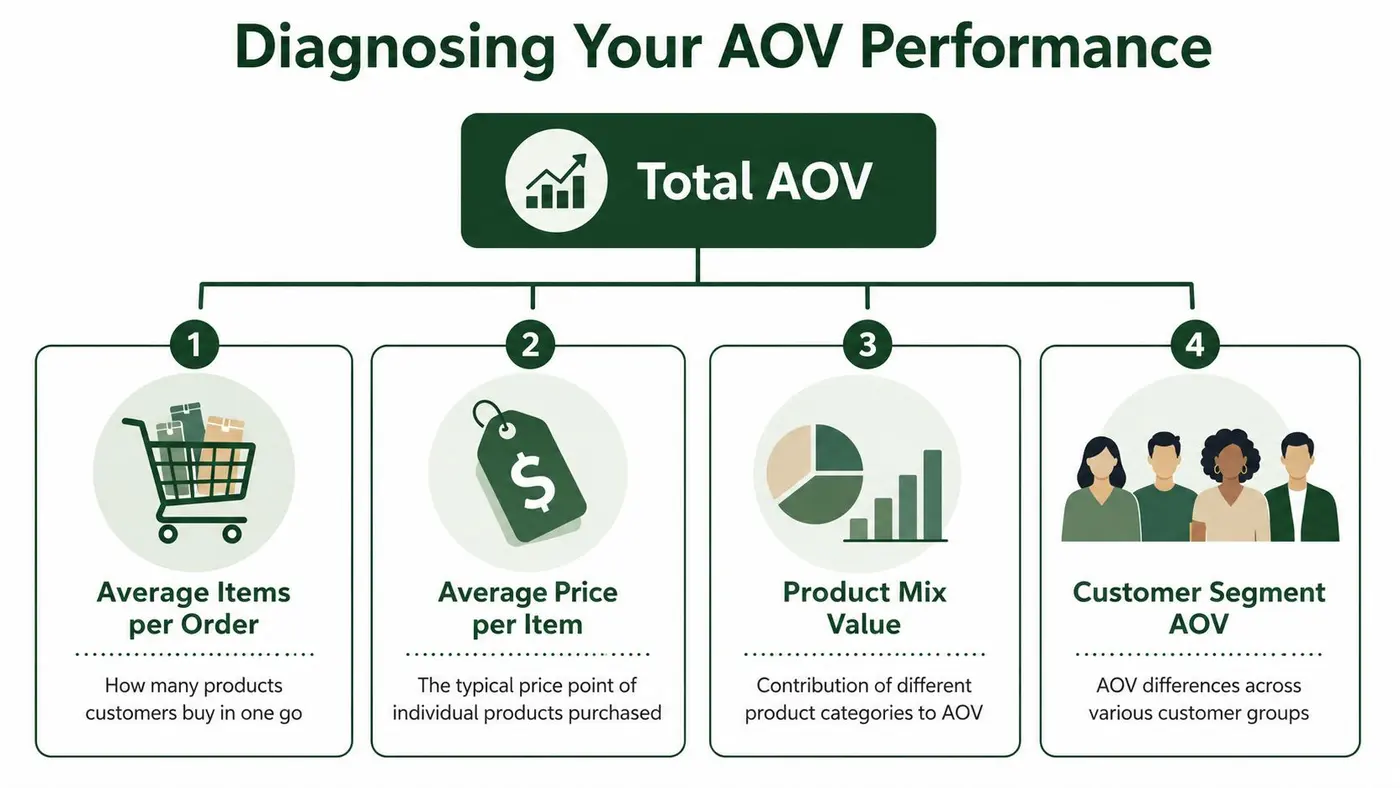
AOV usually isn't flat everywhere. It's flat in specific pockets. New customers might buy one item while returning customers buy sets. Desktop users might build larger baskets than mobile users. Organic search visitors might behave differently from paid social traffic because their intent is different before they ever land on the product page.
Segment first, then interpret
Start with a simple diagnostic cut across four dimensions:
-
Customer type
Separate new and returning customers. Returning buyers often have more trust and more context, which can support stronger bundle or add-on acceptance. -
Channel
Compare organic, email, paid search, paid social, affiliate, and direct traffic. Channel-level intent shapes basket depth. -
Device
Mobile often hides merchandising opportunities that desktop surfaces more clearly. If mobile AOV lags, the problem may be presentation rather than demand. -
Category or collection
A store-wide AOV can hide category-specific behaviour. Accessories, replenishment items, giftable products, and premium ranges behave differently.
Look for the pattern behind the number
A useful diagnosis doesn't stop at “mobile AOV is lower”. It asks why.
- Lower items per order often points to weak cross-sell exposure or limited cart visibility.
- Lower average price per item can suggest that visitors are defaulting to entry-level SKUs and never seeing a premium alternative.
- Category mix shifts may mean some traffic sources bring bargain-seeking behaviour while others bring higher-intent buyers.
- Payment method effects can reveal whether flexible payment options support larger baskets or just move risk elsewhere.
That last point matters in the UK right now. The interaction between pay-later options and basket size deserves its own cut of the data. As Replo notes in its AOV analysis, the useful question isn't whether instalment options sound modern. It's whether flexible payments increase AOV for specific UK segments or shift risk.
Don't diagnose AOV at the store level if shoppers don't behave like one store-level audience. They rarely do.
Build a working baseline
I like to turn diagnosis into a short operating sheet rather than a dashboard that nobody revisits. Include:
- Current AOV by segment
- Orders by segment
- Revenue by segment
- Top categories attached to high-AOV orders
- Payment mix by segment
- Candidates for upsell, cross-sell, and threshold tests
A simple forecasting pass helps too. Otter A/B's revenue impact calculator is useful for estimating how a change in order value or conversion could affect commercial outcomes before you put developer time behind a test.
What you're trying to find
You want asymmetry. AOV opportunities are rarely spread evenly.
| Signal | Likely opportunity |
|---|---|
| Returning customers buy broader baskets | Test bundles or replenishment add-ons |
| Mobile AOV trails desktop | Simplify offers and improve in-cart suggestions |
| Paid social converts but with thin baskets | Use entry-point upsells and lower-friction cross-sells |
| Specific category has strong item attachment | Package products into a clearer bundle |
Good diagnosis gives you a shortlist. Great diagnosis tells you which ideas are worth testing first because they have the highest chance of improving basket value without weakening the rest of the funnel.
Implement High-Impact Product Suggestion Tactics
Once you know where basket value is leaking, the next move is usually some form of product suggestion. Through this, many stores make money back without touching acquisition.
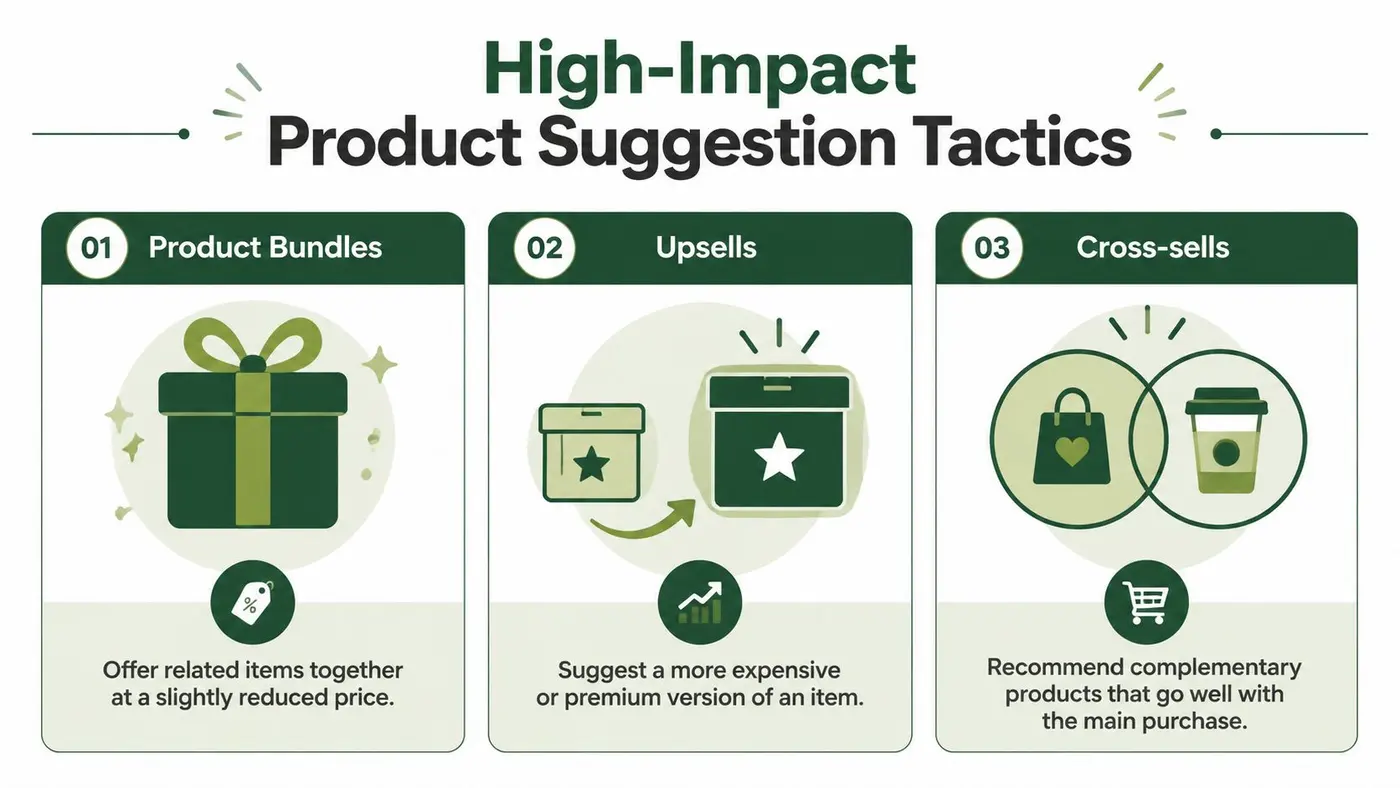
Industry guidance is consistent on this point. Upsells, cross-sells, and bundles are the most effective AOV levers, and Optimizely's AOV definition makes the important point that AOV can be increased without buying more traffic. That's why these tactics deserve so much attention in increasing average order value work.
Upsells raise the price point
An upsell moves the shopper to a better, bigger, or more premium version of what they were already considering.
This works when the premium option is easy to understand. Better materials, stronger features, larger pack size, longer warranty, or a curated premium edition. It fails when the difference is vague or when the jump feels like a different purchase altogether.
A few practical placements tend to work:
- On the product page: Show a premium variant before the shopper commits to the base option.
- Inside the configurator: If a buyer is selecting features, present the stronger package at the moment of choice.
- In-cart for compatible upgrades: This works only when the switch is low-friction and obvious.
What doesn't work is forcing an upsell that requires the shopper to relearn the product. If they came for a simple purchase, don't turn it into homework.
Cross-sells increase basket breadth
A cross-sell adds a complementary product. Many retailers, however, leave money on the table by showing irrelevant accessories or burying the recommendation too late.
The best cross-sells answer one question: what else does this customer need to get full value from the primary item?
For example:
- A skincare product paired with the matching cleanser
- A coffee machine with filters and descaler
- A desk paired with cable management or a monitor stand
- A camera body paired with a memory card or carry solution
Placement matters more than is often realized. Product pages catch planners. The cart catches shoppers who are already assembling an order. Post-purchase works for low-friction add-ons, but it won't save a weak pre-purchase merchandising strategy.
If your team needs a clean breakdown of where these two tactics differ in live ecommerce journeys, Otter A/B's guide to cross-selling vs up-selling is a practical reference.
Relevant cross-sells feel like service. Irrelevant ones feel like clutter.
Bundles reshape the decision
A bundle changes the buying unit itself. Instead of convincing the shopper to add items one by one, you package the right set and let them buy the outcome in one step.
That's powerful because it reduces decision fatigue. It can also improve category discovery. But bundles are where teams most often damage margin by discounting too aggressively or by combining products customers would have bought separately at full price.
A stronger bundle usually has three characteristics:
- Clear use case: The customer immediately understands why the products belong together.
- Logical price relationship: The saving exists, but it doesn't wipe out the economics.
- Simple naming and framing: Kits, starter packs, refill sets, and routines are easier to process than abstract collection names.
For merchandising inspiration outside the usual DTC examples, these B2B product bundling examples from Market Edge are useful because they show how packaging can support value perception without becoming a race to the bottom on price.
Where teams usually get this wrong
Instead of adding more widgets, tighten the offer design.
| Tactic | Strong version | Weak version |
|---|---|---|
| Upsell | Clear upgrade with visible benefit | Random expensive alternative |
| Cross-sell | Complementary item tied to use case | Generic “you may also like” carousel |
| Bundle | Outcome-based set with coherent value | Discount pile of unrelated SKUs |
The stores that do this well don't throw every tactic at every page. They match the suggestion type to the buying moment. That's why their basket-building feels organised instead of aggressive.
Mastering Thresholds for Shipping and Discounts
Thresholds work because they give shoppers a concrete target. The moment a cart is close to a reward, many customers will look for one more product rather than abandon the basket. That's the upside.
The risk is obvious too. Set the threshold too low and you subsidise orders that would have happened anyway. Set it too high and the target feels unreachable, which can hurt conversion instead of lifting basket size.
Start from your current AOV
A practical starting point for a free-shipping threshold is about 30% above current average order value, according to Salesforce's AOV guidance. For a UK shop with a £50 AOV, that points to a threshold around £65 as a concrete initial target.
That doesn't mean every store should blindly choose the same uplift. It means you have a grounded place to begin instead of picking a round number because it “sounds right”.
There's also a more conservative benchmark used in ecommerce strategy work. Triple Whale's AOV advice cites a range of 5% to 15% above current AOV for testing free-shipping or incentive thresholds. In practice, I'd treat that as a lower-friction option when the category is price-sensitive or when customers typically buy single items.
Choose the threshold by behaviour, not preference
Threshold design is easier when you ask one operational question:
Can the average shopper reach the threshold by adding one logical item?
If the answer is yes, the target often feels achievable. If the answer is no, the threshold can look punitive.
Use this quick decision view:
- If baskets are already multi-item: A higher threshold may be realistic because shoppers are used to building an order.
- If the store is mostly single-SKU buying: Keep the jump modest, or the reward won't feel attainable.
- If add-on products are strong and relevant: Thresholds become easier to hit without forced discounting.
- If shipping costs are painful in your margin model: Be careful not to create a “free shipping on almost everything” policy by accident.
Shipping thresholds versus spend discounts
These two mechanisms don't behave the same way.
| Mechanism | Usually best for | Main risk |
|---|---|---|
| Free shipping threshold | Stores where delivery cost strongly influences checkout decisions | Margin leakage from subsidised fulfilment |
| Minimum spend discount | Stores with enough product margin to absorb an incentive | Training shoppers to wait for deals |
Free shipping often feels cleaner because it removes friction rather than lowering listed product value. Spend discounts can work, but they're easier to overuse. Once customers expect them, the threshold stops being a nudge and becomes the new normal.
A good threshold invites one more product. A bad threshold asks the shopper to become a different customer.
Merchandising around the threshold
The threshold itself isn't enough. You need supporting mechanics:
- Progress messaging: Show how close the shopper is to the reward.
- Useful filler products: Surface add-ons that make sense near the cart.
- Category-aware suggestions: Don't recommend random low-value items just to hit the spend target.
- Cart clarity: Make the threshold visible where the shopper makes the decision, not hidden in a banner they won't see again.
Most poor threshold tests fail because the number is isolated from merchandising. The shopper sees the target but doesn't get a clean path to reach it.
Design and Run AOV Experiments with Otter A/B
AOV ideas sound good in planning sessions. Most of them break down when real shoppers meet them. That's why every serious AOV change should run as an experiment, not a rollout.
A simple example is a free-shipping threshold test. One variant keeps the current cart experience. The other introduces a clearer incentive, stronger add-on exposure, and a dynamic message showing how much the shopper needs to spend to qualify.
Build one clean hypothesis
Start with a statement you can disprove.
For example: if we show a cart message that tells shoppers how far they are from free shipping and pair it with relevant add-ons, more shoppers will extend their basket enough to improve order value without hurting overall purchase volume.
That's better than “test a shipping banner”. It identifies the mechanism, the expected behaviour, and the commercial constraint.
To implement the experiment, follow a documented workflow like creating a test in Otter A/B. Keep the scope tight. One idea per test is usually enough if you want interpretable results.
Define the right metrics before launch
AOV tests often go wrong because teams monitor conversion and stop there, or they compare raw average order values and call a winner too early.
For AOV work, I'd always review at least these outcomes:
- Primary commercial signal: order value or revenue per variant
- Purchase completion: did the test affect conversion behaviour?
- Offer interaction: did shoppers engage with the threshold or product suggestion?
- Segment response: did mobile, channel, or customer type behave differently?
You're not trying to prove that people clicked the widget. You're trying to prove that the changed experience improved the economics of completed orders.
Don't trust a raw mean on skewed order data
This point matters a lot. AOV is often distorted by outliers. A few unusually large baskets can make a weak test look strong if you rely only on the mean.
AB Tasty explicitly warns against that in its guidance on AOV analysis and recommends a rank-based nonparametric approach such as the Mann–Whitney U test because order values are often skewed by outliers, which can lead to erroneous CRO conclusions if you compare raw averages alone. That recommendation appears in AB Tasty's AOV testing documentation.
If one oversized order can change your conclusion, your conclusion isn't stable enough.
That's why I treat AOV testing as distribution analysis, not just average comparison. You want to know whether the variant improved the overall pattern of order values, not whether it got lucky with a handful of large purchases.
A short video walkthrough can help if your team is newer to the testing workflow:
Keep the variant operationally realistic
An elegant test still fails if it creates manual fulfilment problems or clashes with ad traffic intent. That's one reason I like reviewing funnel inputs, not just onsite behaviour. If your acquisition team is also iterating creatives, material on A/B testing for ad success can be useful because basket quality often starts before the shopper reaches the PDP or cart.
A practical launch checklist looks like this:
-
Confirm the audience
Test all traffic only if the offer is broadly relevant. Otherwise, segment by device, source, or customer type. -
Keep the UI restrained
A threshold message should help decision-making, not compete with checkout. -
Instrument revenue outcomes
Make sure revenue, purchases, and order value can be compared per variant. -
Set a review plan
Decide upfront what result justifies rollout, iteration, or rejection.
The discipline is simple: test the commercial mechanism, not just the design layer around it.
Analyse Test Results and Scale Your Winners
A result isn't useful because the dashboard says “winner”. It's useful when you can explain why it won and whether the gain is worth rolling out.
The first pass is straightforward. Check whether the variant improved the commercial outcome you cared about, and whether purchase behaviour stayed healthy enough to support the change. A higher basket with weaker completion may still be fine, or it may not. The answer depends on the net revenue effect and the margin profile behind it.
Read results like an operator
I like to review AOV test outcomes in three passes.
Pass one checks the business case
Use a short decision table:
| Result pattern | Likely action |
|---|---|
| AOV up, conversion stable | Strong rollout candidate |
| AOV up, conversion slightly down | Check net revenue and margin before rollout |
| AOV flat, conversion down | Reject |
| AOV up only in one segment | Roll out selectively or retest by segment |
Teams save themselves from “growth at any cost” by adopting a measured approach. If a threshold pushes baskets higher but causes too much abandonment on mobile, the answer isn't a full launch. It may be a segmented launch, a softer threshold, or a better merchandising path for smaller screens.
Pass two checks basket quality
Not all lifted AOV is equal. Ask what changed inside the order.
- Did customers add high-margin complementary items?
- Did they switch into discounted bundles that diluted value?
- Did the offer shift product mix in a way that hurts contribution?
- Did new customers react differently from returning customers?
Pass three checks repeatability
One clean test win is useful. A repeatable pattern is far more valuable.
The strongest AOV programmes don't chase isolated wins. They build a repeatable system for finding the next profitable nudge.
If a test succeeds, turn it into a follow-up queue. Refine the threshold. Change recommendation placement. Split mobile from desktop. Separate new from returning users. Good experimentation programmes scale by iteration, not by declaring victory once and moving on.
When you make that the habit, increasing average order value stops being a list of tactics and becomes a disciplined revenue practice.
If you want a cleaner way to validate AOV ideas before rolling them out, Otter A/B gives teams a lightweight way to test headlines, CTAs, layouts, and revenue-impacting changes on live websites while tracking purchases, average order value, and revenue per variant.
Stop guessing
Ready to start testing?
Set up your first A/B test in under five minutes. No credit card required.
- 14-day free trial
- No credit card required
- Cancel anytime