CRO Best Practices: Boost Website Performance 2026
Master CRO best practices with our top 10 tips for 2026. Learn to A/B test, optimize revenue, and build a testing culture for better website performance.

UK ecommerce conversion rates around 3.6 to 4% for general retail are already a useful reality check, and high-performing sites often push past 5 to 6% through targeted optimisation work such as A/B testing, checkout streamlining, and mobile improvements, according to UK ecommerce conversion research summarised here. That gap is why CRO matters. It's not cosmetic work. It's the discipline of removing friction, validating decisions with evidence, and increasing the share of visitors who take the action you care about.
The teams that do this well stop treating websites like finished assets. They treat them like systems that can be measured, challenged, and improved. That shift changes how you write copy, build landing pages, structure checkout, and judge results. It also changes who gets involved. Good CRO sits between marketing, design, analytics, and engineering.
Most generic advice on CRO best practices stays too high level. It tells you to test buttons, write better headlines, and speed up pages, but it skips the hard part. How do you implement those changes without hurting site performance, muddying your data, or reporting wins that don't translate into revenue? That's where lightweight tooling and disciplined experiment design matter.
If you need a broader playbook for retention and purchase recovery alongside testing, this guide on how to fix UX and recover carts is a useful complement.
Below are the CRO best practices I'd prioritise in real programmes. These are the methods that hold up when traffic is uneven, stakeholders want proof, and every test has to justify its place.
1. A/B Testing with Statistical Significance
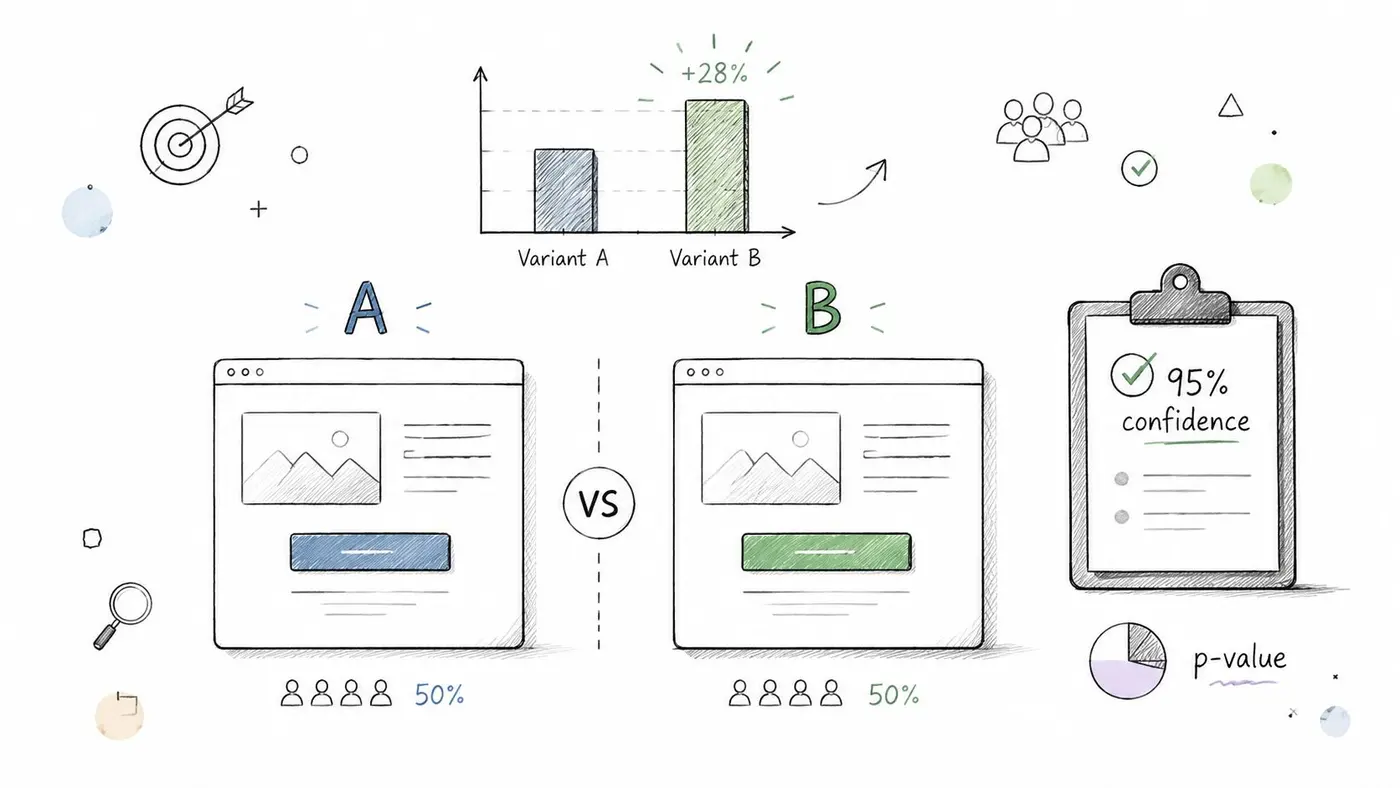
Tests that reach 95% significance still fail businesses every week. The problem is rarely the tool. It is weak setup, uneven traffic, or a result that improves clicks while hurting revenue.
A/B testing remains the base layer of CRO because it answers a practical question cleanly: did one version produce more of the outcome you care about? Teams that run structured experimentation programmes over time often report meaningful conversion gains, especially on high-intent pages such as product listings, checkout steps, and lead capture forms, as discussed in VWO's guide to A/B testing for conversion rate optimisation. The business lesson is straightforward. Start where intent already exists, then measure outcomes tightly.
What good test setup looks like
A Shopify team might compare “Add to basket” with “Buy now” on a product page. A SaaS team might test a shorter onboarding flow against one that explains setup more clearly. In both cases, the job is not to spot a spike after one afternoon. The job is to decide whether the difference is large enough, clean enough, and commercially useful enough to trust.
That last part gets missed. A variant can lift click-through rate and still reduce completed orders if it sends lower-intent users deeper into the funnel.
Set one primary metric before launch. If the test is on checkout, use completed purchase as the primary goal and monitor add-to-cart, checkout start, and payment completion as supporting signals. If the test is on lead generation, use qualified form submissions first, not raw button clicks.
Use this operating standard:
- Change one major variable at a time: Keep attribution clear unless you are deliberately running a multivariate test.
- Run through a full business cycle: Weekday versus weekend behaviour, email sends, and paid traffic swings can distort early numbers.
- Write the hypothesis before building the variant: “Changing the CTA to outcome-led language will increase checkout starts” gives the team something specific to validate.
- Check implementation weight: Heavy testing scripts can slow pages and contaminate results. Lightweight tools such as Otter A/B help teams ship experiments without adding avoidable performance drag.
For a practical explanation of confidence thresholds, sample size, and how to judge whether a winner is reliable, keep Otter A/B's guide to testing statistical significance close.
Practical rule: If the team cannot define the success metric, minimum detectable change, and stopping point before launch, the test is not ready.
2. Multivariate Testing
Multivariate testing earns attention because it promises speed. Test the headline, hero image, and CTA together, then find the best combination. In reality, MVT only works when your traffic can support the extra complexity.
That's the first trade-off. A/B testing tells you whether one version beats another. MVT helps you learn interaction effects between elements. If a pricing page only gets modest traffic, splitting users across too many combinations usually creates noise, not insight.
Where MVT actually helps
MVT makes sense on high-traffic pages where several elements influence the same decision. Think product detail pages with changing product imagery, value proposition copy, and purchase CTA. Or a SaaS landing page with a headline, proof strip, and form layout that all shape the same signup action.
When I see teams misuse MVT, it's usually because they're trying to compress months of prioritisation into one test. They want one experiment to answer every open question. That rarely happens. What you get instead is a crowded matrix and weak confidence in every combination.
Use MVT when the page has:
- Consistent volume: Enough traffic to feed each combination without starving the test.
- Stable intent: A page with a clear job, such as pricing, checkout, or lead capture.
- Limited variables: Two or three meaningful elements, not a full redesign disguised as one experiment.
Keep combinations manageable
An ecommerce team might test two product images, two hero headlines, and two CTA labels. That's a manageable structure. A page with five variables and multiple versions of each quickly becomes difficult to interpret, especially if campaigns, stock changes, or seasonality are affecting user behaviour at the same time.
MVT is powerful when you need to learn which elements reinforce each other. It's wasteful when you use it to avoid prioritisation. If you're unsure, start with straight A/B tests on the biggest lever first. Most of the time, that gives you a cleaner answer faster.
3. Conversion Funnel Analysis and Optimisation
A typical ecommerce checkout loses a meaningful share of buyers before payment. The teams that improve conversion fastest are usually the ones measuring each handoff in the journey, not just the final sale.
Funnel analysis shows where intent breaks down. It turns a vague problem like “conversion is soft this month” into a specific one, such as a product page that is not sending enough visitors to basket, or a checkout step where users hit validation errors and leave.
Start by defining the funnel in a way your team can keep stable over time. For ecommerce, that often means category page, product page, basket, checkout start, shipping, payment, and order confirmation. For SaaS, it may be landing page, form start, form completion, account creation, and first meaningful product action. Consistent step definitions matter because they let you compare tests, traffic sources, and device segments without arguing about what counts as progress.
A useful framework is to track macro conversions alongside micro conversions. Nielsen Norman Group's guidance on measuring UX and conversion success with task-level and outcome metrics supports this approach. In practice, the sale or signup is the macro KPI. Basket adds, checkout starts, form completions, and onboarding milestones are the micro KPIs that explain why the top-line number moved.
That distinction changes what you fix first.
If checkout starts go up but completed orders stay flat, the landing page test did its job and the problem sits deeper in the flow. If product page traffic is healthy but basket adds are weak, the issue is often message clarity, price framing, shipping visibility, or proof placement. Looking only at final conversion hides that pattern.
For ecommerce teams, Otter A/B's guide to the conversion funnel in ecommerce is useful because it ties funnel stages to specific experiment ideas without adding heavy scripts that slow the site down.
The strongest funnel work starts at the step where buying intent is already clear and friction is easiest to remove. On many sites, that means tightening form fields, reducing forced choices, making costs visible earlier, or improving error handling before touching page design. Those changes are rarely glamorous, but they often produce cleaner gains than a visual refresh.
I also recommend checking business impact before prioritising a leak. A 20 percent lift on a low-intent step can matter less than a 5 percent lift near payment. Good funnel optimisation balances volume, intent, and implementation effort. That is where lightweight testing tools help. They make it practical to run focused experiments on the primary bottleneck instead of spending weeks shipping broad redesigns that are harder to learn from.
4. Headline and Copy Optimisation
Users form an impression of a page in seconds, and headline clarity shapes whether they keep reading or leave. Copy sits at the start of that decision. If the message is vague, the rest of the page has to work harder than it should.
Research from the Nielsen Norman Group on message clarity and user comprehension shows the same pattern practitioners see in tests: people scan first, judge relevance fast, and ignore copy that feels generic or hard to parse. Better-performing pages usually match the visitor's intent, reflect the promise that brought them there, and make the next step feel proportionate to that promise, as discussed in Nielsen Norman Group's guidance on writing digital copy for users.
Match the headline to the visitor's job
Headline optimisation starts with message match, not wordsmithing.
On a paid search landing page, the visitor already arrives with a goal in mind. If they searched for next-day flower delivery, “Beautiful Bouquets for Every Occasion” asks them to do extra interpretation. A headline about delivery speed, cutoff times, or local coverage usually performs better because it confirms the thing they came to verify.
The same rule applies in SaaS and lead gen. “Transform your workflow” sounds polished but gives the buyer nothing concrete to evaluate. “Centralise client approvals in one dashboard” sets a clear expectation. That clarity improves conversion quality as well as click-through rate, because people know what they are signing up for.
Useful copy tests usually fall into a few repeatable categories:
- Benefit versus feature: Lead with the outcome the buyer wants.
- Specificity versus abstraction: Replace broad claims with plain language and concrete use cases.
- Commitment level: “Start free,” “See pricing,” and “Book a demo” attract different intent and different lead quality.
- Risk framing: Test whether reassurance such as no contract, free returns, or setup in minutes reduces hesitation.
Write for scanning, then test the pressure points
Visitors do not read pages top to bottom. They scan headings, proof points, labels, and calls to action to decide whether the page deserves more attention. That means the highest-impact copy work usually sits in a small set of elements: headline, subheading, offer description, proof block, form labels, and error or reassurance text near the action.
I prioritise those before touching long-form body copy. A stronger headline can lift engagement quickly. Clear shipping language near the price can improve add-to-basket rate. A better form label can reduce abandonment without changing the design at all.
Test copy cleanly or the result is hard to trust
Implementation quality matters here because copy tests are sensitive to page instability. If a testing tool swaps in the variant after the original headline has already rendered, users can see the page change in front of them. That creates friction and muddies the read on the experiment.
Otter A/B is relevant in this kind of test because lightweight delivery helps teams run headline and messaging experiments without adding the heavy client-side behavior that can interfere with page performance. That matters for business impact, not just UX polish. If the test setup slows the page or introduces flicker, a winning variant can look weaker than it really is.
Strong copy optimisation work is usually less dramatic than teams expect. It is often a tighter promise, a clearer description, a better-framed offer, or a lower-friction ask. Small edits, implemented cleanly and tied to user intent, are often enough to move conversion rate and improve lead or order quality at the same time.
5. Call-to-Action Button Optimisation
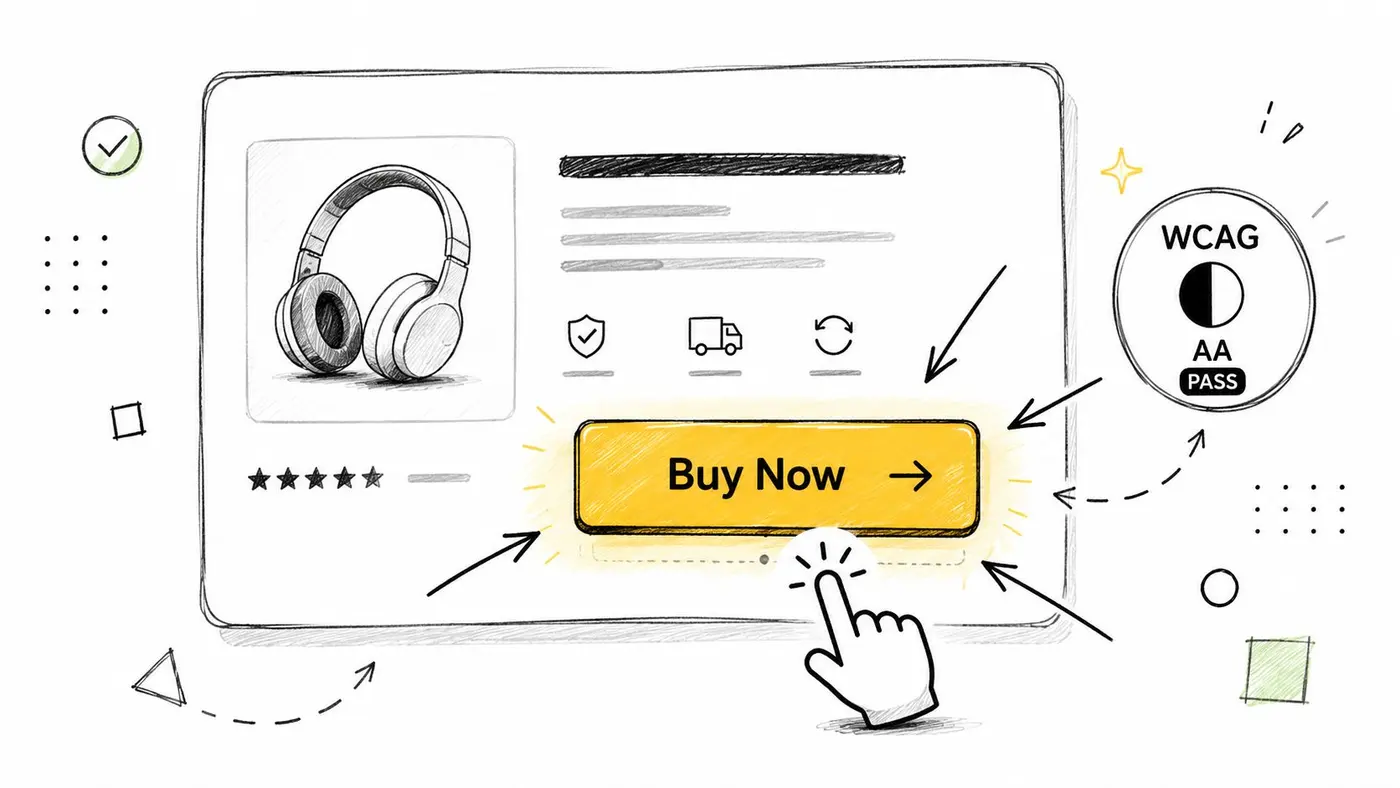
A CTA sits at the point where buying intent either turns into action or stalls. That is why small wording and placement changes can produce outsized business impact, especially on high-traffic product, pricing, and lead-gen pages.
CTA work gets dismissed when teams treat it as a colour exercise. In practice, the better tests change the meaning of the click, reduce hesitation, and make the next step feel clear. A stronger button can increase click-through, but the ultimate win is downstream. More qualified product views, more form starts, more completed checkouts.
What to test beyond colour
Start with the offer behind the button. “Add to basket” asks for a cart action. “Get it tomorrow” brings delivery speed into the decision. “Request demo” feels heavier than “See it in action” because one sounds like a sales step and the other sounds like a product step. Good CTA tests clarify value and commitment level at the same time.
Placement changes matter for the same reason. On long pages, a single bottom-of-page CTA often misses visitors who are convinced earlier. Repeating the action near proof, pricing, shipping details, or key product specs usually captures intent closer to the moment it forms.
Three checks catch a lot of avoidable losses:
- Action language: State the next step in plain verbs.
- Intent match: Keep the button promise aligned with the page and traffic source.
- Mobile usability: Use enough size and spacing to prevent missed or accidental taps.
Implementation affects the result. If the button test loads late, shifts layout, or conflicts with sticky elements on mobile, the experiment measures friction as much as persuasion. Lightweight tools matter here. Otter A/B lets teams run CTA experiments without adding heavy client-side behaviour that can distort both page speed and test readouts.
Watch mobile separately
Mobile CTA performance often breaks for practical reasons, not strategic ones. Sticky bars can cover the primary action. Thumb reach can make a lower button easier to use than one placed higher. A button that looks prominent on desktop can feel cramped on a small screen.
I also separate click lift from commercial lift. A CTA that gets more taps but sends lower-intent users into checkout or onto a form can hurt efficiency. For ecommerce teams, it helps to review CTA tests alongside order quality and basket value. Otter A/B's guide to increasing average order value is useful for that broader read.
A CTA is a decision point, interface element, and revenue lever all at once. Treat it that way, and the testing gets better fast.
6. Revenue Per Visitor and Average Order Value Optimisation
A higher conversion rate isn't always a better business result. If a variant increases purchases but lowers basket quality, pushes people into lower-value products, or weakens margin, you haven't really won. That's why serious CRO work tracks revenue impact, not just conversion lift.
This is a blind spot for many teams. A 2023 report from the Institute of Practitioners in Advertising found that fewer than 30% of UK marketing teams formally connect CRO experiments to financial KPIs such as revenue per visitor, lifetime value, or margin. Many still report vanity metrics first and business metrics second. That gap matters because stakeholders fund revenue growth, not prettier test dashboards.
Optimise the economics, not only the action
On ecommerce sites, some of the highest-value tests happen after the add-to-basket event. Bundles, order thresholds, cart recommendations, and payment presentation can change the size of the transaction more than the number of transactions.
A practical example: a skincare brand might test a bundle module on the cart page against single-item recommendations. A subscription brand might compare annual-plan framing with monthly-plan framing. In both cases, conversion rate alone misses part of the story. Revenue per visitor and average order value show whether the experience is creating more value.
For teams building this into their testing workflow, Otter A/B's guide on increasing average order value is relevant because it ties experiment decisions to purchase outcomes rather than just clicks.
Business lens: If a variant wins on clicks but loses on revenue quality, it's not a winner.
Report outcomes in stakeholder language
When you present results, don't stop at “variant B improved conversion”. Show what changed in basket composition, average order value, and purchase behaviour. Finance, founders, and client leads all understand revenue per visitor faster than they understand a prettier click-through chart.
7. Cohort Analysis and Segmentation Testing
One of the fastest ways to make bad CRO decisions is to trust the blended average. A test can look positive overall while hurting a valuable segment. That happens all the time with mobile users, paid traffic, returning customers, or high-intent geographies.
Segmentation fixes that. It helps you see whether the same experience works equally well for people arriving from different channels, devices, or stages of familiarity.
Not all winners are universal winners
A checkout redesign might improve desktop completion but frustrate mobile users. A pricing page with more detail might help paid search visitors who need reassurance, while returning direct visitors would rather get to plan selection faster. If you only read the aggregate result, you'll miss both truths.
This is especially important for UK SMEs and mid-sized ecommerce businesses with constrained traffic. Research from the Chartered Institute of Marketing, summarised in this discussion of CRO constraints for smaller businesses, highlights that more than 60% of UK SMEs see digital experimentation as important but lack the resources to run statistically reliable tests. In that environment, segmentation needs discipline. You can't slice every audience six ways and expect trustworthy results.
Use segments that map to business reality
Good cohorts are operationally useful. Device type, traffic source, first-time versus returning visitor, and geography are often enough to expose meaningful differences without overcomplicating analysis.
A few sensible segmentation patterns:
- Mobile versus desktop: Usually the first split worth checking.
- Paid versus organic traffic: Message match and intent often differ sharply.
- New versus returning visitors: Trust needs and decision speed aren't the same.
The point isn't to personalise everything. It's to avoid rolling out a “winner” that ultimately harms the users who matter most.
8. Speed and Performance Optimisation for Conversions
Performance is part of CRO, not a separate technical hygiene task. If your test script slows rendering, causes flicker, or introduces layout shift, you can improve one metric while degrading the actual experience.
UK site-speed data from the 2024 Almanac of Web Performance shows that 68% of top-performing UK retail and B2B sites now meet Core Web Vitals thresholds, with median mobile LCP under 2.5 seconds and INP under 200 milliseconds, according to this summary of UK performance and CRO guidance. Users increasingly expect that level of smoothness. Your experimentation setup has to respect it.
Treat performance as a guardrail metric
If a team launches a homepage test that increases clicks but adds visible flicker, that's not harmless. The same UK summary also notes that a notable share of digital A/B tests still introduce layout shifts or flicker, and those issues correlate with drops in key conversion metrics. That tracks with what practitioners see in the field. Users may not describe the problem technically, but they feel it immediately.
For growth teams using lightweight testing tools, implementation details matter:
- Measure variant impact: Check CLS and interaction responsiveness after launch.
- Audit third-party scripts: Testing tools, chat widgets, and tag sprawl often collide.
- Keep experiments lean: Don't load heavy libraries to test a line of copy.
Lightweight tooling changes the trade-off
This is where product design matters. Otter A/B uses a 9KB SDK that loads in under 50ms with zero flicker, according to the publisher information provided for this article. For teams that care about Core Web Vitals, that's a practical advantage because it lowers the risk that the testing layer itself creates the problem you're trying to solve.
Speed work also overlaps with broader page optimisation. Compress heavy images, defer non-critical scripts, and keep mobile layouts clean. The best CRO programmes don't ask design and engineering to choose between testing and performance. They insist on both.
9. Continuous Experimentation and Testing Culture
Teams that test consistently tend to outperform teams that treat CRO as a quarterly project. The gap usually is not idea quality. It is operating discipline.
A healthy testing culture shows up in the day-to-day work. Hypotheses are written before launch. Success metrics are agreed in advance. Results are logged in a place the wider team can find and use. Without that structure, experimentation slows down as soon as priorities shift or the person running tests gets pulled into something else.
Build an operating system for experimentation
As noted earlier, adoption of testing is growing faster than testing maturity. Plenty of companies can launch experiments. Fewer can prioritise them well, track secondary signals, and turn outcomes into repeatable decisions across product, marketing, and engineering.
The teams that keep momentum usually have a few habits in place:
- A visible experiment backlog: ideas are ranked by expected business impact, implementation effort, and confidence.
- Clear hypothesis format: state the audience, the change, the expected behaviour, and the metric that should move.
- A shared results log: record wins, losses, neutral tests, and follow-up questions.
- Regular review cadence: review completed tests often enough that learnings influence roadmap decisions, email strategy, paid landing pages, and checkout changes.
This is also where tooling affects culture. If launching a test needs a sprint, a heavy QA cycle, and engineering cleanup after every result, volume drops fast. Lightweight tools such as Otter A/B help teams keep shipping because the implementation burden stays low and site performance stays protected. That changes the business case for experimentation. More tests make it into production without turning CRO into an engineering bottleneck.
Reward decision quality, not just uplifts
A losing test can save real money.
I have seen retailers learn that aggressive urgency messaging lifts clicks but reduces completed orders on higher-ticket products. I have also seen SaaS teams add more detail above the fold, only to find that trial starts fall because first-time visitors hit too much complexity too early. Those are useful outcomes because they remove bad assumptions before they spread into campaigns, redesigns, and sales messaging.
The practical standard is simple. Keep the queue full, keep the documentation clean, and make every result usable by another team. For teams exploring adjacent conversion tactics beyond on-page testing, Cosmy on chatbots for eCommerce is a useful reference point. Continuous experimentation works best when it becomes part of normal operating rhythm, not a one-off CRO exercise.
10. Behavioral Data and User Session Analysis
Quantitative results tell you what changed. Behavioural data often tells you why. Heatmaps, session recordings, scroll patterns, and click analysis are how you catch friction that analytics dashboards flatten into a drop-off percentage.
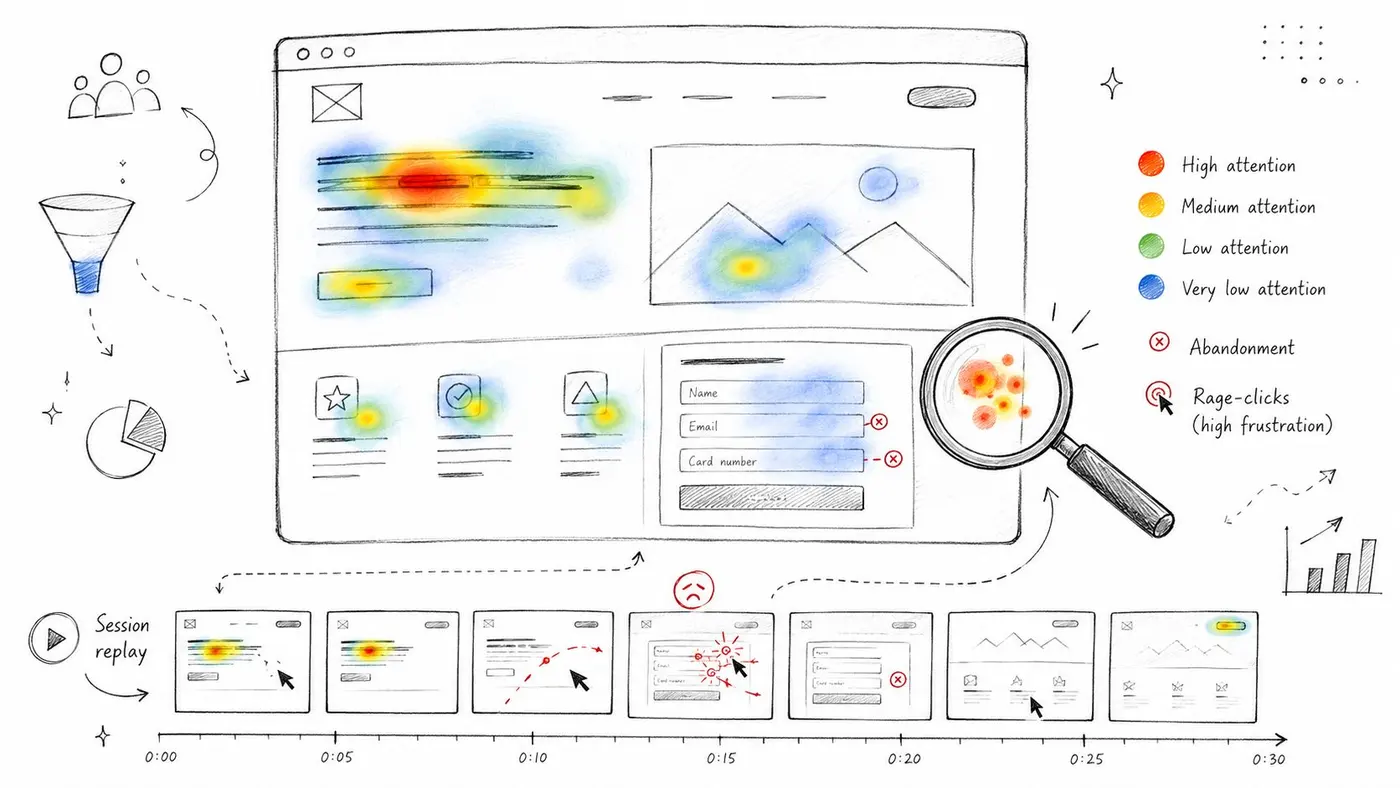
I wouldn't run a mature CRO programme without this layer. Funnel numbers can tell you that users abandon shipping. Session review can show you they're repeatedly clicking a non-clickable element, missing a field error, or pausing when delivery costs appear late.
Use behaviour to sharpen hypotheses
Suppose a category page has decent traffic but weak product page click-through. Heatmaps may reveal users interacting with filters that are hard to use on mobile. Recordings may show rage-clicking on product cards where users expect quick-view behaviour that doesn't exist.
That's much stronger than saying “engagement feels low”. It gives you a fixable problem. It also helps you avoid wasting A/B tests on pages with obvious UX defects that should be repaired.
A useful adjacent read is Cosmy on chatbots for eCommerce, especially for teams looking at conversational assistance as one route to reducing hesitation and support friction during the buying journey.
Watch enough recordings and you'll stop arguing about opinions. Users show you where the journey breaks.
Pair qualitative insight with experiment tracking
Behavioural tools are most useful when tied back to goals. Watch sessions from users who reached checkout but didn't finish. Compare them with users who completed purchase. Review recordings by device type when a mobile test underperforms. That's how qualitative evidence earns its place in CRO work.
A short explainer is useful here:
If you're using a testing platform alongside session replay and analytics, keep the instrumentation clean. You want each variant tied to the same goals, events, and user segments so the story holds together from replay to report.
10-Point CRO Best Practices Comparison
| Method | Complexity 🔄 | Resources ⚡ | Expected Outcomes 📊 | Ideal Use Cases | Key Advantages ⭐ / Tips 💡 |
|---|---|---|---|---|---|
| A/B Testing with Statistical Significance | Moderate, straightforward setup but requires statistical rigor | Moderate traffic & basic analytics/statistics expertise | Clear, quantifiable uplift and confident winner selection | Single-variable changes (buttons, copy, layouts) | Reliable data-driven decisions; reduces risk. 💡Ensure adequate sample size and control multiple comparisons |
| Multivariate Testing (MVT) | High, factorial design and complex analysis | High traffic, advanced analytics and experiment platform | Identifies best element combinations and interaction effects | Testing multiple elements on high-traffic pages | Reveals interactions and optimal combos. 💡Limit to 2–3 variables to keep combos manageable |
| Conversion Funnel Analysis & Optimisation | Moderate, requires mapping and analytics instrumentation | Analytics implementation, funnel tracking, moderate traffic | Pinpoints biggest drop-offs and prioritised impact opportunities | Multi-step flows (checkout, signup, onboarding) | Targets highest-impact fixes tied to revenue. 💡Focus first on largest drop-off stages |
| Headline & Copy Optimisation | Low, simple to implement and iterate | Low, copywriting resources and basic testing tool | Quick CTR/conversion uplifts; often fast measurable wins | Landing pages, emails, CTA text | Fast, low-cost wins that improve messaging fit. 💡Test one copy variable at a time |
| Call-to-Action (CTA) Button Optimisation | Low, small UI/CSS changes | Low, minor design/dev effort | Measurable CTR increases (often large) | CTAs across product pages, checkout, hero sections | High-impact with minimal effort. 💡Ensure WCAG contrast and test placement too |
| Revenue Per Visitor (RPV) & AOV Optimisation | Moderate, needs revenue tracking and careful analysis | High sample sizes, e‑commerce tracking and attribution | Direct revenue gains; improved AOV/RPV (business metric focus) | Pricing tests, bundles, upsells, cross-sell experiments | Optimises for profitability rather than just clicks. 💡Track revenue per variant and control for seasonality |
| Cohort Analysis & Segmentation Testing | High, many separate analyses and control for comparisons | High traffic, segmentation tools, analytics expertise | Segment-specific winners; avoids aggregate masking | Mobile vs desktop, traffic source, geographic personalization | Enables targeted personalization and safer rollouts. 💡Define cohorts by business value and sample size limits |
| Speed & Performance Optimisation for Conversions | Moderate–High, technical work and engineering changes | Developer time, infra/CDN, monitoring tools | Lower bounce, improved SEO and conversion rates | Slow pages, mobile-first experiences, heavy pages | Improves UX and SEO simultaneously. 💡Measure Core Web Vitals and defer non‑critical JS |
| Continuous Experimentation & Testing Culture | High, process, governance, cross-functional buy-in | Sustained team effort, tooling, hypothesis repository | Compounded long-term growth and institutional learning | Organizations scaling product/marketing experimentation | Scales learning and reduces strategic risk. 💡Start small, document hypotheses, celebrate learnings |
| Behavioral Data & User Session Analysis | Moderate, tooling plus qualitative analysis time | Session-replay tools, analysts, privacy controls | Qualitative insights to explain behavior and generate hypotheses | UX troubleshooting, hypothesis generation before tests | Explains why metrics move and uncovers UX friction. 💡Fix obvious UX issues before A/B testing and respect privacy consents |
From Practice to Profit Start Your CRO Journey
The best CRO programmes don't win because they follow a trendy list of hacks. They win because they reduce uncertainty. They replace opinion-led changes with measured changes. They give teams a way to improve the site without guessing which idea mattered, which page caused the leak, or whether a result helped the business beyond a click metric.
That's the value behind these CRO best practices. A/B testing gives you evidence. Funnel analysis shows you where effort belongs. Copy and CTA optimisation sharpen the decision moment. Segmentation protects you from averaging away important truths. Performance work keeps experiments from damaging the experience they're supposed to improve. Behavioural analysis adds the human context that raw numbers can't provide on their own.
There's also an important commercial discipline running through all of this. If you only optimise for top-line conversion rate, you can end up celebrating the wrong wins. Revenue per visitor, average order value, and financially relevant KPIs give your testing programme credibility with stakeholders who care about profit, not just interaction lifts. That matters even more in organisations where CRO still has to justify budget against acquisition, brand, or product investment.
For smaller teams, the message is simple. Don't wait for perfect traffic levels, a huge experimentation team, or a full analytics rebuild before you start. Begin with one important page and one clear hypothesis. Instrument the main goal and the supporting micro-conversions. Watch a small set of session recordings. Measure the business effect, not just the surface metric. Then repeat.
For larger teams, the challenge is usually different. It's less about starting and more about creating consistency. Standardise how hypotheses are written, how significance is judged, how test outcomes are documented, and how results get reported into business dashboards. That's where experimentation stops being a series of isolated wins and becomes an operating capability.
Tooling matters here because implementation quality changes the trade-offs. If your testing platform is heavy, slow, or visually unstable, teams become cautious for the wrong reasons. If it's lightweight and easy to deploy, more useful tests get launched. Otter A/B is one example of a platform built around that practical requirement, with a lightweight SDK, frequentist significance reporting, and revenue tracking tied to variants. For growth teams that need to test without adding UX drag, that kind of setup fits the job.
Start with your highest-intent page. Write the hypothesis in plain English. Define success before launch. Track what happens at each key step, not only at the end. Then let the evidence do the work. That's how websites stop acting like static brochures and start performing like revenue systems.
If you want a lightweight way to run statistically grounded experiments, track conversion and revenue outcomes, and launch tests without adding visible flicker, take a look at Otter A/B. It's built for teams that want practical CRO execution, not just more dashboards.
Stop guessing
Ready to start testing?
Set up your first A/B test in under five minutes. No credit card required.
- 14-day free trial
- No credit card required
- Cancel anytime