What Is Multivariate Testing? a Practical Guide for 2026
Wondering what is multivariate testing and if it's right for you? Learn how it differs from A/B testing, its high traffic cost, and when to use it for CRO.

Multivariate testing (MVT) is an experimentation method that tests multiple changes on a single page simultaneously to understand which combination of elements performs best, unlike A/B testing which compares two distinct versions. It can uncover interaction effects that matter, but it also gets expensive fast: a setup with 3 elements and 3 variations each creates 27 combinations, and for a UK e-commerce site with 10,000 monthly visitors, an A/B test might reach significance in 4–6 weeks while a comparable MVT can take 12–18 months.
That's the situation many teams run into after they've done the obvious work. You've tested a headline. You've tried a stronger CTA. Maybe you swapped the hero image. Results improved, but only a bit, and the page still feels like it has more in it.
The frustrating part is that A/B testing can leave a blind spot. A headline might look average on its own but perform much better with a specific image or button treatment. If you only test one change at a time, you can miss that combination effect completely.
That's where multivariate testing becomes useful. It's also where a lot of teams make the wrong call. MVT is powerful, but it isn't the default next step for every optimisation programme.
Beyond A/B Testing Your Optimisation Journey
Most optimisation teams don't start by asking, “What is multivariate testing?” They start with a practical problem. A landing page has already been through a few rounds of A/B tests, the easy wins are gone, and the remaining questions are no longer about one isolated element.
You might be looking at a page and thinking something like this: the stronger headline worked, but only with the old layout. The new image looked promising, but only when paired with softer CTA copy. That's a signal that the page elements may be influencing each other.
Where A/B testing stops being enough
A/B testing is excellent when you want a clean answer to a narrow question. Does CTA A beat CTA B? Does a shorter form beat a longer one? That's why it remains the workhorse of most CRO programmes, and why a solid grounding in conversion rate optimisation fundamentals matters before moving to more complex methods.
Multivariate testing is different. Instead of comparing two page versions, it tests multiple elements at once and measures how combinations perform together.
A/B testing tells you which version won. MVT helps you understand which mix of ingredients created the win.
That sounds like a natural upgrade. Sometimes it is. Often it isn't.
Why smart teams still overuse MVT
MVT has a certain appeal because it feels more advanced. It promises a fuller answer. But greater complexity doesn't always mean better outcomes. In practice, many organizations get more value from fast, disciplined testing cycles than from building a giant experiment they can't properly power or maintain.
If you want the broader operating model around experimentation, analytics, and decision-making, this guide to optimize business growth is useful because it connects testing to the measurement layer teams often neglect.
The right question isn't whether MVT is “better” than A/B testing. It's whether your page, traffic level, and hypothesis justify it.
A/B Testing vs Multivariate Testing An Analogy
A simple way to explain multivariate testing is to stop thinking about web pages for a minute and think about baking.
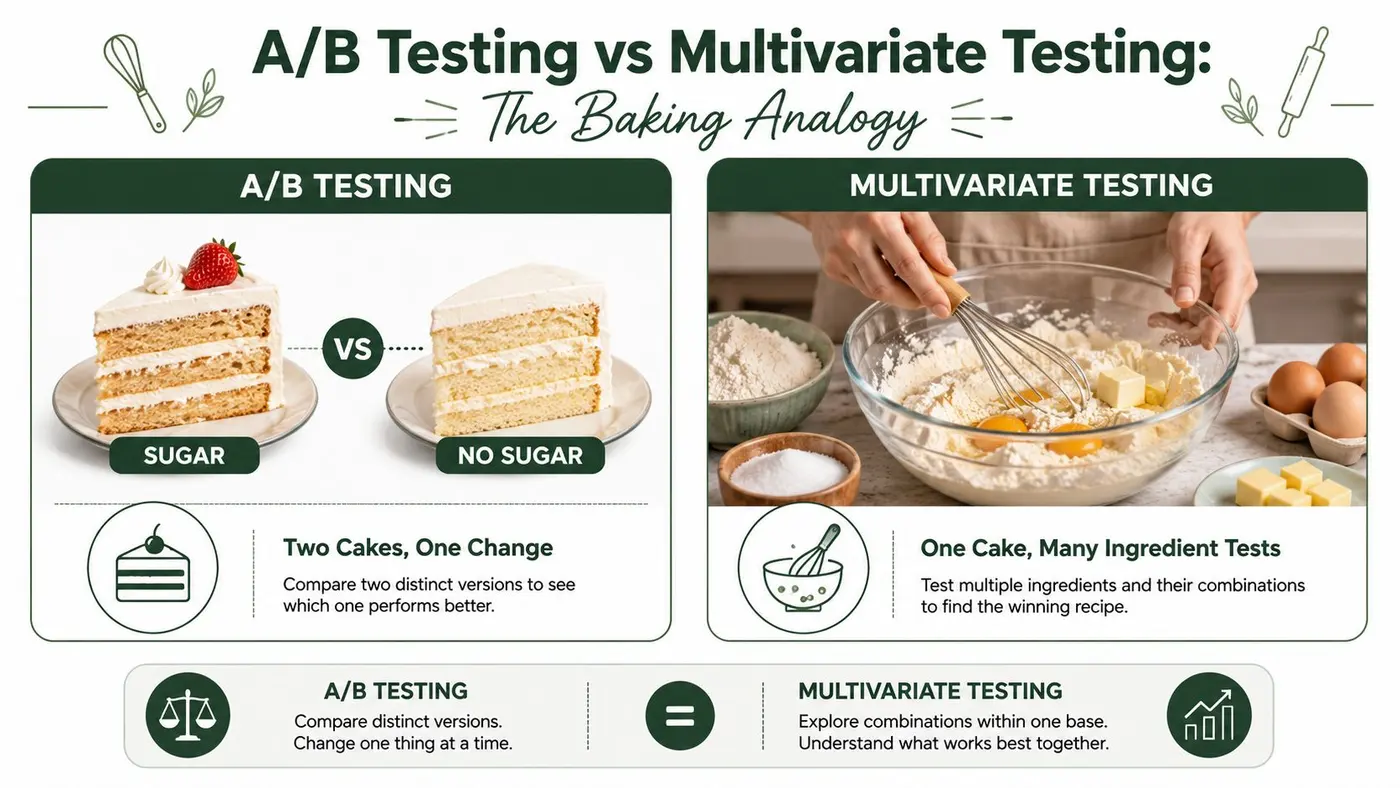
The cake version
With A/B testing, you bake two cakes. Everything stays the same except one ingredient. One has sugar, one doesn't. You taste both and choose the better one.
With multivariate testing, you don't change just one ingredient. You systematically test combinations of flour, sweetener, and topping to figure out which recipe works best as a whole.
On a web page, those “ingredients” might be:
- Headline: Formal or friendly
- Hero image: Product-focused or lifestyle-led
- CTA colour: Blue or red
A/B testing might compare one complete page against another. MVT breaks the page into variables and measures the combinations.
Why the interaction matters
This is the main reason MVT exists at all. It can isolate interaction effects, which A/B testing can't properly reveal when multiple elements change together.
Interaction effect: when the impact of two variables together is different from the impact you'd expect by looking at each variable alone.
If you change the headline and button colour in the same A/B variant and conversions rise, you still don't know what caused the lift. It might be the headline. It might be the button. It might be the combination.
That distinction matters more than many teams realise. UK academic research from the London School of Economics found that in 30% of tested UK digital campaigns, the interaction effect between two variables contributed more to conversion lift than the individual effects alone, which is exactly why MVT can reveal patterns that simpler tests miss.
If you need a more general refresher on split testing principles before stepping into MVT, this overview of A/B testing for data-driven strategy is a helpful reference.
A quick side-by-side view
| Aspect | A/B Testing | Multivariate Testing (MVT) |
|---|---|---|
| Core question | Which version wins? | Which combination wins? |
| Change scope | Usually one major difference or one focused hypothesis | Multiple page elements at once |
| Best use | Clear, narrow decisions | Pages where elements likely influence each other |
| Readability of results | Easier to explain | Harder to analyse and socialise |
| Traffic demand | Lower | Much higher |
| Main advantage | Speed and clarity | Interaction insight |
What teams often misunderstand
A lot of marketers assume MVT is just “A/B testing, but more advanced”. That framing causes problems. MVT isn't merely a bigger test. It's a different kind of question.
A/B testing asks, “Which option should we choose?” MVT asks, “How do these options behave together?”
Those aren't interchangeable questions. If you don't care about interactions, or can't act on the extra nuance, MVT adds complexity without much payoff.
How to Design a Multivariate Test
Good multivariate testing starts long before you touch a platform. Most failed MVTs aren't analysis failures. They're design failures. Teams choose too many elements, mix incompatible variations, or launch without a sharp hypothesis.
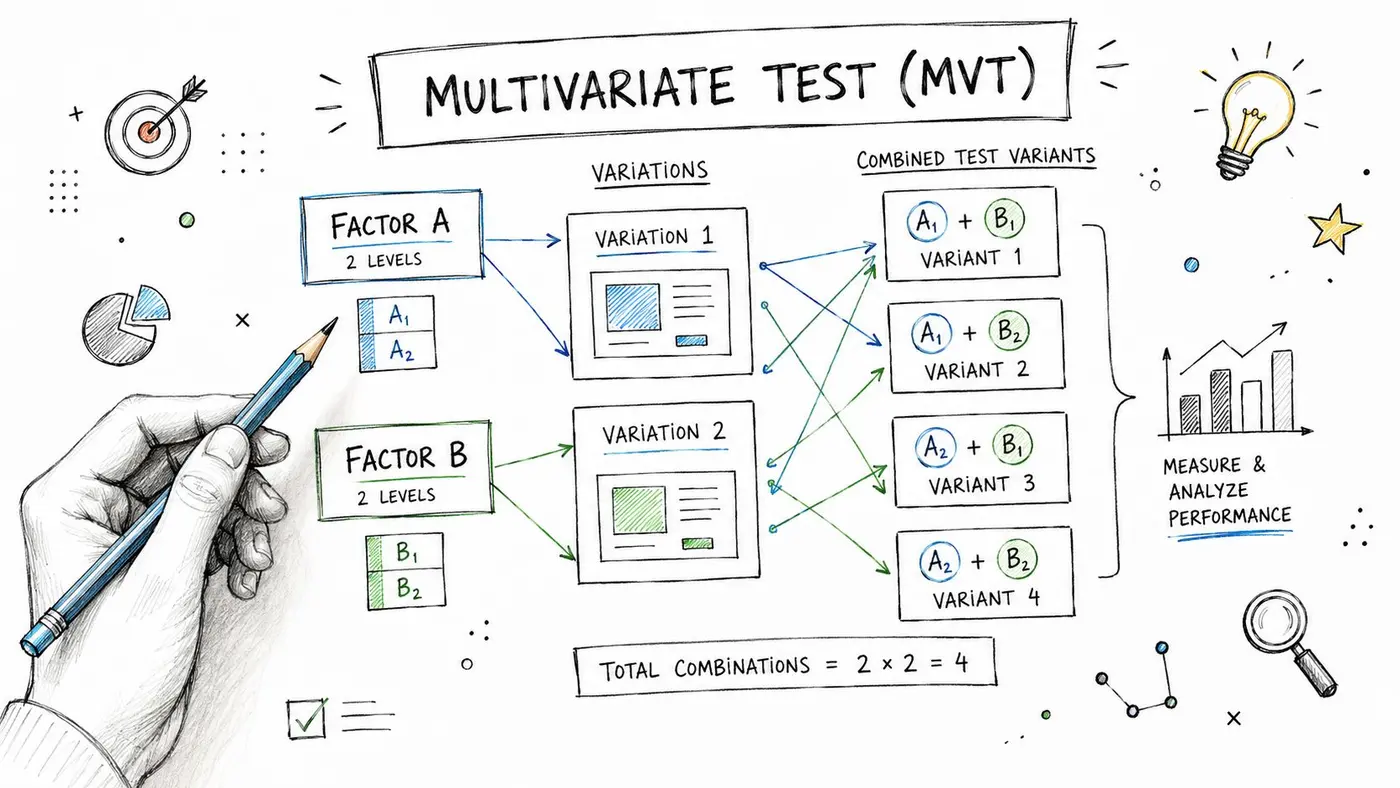
Start with factors and variants
In MVT language, a factor is the page element you want to test. A variant is one version of that element.
For example, on a product page you might define:
- Factor one: Headline
- Factor two: Product image
- Factor three: CTA button colour
Each factor can have several variants. Once you choose them, the combinations multiply quickly.
A practical page setup
Say your product page test includes:
- Headline: 2 variants
- Product image: 3 variants
- CTA button colour: 2 variants
That creates 12 total combinations because the setup multiplies across all factors. Every visitor needs to be assigned to one of those combinations, and each combination needs enough data to tell you something useful.
That multiplication effect is the first design constraint you need to respect. The more combinations you add, the harder the test becomes to finish.
Build combinations that make sense
The best MVT plans don't start with “what can we test?” They start with “which elements are likely to interact?”
Useful pairings often include:
- Message plus cue: A trust-focused headline with a conservative button treatment
- Intent plus visual: A benefit-led promise with imagery that supports the same expectation
- Urgency plus friction: CTA copy paired with form length or surrounding reassurance
Bad pairings are usually random. If a combination would look incoherent to a user, it shouldn't be in the test.
Practical rule: Don't include a variable just because the platform allows it. Include it only if you have a reason to believe it changes user interpretation of another element.
Keep the hypothesis tight
A strong MVT hypothesis sounds like this: users may respond better to a softer headline when the CTA colour feels lower pressure, because both elements signal trust and reduce perceived risk.
A weak hypothesis sounds like this: let's test a bunch of headline, image, and button options and see what happens.
That second approach is common. It also wastes traffic.
This walkthrough adds a useful visual explanation of experiment structure if your team needs a quick primer before implementation:
A simple design checklist
Before launching, make sure you can answer these clearly:
- What single conversion event matters most? MVT works best when the success metric is unambiguous.
- Which elements might interact? Not every page component does.
- Are the variants internally consistent? Don't create combinations that conflict in tone or intent.
- Can the test run cleanly for long enough? If the answer is doubtful, shrink the design before launch.
When a test gets too broad, the smart move isn't to push ahead. It's to reduce variables and return to a simpler sequence.
The High Cost of MVT When to Actually Use It
This is the part most glossy explainers soften. Multivariate testing is usually expensive in traffic, time, and opportunity cost. For many sites, it's the wrong tool.
The reason is straightforward. MVT doesn't just split traffic between two versions. It splits traffic across every combination in the design.
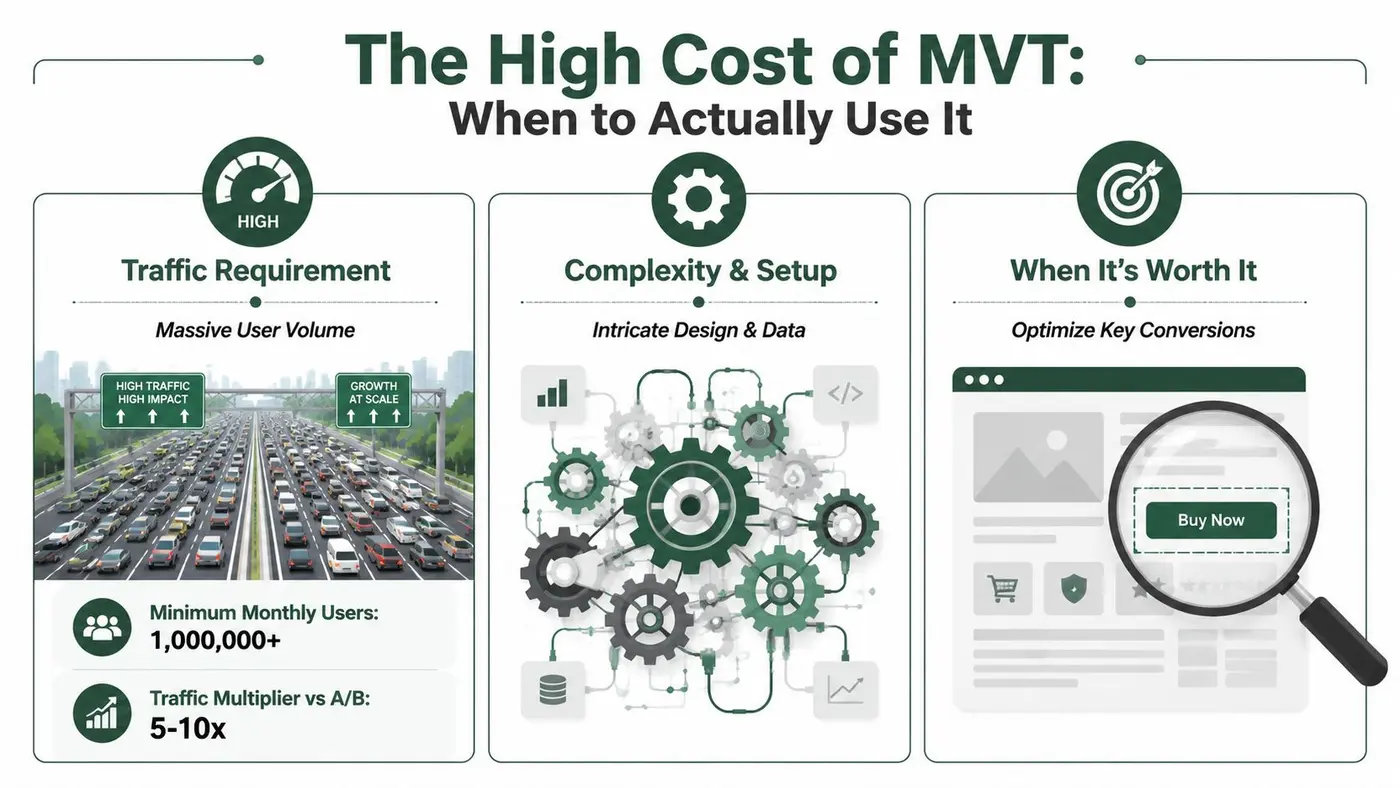
The sample size problem
If an A/B test compares two variants, traffic is split in two. If an MVT tests 3 elements with 3 variations each, it creates 27 combinations. That means the same audience is now being divided across 27 buckets instead of 2, which sharply increases the time needed to reach significance.
For a UK e-commerce site with 10,000 monthly visitors, industry benchmarks indicate an A/B test might reach 95% significance in 4–6 weeks, while an equivalent MVT could require 12–18 months to detect the same effect size with 95% power. That's one of the clearest reasons most lower-traffic teams should stay with simpler tests. The same benchmark also notes that MVT is best suited to high-traffic UK landing pages exceeding 50,000 monthly visitors because underpowered tests create a serious false-negative risk. If you need help planning that threshold, this guide on how to calculate sample size is worth reviewing before you launch anything.
Adobe's own guidance on multivariate testing in Adobe Target also makes the core issue clear. MVT is intended for cases with at least three elements, and the total variants grow multiplicatively. For UK e-commerce and lead-gen teams, that matters because the average website conversion rate is only around 2–4%, so many pages don't produce enough daily conversions to support a large MVT without very long runtimes.
When MVT is worth it
There are pages where the cost makes sense. Usually they share a few traits.
- High traffic: The page gets enough consistent visitors to feed many combinations.
- Clear commercial value: It's a page where a better combination affects revenue or qualified leads directly.
- Likely interaction effects: You have a real reason to think the elements influence each other.
- Single-variable tests are mostly exhausted: You've already learned the obvious wins through A/B testing.
If you haven't exhausted straightforward A/B tests, MVT is usually premature.
When it's the wrong choice
Just as important, there are cases where you should avoid it.
| Situation | Better approach |
|---|---|
| Low-traffic landing pages | Sequential A/B tests |
| Pages with one dominant variable | Focused split testing |
| Short campaign windows | Fast, narrower experiments |
| Teams without strong analysis discipline | Simpler test designs with clearer readouts |
This is the contrarian truth that more teams need to hear: sequential A/B testing often produces faster, more actionable learning than MVT, especially for UK businesses with modest traffic.
A sober decision filter
Use MVT only if all of these are true:
- The page has substantial traffic: Not “decent traffic”, but enough to support a long, multi-cell experiment.
- You care about the interaction, not just the winner: If all you need is the best headline, run a headline test.
- The page is stable: Don't run a long MVT on a page that product, brand, or engineering teams keep changing.
- You can tolerate delayed decisions: Every extra week spent waiting has a cost.
If one of those conditions breaks, stick to simpler tests. That isn't conservative. It's usually the more profitable decision.
Implementation Tools and Performance Pitfalls
Even when a page qualifies for MVT statistically, there's another issue teams often underestimate. Implementation itself can hurt performance.
That matters more now than it did a few years ago because experimentation code doesn't run in a vacuum. It runs on real pages, on real devices, under real network conditions.
Why heavy testing setups can damage the page
For UK audiences, mobile-first UX and Core Web Vitals are a practical constraint, not a nice-to-have. Ofcom reports that UK adults increasingly rely on smartphones for everyday online activity, which means heavy experiment setups can create real tension between testing ambition and usability. The safer trend is lighter experimentation that preserves performance, accessibility, and consent flow simplicity rather than piling extra client-side complexity onto already busy pages.
A bloated testing setup can lead to problems like:
- Slower rendering: More scripts and more page manipulations increase the risk of lag.
- Visual instability: Users may see content shift if variants are applied late.
- Mobile friction: The weakest devices expose implementation mistakes first.
- Accessibility regressions: Multiple experimental treatments can create inconsistent behaviour for assistive technologies.
Tool choice changes the risk profile
This isn't just a tooling debate. It's an operating model decision.
Enterprise platforms can run complex experiment designs, but they often bring more implementation overhead. For many marketing teams, a lighter stack and a series of disciplined A/B tests are easier to ship, easier to QA, and less likely to interfere with the user experience.
If you're comparing platforms for broader experimentation work, Market With Boost's conversion tool roundup gives a useful market-level view of what different categories of tools are built to do. For a more practical shortlist focused on website experimentation workflows, this guide to website optimisation tools is also worth bookmarking.
The best testing setup is the one your team can deploy cleanly, monitor properly, and trust under mobile conditions.
What usually works better in practice
The day-to-day win doesn't typically come from running one giant multivariate test. It comes from running many smaller, sharper tests with minimal technical drag.
That approach tends to work better because it:
- Shortens feedback loops
- Reduces QA complexity
- Protects site performance
- Makes results easier to interpret
- Lets teams ship learning continuously
MVT still has a place. But it's specialised equipment. If your page isn't high traffic, high value, and stable enough to support it, the extra implementation burden usually isn't justified.
Your Next Steps From Theory to Action
If you came into this asking what is multivariate testing, the practical answer is simple. It's a way to test several page elements together so you can learn which combination performs best. The strategic answer is more important. You should only use it when the page, traffic, and hypothesis justify the complexity.
A practical next-step checklist
Start with your own pages, not the method.
- Check traffic first: Look at monthly visitors and conversion volume for the specific page, not the whole site.
- Review your testing history: If you haven't already run strong A/B tests on the obvious variables, do that first.
- Ask if interaction is the key question: If you only need to choose the better headline or CTA, MVT is unnecessary.
- Audit page stability: A page that changes constantly is a bad candidate for a long-running multivariate test.
- Assess implementation risk: If testing setup could slow the page or complicate consent and QA, simplify the design.
A simple decision path
You can usually decide quickly:
| If this is true | Do this |
|---|---|
| The page has modest traffic and several untested basics | Run focused A/B tests |
| The page has strong traffic but unclear hypotheses | Do research first, then test one variable at a time |
| The page has high traffic, strong commercial importance, and likely element interaction | Consider MVT |
| The page is mobile-sensitive or performance constrained | Favour lighter experiments |
The best optimisation teams don't choose MVT because it sounds advanced. They choose it because they've earned the right to use it. They know the page well, the traffic is there, and the interaction question is worth the delay.
For everyone else, the next move is usually more straightforward. Pick the highest-impact variable. Write a tight hypothesis. Launch a clean A/B test. Learn fast, then stack the next decision on real evidence.
If your team wants a faster way to run clean website experiments without loading the page down, Otter A/B is built for that style of work. It's a lightweight platform for testing headlines, CTAs, layouts, and other high-impact changes quickly, so you can keep improving conversion rates without the overhead that often makes larger test setups hard to justify.
Stop guessing
Ready to start testing?
Set up your first A/B test in under five minutes. No credit card required.
- 14-day free trial
- No credit card required
- Cancel anytime