No Credit Card Required Trials That Convert
Discover how no credit card required trials boost sign-ups and trust. Learn to optimise conversion funnels, run A/B tests, and reduce friction effectively.
A visitor reaches your pricing page, chooses the free trial, and stops at the payment form. They haven't seen the product work yet, so the card field feels less like a checkout step and more like a commitment to an unknown outcome. Remove that field and the signup may feel effortless, but the commercial problem hasn't disappeared. You've traded immediate payment intent for a larger pool of people who still need to experience value, build trust, and understand why upgrading makes sense.
The phrase no credit card required has become a powerful promise because it answers a direct objection: “What happens if I forget to cancel?” In the UK, that concern has a substantial consumer context. Capital One research found that 18.5 million people, or 37% of UK adults, signed up for free trials in the preceding 12 months, while unwanted trial-related charges were estimated at £251 million annually (SmartSurvey pricing research). A card-free trial can therefore improve acquisition and reduce anxiety, but only when the rest of the funnel is designed to replace the commitment that the payment field would otherwise create.
The Psychology Behind Frictionless Sign-Ups
A prospect has selected a trial, but the payment form appears before they have imported data, invited colleagues, or completed a meaningful task. At that point, the card field asks for more than billing details. It asks the prospect to accept financial exposure before the product has earned confidence.
Removing card capture lets the buyer evaluate the product first and decide about payment later. The trust exchange becomes asymmetric: the company carries more responsibility to prove value, while the user keeps control over whether billing ever begins. That can increase trial starts, but it also removes an early signal of purchase intent. Teams must replace that signal with clear activation criteria and timely lifecycle follow-up.
The concern is practical, not theoretical. Trial users may worry about automatic renewal, unclear cancellation, unwanted contact, or charges that appear before they understand the product's limits. A card-free offer addresses those concerns, yet it can also attract registrations from people who are curious rather than ready to adopt.
Trust is part of conversion design
A card-free offer changes the vendor's obligation after signup. The product must demonstrate value quickly, explain the route to payment plainly, and give users reasons to return before the trial loses momentum.
Use the signup page and onboarding flow to answer four questions:
- What starts today: State exactly what access the user receives after signup.
- What remains free: Distinguish a free plan from a time-limited evaluation.
- What happens next: Explain whether payment is requested later and at which point.
- What the user controls: Make cancellation, deletion, and contact preferences easy to find.
Practical rule: “No credit card required” should describe the entire trial experience, not just the first form.
SmartSurvey's UK pricing information uses this signal directly. Its free version is presented as available without card details, and its paid plans include a 14-day free trial without requiring a card, according to its UK guide to online survey tools. The message works because users can understand the commitment before investing time in setup.
The hidden cost appears after acquisition. A card-free cohort may need stronger onboarding prompts, usage-based emails, in-app reminders, and sales outreach to reach the same payment decision that a card field would have signalled earlier. Set an activation event before launch, then test whether completing it predicts paid conversion. Use A/B testing to compare signup volume, activation, return visits, and revenue by cohort. Automations should respond to behaviour: prompt an incomplete setup, recommend the next valuable action, and present an upgrade when usage demonstrates a relevant need. Without that measurement and follow-up, card-free signups create volume the business cannot monetise. Teams planning the flow can apply these friction-reduction principles while preserving clear payment expectations.
Balancing Funnel Volume and Conversion Quality
The central trade-off is simple. No-card trials usually lower the barrier to starting, while card-required trials filter for stronger immediate intent. The mistake is to compare only trial starts or only paid conversion. A pricing experiment should measure the complete path from visit to trial start, activation, and paid conversion.
Industry benchmark reporting cited by pricing page conversion analysis places opt-in trials without a card at an average 18.2% conversion, compared with 48.8% for opt-out trials that collect a card. Those figures aren't a universal forecast for your product. They illustrate the underlying trade-off: card-free acquisition can produce more initial interest, while card-required acquisition often produces a smaller group with stronger payment commitment.
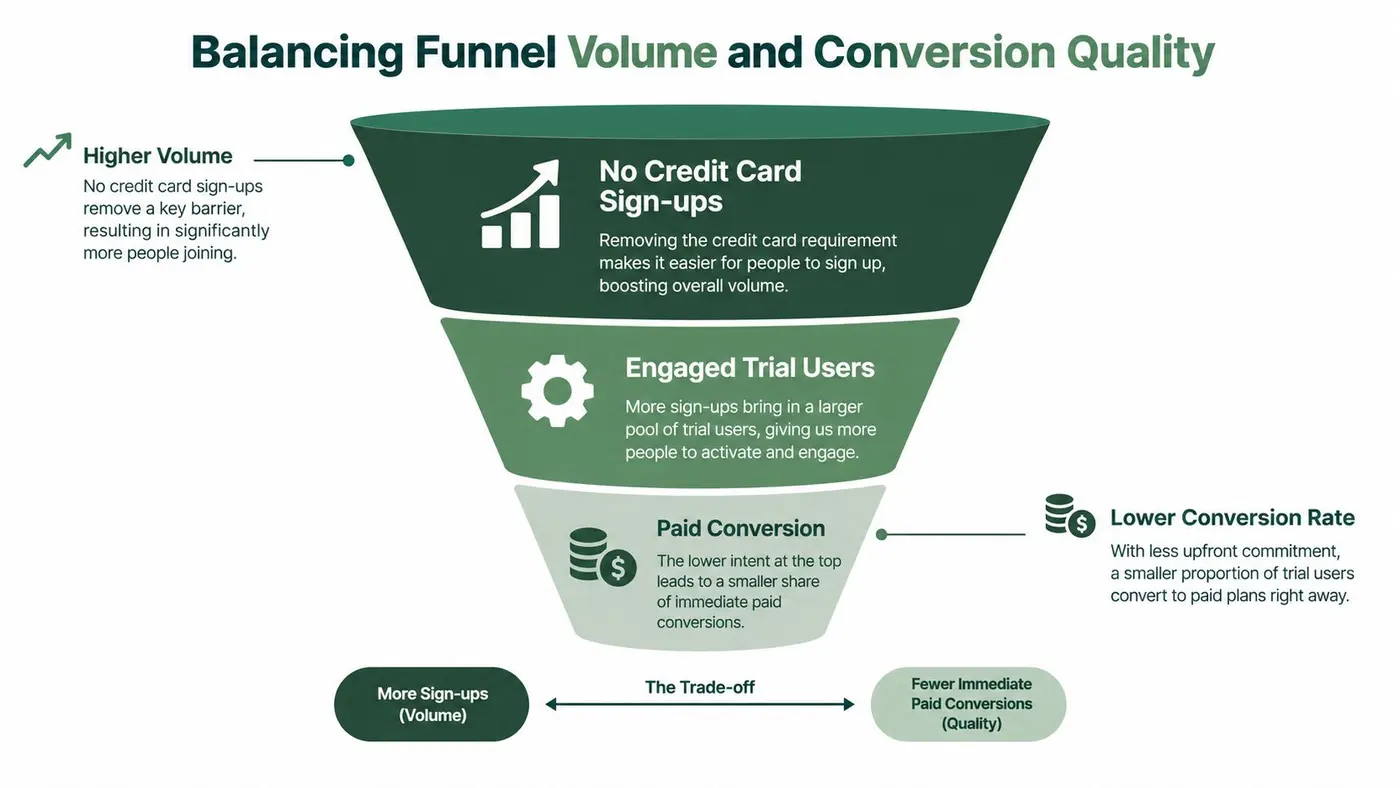
Model the whole journey
Build a cohort view that follows each variant through the same stages:
- Visit to trial start: Does removing the card field increase completed registrations?
- Trial start to activation: Does the new user complete the action that predicts meaningful value?
- Activation to paid conversion: Do activated users upgrade when the payment request appears?
- Paid conversion to revenue: Does the variant produce comparable order value, retention, or expansion?
A card-free variant can win the first step and lose the final outcome. That doesn't make it a bad strategy, but it means the activation programme must carry more responsibility. Define the product event that demonstrates value, then connect it to revenue rather than treating account creation as success.
For example, an analytics product might use a completed report, a collaboration invite, or a connected data source as an activation checkpoint. A form builder might use a published form with a response collected. The event needs to reflect actual product use, not an easily completed setup task.
Compare users by value, not volume
Calculate revenue per visitor for each variant. At a basic level, divide the revenue generated by a trial cohort by the number of visitors allocated to that experience. Then examine the same result by acquisition source, customer segment, and activation status.
This prevents a high-volume channel from masking weak economics. A card-free offer may work well for self-serve buyers with a short path to value, but create support costs for complex products that require implementation help. Conversely, a longer sales cycle may benefit from removing the card barrier if the trial creates a qualified product conversation.
Sample size and test duration matter because downstream conversion arrives later than signup conversion. Use a pre-defined primary metric and a practical stopping rule. Teams that need a lightweight explanation of the smallest useful effect to detect can consult Otter A/B's guide to minimum detectable effect before launching the test.
The winning variant is the one that creates the strongest commercial journey, not necessarily the most permissive first step.
Designing High-Impact Onboarding Sequences
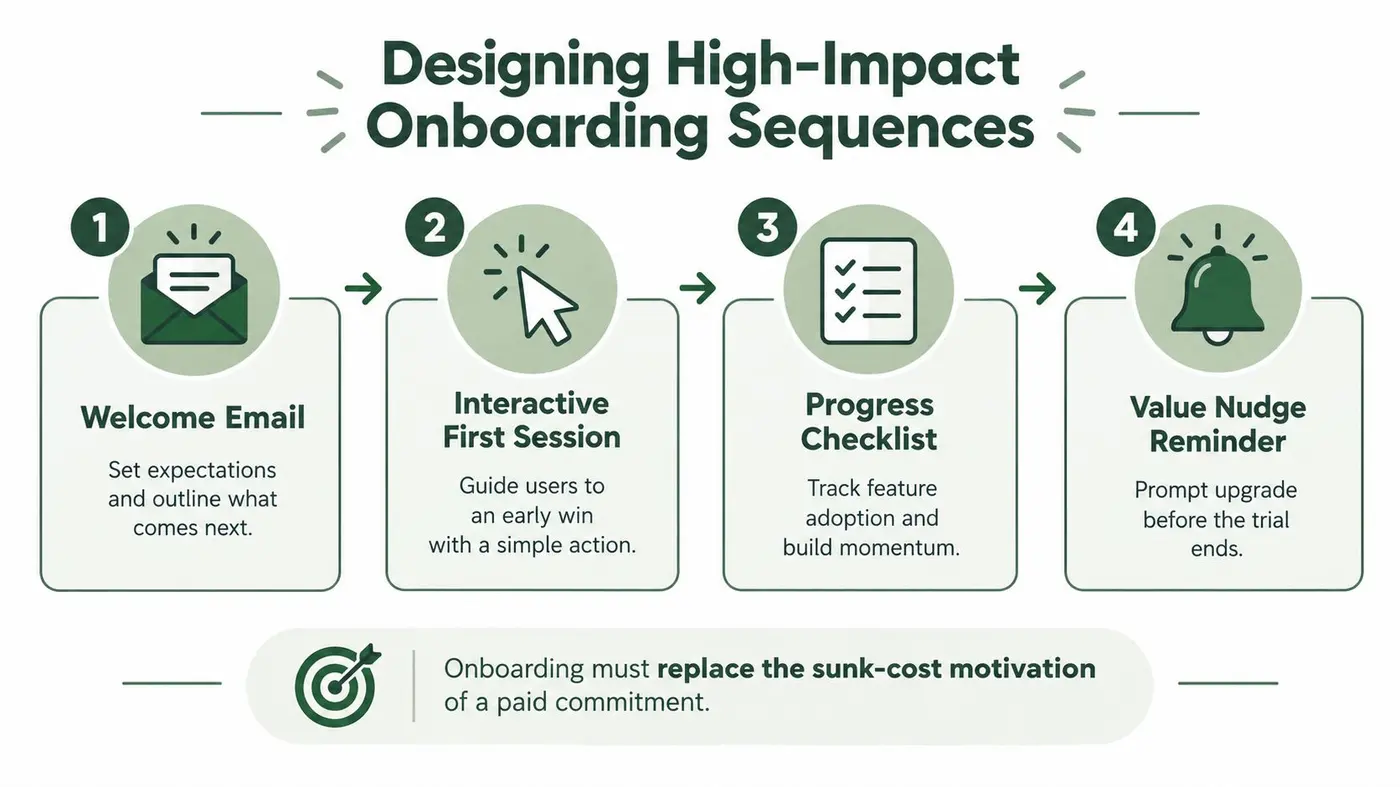
A card-free trial removes one source of commitment, so onboarding must create another. The substitute isn't pressure. It's a sequence of useful experiences that helps the user reach a meaningful outcome before the evaluation window closes.
Start by mapping the shortest route from signup to value. List the first action, the supporting setup, and the result the user should see. Then turn that route into an observable activation event. Without this definition, lifecycle automation becomes a collection of reminders rather than a system that changes behaviour.
Build the sequence around behaviour
A useful onboarding flow has four connected jobs:
- Set expectations in the welcome message. Tell the user what to do first, what the trial includes, and when the evaluation ends. Avoid a catalogue of features.
- Guide the first session. Use an in-app prompt, sample workspace, checklist, or interactive walkthrough to remove uncertainty at the first meaningful task.
- Track progress visibly. A checklist should reflect actions that correlate with value, such as creating, publishing, sharing, or reviewing something.
- Nudge the next decision. Once the user has experienced value, show the relevant plan, explain what continues after the trial, and make payment an informed next step.
A 14-day window needs deliberate pacing rather than one reminder near expiry. SmartSurvey's UK paid plans use a clearly stated 14-day trial without requiring card details, a format that gives users an explicit evaluation period while avoiding payment capture at the outset (SmartSurvey's UK survey-tool guide). Your own messages should reinforce the schedule without making the user hunt for dates.
Segment before you automate
Send different prompts to users who have activated, started but stalled, or never reached the product's core action. An activated user may need a plan comparison or collaboration prompt. A stalled user may need a short task-specific guide. Someone who hasn't returned may need a plain explanation of the first useful outcome, not another feature announcement.
Lifecycle events should also respond to product behaviour. If a user creates a project but doesn't publish it, trigger help with publishing. If they invite colleagues but no one joins, explain the collaboration step. If they reach a limit, show the paid capability and the value it provides.
For teams improving the experience beyond software, a relevant resource such as an AI video generator starter plan can also illustrate the same principle: let people reach an early creative result before asking them to commit. The lesson is transferable. Demonstrated value is a stronger upgrade prompt than repeated urgency.
Use the user onboarding best practices framework to audit every message for timing, relevance, and a clear next action. The sequence should feel like guidance, not surveillance.
Running Pricing Page Experiments with Otter A/B
The cleanest way to test a card-free trial is to isolate the payment requirement while keeping the surrounding experience stable. Start with a control that collects card details and a challenger that removes the field. Keep plan names, pricing, traffic allocation, and core onboarding consistent unless the experiment is intentionally testing a broader offer.
Choose the right experiment variables
Test one meaningful change at a time where possible:
- Form requirement: Card required versus card-free signup.
- Expectation setting: A concise trial explanation versus a more detailed billing disclosure.
- Call to action: Copy that emphasises starting the evaluation versus copy that emphasises the first product outcome.
- Payment handoff: Payment at signup versus payment after activation.
- Trust content: Cancellation language, plan limits, and renewal information near the CTA.
Set the primary outcome before looking at results. Trial starts are useful diagnostic metrics, but paid conversion and revenue per visitor determine whether the change works commercially. Track activation as the bridge between them, and record support contacts or failed payment events if they affect profitability.
Keep the test technically quiet
A pricing experiment shouldn't introduce flicker, delay, or layout instability that changes user behaviour for reasons unrelated to the offer. Keep the variant logic lightweight, ensure the form remains keyboard accessible, and verify that analytics events fire identically across devices and browsers.
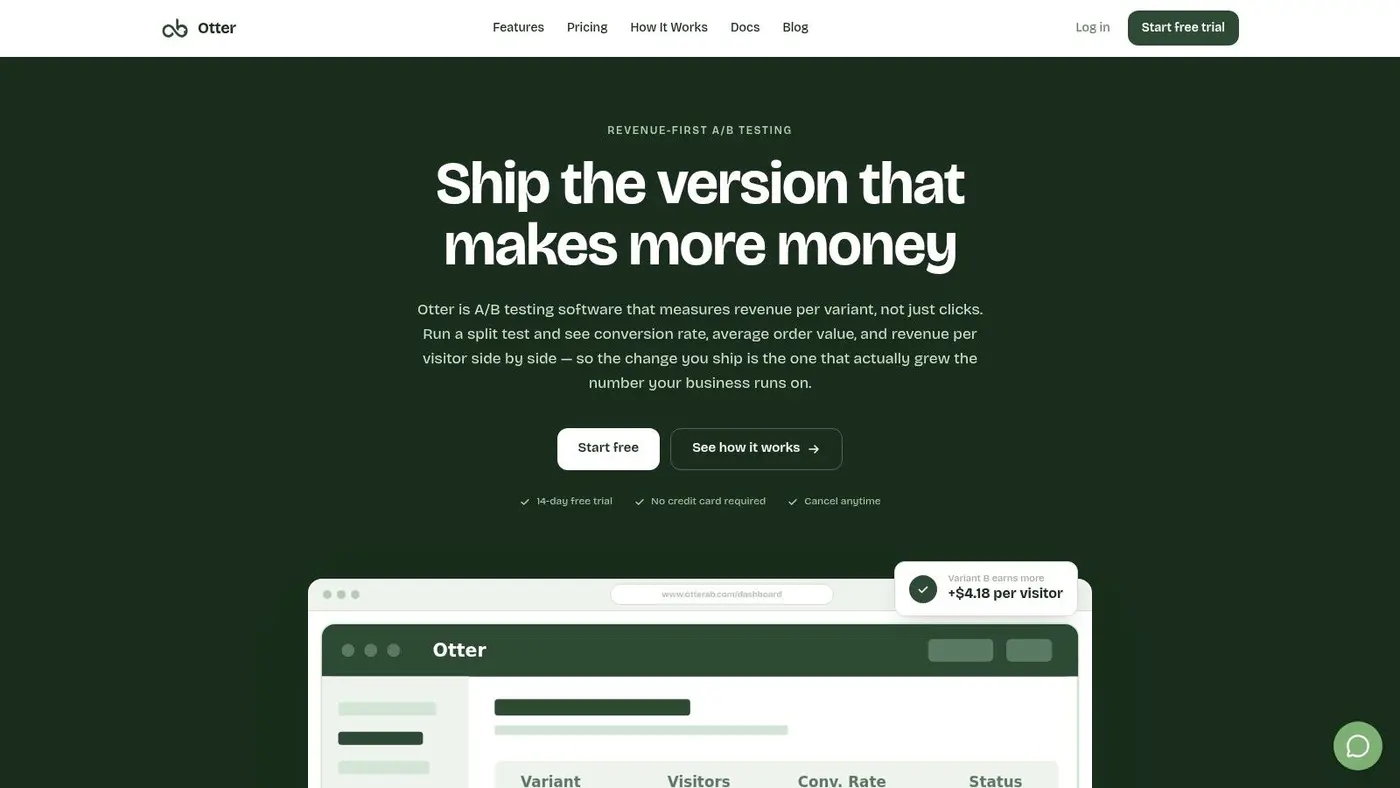
Otter A/B is one option for this workflow. Its product materials describe a lightweight SDK, variant allocation, goal tracking, and reporting for purchases, average order value, revenue per variant, and revenue trends. It also supports integrations including Shopify, Webflow, and Google Tag Manager, which can help teams connect the pricing page test to existing implementation workflows.
Don't declare a winner because the signup rate looks attractive after a short run. The card-free variant may need time for activation and billing events to mature. Review the result at the cohort level, then inspect segments. If the challenger lifts trial starts but lowers activation for a particular acquisition source, the answer may be better onboarding rather than reverting to card capture.
Use a confidence threshold selected in advance, document the test, and record the decision rationale. A statistically persuasive result can still be commercially poor if it produces low-value accounts or creates extra service demand.
Navigating Consumer Trust and Compliance Rules
“No credit card required” is not the same as “nothing will ever be charged”. That distinction is where many trial pages lose credibility. A user needs to know whether the offer is free forever, free for a limited period, or an entry tier that later invites payment.
UK consumer guidance highlights the cancellation risk behind recurring subscriptions. Citizens Advice reported that more than 2 million people in Great Britain had problems cancelling recurring payments, and its guidance warns that free trials can become paid automatically when card details are entered (Citizens Advice subscription cancellation guidance). Removing card capture addresses part of that concern, but it doesn't excuse unclear terms.
Explain the payment handoff
If the product requests payment after activation, show the user:
- The date or event that causes the payment request.
- The plan and price that will be offered.
- Whether access changes if no payment method is added.
- How to cancel or delete the account.
- What happens to stored data after the trial.
The ASA specifically warns consumers to check whether a “free trial” contains later charges, auto-renewal, or cancellation conditions (ASA guidance on free trials). That makes disclosure a conversion tool as well as a compliance measure. Clear terms reduce the fear that the user is entering a trap.
A trustworthy trial makes the exit as understandable as the entry.
Avoid ambiguous labels such as “Start free” when the next step involves an automatic paid subscription. If the offer is free forever, say so where the claim is made. If it is time-limited, display the duration near the CTA rather than burying it in terms.
The best flow asks for payment only after the product has established value, then presents the commercial decision with explicit pre-billing information. That approach can preserve the low-friction experience while treating users fairly. It also gives the lifecycle team a clear moment for reminders, without relying on surprise expiry.
Real-World Applications and Market Evidence
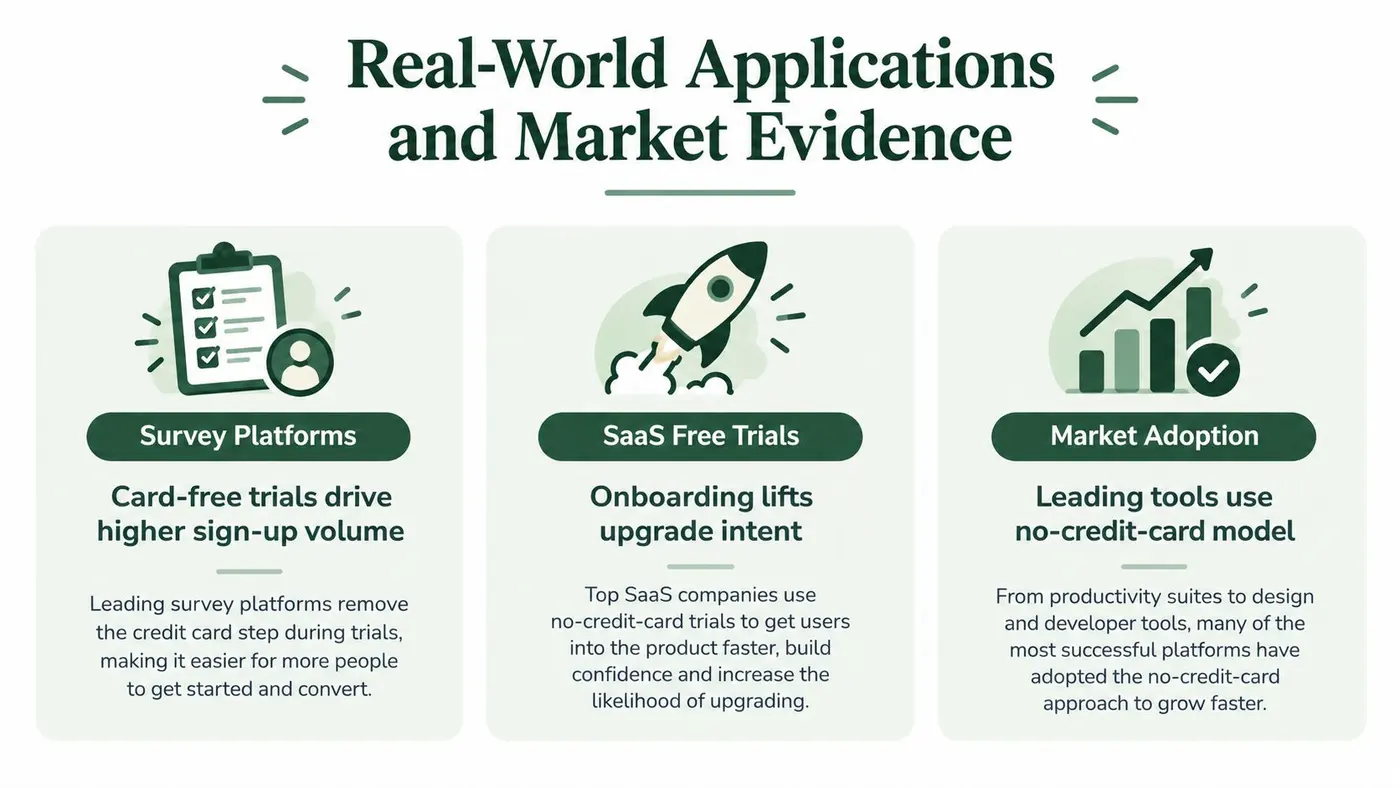
The no-card model appears in products where access can be granted before payment and where the vendor can demonstrate value through usage. IBM's Classroom Accounts, for example, give educators a way to onboard students to quantum-computing resources without requiring a credit card, according to IBM's Classroom Accounts announcement. The model works because the administrator's problem is access management, not immediate checkout.
Survey software provides a more familiar commercial example. SmartSurvey presents a free version without card details and a paid evaluation period without requiring payment information, while its UK positioning reflects a market where users are alert to unwanted trial charges. A product in this category can let a user create a form, share it, and collect responses before introducing a paid decision.
Match the offer to the product's value path
A card-free trial is easier to justify when:
- The first outcome is quick: Users can experience the core benefit without implementation work.
- Usage creates evidence: The product produces a report, response, export, design, or other tangible result.
- The upgrade boundary is clear: Users understand which capability requires payment.
- The business can nurture responsibly: Behavioural messages can guide users without overwhelming them.
An online form and survey builder illustrates the category logic. A prospective user can evaluate the building and publishing workflow before deciding whether paid functionality fits the team. The commercial handoff should still make limits and plan differences visible.
The model becomes less suitable when setup is complex, data migration is expensive, or the sales cycle depends on procurement before meaningful value appears. In those cases, a card requirement may not solve the underlying issue. A guided demo, sales-assisted trial, or proof-of-concept may qualify demand more effectively.
The evidence points to a responsible middle ground. Reduce commitment at the entry point, then increase relevance and clarity as the user approaches payment. Don't use a card-free trial to hide the commercial model. Use it to let the product earn the next decision.
Strategic Next Steps for Your Trial Flow
Treat the decision as a funnel design choice, not a slogan. A self-serve product with a quick first win is a strong candidate for no-card entry. A complex platform may need a card-free discovery flow paired with guided activation, qualification, or a sales conversation. The right model depends on where value appears and how much help users need to reach it.
Audit the current journey before changing the form:
- Record where users abandon the signup flow.
- Define the activation event that demonstrates product value.
- Separate trial starts, activation, payment, and revenue in reporting.
- Write the billing handoff in plain language.
- Create behavioural segments for activated, stalled, and inactive users.
- Test card-free entry against the existing control.
- Review downstream revenue, not just completed registrations.
Keep the first experiment narrow. If removing the card field wins, improve the activation sequence before adding more acquisition traffic. If it loses, inspect whether the product failed to communicate value or whether the audience genuinely needs a stronger commitment signal.
The strategic shift is from capturing payment details to capturing attention and proving usefulness. No credit card required works when the product earns trust through a clear first outcome, the lifecycle programme maintains momentum, and the measurement plan follows users to revenue.
Otter A/B lets growth teams test card-required and card-free trial experiences, compare activation and conversion goals, and connect pricing-page changes to revenue outcomes. Visit Otter A/B to start a focused experiment and make the next trial-flow decision with evidence rather than assumptions.
Stop guessing
Ready to start testing?
Set up your first A/B test in under five minutes. No credit card required.
- 14-day free trial
- No credit card required
- Cancel anytime