Omni Channel Retail: Strategy and Growth Playbook
Master omni channel retail with our guide covering strategy, customer journeys, KPIs, and A/B testing to grow revenue across every channel.
You can feel it in the day-to-day grind of a mid-market retail team. Marketing is pushing a product on Instagram, e-commerce sees the click, stores see footfall, customer service gets the complaint, and finance is left trying to explain why none of it adds up neatly on the P&L. That's the moment most retailers realise omnichannel isn't a buzzword anymore, it's the operating reality.
In the UK, the customer base is already built for this behaviour. The ONS reported that in 2024, 93% of UK households had internet access, 84% of adults used online banking, and 82% of adults purchased goods or services online in the previous 12 months (Ringly's summary of UK omnichannel retail statistics). Contactless payment behaviour reinforces the pattern in-store, with the contactless limit raised to £100 in 2021 in a move reported by the British Retail Consortium in the same source. That mix of digital comfort and physical convenience is why omni channel retail has become a mainstream UK operating model, not a side project.
Why Omnichannel Has Become a Retail Operating Model
A customer sees a jacket on social, checks stock on the website, walks into the store after work, taps their card at the till, then sends the size back by post two days later. On paper, that's one purchase journey. In most retailers, it shows up as four disconnected events in four different systems, and the commercial team spends weeks arguing about which channel “won”.
That gap between customer behaviour and internal reporting is why omnichannel moved out of marketing decks and into boardroom conversations. UK shoppers already move fluidly between digital and physical touchpoints, and the retail model has to follow them. The commercial pressure isn't just about convenience, it's about keeping the brand visible wherever the customer decides to continue the journey.
The customer already shops across channels
The key shift is simple. Customers don't experience stores, websites, apps, delivery, and service as separate businesses. They experience one brand, and they expect the handoff between touchpoints to be invisible. If a retailer can't recognise that journey end to end, the customer feels the friction even when the internal team can't.
That's why practical operators now think in terms of journey continuity instead of channel ownership. A store colleague who can see the online basket, or a service agent who understands what's in stock locally, can save a sale without forcing the customer to repeat themselves. If you want a deeper look at how channel interaction affects revenue and retention, boost revenue and retention is a useful external read.
Practical rule: if the customer has to explain the same situation twice, your channels are still siloed.
Retailers also need to treat attribution carefully. A common mistake is to over-credit the final click and under-credit the store visit, the assisted sale, or the service interaction that made the purchase possible. The mechanics matter, which is why many teams now link journey thinking to their attribution setup, rather than treating reporting as an afterthought. A good starting point is a multi-touch attribution framework that reflects how people buy.
The business model changed before the org chart did
The hardest part isn't customer behaviour, it's internal design. Merchandising, ecommerce, stores, fulfilment, and service still tend to run on different incentives and different data. The customer, meanwhile, is blending all of them into one decision.
That's the reason omnichannel became a retail operating model. It forces the business to organise around the buyer's journey instead of the team chart. Once that happens, the question stops being “Which channel produced the order?” and becomes “Which combination of touchpoints moved the customer forward?”
Defining True Omnichannel
A retailer can have stores, a website, marketplaces, and a support team, and still fail at omnichannel. The test is whether the customer can move between those touchpoints without losing context. If someone starts a journey on mobile, checks stock in store, and later asks support for help, the retailer should already know what happened.
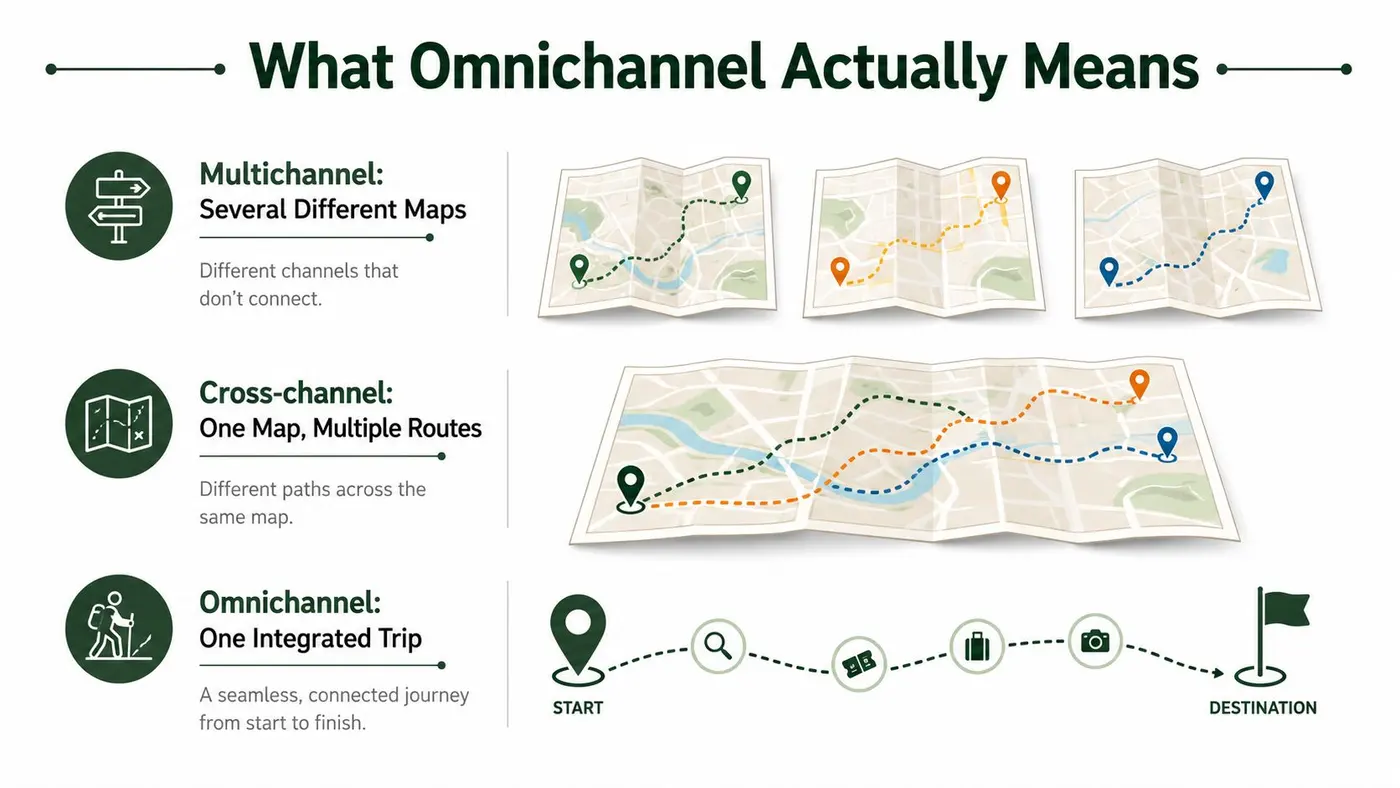
Multichannel gives the customer several separate routes to buy. Cross-channel connects some of those routes, so one touchpoint can inform another. Omnichannel goes further, because the retailer keeps the journey consistent across channels, rather than asking the customer to adapt to each system in turn.
The difference shows up in real operations. A site can show an item as available while the store cannot fulfil it. A promotion can work online and fail at till. A loyalty balance can exist in one system and disappear in another. That is not an omnichannel journey, it is a set of disconnected processes with a shared brand on top.
The minimum capability set
Most practical guidance on omnichannel architecture starts with a small number of requirements. You need a single inventory pool that is visible across channels. You need unified customer IDs so online and offline activity can be tied together. Pricing and promotions need to stay aligned, or the customer starts to question the offer. Analytics also needs to sit on centralised data that can be normalised into a common schema before attribution or activation makes sense (digital applied guidance on omnichannel retail strategy).
That is the minimum, not the finish line. If those pieces are missing, basket continuity breaks, click-and-collect becomes hard to manage, and store-assisted digital conversion turns into guesswork. The customer does not care which platform owns the gap.
What good looks like: one customer record, one view of stock, one set of commercial rules, one reporting layer.
How to audit your own setup
A quick audit usually exposes the weak links. If a store colleague cannot see what the customer has already done online, the customer identifier is not unified. If a website says stock is available but the store cannot fulfil it, the inventory layer is not trustworthy. If a discount behaves differently by channel, pricing governance is still fragmented.
A customer journey map makes those gaps easier to spot. For a practical reference on how teams structure those handoffs, customer journey map examples can help. The question is simple: can the customer move from browsing to buying to returning without the business making them start again?
If that sounds basic, it is. Most omnichannel programmes fail because the journey never became real enough in the data, the stock system, or the service workflow. For teams trying to put support around that setup, the practical omnichannel support guide is a useful companion.
The Business Value of Omnichannel Retail
The value case gets clearer when you stop looking at last-click sales and start looking at the journey as a whole. Independent research in the provided results says 91% of consumers are omnichannel shoppers, they use an average of 11 touchpoints before purchase, and omnichannel engagement is associated with 30% higher lifetime ROI and 89% retention versus 33% for single-channel engagement (Capital One Shopping omnichannel statistics). The number that matters most isn't the headline conversion lift, it's the longer relationship.
Measure the journey, not the channel
Single-channel reporting flatters the wrong decisions. A paid social campaign may look weak if the customer researches on mobile, visits the store, then converts through a service-led follow-up. The sale still happened, but the channel dashboard can't see the full chain of influence.
That's why assisted conversions, cross-device identity resolution, and inventory accuracy matter more than isolated channel metrics. If the customer journey spans mobile, desktop, store, and fulfilment, the data model has to follow the same path. Otherwise, commercial teams optimise the wrong part of the experience and wonder why the P&L doesn't move.
A useful way to frame this in planning meetings is simple. Last-click conversion answers who got credit. Journey measurement answers what worked.
Lifetime value beats vanity wins
The internal discussion usually gets sharper once customer lifetime value enters the room. A retailer can chase one-time sales with aggressive promotions and still damage margin or retention if the post-purchase experience is clunky. A connected journey doesn't just raise the chance of purchase, it gives the brand more chances to serve the customer well enough to earn the next one.
For a detailed internal lens on this, customer lifetime value is the better north star than channel revenue alone. That's especially true when the same customer may browse online, buy in store, return by post, and later respond to a service follow-up. The value is in the relationship, not the final interaction.
AI can help, but only after the journey is readable
There's growing interest in AI for commerce, especially when teams want to speed up support, recommendations, or basket recovery. Zinc's discussion of AI for commerce is relevant here, but the sequencing still matters. If your customer identity is fragmented and your inventory is unreliable, AI just automates confusion faster.
The commercial lesson is blunt. Omnichannel pays when the retailer can recognise the same customer, trust the stock view, and see how touchpoints combine. If the reporting stack can't do that, the value story will stay abstract in the board pack and invisible in trading.
Building the Omnichannel Stack and Customer Journey
The sequence matters more than the brand of software. Start with inventory, because no customer journey survives bad stock data. Then fix identity, because the business can't join behaviour across channels without a stable customer record. Only after that should you spend serious time on journey design and analytics.
Inventory first, because trust starts there
Real-time stock visibility is the first foundation. If a retailer can't tell whether an item is available, click-and-collect, ship-from-store, and assisted selling all become risky. The usual failure mode is a beautiful website sitting on top of stale store data, which creates more support work than revenue.
The cheapest test is often operational, not technical. Pick one high-volume product range, expose live availability to store and digital teams, and check whether the same truth appears in both places. If it doesn't, the stack needs repair before the journey can scale.
Identity second, because one customer needs one record
Unified identity is the difference between a real customer profile and a pile of disconnected sessions. If the retailer can't reconcile email, phone, loyalty, and purchase history, any attempt at personalisation becomes partial at best. The common failure is over-reliance on one system that only sees one slice of behaviour.
A lightweight proof is to take a known customer and trace their activity across web, store, and service. If teams need manual joins to reconstruct the journey, the system isn't ready. Keep the identity model simple enough that store teams and analysts can both understand it.
Journeys and analytics come after the foundations
Once stock and identity are stable, journey design becomes useful instead of decorative. The retailer can decide where the customer should see alternatives, how returns should work, and where service should intervene. Analytics then measures whether those journeys reduce friction or increase value.
| Objective | Capability needed | Proof metric |
|---|---|---|
| Make stock trustworthy across channels | Single inventory view | Fewer stock mismatches between web and store |
| Recognise the same customer everywhere | Unified customer ID | Higher profile match rate across touchpoints |
| Reduce friction in checkout and pickup | Consistent journey rules | Higher completion of the chosen journey |
| Prove the commercial effect | Centralised analytics layer | Better assisted revenue visibility |
The fastest wins usually come from one journey with one defect, not a full replatform.
That's the point many teams miss. You don't need to “finish omnichannel” before you start learning from it. You need enough structure to test whether the journey works, then enough discipline to keep the findings tied to revenue, service load, and inventory performance. If you build in that order, the stack supports the strategy instead of dictating it.
A/B Testing Tactics That Lift Omnichannel Revenue
A retailer only starts learning once the team stops treating channel changes as permanent decisions. In omnichannel, that matters more than in single-channel retail, because a small change to stock copy, checkout flow, or store handoff can shift both revenue and workload. If the team does not test, debates quickly drift toward opinion, store anecdotes, or whichever stakeholder is loudest that week.
That is why A/B testing should sit at the centre of omnichannel measurement. It gives the business a simple question to answer, did the change improve revenue, or did it just feel better in a meeting?
Otter A/B is one option for teams that want a lightweight setup. It uses a 9KB SDK that loads in under 50ms with zero flicker and 99.9% uptime, applies a frequentist z-test engine at 95% confidence, and tracks purchases, average order value, and revenue per variant (Otter A/B). In omnichannel, that matters because the unit you are testing is usually not a single button or headline, it is the behaviour of a journey across web, store, and service.
The tests worth running first
Start where the customer has already shown intent. Product detail pages are often the fastest place to learn whether stock messaging, delivery promises, or local store availability changes behaviour. Checkout tests matter too, especially where basket continuity breaks between devices or sessions.
Then move into cross-channel messaging. A customer who browsed online but did not buy may respond differently to a store email, a pickup reminder, or a service-led nudge. Store-assisted digital flows are another strong area, because the shop floor often influences conversion more than the reporting dashboard suggests.
A useful prioritisation list looks like this.
- PDP stock messaging: test whether clearer local availability improves add-to-basket behaviour.
- Checkout reassurance: test whether delivery, pickup, or returns copy reduces hesitation.
- Cross-channel follow-up: test store-to-email or service-to-web nudges against a control.
- Assisted selling prompts: test whether store staff tools improve the value of the online basket.
Make the result commercially legible
The wrong way to run these tests is to chase click-throughs with no commercial link. In omnichannel, a prettier page that lowers revenue is still a loss. Measure against revenue per variant and average order value, then check whether the winning experience created operational strain elsewhere.
Practical rule: if a test improves clicks but weakens order value, it is not a win.
Keep the test surface small and the hypothesis specific. That makes it easier to tell whether the effect came from inventory clarity, stronger social proof, or a better handoff between channels. It also keeps the team focused on learning, not just shipping more variants.
The advantage of experimentation in omnichannel is that it replaces channel politics with evidence. One test turns a belief into something the business can act on. That is usually what gets budget released for the next change.
Where Omnichannel Subtly Hurts Margin
Profitable-sounding journeys often hide operational costs. Some omnichannel initiatives add cost faster than they add value, especially when fulfilment, labour, and returns are not modelled properly. Industry and academic discussion around omnichannel continues to point to unresolved problems in inventory synchronisation, fulfilment, and operational visibility (Retail Dive on omnichannel struggles).
The margin traps are predictable
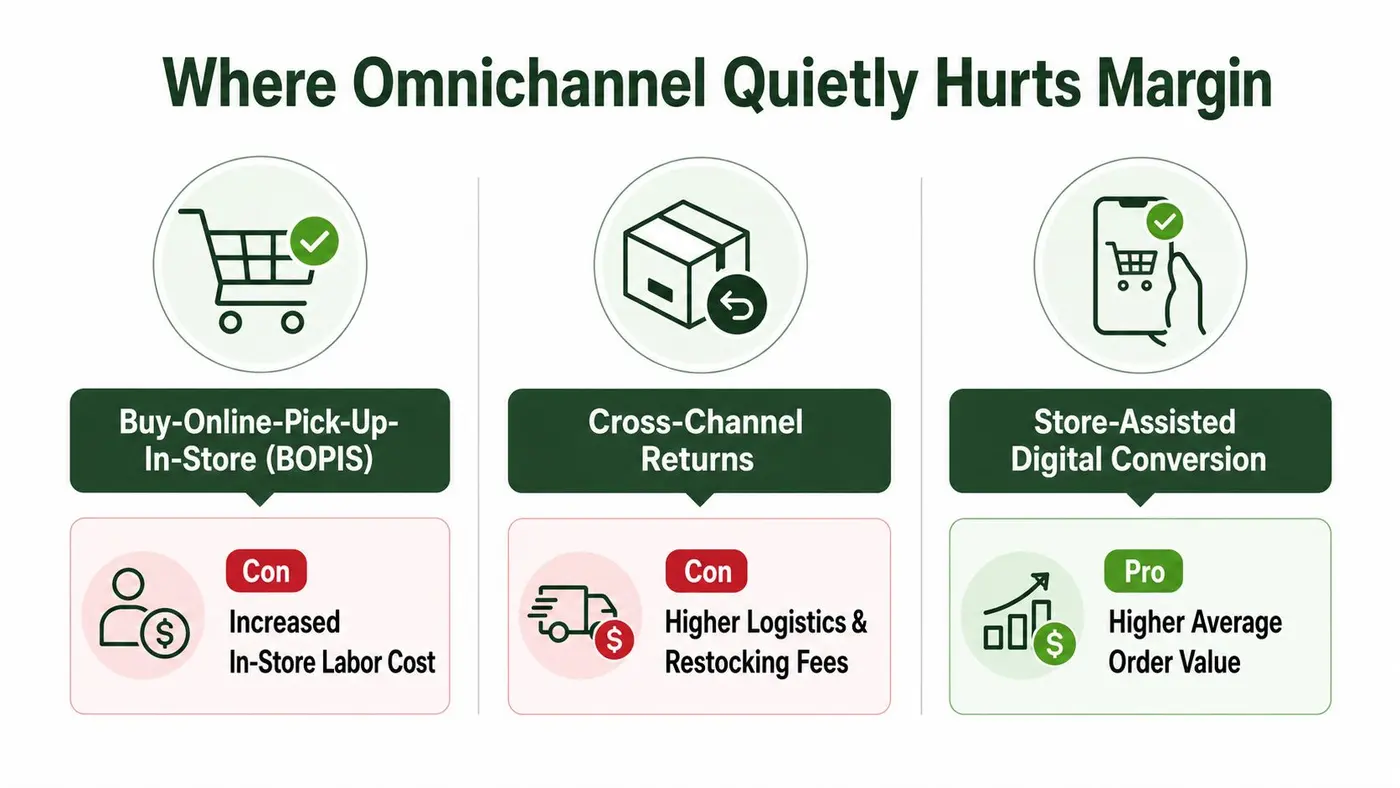
Buy-online-pick-up-in-store can lift convenience, but it also pulls store labour into order handling. Cross-channel returns protect the customer experience, yet they can create higher logistics and restocking friction. Store-assisted digital conversion can raise basket value, but only if the store team has the time and tools to support it.
The pattern is familiar. Retailers celebrate the top-line effect and ignore the cost layer underneath. That is not strategy, it is selective accounting. If the store becomes a mini-fulfilment hub without a clear operating model, the store team ends up carrying extra work that never shows up in the customer-facing dashboard.
Fix the right problem first
A frequently under-answered question is which problem the retailer should fix first, customer-facing consistency, inventory visibility, or fulfilment speed. The right answer depends on where the customer pain is and where margin leakage happens. If the brand is losing trust because stock is wrong, fix inventory. If the journey is clunky but available stock is accurate, focus on the handoff. If the promise is good but delivery breaks operationally, work on fulfilment.
Decision rule: do not launch a new omnichannel promise until you know which part of the journey is paying for it.
That prioritisation mindset matters because not every channel combination adds margin. Some journeys lift conversion but pull too much labour from stores. Others improve service quality but create returns complexity that cancels the gain. The goal is to know which operating problem the programme should solve before you scale it.
The practical takeaway is direct. Omnichannel is not automatically better margin, it is better alignment when the retailer has chosen the right constraint to remove first.
A 90-Day Omnichannel Rollout and KPI Playbook
A small retail team doesn't need a grand transformation programme. It needs one quarter, one clear journey, and a dashboard that tells the truth. The fastest route is to stabilise the foundations, run a few tests, then watch a compact set of KPIs closely enough to act on them.
The video below is a useful companion if your team needs a sharper operational lens on the rollout sequence.
Keep the rollout narrow
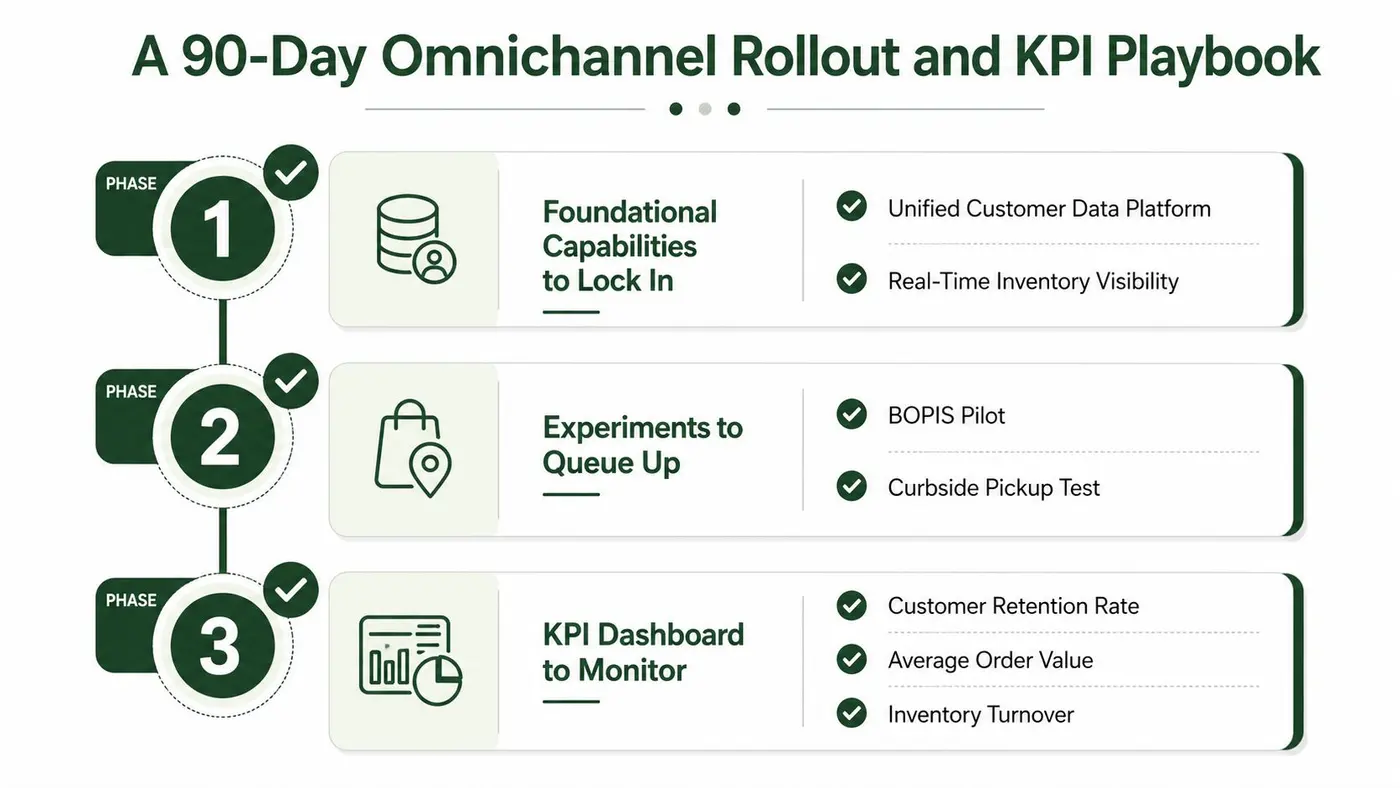
In the first phase, lock in unified customer data and real-time inventory visibility. In the second, queue up a BOPIS pilot and a curbside pickup test, because those journeys surface the same data and fulfilment issues teams need to solve anyway. In the third, watch cross-channel conversion rate, inventory accuracy, assisted revenue share, AOV per variant, and customer lifetime value by channel mix.
The point isn't to track everything. It's to prove that the journey is getting easier to complete, easier to fulfil, and more valuable over time. If those signals don't move together, something in the operating model still needs work.
Use the KPI dashboard to make decisions
A useful dashboard answers operational questions, not just reporting ones. Are store and web seeing the same stock truth? Are assisted sales showing up in the revenue mix? Are tests improving order value without damaging fulfilment speed?
That keeps the team honest. It also stops omnichannel from becoming a vague ambition that everyone supports in principle but nobody can manage in practice. Once the data shows what's working, you can scale the journeys that deserve more budget and cut the ones that don't.
Otter A/B helps teams test omnichannel changes without guessing, so you can see which headlines, CTAs, and journey tweaks actually move purchases and revenue. If you're trying to prove whether a cross-channel change helps the P&L, start with the experiment, not the opinion, and visit Otter A/B to see how it fits your next rollout.
Stop guessing
Ready to start testing?
Set up your first A/B test in under five minutes. No credit card required.
- 14-day free trial
- No credit card required
- Cancel anytime