Product Manager vs Product Owner: Who Decides What
Product manager vs product owner compared: decision rights, daily work, how the roles interact in experiments and which role to hire first, with UK evidence.
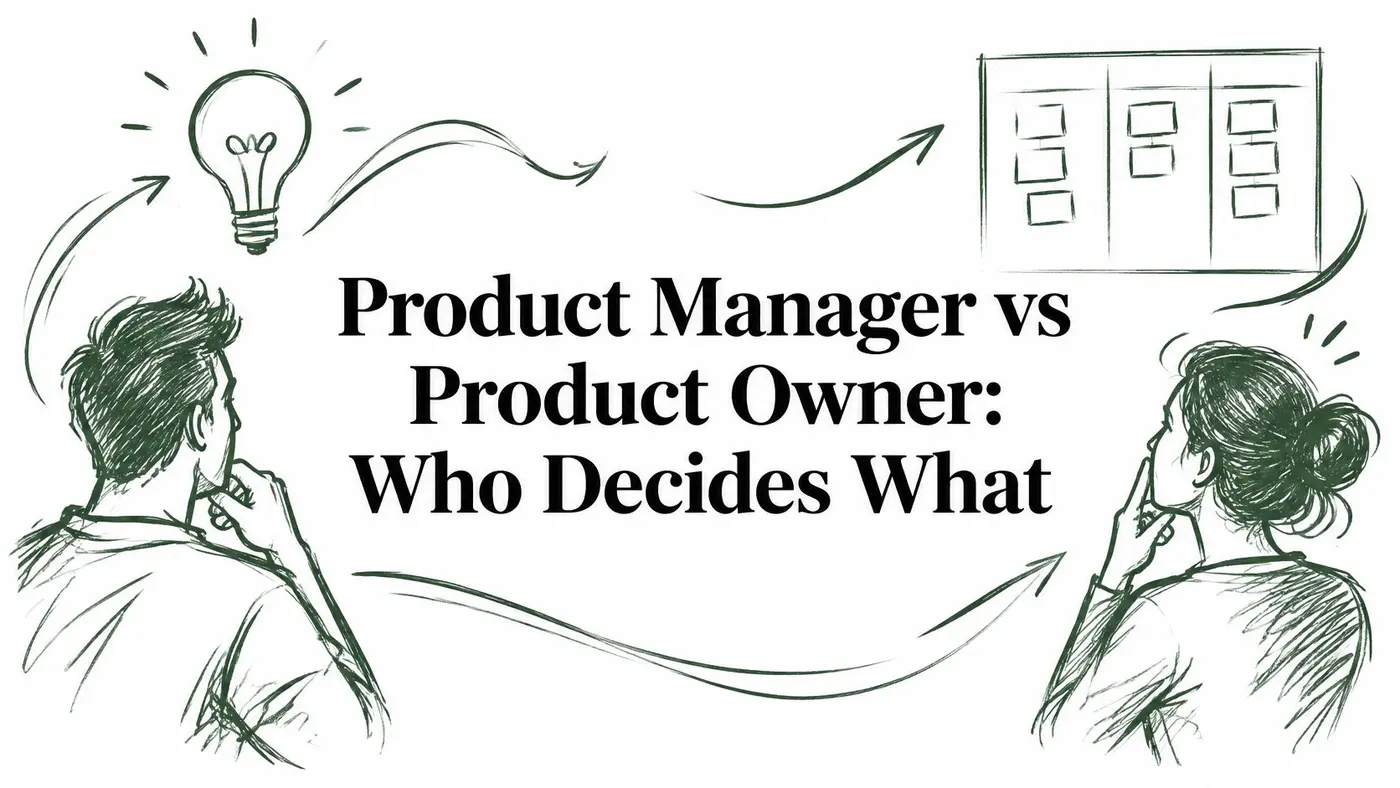
The product manager decides which problems the product should solve and how success is measured; the product owner turns those priorities into an ordered backlog the delivery team can build. But the popular advice that one does strategy and the other does delivery is too neat to use as an organisation chart.
It doesn't tell you who can reject an executive request, stop a release or ship an experiment when conversion improves but revenue falls. For a useful product manager vs product owner comparison, map those decisions before assigning the titles.
Product Manager and Product Owner at a Glance
Treat the following comparison as a proposed operating model, not a universal hierarchy. In particular, reporting lines and delivery measures shouldn't be mistaken for the authority to make product decisions.
Product manager and product owner compared at a glance
| Dimension | Product manager | Product owner |
|---|---|---|
| Core purpose | Decides which problems and outcomes the product pursues | Turns agreed priorities into an ordered, buildable backlog |
| Time horizon | Quarters through the full product lifecycle | Sprints through the coming quarter, release by release |
| Main question | Should we build this, and what should change for users and the business? | Is this ready, and is it the right next item? |
| Main artefacts | Product vision, roadmap, outcome targets, business case | Ordered backlog, user stories, acceptance criteria |
| Typical reporting line | Head of product or commercial leadership, according to the organisation chart | Product manager, product leadership or delivery lead, according to the organisation chart |
| Origin | A wider product management discipline, independent of delivery framework | A defined Scrum role with product-backlog accountability |
| Usual success measure | Adoption, conversion, revenue and retention | Value delivered, supported by backlog health, predictability and acceptance quality |
Product ownership has a specific meaning in Scrum; product management doesn't require Scrum. However, a company can use the product-owner title for a broader job than the framework describes, so neither the title nor the reporting line settles its scope.
Also, don't reduce product-owner success to stories accepted or sprint commitments completed. Those are delivery indicators: a team can meet them while building something customers don't need.
The market doesn't maintain a clean boundary
The 2024 Product Focus industry survey, covering 797 product professionals across 46 countries, with 87% from the UK and Europe, reported that 30% of respondents worked in companies where product managers covered the product-owner role. That's evidence of overlapping responsibilities, not a measure of how every UK employer structures its teams.
For a complementary introduction to the terminology, TekRecruiter on product owners versus managers is a useful resource to read alongside an actual job specification. The specification should identify authority, not repeat role labels.
Starting hypothesis: Separate outcome choices from delivery choices, then check whether your organisation actually delegates them that way.
A combined role isn't confused. Confusion starts when colleagues assume different people own the same decision, or when someone carries accountability without permission to change priorities.
Decision Rights and Accountability Compared
HM Revenue & Customs' role description describes product management as responsibility for quality, value and the end-to-end lifecycle, from discovery through live operation, with product managers working with product owners on backlog prioritisation. That supports broader lifecycle accountability, rather than a product manager handing responsibility away once development begins.
The following is a recommended delegation model. It needs explicit agreement, especially for release safety and work already committed to a sprint.
Who owns each product decision
| Decision | Product manager | Product owner | Usually shared with |
|---|---|---|---|
| Which customer problem to address next | Decides after discovery | Advises on delivery implications | Leadership and engineering lead |
| Roadmap changes and investment trade-offs | Decides within delegated budget | Flags delivery impact | Executive sponsor |
| Backlog order within a sprint | Consulted on outcome implications | Agrees priority changes with developers | Delivery team |
| Whether an experiment is approved to run | Approves hypothesis and outcome metric | Approves acceptance criteria and tracking readiness | Both sign off on their respective gates |
| Declaring a test winner and shipping the change | Owns the business decision using statistical and commercial evidence | Verifies implementation readiness | Commercial owner |
| Stopping a release for quality reasons | Handles business escalation | Exercises delegated acceptance authority | Engineering lead |
| Resolving conflict between conversion and revenue results | Decides against agreed objectives | Escalates implementation evidence | Commercial owner |
Separate approval gates from joint accountability
Say a retailer proposes a Delivery Promise experiment, testing clearer delivery information on product pages. The product manager approves the customer hypothesis and intended outcome; the product owner checks that acceptance criteria cover the variants, purchase tracking and relevant device behaviour.
Both approvals matter, but they aren't interchangeable. A persuasive hypothesis doesn't excuse broken instrumentation, and technically correct tracking doesn't justify an experiment with no worthwhile question.
For a roadmap change, suppose the executive sponsor requests a promotional banner while checkout work is underway. The product manager should decide whether the commercial opportunity justifies displacement, while the product owner identifies abandoned work, dependencies and release consequences. Engineers still own implementation choices and must participate in changes to their sprint plan.
Make stopping authority explicit
If the Delivery Promise variant shows an incorrect delivery date, the product owner should have the right to withhold acceptance according to the agreed quality rules. The engineering lead should maintain authority to halt unsafe deployment; commercial escalation must not override that safeguard.
A data-driven decision-making process should distinguish evidence collection, recommendation and final authority. Otherwise, an unresolved disagreement can look like an analytical problem when it's a governance problem.
At Otter A/B, we let teams invite members as owner, admin, member or viewer. Map access to agreed responsibilities, and check permissions before assuming a role label grants or restricts a particular action.
Every decision needs a named accountable person. Where approvals are shared, document which gate each person controls and who resolves a disagreement.
Daily Work, Skills and Job Advert Signals
Job titles provide weak evidence of who controls a product decision. Daily responsibilities and the wording of job adverts offer better clues, although employers often use the same title for different work.
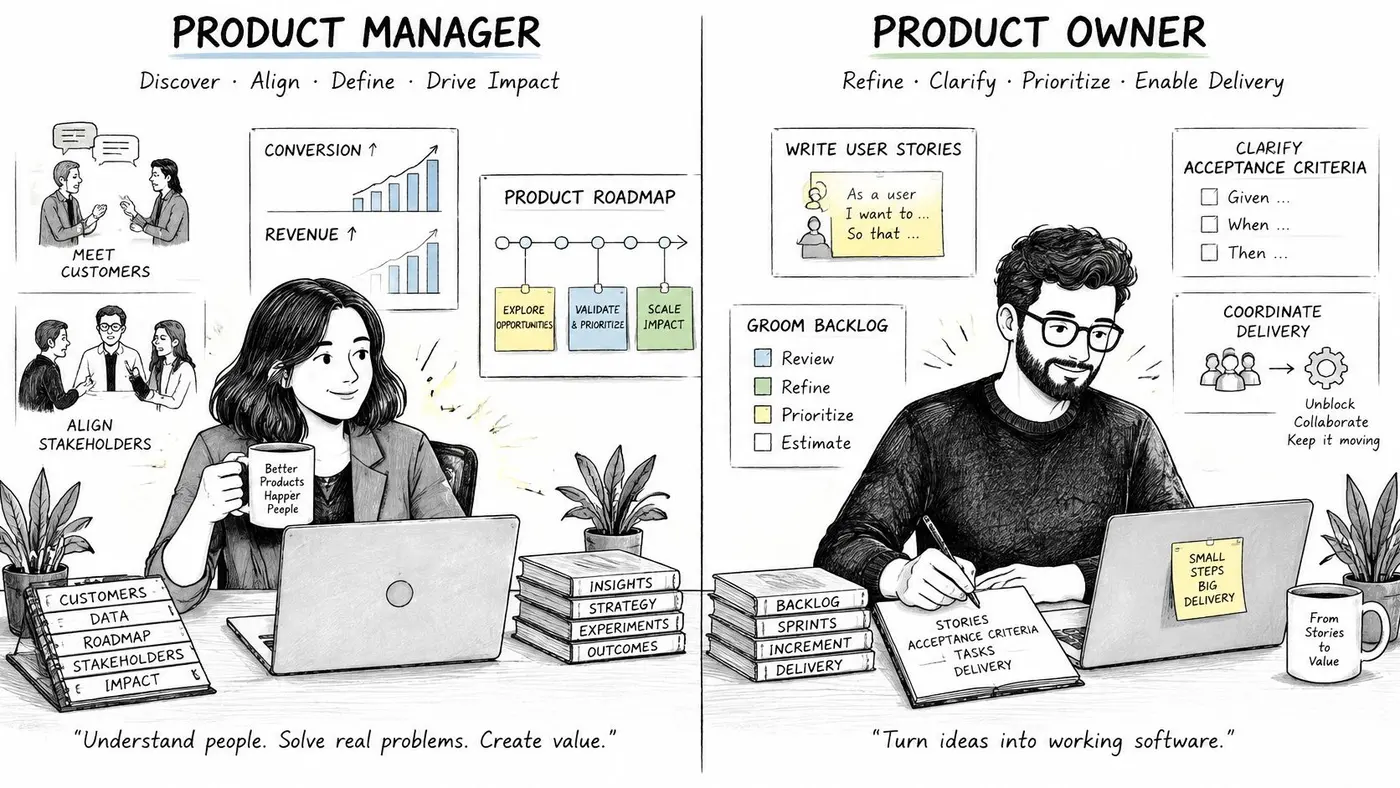
Read the emphasis without inventing a boundary
A product manager's week might include customer interviews, conversion and revenue reviews, stakeholder negotiations and roadmap decisions. A product owner's might involve refinement, sprint planning, story clarification and checking completed work against acceptance criteria. These patterns suggest different decision pressures, not fixed job boundaries.
The figures below come from IT Jobs Watch's vacancy analysis. The product-owner sample covers England; the product-manager sample covers the UK. “Not stated” means the table does not report a figure for that term and role.
Most-cited skills in UK job adverts by role
| Skill term | Product owner adverts, England | Product manager adverts, UK |
|---|---|---|
| Agile | 43.6% | 25.9% |
| Stakeholder management | 36.3% | 24.6% |
| User stories | 30.6% | Not stated |
| Product backlog | 29.6% | Not stated |
| Backlog management | 26.4% | Not stated |
| Sprint planning | 19.4% | Not stated |
| Acceptance criteria | 18.2% | Not stated |
| Backlog refinement | 13.7% | Not stated |
| Roadmaps | Not stated | 42.6% |
| Product management | Not stated | 29.9% |
| Product strategy | Not stated | 21.7% |
| Product-owner postings, England | 19.1% | Not stated |
These are job-ad mentions, not measures of employees' time or proof of seniority. The samples cover different geographies, so treat the pattern as a source of interview questions rather than a controlled comparison.
Test the skill behind the keyword
For a product manager, prioritisation means explaining opportunity cost: why improve checkout rather than acquisition, and what evidence could change that choice? Commercial reasoning and experiment design connect the trade-off to a decision that can be tested.
For a product owner, facilitation means resolving ambiguity before it becomes rework. Technical literacy helps them discuss event duplication, loading behaviour and dependencies with engineers while leaving implementation decisions with engineering.
Written delivery work offers another useful signal. A story should give its reader enough detail to build and verify the intended outcome. AIDictation's guidance can help candidates write user stories ready for development.
The accompanying video offers another format for considering the role distinction.
Read an advert's opening responsibilities before its qualification list. If it centres on requirements gathering and sprint coordination, ask how much customer discovery and commercial decision-making the role includes.
How the Two Roles Work Together in an Experiment
An experiment needs visible handoffs, but it shouldn't become a queue of documents passed between isolated specialists. Keep the hypothesis, implementation criteria and decision record connected.
The process below separates the business question from the delivery preparation.
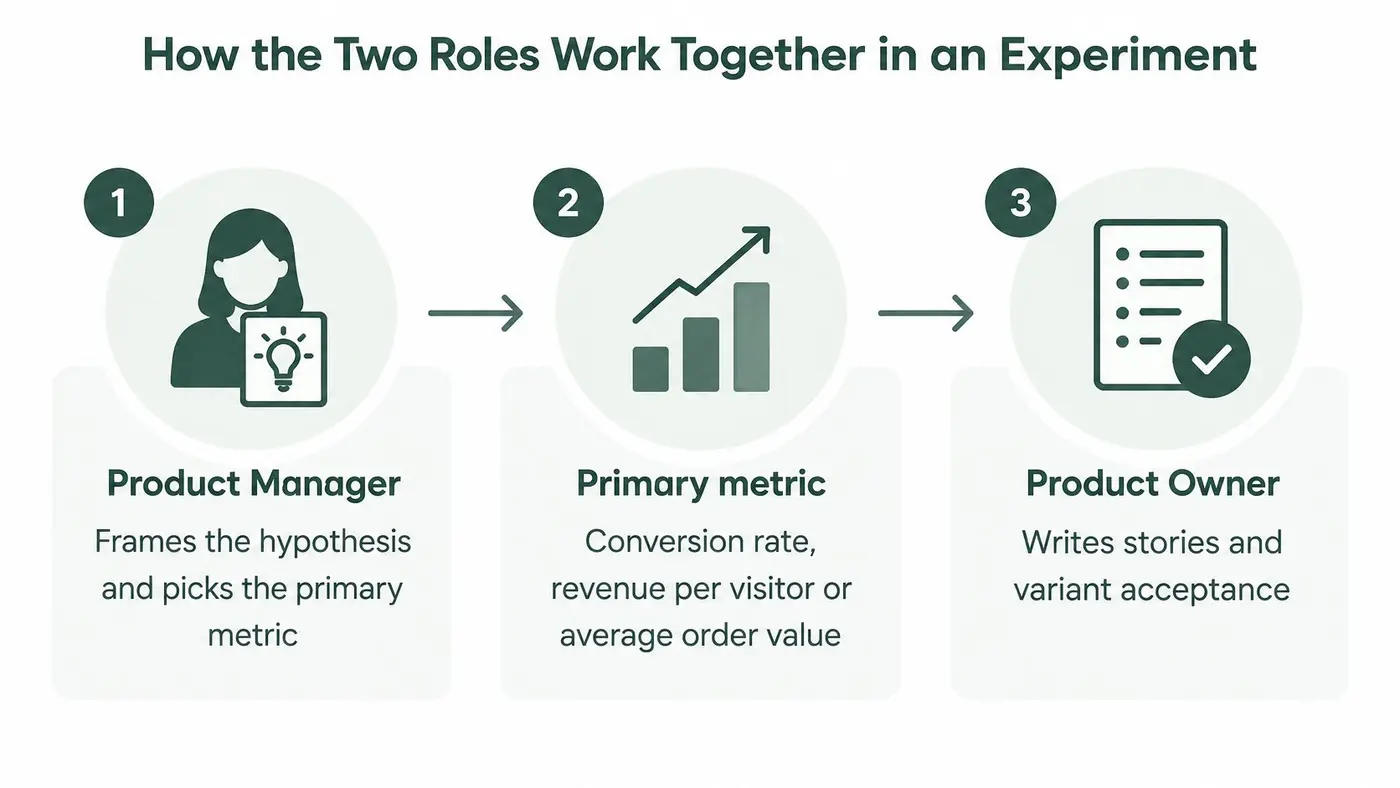
From question to launch
-
The product manager frames the hypothesis. Say a shop believes clearer delivery information will reduce purchase hesitation. Choose the primary metric, such as conversion rate, revenue per visitor or average order value, and specify which adverse outcomes would prevent rollout.
-
The product owner makes the test implementable. Write stories, variant acceptance criteria and goal definitions, including purchase or revenue measurement where appropriate. Define what counts as a valid event so a repeated confirmation-page load doesn't become an unnoticed measurement ambiguity.
-
Engineering and design build; the product owner verifies. In our Preview Mode, a reviewer can force a specific variant for QA and stakeholder review. Check each variant, confirm the intended traffic split and verify that the same purchasing journey is measured consistently.
Linking experimentation to the software development lifecycle and Agile delivery helps the team include testing readiness in normal delivery work. It shouldn't be an extra check performed after everyone considers the feature finished.
From launch to a defensible decision
-
The product owner monitors implementation health while the product manager monitors the planned evaluation. Investigate broken layouts, missing events or unexpected eligibility behaviour promptly. Don't treat an encouraging early trend as permission to abandon the agreed sample and duration.
-
The product manager interprets conflicting outcomes. When conversion rate and revenue disagree, Otter A/B says so instead of declaring a winner. The accountable decision-maker must assess that disagreement against the commercial objective, uncertainty and any customer-experience constraints.
-
The product owner implements the authorised outcome. Every results page has an executive summary card stating in one line whether to ship the change, keep testing or stop. The product manager records the reasoning and learning, including why the team accepted or rejected the recommendation.
A recommendation isn't an authorisation. Record who accepted it and what evidence supported the decision.
In a small team, the same person can perform these activities. Still record the handoffs as separate responsibilities, so nobody mistakes a completed implementation check for an approved commercial rollout.
Hiring Guidance by Team Situation
| Team situation | Hire first | Why | Watch for |
|---|---|---|---|
| Early-stage single product, small engineering team | Product manager | Customer discovery and outcome choices need an explicit owner | Founder becoming the unofficial backlog owner |
| Scaled product with several squads | Product manager for the product, with product-owner capacity per squad where needed | Product-level priorities need translation into coordinated squad work | Duplicate roadmaps and conflicting priorities |
| Regulated or public-sector delivery | Product owner alongside a named product manager | Delivery acceptance needs clear delegation and traceability | Titles that promise authority the role doesn't possess |
| Growth team running constant tests | Product manager, adding a product owner when delivery coordination warrants it | Hypotheses and metric choices need ownership alongside reliable implementation | Tests launched without an outcome decision-maker |
| Agency or contract build | Client-side product owner, with a named business outcome owner | The client needs timely ordering and acceptance decisions | A well-delivered contract with no accountable product strategy |
These are hiring recommendations, not staffing ratios. Hire for the missing decision that hurts most, rather than copying another company's structure.
Budget for accountable scope
3Search's 2025 UK salary survey reported that Product Manager salaries generally ranged from £70,000 to £95,000, across a survey with more than 1,300 respondents. That makes it important to define the outcome authority you're buying, rather than filling the specification with coordination tasks.
The figure isn't a matched product-owner comparison. Don't use it to infer a pay gap or assume that changing someone's title establishes their market value.
A useful specification should state:
- Owned decisions: Name the roadmap, experiment or acceptance decisions the person can make without further approval.
- Accountable outcomes: Specify the customer and business measures they must explain.
- Delivery environment: Identify the backlog, analytics and experimentation tools they'll use, plus their relationship with engineering.
- Authority limits: Explain budget boundaries, release safeguards and escalation routes.
Use a decision exercise in interviews
Give candidates a realistic experiment brief: purchase conversion improves, revenue looks weaker and the commercial team wants to ship. Ask what evidence they need, who should make the rollout call and who should write the acceptance criteria for the next iteration.
Assess the reasoning, not whether they repeat your preferred title split. A strong candidate distinguishes a business recommendation from implementation readiness and knows when the evidence doesn't support a confident conclusion.
Before opening a vacancy, check whether the missing authority could be delegated to an existing colleague. Hiring another coordinator won't resolve a decision that leadership still refuses to delegate.
Who Can Move From Product Owner to Product Manager
A product owner can move into product management by demonstrating broader decisions, not just by accumulating more backlog responsibility. Equally, product ownership can remain a valuable specialism rather than a compulsory intermediate rung.
Build evidence of judgement
-
Inspect the target role, not an assumed career ladder. Look for responsibility for customer discovery, investment choices and measurable outcomes. A role mentioning strategy may still leave all meaningful decisions with a founder or sponsor.
-
Audit your current authority. Separate decisions you've made from recommendations you've prepared and instructions you've implemented. All are useful experience, but they demonstrate different levels of responsibility.
-
Create an outcome decision record. Capture a customer problem, written hypothesis, controlled test and subsequent roadmap recommendation. Include uncertainty and rejected alternatives, not just the feature that shipped.
-
Request a bounded product decision. Ask to select an experiment's primary metric or recommend which opportunity should displace another. Agree the limits with your manager, then document the evidence and consequences.
-
Present the result as a reasoned choice. Explain what you expected, what happened and what you changed. If the result was inconclusive, show how you avoided spending more without a worthwhile learning objective.
Portfolio test: Could a hiring manager understand why you chose this work instead of a credible alternative?
Keep the specialist route open
Don't accept a broader title as a substitute for access to customers, commercial information and decision-makers. Those are practical conditions for doing the work, not perks to negotiate after accepting accountability.
For interviews, prepare an anonymised decision memo rather than screenshots of a tidy backlog. Show the customer evidence, competing options, chosen metric and recommendation so the panel can assess your judgement.
The important career question isn't whether product ownership automatically leads somewhere else. It's whether you want broader outcome accountability and can demonstrate readiness to exercise it.
Common Mix-Ups and How to Confirm Decision Owners
A title can describe someone's expertise without authorising them to act. That's why a team can contain capable product professionals and still struggle to decide what happens next.
IT Jobs Watch's England product-ownership vacancy analysis shows overlapping language across the roles, including roadmaps and stakeholder management, alongside product-owner references to vision and continuous improvement. Treat that overlap as a reason to interrogate responsibilities, not to declare the roles identical.
Replace assumptions with operating rules
- Treating the title as authority: Ask who can approve the decision without seeking another person's permission, then record that person's name.
- Applying a textbook split everywhere: Check whether the product owner contributes to discovery and investment decisions before excluding them from strategic discussions.
- Writing strategy without measurable outcomes: Attach an observable customer or business objective to each backlog theme, and identify who will review it.
- Claiming joint ownership of a disputed rollout: Agree how conflicting outcomes will be weighed before launch, including who can decide that the evidence is insufficient.
- Letting sprint administration consume discovery time: Delegate refinement preparation and delivery clarification deliberately, while agreeing facilitation responsibilities with the delivery team.
These fixes require more than changing a responsibility matrix. Someone must grant the authority, affected colleagues must recognise it, and the accountable person must have access to the evidence needed to act.
Good stakeholder communication makes those boundaries visible before a contentious request arrives. Record who was consulted separately from who authorised the decision; attendance at a meeting isn't approval.
Run a practical ownership check
Use a short working session with product, engineering and the commercial sponsor. Bring an upcoming experiment or release so the discussion stays concrete.
- Write the decision inventory. Include problem selection, roadmap changes, backlog priority changes, experiment approval, rollout, quality stops and conflicting commercial results.
- Assign accountable names. Where several names appear, separate distinct approvals or agree a tie-break rule in writing.
- Name the website steward. In our platform, a project represents a single website or domain, with its own API key, snippet and test history. Assign someone to maintain continuity of that experiment record without assuming they're automatically the commercial decision-maker.
- Check titles against actual scope. If someone answers for revenue but can't influence priorities, either expand their authority or narrow their accountability.
- Revisit after organisational changes. Recheck the agreement when a squad forms, leadership changes or the roadmap shifts materially; don't leave delegation attached to someone who has moved on.
Don't aim for a grid with no collaboration. Aim for a grid that lets people collaborate without reopening the question of authority every time they disagree.
Your next decision is concrete: hire a product manager to address missing outcome ownership, hire a product owner to strengthen delivery decisions, or re-scope existing roles so authority matches the work people already do.
Otter A/B supports website experiments with variant previews, conversion and revenue results, and a clear recommendation to ship, keep testing or stop. Visit Otter A/B to put an experiment through that workflow with a named owner for implementation checks and a named owner for the final business decision.
Stop guessing
Ready to start testing?
Set up your first A/B test in under five minutes. No credit card required.
- 14-day free trial
- No credit card required
- Cancel anytime