Stakeholder Communication for A/B Tests: A Playbook
Master stakeholder communication for experiments. This playbook covers mapping, messaging, reporting, and using Otter A/B outputs to drive buy-in and action.
You launch an A/B test on a pricing page. The variant wins. The numbers are clear enough for the experiment team to move forward. Then nothing happens.
Product says they didn't realise the test affected the onboarding flow. Sales asks why no one explained the likely effect on lead quality. Finance wants a cleaner view of commercial impact. Leadership glances at a chart in Slack, says “interesting”, and moves on to the next fire.
That's the part most experimentation articles skip. The test didn't fail. The stakeholder communication failed.
In practice, the difference between a useful experiment and an ignored one often comes down to whether people were prepared before launch, kept warm during the run, and given a result they could act on without doing extra interpretation. If you treat communication as a reporting task at the end, you'll keep producing technically sound work that creates very little organisational movement.
That problem is bigger than experimentation. UK workplace data summarised by Oak Engage reports that only 8% of UK workers are engaged, and 74% feel they are missing out on company news because internal communications is absent or ineffective, which is a blunt reminder that internal messages often don't land in the way teams assume they do (Oak Engage's UK internal communication statistics summary). If your A/B test update is just another dashboard link dropped into a crowded channel, don't expect alignment.
Good stakeholder communication changes the role of the CRO team. You stop being the people who publish findings and start being the people who help the organisation make decisions with less friction.
When Great Experiments Fail to Make an Impact
A lot of growth teams think they have an analysis problem when they really have an activation problem.
The pattern is familiar. A marketer runs a clean headline or CTA test, gets a credible winner, sends a recap with screenshots and a conversion delta, and expects the rest of the organisation to be impressed. Instead, the message lands flat because each stakeholder is thinking a different question.
The Head of Growth wants to know whether the result is strong enough to roll out. The product manager wants to know whether the learning applies beyond one page. Engineering wants to know whether implementation is simple or whether they're inheriting a messy variant. Leadership wants the commercial implication in plain English.
If your update answers only the experimentation team's question, no one else sees their next move.
Stakeholder communication isn't what happens after the test. It's part of how the test creates value in the first place.
That's why “we shared the results” is usually a weak defence. Sharing isn't the same as aligning. Most internal communication fails because it arrives too late, says too much, or assumes every audience cares about methodology in the same way the experiment owner does.
In CRO work, poor communication creates three expensive outcomes:
- Winning tests stall: nobody owns rollout, so the variant sits in limbo.
- Inconclusive tests get dismissed: useful behavioural learning disappears because the result wasn't framed properly.
- Trust erodes: stakeholders start to see experimentation as interesting but operationally disconnected.
The teams that avoid this don't write longer updates. They build communication into the test plan from day one. They know who needs confidence, who needs context, and who only needs a decision memo.
That's the shift worth making. Treat the experiment as two parallel workflows: the statistical one and the stakeholder one.
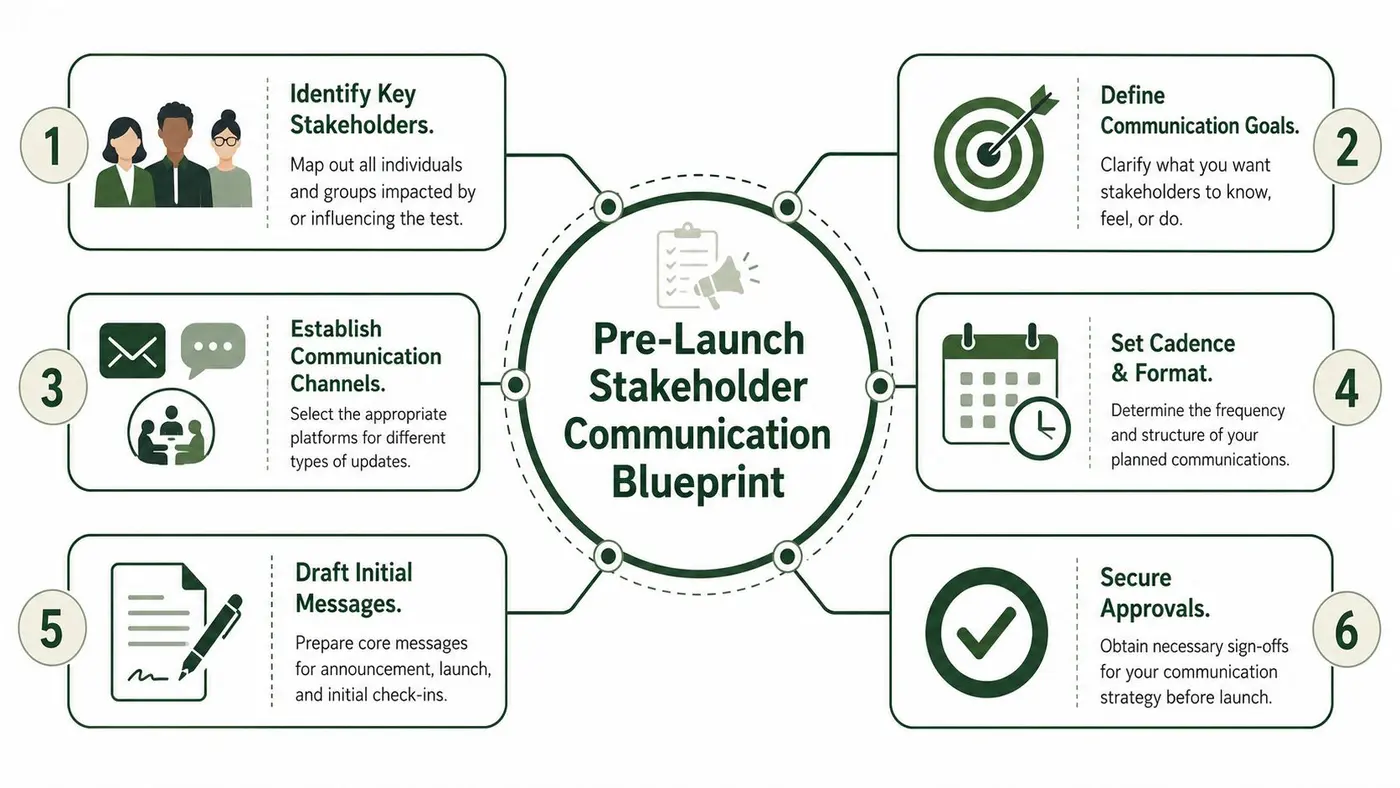
The Pre-Launch Blueprint for Stakeholder Communication
Most communication mistakes happen before the test is live.
Teams jump straight into variant design, implementation, and sample-size debates. They leave stakeholder communication until someone asks for an update. At that point, the project already feels reactive. A better approach is to map influence, interest, and decision rights before a single visitor sees the variant.
Build an interest and influence map
PMI-style guidance is practical here: classify stakeholders by interest and influence, then decide whether to inform, consult, involve, or collaborate, while avoiding the common mistake of over-sharing or using overly technical language with the wrong audience (PMI guidance on engaging stakeholders).
For an A/B test, that usually looks like this:
| Stakeholder group | Likely influence | Likely interest | Best mode |
|---|---|---|---|
| Executive sponsor | High | Medium | Consult |
| Product manager | High | High | Collaborate |
| Designer | Medium | High | Involve |
| Developer | High | Medium | Consult |
| Sales or customer success lead | Medium | Medium | Consult |
| Wider marketing team | Low | Medium | Inform |
The point isn't to make a fancy matrix. The point is to stop sending the same update to everyone.
Decide what each group needs before launch
A useful pre-launch checklist is short and blunt:
- Business owner: what decision will this test influence if it wins, loses, or stays inconclusive?
- Product lead: what user behaviour are we trying to change?
- Engineering: what must stay technically stable and what fallback exists?
- Commercial teams: what customer-facing implications might appear if the variant changes messaging?
- Leadership: what counts as a meaningful outcome?
If you can't answer those cleanly, you're not ready to launch.
Practical rule: every stakeholder should know one thing before launch, what's being tested, why it matters, and what happens if the result is strong enough to act on.
Turn the test brief into the source of truth
This is where experimentation tooling matters. If your hypothesis, primary goal, secondary metrics, and audience rules live in scattered docs, stakeholders will remember different versions of the test. That's how goalposts move halfway through.
Keep the test brief operational. Define the objective in the experiment workspace, document the hypothesis in plain language, and link the expected outcome to the metric that matters. If you need to align traffic needs early, a quick guide to calculating sample size for A/B tests helps anchor the conversation around feasibility rather than optimism.
One adjacent point that growth teams often miss is that strong internal communication doesn't just reduce confusion. It improves downstream execution across commercial teams. If you work closely with sales or B2B marketing, this piece on how internal comms drives B2B demand gen is worth reading because it frames communication as an enablement lever, not just an update stream.
Secure approval without slowing the team down
You don't need a committee for every test. You do need clarity on who can block, who can advise, and who only needs visibility.
A lightweight approval model works well:
- One accountable owner: usually the experiment lead.
- One business approver: the person who owns the commercial area affected.
- One implementation approver: usually product or engineering.
- Named observers: people who don't approve the test but should never be surprised by it.
If you handle this before launch, the result conversation later becomes faster and less political.
Crafting the Narrative with Goal-Aligned Messaging
Raw experiment output rarely persuades anyone on its own. Most stakeholders don't need more data. They need the data translated into the language of their priorities.
That doesn't mean spinning the result. It means presenting the same truth through the lens each audience uses to make decisions.
Translate one result three ways
Say your variant changed the page structure, simplified the copy, and improved completion of the primary action. The underlying result is the same. The narrative changes depending on who's listening.
For the C-suite:
- This test reduced friction in a key conversion step.
- The decision is whether to roll the variant out broadly and monitor downstream commercial quality.
- The implication is business performance, risk, and rollout priority.
For design:
- The cleaner information hierarchy appears easier for visitors to process.
- The useful learning isn't just “version B won”. It's that users responded to less cognitive load and clearer visual sequencing.
- That insight can inform future page design.
For engineering:
- The winning variant is simpler to support if it removes interface complexity.
- The next question is implementation effort, QA scope, and dependency risk.
- The communication should be about operational change, not persuasion theatre.
Answer the hidden question
Every stakeholder reads your update with one silent filter: “What does this mean for my area?”
If you ignore that, even a good summary feels abstract. A better structure for stakeholder communication is:
- What changed
- What behaviour shifted
- Why that matters to this team
- What decision is now needed
That fourth line is where many experiment updates fall apart. They describe the result but avoid asking for a concrete next step.
Don't send a stakeholder update that ends with “for information”. If the test matters, someone needs to approve, implement, monitor, or learn from it.
Keep the strategic thread visible
The cleanest way to stop messaging drift is to connect each experiment back to the larger operating metric your organisation already respects. If your company tracks activation, qualified pipeline, repeat purchase, or another strategic measure, the experiment narrative should point there.
That's why it helps to frame tests against a clearly defined North Star metric. When stakeholders understand how a page test relates to the broader system, they're less likely to dismiss it as local optimisation.
What good messaging sounds like
Here's the difference in tone.
Weak:
- “Variant B increased conversions, see dashboard for details.”
Strong:
- “Variant B reduced decision friction on the pricing page. Marketing can roll the new messaging live, product should watch downstream onboarding quality, and leadership can treat this as evidence that simpler pricing language supports the current acquisition strategy.”
Same result. Different level of usefulness.
Good stakeholder communication also means knowing what not to say. Don't dump methodology on people who need a decision. Don't promise certainty where there isn't any. Don't over-explain caveats until the recommendation disappears.
The job is clarity with enough evidence behind it.
Maintaining Momentum with a Smart Communication Cadence
Silence makes stakeholders nervous.
When a test runs for days or weeks without context, people start filling the gap themselves. Product assumes nothing important is happening. Leadership forgets the test exists. Sales hears about a page change from a customer before they hear about it internally. None of that is a data problem. It's a cadence problem.
The case for steady stakeholder communication is stronger than many teams realise. One cited study reports that projects with engaged stakeholders succeed 78% of the time, compared with 40% for projects with less engagement, which is a sharp reminder that consistent involvement changes outcomes, not just sentiment (stakeholder engagement effectiveness summary).
Use cadence to prevent doubt
You don't need weekly essays. You need predictable signals.
A simple experiment cadence often works better than a polished monthly report:
- Launch note: test is live, hypothesis confirmed, owner named.
- Mid-run check-in: no conclusions yet, no action required, key observation if relevant.
- Decision alert: test reached a point where rollout, extension, or closure should be discussed.
- Final summary: outcome, rationale, next step, owner.
This rhythm keeps people informed without dragging them into noise.
Make notifications do the heavy lifting
Manual updates break down when the team gets busy. That's why automation is useful in stakeholder communication. If a system can notify the right people when a result becomes decision-worthy, the CRO team spends less time chasing attention and more time framing the implication.
Used well, a Slack notification is not just an alert. It's a prompt for action.
A good significance message in a team channel should include:
| Element | Why it matters |
|---|---|
| Test name | Removes ambiguity |
| Primary goal | Reminds people what was being optimised |
| Status | Signals whether attention is needed now |
| Immediate recommendation | Prevents passive reading |
| Link to fuller context | Gives detail to those who need it |
That structure stops the common failure mode where a milestone appears in Slack and then disappears under twenty unrelated messages.
Match the channel to the audience
Cadence isn't only about frequency. It's also about format.
Executives usually want short summaries with decision language. Product and design may want a working thread with context and discussion. Engineering often prefers crisp implementation notes and clear dependency calls. Wider teams can receive a lighter recap once the decision is made.
If you use Otter A/B for experimentation, its Slack notifications and reporting outputs can support that flow by surfacing milestones when a test reaches a decision point and giving the team something concrete to share. That's useful because it reduces the lag between “the result is ready” and “the organisation knows what to do with it”.
A quiet test loses momentum long before it loses relevance.
The best communication cadence feels almost boring. That's a compliment. It means stakeholders know when they'll hear from you, what kind of update to expect, and whether they need to do anything.
Reporting for Impact with Otter A/B Outputs
The final report is where experimentation teams often waste their best advantage.
They've done the hard work. The test is complete. The learning is real. Then they package it as a screenshot, a chart, and a sentence that says one version “performed better”. That's not enough for serious stakeholder communication. Decision-makers need a report that connects evidence, accountability, and action.
In the UK public sector, this kind of discipline is treated as normal governance, not extra admin. The Government Communication Service's toolkit says stakeholder management should be a key part of any communications plan, with tiered contacts, named owners, and regular reporting built into the process (UK Government Communication Service stakeholder engagement toolkit). Growth teams can borrow that logic directly. A test report should show not just what happened, but who owns the next step and how the result will be shared.
Report in business language first
The first screen of your report should answer the commercial question, not the analyst's question.
That usually means opening with:
- the decision
- the effect on the primary goal
- any relevant revenue framing
- the rollout recommendation
- the owner
If your reporting view includes revenue by variant, average order value, purchases, or revenue trends, use those outputs carefully. They help stakeholders who don't live in conversion metrics understand why the result matters. A finance lead or commercial director may not care much about a design detail, but they will care whether the winning experience appears to support stronger business outcomes.
Make the report easy to circulate
A good experiment report isn't only accurate. It's shareable.
That matters because stakeholder communication often breaks at the handoff point. The CRO lead understands the result. The VP shares it upward. A product manager forwards it to engineering. By the time it reaches the final decision-maker, context has been stripped away.
A cleaner option is to use a single report link that people can open without asking the analyst for a tour every time. If you need a controlled format for internal teams or clients, shared reports in Otter A/B provide a way to distribute a brandable, password-protected summary rather than pasting fragments into email threads.
Structure the report so nobody has to guess
The most useful report format I've seen is simple:
Decision summary
Start with three lines:
- winning, losing, or inconclusive
- recommended action
- named owner
If the result is inconclusive, say so plainly. Then explain what was learned and whether the test should be iterated, archived, or expanded.
Stakeholder-specific implications
The report earns trust through a dedicated section. Include a short section for the teams affected.
For example:
- Marketing gets the messaging implication.
- Product gets the behavioural learning.
- Engineering gets the implementation note.
- Leadership gets the business context and recommended priority.
Governance notes
This sounds formal, but it solves real political problems. Record who approved the rollout, when the change will go live, and what will be monitored after release. That prevents the classic “I thought someone else owned it” problem.
The best experiment report doesn't just prove a winner. It makes implementation hard to avoid.
What not to include
You don't need to bury stakeholders in every chart available.
Avoid:
- long methodological detours unless the audience asked for them
- screenshots without interpretation
- contradictory caveats that dilute the recommendation
- reporting that treats rollout as someone else's issue
A final report should reduce uncertainty. If people leave with more ambiguity than they had before, the communication failed even if the analysis was solid.
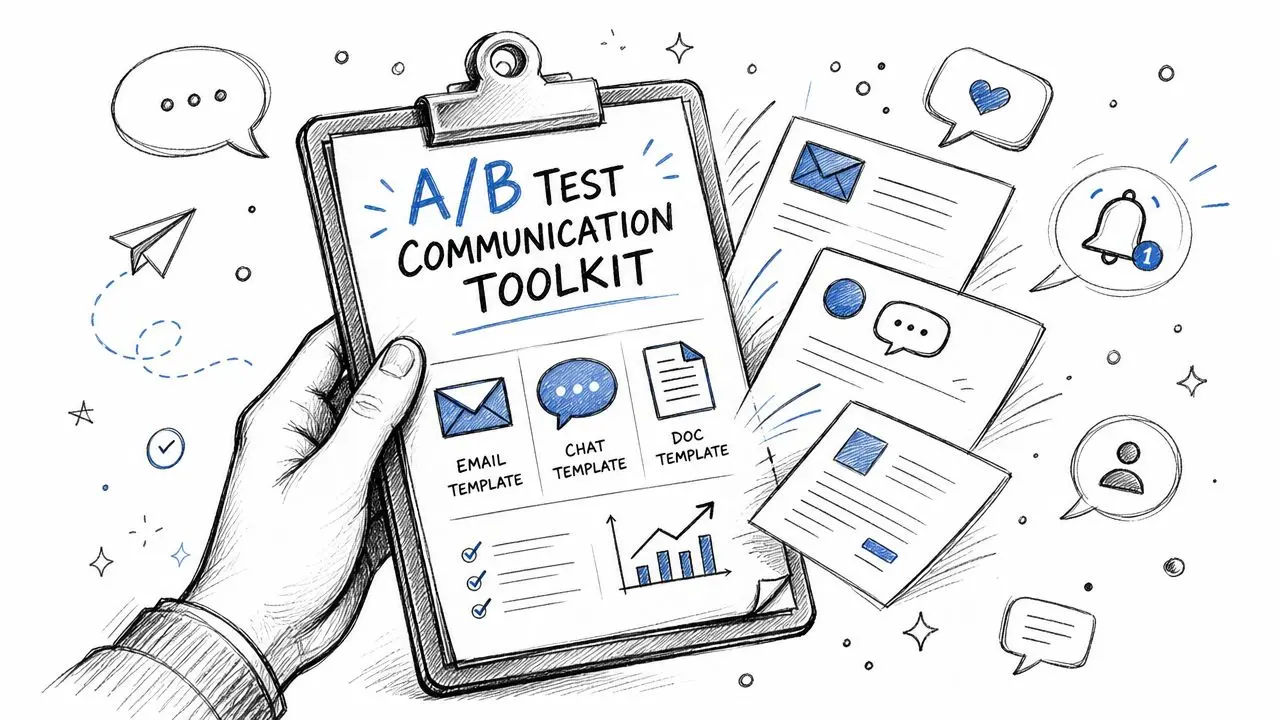
Your A/B Test Communication Toolkit and Templates
Lack of ideas isn't the primary reason teams struggle. Instead, they struggle because they're busy and don't want to write every stakeholder message from scratch.
That's why a small template library helps. Use these as working drafts, not scripts carved in stone.
Kick-off message
Subject: New experiment launching on [page or journey]
Hi all, we're launching an A/B test on [area] to evaluate whether [change] improves [primary goal].
Hypothesis: [plain-English hypothesis]
Primary metric: [metric]
Owner: [name]
Expected decision: if the result is clear, we'll recommend [rollout / iteration / further testing].
You don't need to take action right now. I'm sharing this so the teams affected know what's live, why it matters, and who to contact with questions.
We have a winner alert
Slack message
Test update: [test name] has reached a decision point.
Current read: [variant] is the recommended option for the primary goal.
Why it matters: [one sentence on business or user impact].
Next decision needed: [roll out / review / QA / approve implementation].
Owner: [name]
I'll share the full summary in [channel or report link].
Inconclusive but still useful
Many teams communicate inconclusive tests badly because they sound apologetic. Don't do that. An inconclusive result can still narrow future decisions.
Email draft
Hi all, the [test name] experiment didn't produce a clear winning variant for the primary goal.
The useful learning is that [behavioural or messaging insight]. Based on that, the recommendation is to [stop this direction / refine the hypothesis / test a narrower change]. No immediate rollout is recommended.
That keeps the learning visible without pretending uncertainty is success.
Final report summary
Subject: Final outcome for [test name]
Hi all, the [test name] experiment is complete.
Outcome: [winner / no clear winner / follow-up required] Decision: [what should happen next] Why: [two-sentence explanation appropriate for the audience] Owner: [name] Timing: [when implementation or review happens]
For teams that want more polished status-message options, a comprehensive email template collection can help you adapt these into different update styles without making every note sound identical.
If you want to walk through how to present results verbally, this short video is a useful companion to the written templates below.
A short checklist before you hit send
- Name the decision: don't make people infer it.
- Name the owner: accountability shouldn't be implied.
- Tailor the language: execs, product, and engineering don't read the same way.
- Keep one source of truth: the message can be short if the report is accessible.
- Close the loop: once action is taken, confirm that the decision was implemented.
Good stakeholder communication is repeatable. Once you have these templates in place, experiments stop feeling like isolated analyses and start functioning like a system the business can trust.
Otter A/B helps teams run website experiments and share results in a way stakeholders can use, with clear goals, Slack notifications, revenue-focused outputs, and shareable reports. If your tests keep producing answers but not action, it's worth exploring Otter A/B.
Stop guessing
Ready to start testing?
Set up your first A/B test in under five minutes. No credit card required.
- 14-day free trial
- No credit card required
- Cancel anytime