Software Environment Testing: A Practical Guide for UK Teams
Master software environment testing with proven strategies for parity, CI/CD integration, and secure test data. Learn how UK teams reduce production risk.
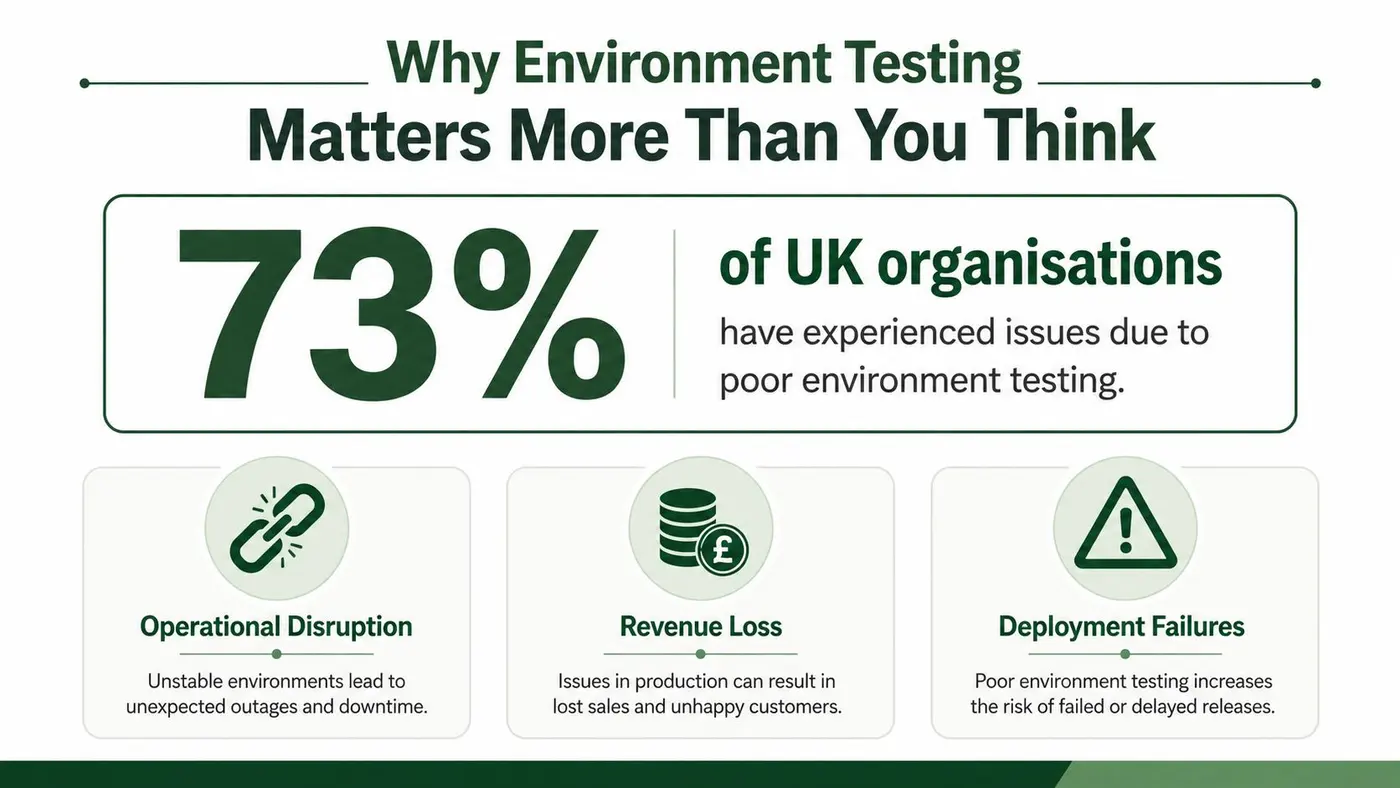
73% of UK organisations admit deploying untested code, while 44% say untested code has reached production accidentally. UK-focused reporting puts those figures in a category that engineering teams can't dismiss as a QA process problem. They point to an operational control problem, where configuration drift, unreliable data, missing dependencies, and production-only behaviour turn an apparently safe release into an incident.
Software environment testing is the discipline that closes that gap. It checks whether the systems around your code behave consistently enough for test results to mean something, then verifies that the release environment can support the same assumptions. For UK teams, particularly those working in regulated or operationally sensitive sectors, environment confidence affects release timing, incident exposure, auditability, and customer trust.
Why Environment Testing Matters More Than You Think
73% of UK organisations face issues because of poor software environment testing, and 44% say untested code has reached production accidentally. UK-focused reporting places those figures beyond a narrow QA concern. They indicate an operational control problem. Configuration drift, unreliable data, missing dependencies, and production-only behaviour can turn a release that passed its checks into an incident.
Environment testing tests the assumptions around the application, not only the application itself. It checks whether service versions, network rules, permissions, feature flags, data conditions, and external integrations behave as the release expects. A staging result has limited value if staging uses cleaner data, a mock instead of the actual provider, or defaults that production does not share.
The mismatch usually surfaces late. Developers start with application code, QA repeats a test that already passed, and release managers pause deployment while the team decides whether the failure is environmental, functional, or both. UK reporting says 72% of organisations have delayed releases because they lacked confidence in test coverage, showing how uncertainty consumes delivery capacity even without a customer-facing incident.
The cost is larger than the testing budget
Environment failures produce several forms of operational waste:
- Investigation time: Engineers compare logs, variables, versions, routes, permissions, and data states instead of improving the product.
- Release delay: Teams hold back changes because a passing result no longer provides enough confidence.
- Incident exposure: A defect that staging could not reproduce may reach customers with little warning.
- Rework: Developers fix production symptoms, then recreate the missing test conditions afterwards.
- Trust erosion: Customers encounter failed journeys, inconsistent responses, or unavailable functionality, regardless of where the original mismatch began.
The UK software testing services market was valued at £1.3 billion in 2025, up from £1.2 billion in 2024, with a 3.3% year-on-year increase in 2025, according to IBISWorld's UK software testing services market data. That market reflects a mature capability, but spending on testing does not compensate for unmanaged configuration or weak environment evidence.
Practical rule: A test is only as trustworthy as the environment assumptions behind it.
Risk management changes the decision
A QA checklist asks whether a feature passed. Risk management examines what could make that result misleading, which production conditions remain unrepresented, and how quickly the team can detect drift. The practical response is to version environment definitions, validate them in the delivery pipeline, monitor important differences, and document exceptions.
For regulated UK teams, the evidence matters as much as the test result. KPMG's UK software testing market insight estimates that financial services will account for 31% of the UK software testing market in 2025, worth £370.7 million. Environment isolation, access controls, data handling, and recorded changes help demonstrate that a release was controlled, while also reducing the hidden cost of investigating failures after deployment.
Understanding Environment Types and Parity
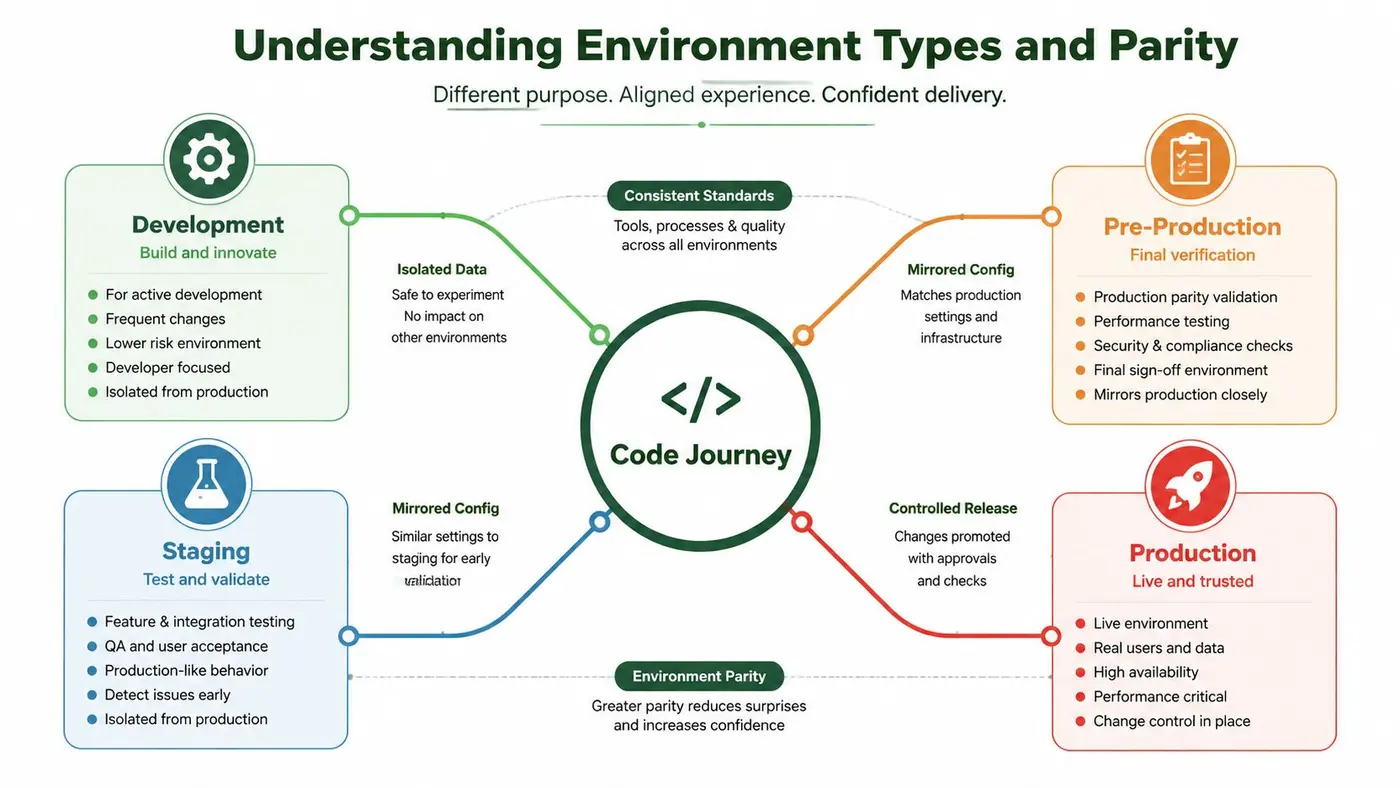
Environment boundaries define which risks a team can expose before release. Development supports rapid code changes and local substitutes, so instability is expected while engineers explore an implementation. Staging combines services and representative workflows for repeatable integration checks. Pre-production should match the release path closely enough to reveal deployment, capacity, security, and operational faults before they reach customers.
Production has real traffic patterns, integrations, permissions, data history, and consequences that lower environments cannot reproduce fully. Parity doesn't require every environment to be identical. It requires every meaningful difference to be deliberate, documented, and covered by a compensating test. In UK production systems, that record reduces the time spent proving whether a failure came from code, configuration, or an untested dependency.
Define what must match
Create an environment contract in version control. Describe attributes that can change application behaviour:
- Runtime: Language versions, operating-system images, container bases, and process settings.
- Dependencies: Service versions, queues, caches, database engines, SDKs, and third-party clients.
- Configuration: Feature flags, timeout values, retry policies, regional settings, and endpoint references.
- Data state: Schema version, seed data, representative edge cases, retention rules, and masking status.
- Access and networking: Roles, service identities, routing, firewall policies, certificates, and observability permissions.
- Resources: CPU and memory limits, replicas, storage classes, and autoscaling behaviour.
The contract gives engineers a reviewable baseline. Without it, “staging is like production” remains an opinion rather than evidence.
Find drift before it becomes a defect
Drift often begins with a manual change that appears harmless. An engineer adjusts a timeout during an incident, updates a staging package to unblock a test, changes a secret in a console, or applies infrastructure outside the repository. The immediate problem disappears, but the difference remains and may affect a later release.
Use infrastructure-as-code with a reviewable plan, then audit deployed state automatically. Compare Terraform plans, Kubernetes manifests, container image digests, migration versions, and application configuration. Classify each difference as intentional, tolerated, or blocking. This directs investigation towards gaps that can alter behaviour instead of cosmetic variation.
Prioritise parity checks around behaviour: could a difference change the result of a user journey? Payment callbacks, identity providers, message brokers, and data migrations warrant tighter controls than development-only logging. A team that records those exceptions can assess release risk clearly and avoid discovering environment drift through a customer incident.
Setting Up Reliable Test Environments
Reliable environments start with a single source of truth. Define infrastructure declaratively in Terraform or another infrastructure-as-code system, keep application configuration beside the service that consumes it, and require changes to pass review before they reach a shared environment. Ansible can configure hosts where containers aren't practical, while Docker images package runtime dependencies so engineers aren't relying on slightly different laptops or manually prepared servers.
Don't store secrets in repository files. Reference a managed secret store from the deployment system, inject values at runtime, and make the pipeline prove that required variables exist without printing their contents. Separate secret identity from environment identity, so a staging service can't accidentally authenticate against a production dependency.
Build the environment in dependency order
A dependable provisioning flow usually follows this sequence:
- Create the network and access boundaries. Establish the routing, security groups, service identities, and observability connections that the application expects.
- Deploy platform dependencies. Bring up databases, queues, caches, object storage, and service emulators using pinned versions.
- Apply the schema. Run migrations through the same mechanism used for release, rather than allowing testers to edit tables manually.
- Load controlled data. Seed deterministic fixtures, masked records, or synthetic datasets with known relationships.
- Deploy the application. Use the release artefact that will be tested, not a locally rebuilt substitute.
- Run health checks. Confirm readiness, dependency reachability, permissions, migrations, and critical user journeys before the broader test suite begins.
Microservices make this harder because one branch may depend on several changing services. Contract tests can catch incompatible interfaces early, while a service catalogue should record which versions and endpoints belong together. For external providers, use a realistic sandbox where available, but retain a small number of controlled integration tests against the actual boundary when the provider's behaviour matters.
For commerce teams, environment separation also applies to catalogue, basket, checkout, payment, tax, and shipping behaviour. A practical reference for a safe WooCommerce testing setup can help teams avoid experimenting against live orders or customer-facing configuration. For broader guidance on keeping application settings consistent between staging and production, use this staging and configuration guide.
Prefer disposable environments where isolation matters
Ephemeral environments are useful for pull requests, risky migrations, and integration-heavy changes. Provision them from the same modules as production, attach isolated data, run the tests, publish logs and results, then destroy the environment automatically. The teardown step matters. Without it, unused databases, storage, and preview services accumulate and obscure which environment is authoritative.
Document the environment as an executable specification. A new engineer should be able to read the repository, obtain approved credentials, run the provisioning workflow, and reproduce the relevant test conditions without asking a single colleague which console setting was changed months ago.
Managing Test Data in Regulated Environments
Production data is often the fastest route to realism and the worst route to uncontrolled exposure. UK financial services, healthcare providers, and public-sector systems may hold personal, financial, or commercially sensitive information that shouldn't be copied into a general test environment. Environment testing therefore has to validate both application behaviour and the controls governing data movement.
The choice is usually between masking, anonymisation, and synthetic data. Masking transforms selected fields while retaining enough structure for a test to work. Anonymisation aims to remove the ability to identify a person, but weak transformations can leave indirect identifiers intact. Synthetic data is generated from rules or models and offers stronger separation from production, although it may miss unusual correlations or operational edge cases.
Preserve relationships, not just values
A masked dataset is useless if its relationships break. If an account identifier changes in one table but not in its transactions, the application may fail for reasons unrelated to the release. Build masking as a repeatable, dependency-aware pipeline that preserves referential integrity across users, accounts, orders, permissions, events, and audit records.
Include difficult states deliberately:
- Empty and null values to exercise optional fields and incomplete profiles.
- Boundary conditions such as minimum, maximum, expired, and recently created records.
- Duplicate-like records to test matching and reconciliation logic.
- Failure states including rejected payments, interrupted callbacks, and partially completed workflows.
- Time-sensitive data covering ordering, time zones, retention, and date transitions.
Synthetic data should come with a scenario catalogue. Name each fixture by the behaviour it supports, not by an arbitrary file name. That makes failures easier to interpret and keeps a refresh from removing the case a regression test depends on.
Make data state deterministic
Tests become flaky when one run changes the database for the next. Create a known starting state, apply migrations explicitly, seed fixtures through versioned scripts, and reset or replace the data between isolated test groups. Don't let a tester “fix” a record manually and then treat the altered environment as evidence.
Access should follow least privilege, with separate identities for provisioning, test execution, and investigation. Keep audit records for imports, transformations, refreshes, and deletions. In regulated delivery, those records support segregation of duties and help demonstrate that teams tested realistic workflows without treating customer data as disposable development material.
The strongest setup combines masked extracts for selected production-shaped scenarios with synthetic data for broad coverage. That balances realism against privacy and prevents the test suite from becoming dependent on a frozen copy of yesterday's production state.
Integrating Environment Validation into CI/CD Pipelines
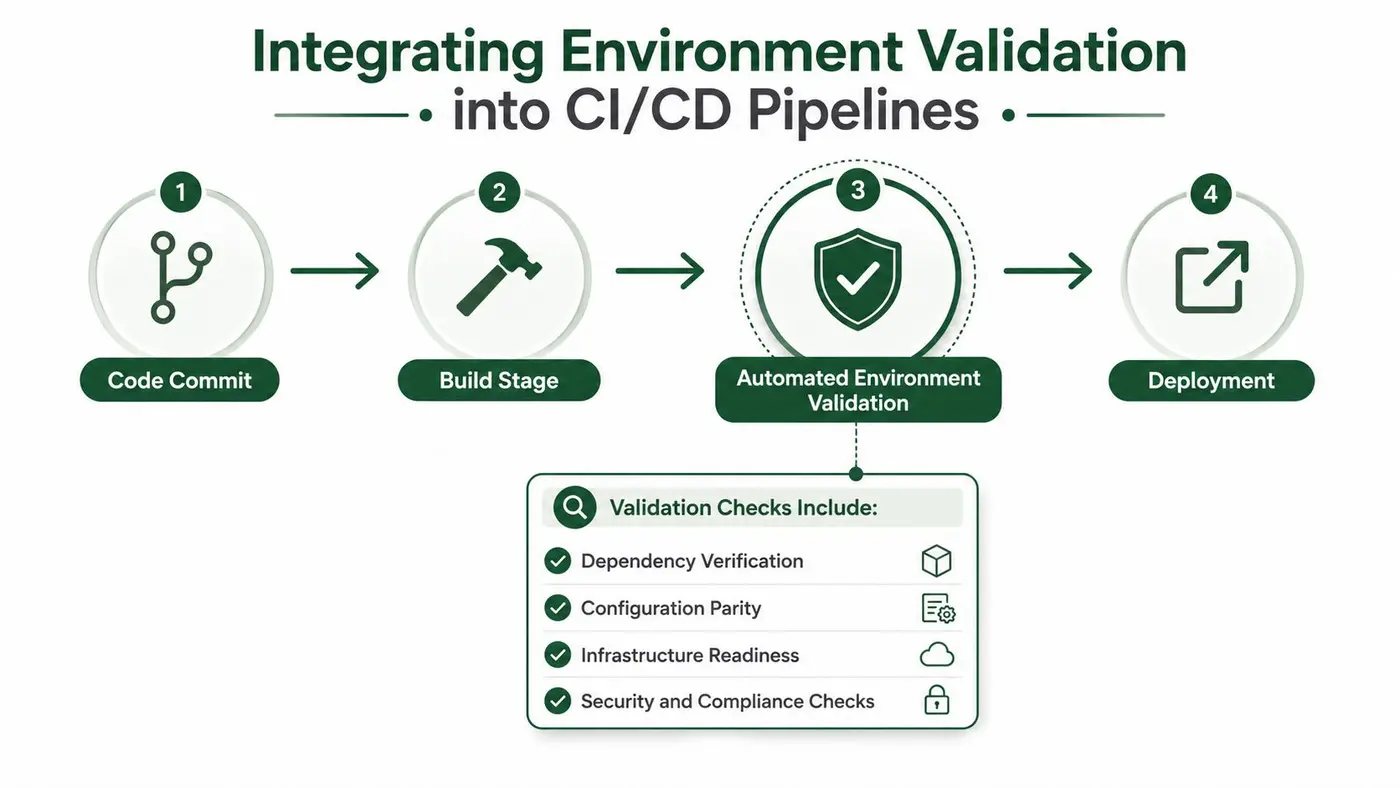
Environment validation belongs before the expensive tests, not after a failed release. A pipeline should first prove that the environment can be created and understood, then deploy the artefact, then test the application's behaviour inside that controlled context.
A practical pipeline sequence
Use separate failure signals for code, environment, and test behaviour. That distinction prevents engineers from treating every red build as an application defect.
- Pull request checks: Validate Terraform or Kubernetes changes, scan configuration schemas, confirm required variables, and compare dependency lockfiles.
- Build stage: Produce one immutable artefact, run unit tests, and record the commit and image digest that will travel through later environments.
- Provisioning stage: Create or reconcile the target environment from version-controlled definitions. Fail if the plan contains unapproved changes.
- Environment health stage: Check service readiness, migration state, permissions, queues, caches, and external provider connectivity.
- Integration stage: Run contract and end-to-end tests against the deployed artefact with controlled data.
- Deployment gate: Require the validation results and relevant approvals before production promotion.
- Post-deployment stage: Run smoke tests, verify telemetry, and retain a rollback path if the live checks fail.
Parallelise independent checks, but don't parallelise steps that mutate shared state without isolation. A test that depends on another test's database writes will fail unpredictably when the runner schedule changes. Give each suite a clean data namespace or its own disposable environment.
Fail early, recover safely
Drift checks should be blocking when they affect runtime behaviour, security, data handling, or integration routes. Non-critical differences can produce warnings, but warnings need an owner and an expiry date. Otherwise the pipeline becomes a reporting system that everyone learns to ignore.
If validation fails after deployment, the pipeline should stop promotion and preserve enough evidence to investigate. Capture the environment manifest, configuration checksum, dependency versions, migration output, test logs, and deployment metadata. Roll back the application and infrastructure independently where possible. Rebuilding blindly can destroy the evidence needed to identify the mismatch.
For teams reviewing their wider toolchain, integrating testing tools into delivery workflows provides a useful companion perspective. Environment validation works best when it's treated as part of the delivery system, rather than as a separate QA platform that receives a deployment only after everything else has finished.
Performance checks need their own discipline. The GOV.UK Service Manual performance testing standard recommends a test environment that resembles production and remains isolated from live systems. It also calls for recording concurrent users, requests per second, HTTP response codes, and timings, because those measures help identify bottlenecks and establish supported capacity.
Choosing the Right Tools for Your Team
Tool selection should follow the failure you're trying to remove. Docker can standardise application and dependency packaging, but containers alone don't reproduce cloud permissions, routing, managed services, or production data. Terraform can make infrastructure repeatable, while Ansible remains useful for configuration tasks on systems that don't fit a container-first model. Kubernetes provides orchestration and isolation at scale, but it adds operational complexity that a small team may not need.
Enterprise teams often need policy enforcement, audit trails, multiple accounts, and integration with identity and service-management systems. Smaller teams may gain more from a narrow, well-maintained stack than from an environment-as-a-service platform that nobody has time to operate properly.
| Tool category | Best for small teams | Best for enterprise | Key consideration |
|---|---|---|---|
| Containerisation | Docker Compose and pinned images | Docker with Kubernetes or an equivalent orchestrator | Containers package software, not every production condition |
| Infrastructure provisioning | Terraform modules with a small state model | Terraform with policy checks, remote state, and approval workflows | Review drift and state access carefully |
| Configuration management | Ansible for targeted host configuration | Ansible with role libraries and central governance | Prevent manual overrides outside version control |
| Orchestration | Managed container services where possible | Kubernetes with admission, policy, and observability controls | The platform becomes another environment to test |
| Environment management | Scripts and CI-created preview environments | Environment-as-a-service with access, lifecycle, and audit controls | Automated teardown controls cost and clutter |
| Monitoring | Application logs, health checks, and alerts | Unified telemetry across infrastructure and services | Monitor environment readiness, not only uptime |
Assess the total operating burden
Licensing is only one cost. Count training, upgrades, security reviews, pipeline maintenance, incident support, and the work required to keep modules current. A platform that creates environments quickly but leaves teams debugging opaque failures may increase operational risk rather than reduce it.
Start with one high-value path. Automate its infrastructure, data setup, parity checks, and teardown. Measure whether engineers can reproduce failures and whether releases spend less time waiting on a shared environment. Add complexity only when the simpler approach has a documented limitation.
For experimentation workflows, Otter A/B is one option for website teams that need to preview variants before launch, share a variant link with reviewers, and track experiment goals through a dashboard. It belongs in the application validation layer, not as a replacement for infrastructure controls.
Connecting Environment Testing to Experimentation Workflows
A feature flag or A/B test can appear technically healthy while producing unusable evidence. If staging loads a different analytics configuration, assigns users differently, omits a payment event, or serves a cached variant, the experiment may measure environment behaviour rather than customer behaviour.
Validate the experiment as a complete path. Confirm that the assignment rule is deterministic for the intended session or user, that each variant renders the correct assets, and that conversion events carry the right experiment and variant identifiers. Test refreshes, returning users, consent choices, logged-in states, mobile layouts, and failure responses. These checks belong in an environment where the analytics and application dependencies resemble production.
Keep experiment boundaries explicit
Separate staging and production workspaces or projects. Use explicit environment variables for SDK keys and endpoint destinations, then add a guardrail that blocks a staging experiment from running against production traffic. Preview links should allow reviewers to inspect each variant without changing the live allocation logic.
Feature flags need their own matrix of states. Test the flag off, on, targeted, and unavailable, including the behaviour when the flag service times out. For an A/B test, verify that variant assignment doesn't leak across experiments and that analytics receives one valid exposure event per intended assignment.
Protect the evidence during release
Before a high-risk launch, run a production-like validation with test traffic and inspect raw events as well as dashboard totals. Check that consent handling, caching, redirects, checkout steps, and revenue attribution remain consistent between variants. A visually correct page isn't enough if the goal event disappears after a client-side route change.
Environment testing becomes experimentation governance. Reliable environments let growth and product teams distinguish a genuine customer response from a deployment defect, configuration mismatch, or broken tracking path. During peak trading periods, that separation matters more than adding another variation to the test.
Troubleshooting Common Environment Failures
Start with a reproducible failure path. Record the commit, artefact version, environment identifier, test fixture, feature flags, and timestamp. Compare that evidence with the last known good release before changing variables.
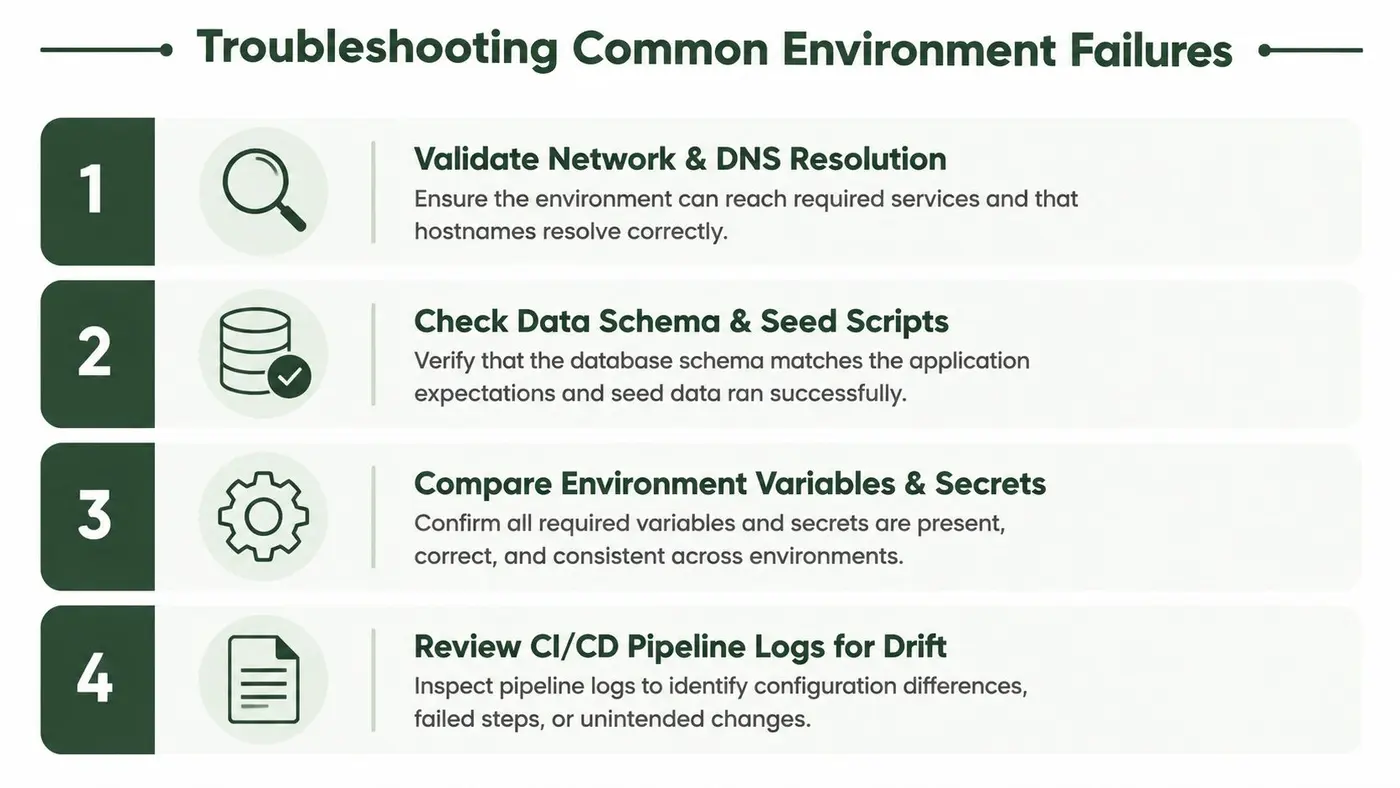
Use this diagnostic order:
- Validate reachability: Check service health, logs, network routes, and dependency responses. A staging API may respond successfully while a production firewall, certificate, or DNS record blocks the same call.
- Compare configuration: Diff rendered manifests and runtime variables against the approved environment contract. Check region, secrets, feature flags, and resource limits.
- Check data state: Confirm migration versions, seed results, fixture identifiers, and transaction isolation. Shared test records can make one checkout or consent test affect another.
- Inspect pipeline evidence: Review provisioning plans, deployment logs, test order, retries, and teardown behaviour. Retries can hide the first configuration error.
For intermittent failures, examine clock assumptions, race conditions, shared mutable data, and exhausted resources. Capture correlation identifiers to follow one request across services. If production is affected, preserve live configuration and telemetry before repair, then reproduce that state in isolation.
Operational visibility should cover readiness and dependency health alongside basic process availability. A focused uptime monitoring approach helps distinguish a reachable service from a functionally usable one.
Otter A/B lets teams preview website variants, share review links, and separate staging from production experiment settings before launch. Otter A/B can support controlled experimentation checks within environment testing.
Stop guessing
Ready to start testing?
Set up your first A/B test in under five minutes. No credit card required.
- 14-day free trial
- No credit card required
- Cancel anytime