What Is Growth Marketing: A Practical 2026 Guide
Learn what is growth marketing in 2026 and how to apply frameworks, channels, KPIs, and A/B testing to drive measurable business growth across the funnel.
You can feel the pressure long before anyone says the word growth. Traffic is up, the content calendar is full, paid spend keeps climbing, and the dashboards still don't answer the one question that matters, why revenue has stopped moving the way the team expected.
That's the point where a lot of marketers realise they've been optimising for motion, not momentum. In the UK, that problem is even sharper because so much commerce now depends on turning web visits into purchases, not just attracting attention. The discipline that emerged to solve that problem is growth marketing, a way of working that treats every campaign, page, email, and product flow as something that can be measured, tested, and improved.
The Moment Traditional Marketing Stops Working
A common pattern looks like this. The team launches a new paid campaign, the blog starts ranking, social engagement improves, and weekly traffic reports look healthy. Then the quarter ends, and the commercial picture barely shifts. Nobody can clearly explain whether the issue is the landing page, the offer, the checkout flow, the follow-up email, or the audience itself.
That's when traditional marketing starts to show its limits. It's good at creating reach, awareness, and brand presence, but those outputs don't always connect cleanly to revenue. If you want a practical benchmark for why this matters in the UK, the Office for National Statistics said UK online retail sales were 17.3% of total retail sales in December 2024 in the broader growth-marketing statistics brief, which shows how much commerce now depends on conversion work rather than visibility alone. The UK government's Digital Strategy also estimated the UK digital sector contributed £158.3 billion in 2022 (growth marketing statistics brief).
Why the old playbook stalls
When a market gets more digital, small conversion gains start to matter more than broad awareness gains. That doesn't make awareness useless. It just means awareness without a measurable path to purchase becomes an expensive halfway point.
Practical rule: if a team can't trace a campaign to revenue, retention, or customer value, it's operating with partial visibility.
That's why many teams shift toward evidence-based marketing. The phrase sounds academic, but the idea is simple. Stop treating marketing as a set of disconnected activities, and start treating it as a system with observable cause and effect.
The symptom of the growth ceiling isn't flat traffic. It's confusion. When leaders can't tell which part of the journey broke, they end up guessing, and guessing gets expensive fast.
What Growth Marketing Actually Means
Growth marketing is a full-funnel, experiment-led operating model focused on measurable business outcomes across the entire customer lifecycle. That means acquisition matters, but so do activation, retention, referral, and revenue. It's not about more activity. It's about better decisions, made with better evidence.
Think of it as a lab that sits inside the commercial engine of the business. Every email subject line, homepage headline, onboarding step, and pricing message is a potential experiment. The point isn't to test for the sake of testing. The point is to learn which changes improve the numbers that matter.
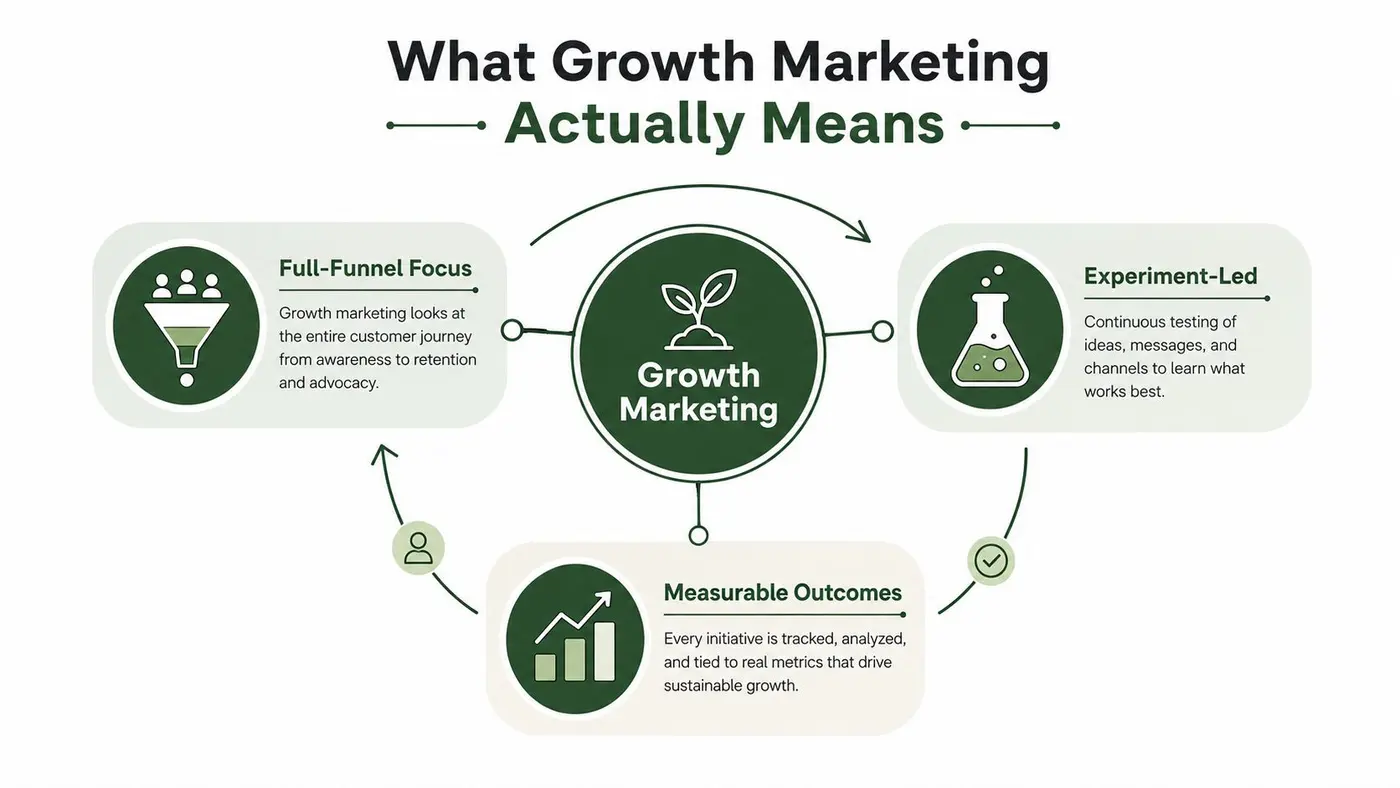
The four principles that separate it from campaign marketing
First, it has full-funnel scope. A growth marketer doesn't stop at the click or the lead. They follow the user into onboarding, repeat use, renewal, and advocacy.
Second, it runs on continuous experimentation. The work never really ends because each winning test creates the next question. That mindset is a lot closer to product development than to a one-off campaign launch.
Third, it uses data-driven decisions. UK and Europe-oriented growth frameworks lean on business-health metrics such as CAC, LTV, conversion rate, and payback period, because those numbers tell you whether growth is efficient or just noisy. A team can improve click-through rate and still make the business weaker if payback worsens.
Fourth, it needs cross-functional ownership. Marketing, product, design, engineering, analytics, and sometimes sales all touch the same journey. Growth marketing fails when one team owns the traffic and another team owns the outcome.
A useful way to separate it from other disciplines is this. Traditional marketing asks, “How do we reach people?” Growth marketing asks, “How do we turn attention into durable value?” That's why it's an operating model, not just a channel strategy or a department label.
Growth Marketing Versus Growth Hacking and Traditional Marketing
These terms get mixed together because they overlap, but they're not the same thing. Growth hacking is usually the scrappiest end of the spectrum, with a strong bias towards speed, unconventional tactics, and one sharp metric. Traditional marketing tends to prioritise brand, reach, and campaign planning over a longer horizon. Growth marketing sits between them, borrowing the creativity of growth hacking and the broader customer view of traditional marketing.
| Discipline | Scope | Time horizon | Primary metrics | Mindset | Typical ownership |
|---|---|---|---|---|---|
| Traditional marketing | Brand and demand generation | Longer-term | Reach, awareness, engagement | Message-led | Marketing team |
| Growth hacking | Narrow, fast-moving tests | Short-term | Sign-ups, clicks, one conversion event | Scrappy, opportunistic | Founder, product, or growth lead |
| Growth marketing | Full lifecycle, revenue-linked | Continuous | Conversion rate, CAC, LTV, retention, payback | Experimental and accountable | Cross-functional growth team |
The biggest difference is accountability. Traditional marketing can succeed by strengthening the brand and filling the funnel. Growth marketing has to prove that the work improves business outcomes, not just top-of-funnel volume.
Where each model fits best
A startup chasing its first users may lean on growth hacking because it needs quick learning with limited resources. A mature company with a known category might need traditional marketing to shape demand and defend brand memory. Most companies that want sustainable scaling eventually need growth marketing, because they need a repeatable way to connect both worlds.
Useful lens: if a tactic helps awareness but not conversion, it belongs in a different conversation from a growth test.
The distinction matters in hiring too. A brand marketer can write a strong campaign. A growth marketer has to ask what happens after the click, after the form fill, and after the first purchase. That changes the questions, the dashboards, and the decisions.
This is also why the conversation around what is growth marketing isn't just semantic. It's about whether the business sees marketing as a cost centre or a measurement system.
The AARRR Framework and the Experimentation Loop
The easiest way to make growth marketing operational is to map it to AARRR, also called Pirate Metrics. The stages are Acquisition, Activation, Retention, Referral, and Revenue. Each stage answers a different question about the customer journey, and each one can be improved with experiments.
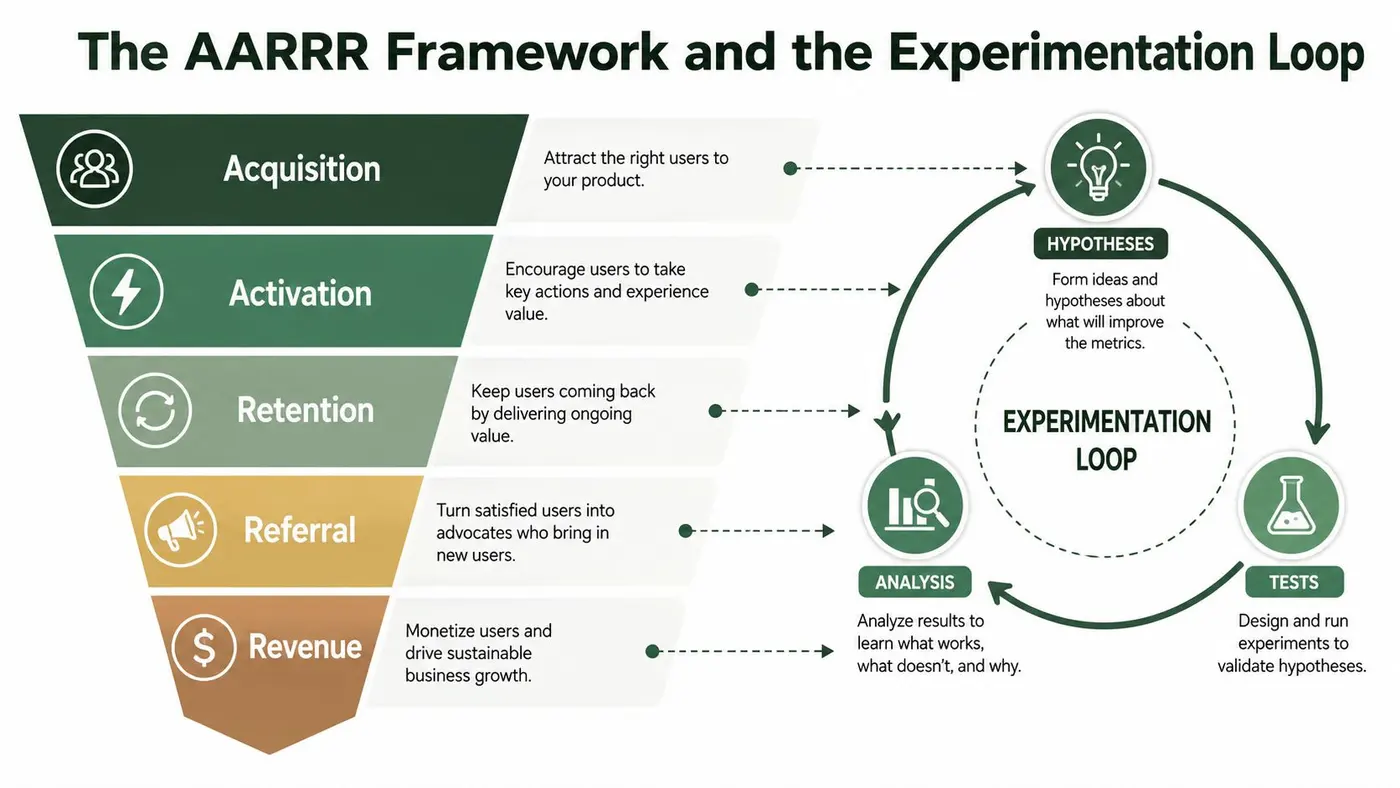
The loop sits on top of the framework. You hypothesise, design, run, measure, and learn. That loop is what keeps growth marketing from becoming a bag of disconnected tactics.
What each stage is really asking
Acquisition asks how people discover you. A typical experiment here might compare two ad angles or test a search landing page built for a specific intent.
Activation asks when someone first sees value. That could be a tighter onboarding flow, a shorter form, or a clearer first-run experience.
Retention asks why people come back. Lifecycle email, in-product prompts, and usage nudges often live here.
Referral asks how users bring others in. Sharing flows and referral prompts are common experiments.
Revenue asks how the business turns use into money. Pricing pages, upgrade prompts, bundle offers, and checkout changes usually belong here.
The framework gets practical when a single test is tied to one stage. An onboarding email isn't just “an email”. It's an activation experiment if it helps new users reach value faster. A checkout edit isn't just “UX work”. It's a revenue experiment if it changes completion behaviour.
dashboard creation guidance matters here because the loop depends on visibility. If the team can't see stage-by-stage movement, it can't learn quickly enough to improve the next test.
Channels and KPIs That Actually Move the Business
Growth teams don't organise channels first. They organise the journey first, then pick the channel that best serves the stage they're trying to improve. That's a useful shift because the same channel can play different roles depending on where the user is in the funnel.
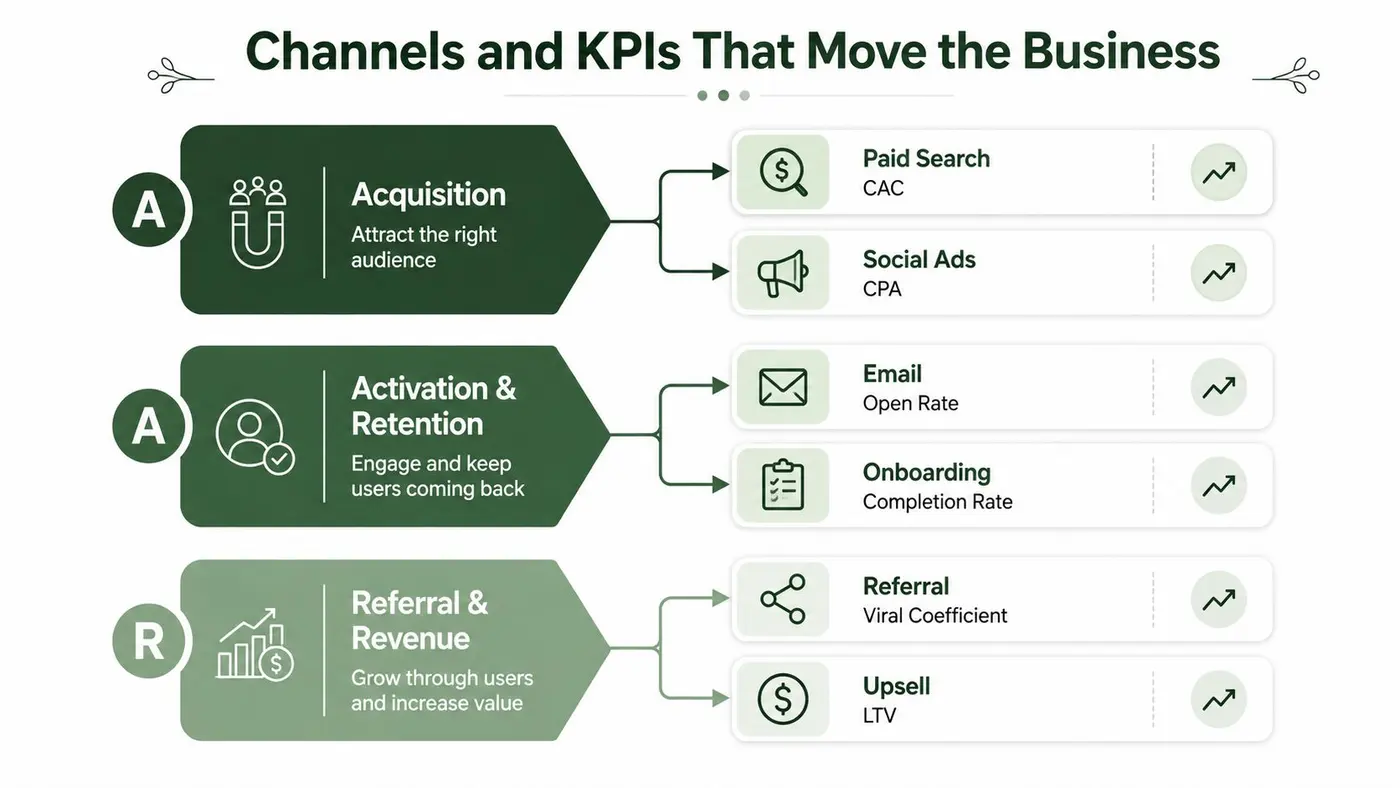
Stage by stage channel logic
At Acquisition, teams usually work with paid search, SEO, partnerships, and lifecycle email. The KPI isn't just traffic. It's the quality of the traffic and what that traffic costs to turn into a customer.
At Activation, the important work shifts into onboarding flows and product UX. If a user arrives and never gets to the “aha” moment, acquisition spend is wasted.
At Retention and Revenue, lifecycle messaging, loyalty mechanics, pricing tests, upsells, and cross-sells become more important. That's where customer value compounds.
A lot of teams still report impressions, clicks, and opens because those numbers are easy to collect. They're useful starting points, but they're not outcomes. A growth team anchors reporting to conversion rate, CAC, LTV:CAC, payback period, and revenue per variant because those metrics tell the truth about business health.
If you want a practical example of channel discipline, a strong cold email guide can be useful for acquisition teams that need to turn outreach into qualified conversations rather than just opens. The point isn't the channel itself. It's whether the channel moves a measurable stage in the journey.
The KPIs that deserve attention
- Acquisition: CAC, qualified conversion rate, cost per converted customer.
- Activation: onboarding completion, time to first value, first-use conversion.
- Retention: repeat usage, retention curve, churn signals.
- Revenue: AOV, LTV, payback period, revenue per variant.
- Referral: invite rate, share rate, referral conversions.
A common mistake is to celebrate a channel win before checking downstream effects. A campaign can lower cost per click and still create poor customers. Growth marketing makes the team follow the customer, not just the campaign.
How A B Testing Fits into the Growth Loop
A/B testing is not a separate topic sitting beside growth marketing. It's the workhorse inside the loop. If growth marketing is how a team learns, A/B testing is one of the main ways it turns guesses into evidence.
A strong test starts with a single, testable hypothesis. “Changing the CTA from ‘Start free trial' to ‘See it in action' will increase click-through on the pricing page” is a usable hypothesis. “Let's improve the page” is not. The team should change one variable, define one primary metric, and decide the duration before launch so the result isn't rewritten after the fact.
What good testing discipline looks like
- One variable: headline, CTA, layout, or offer, not all four at once.
- One primary metric: conversion, revenue per visitor, or another agreed outcome.
- Pre-set duration: no peeking and stopping early because the graph looks nice.
- Written learning: every test should leave a note that the next person can use.
Frequentist significance engines, which are common in modern testing tools, answer a simple question. If one variant appears to win, how likely is that difference to be due to chance? 95% confidence means the team is comfortable that the observed lift is unlikely to be random, not that the result is magical or permanent.
The most common mistakes are familiar. Teams test too many variants at once, call winners on tiny samples, or stop tests the moment one line spikes. That creates false confidence and messy learning. A/B testing only helps if the rules are stricter than the opinions.
For teams comparing tools and methods, the A B testing guide for high ad is a helpful reference point for landing-page testing structure. A lightweight testing layer can then sit inside the site stack, whether that's Shopify, WordPress, Webflow, or Google Tag Manager, and report on revenue per variant and statistical significance so the learning loop closes quickly.
Don't ask whether a test “won” in isolation. Ask what part of the funnel changed, what the business metric did, and what the next hypothesis should be.
If you understand split testing as a measurement habit rather than a novelty, the whole discipline starts to make sense. split testing definition is the term worth knowing, but the operating idea is more important than the label.
Two Short Case Examples from the Wild
An ecommerce team I worked with had a familiar problem. Traffic was healthy, but product-page performance was uneven, and the checkout step was leaking buyers. The team first tested a product page headline, then simplified the checkout flow. Both tests sat in the Revenue part of AARRR, and the KPI was conversion rate.
The lesson was simple. The team didn't start with a redesign. It tested the highest-friction surfaces first, then used the result to decide whether the bigger design work was worth the effort. That saved time and gave stakeholders something measurable instead of a style debate.
A SaaS team faced a different issue. New users were signing up, but they weren't reaching the core product moment quickly enough. The team changed the first-run experience so users hit the main value point sooner, then tracked the result in Activation and Retention. The KPI moved in week-two retention, and that improvement flowed into stronger long-term customer value.
The transferable lesson there was about sequence. If activation is weak, acquisition spend just pours water into a cracked bucket. The team had to instrument the first experience before it could sensibly optimise traffic.
These examples look different on the surface, but the logic is the same. Find the bottleneck, tie the test to one stage, measure the right KPI, and learn fast enough to do it again.
A Starter Checklist and a 90-Day Plan
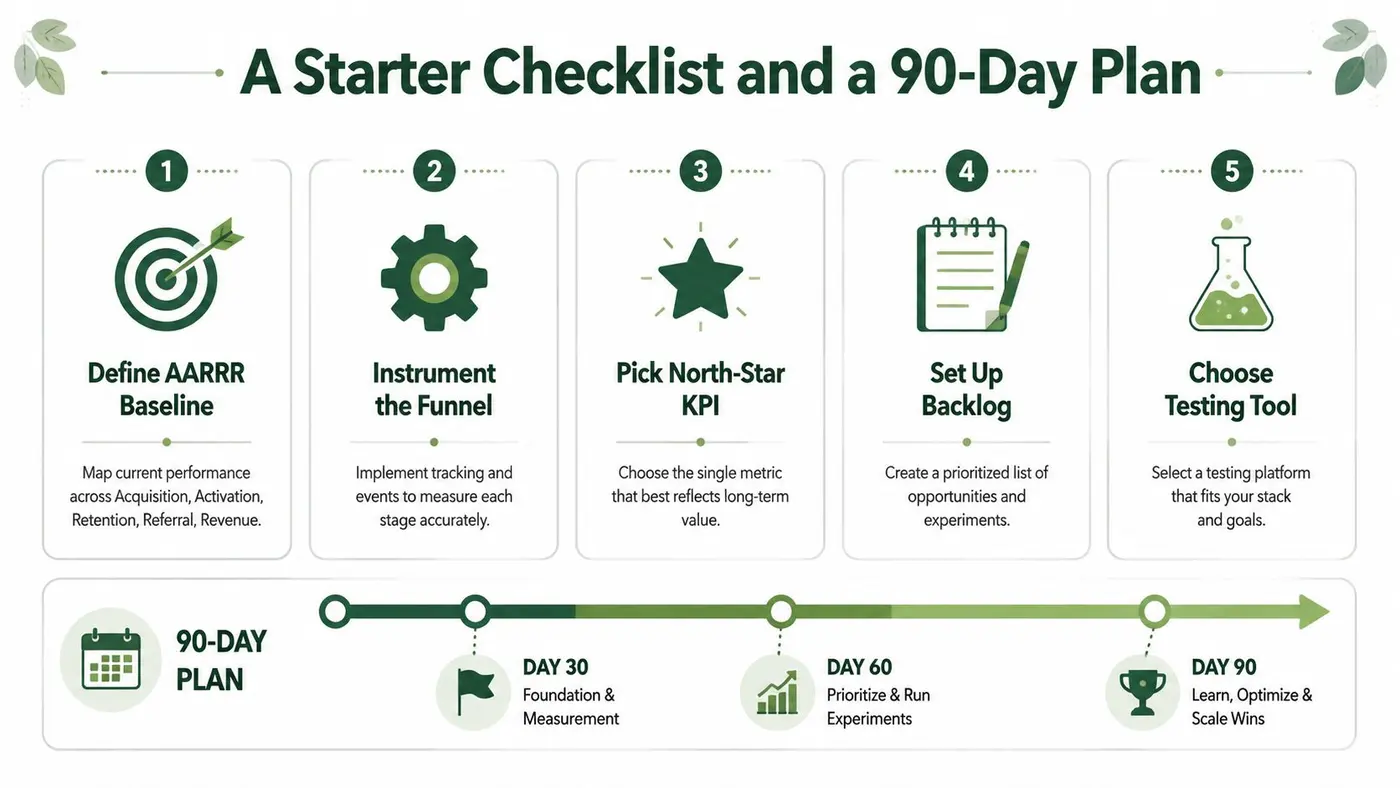
Start with a clean baseline, then build the habit.
- Define your AARRR baseline so the team knows where the leak is.
- Instrument the funnel so stage-level movement is visible.
- Pick one north-star KPI to keep the programme honest.
- Set up an experimentation backlog so ideas don't live in random Slack threads.
- Choose a lightweight testing tool that doesn't slow the site.
- Document learnings after every test so the next cycle starts sharper.
A sensible 90-day sequence is straightforward. Use the first two weeks for measurement and instrumentation. Run the first wave of tests from weeks three to eight. Use weeks nine to twelve for review, pattern-spotting, and planning the next cycle.
AI is already changing the tempo of ideation and creative production, but it also raises the standard for governance. In the UK, that matters because the ICO's guidance on profiling and automated decision-making pushes teams to be able to explain how personal data is used in automated processes. The result is a growth function that has to be both faster and more traceable.
Start with one test this week, not a perfect programme later.
If you want a practical way to turn this into a working system, visit Otter A/B and see how lightweight A/B testing can sit inside your growth loop. It's a simple way to test headlines, CTAs, and layouts while keeping your reporting tied to revenue, not vanity.
Stop guessing
Ready to start testing?
Set up your first A/B test in under five minutes. No credit card required.
- 14-day free trial
- No credit card required
- Cancel anytime