8 A/B Testing Benefits for Smarter Growth in 2026
Explore 8 a/b testing benefits, from higher conversions and revenue to faster learning, lower risk, better UX, and stronger stakeholder buy-in.
A/B testing is formally recognised by the UK government as a method for comparing designs with quantitative data, not merely as a marketing technique. Its value is broader than finding a higher-performing button. By randomly assigning users to comparable groups, teams can connect a page change to an outcome, reduce uncertainty around risky launches, and replace internal preference with evidence. GOV.UK guidance describes randomisation as a way to make definitive comparisons, while a GOV.UK case study shows how this approach has been used to improve live user journeys.
That makes the A/B testing benefits operational. A disciplined programme can improve conversion, expose revenue quality, protect user experience, accelerate learning, reveal audience differences, and give stakeholders a defensible basis for decisions. It can also mislead when teams stop a test too early, over-segment visitors, chase a secondary metric, or treat a temporary fluctuation as a durable result. The strongest programmes therefore define a primary metric, audience, traffic allocation, and decision rule before launch, then interpret the result in context.
1. Conversion Rate Improvement
A/B testing improves conversion rates only when the business defines the conversion precisely. A purchase, completed enquiry, product signup, or meaningful click may be appropriate, depending on the page's role in the customer journey. The method compares the current experience with a controlled variation, linking changes to headlines, calls to action, forms, or layouts with observed behaviour.
That link turns a design preference into a business decision. A prominent CTA may appear clearer to a product manager yet distract visitors. A shorter form may reduce friction while removing information the sales team needs. The test should therefore measure the stated outcome and any relevant quality constraint, rather than treating visual appeal as evidence of performance.
For ecommerce, a product page could compare alternative ways to present delivery information or product benefits. A SaaS team might test whether a revised signup form increases completion without weakening lead quality. A digital agency can validate a landing-page recommendation before making it permanent. Next Point Digital's CRO strategy guide places these experiments within a wider optimisation process.
A reliable test also controls scope. If a headline, form, and page structure all change together, the result may identify a stronger experience but not explain which intervention caused it. That limits what the team can reuse elsewhere and slows learning across the programme.
Turn page ideas into measurable hypotheses
Begin with a sentence connecting an intervention to an outcome. “Changing the CTA wording will increase completed enquiries” is testable. “Make the page feel more modern” is not. Keep the control and variation distinct enough to express the hypothesis, but narrow enough for the result to remain interpretable.
The Otter A/B conversion rate improvement guide is relevant to teams setting up this workflow. Its platform supports variant delivery, goal tracking, and significance monitoring, reducing manual comparison for marketers. Test high-value page elements first, then judge the primary conversion rather than clicks alone. A higher click rate is useful only if it contributes to the action the business needs.
2. Revenue Per Visitor Optimisation
A higher conversion rate can conceal a weaker commercial result. If one variation attracts more low-value orders while another produces fewer but more valuable purchases, the conversion winner may not be the revenue winner. That's why revenue per visitor, average order value, purchase behaviour, and downstream customer quality deserve attention alongside the headline conversion rate.
Consider a Shopify store testing a bundle offer against individual products. The bundle may change both purchase likelihood and basket composition. A subscription business might compare pricing-page structures that attract similar signup volumes but different plans. In each case, a click or signup is only an intermediate signal. The business needs to know which experience creates healthier revenue.
This is one of the less obvious A/B testing benefits because conventional optimisation content often stops at conversion rate. The Oracle UK overview of A/B testing highlights the importance of looking beyond immediate actions towards business outcomes such as revenue per visitor, average order value, and retention. The practical lesson is simple. A “winning” variant can be commercially poor if it encourages low-value behaviour or damages trust.
Measure quality, not just volume
Otter A/B tracks purchases, average order value, revenue by variant, and revenue trends over time. That gives ecommerce teams a way to compare the economic consequence of an experience rather than relying on a proxy metric alone. A landing-page test can still use form completion as its primary metric, but the team should assess whether the resulting leads progress meaningfully through the sales process where that data is available.
Revenue data can also be noisy. A single large order may distort an early comparison, while traffic sources can bring visitors with different buying intent. Segmenting the result by acquisition source and customer type can expose these differences, but excessive segmentation makes conclusions less dependable. Use the broadest useful view first, then investigate segment patterns as supporting evidence rather than treating every subgroup as a separate winner.
3. Reduced Design and Development Risk
A redesign can consume substantial design, engineering, content, and stakeholder time before users ever see it. If the new experience underperforms, the organisation has to absorb not only implementation cost but also the opportunity cost of replacing a functioning page. A/B testing reduces that exposure by allowing teams to validate a change with a controlled audience before making it the default.
The method doesn't eliminate risk. It limits the blast radius of an uncertain decision and gives the team a clearer basis for continuing, revising, or stopping the work. A product manager might expose a new onboarding flow to a limited portion of eligible users. An agency could test a client's proposed homepage structure before recommending a site-wide rollout. A Webflow, Framer, or WordPress team can treat a substantial layout change as a hypothesis rather than an irreversible commitment.
Use experiments as release gates
Risky tests need tighter governance than routine copy changes. Define what would count as harm before launch, monitor the main business metric, and keep a rollback path available. If the variation produces a negative result, that isn't wasted work. It has prevented the organisation from scaling an unproven assumption.
Practical rule: The more expensive or difficult a change is to reverse, the more valuable controlled validation becomes.
Browser-based delivery can also reduce deployment risk. Otter A/B uses a JavaScript SDK and supports implementation through a snippet, Google Tag Manager, or custom JavaScript, which allows teams to test many front-end changes without rebuilding the entire site. Agencies can turn results into brandable, password-protected reports, giving clients a record of the evidence behind a recommendation. That changes the client conversation from “which design do we prefer?” to “which option produced the stronger defined outcome, and what risks remain?”
4. Statistical Significance and Confidence
A/B testing becomes a business operating system when it separates measured effects from coincidental movement. Randomisation makes test groups sufficiently comparable to support stronger conclusions, helping teams judge whether a design change caused the result rather than differences in users. That discipline supports marketing campaigns, product releases, public services, and agency recommendations.
Results can shift because of a traffic spike, campaign change, seasonal event, tracking error, or uneven audience mix. Statistical analysis cannot remove uncertainty, but it can show whether the observed difference is consistent with a real effect under the test design. That distinction protects revenue decisions from being based on noise.
Otter A/B uses a frequentist z-test engine and a 95% confidence threshold to monitor significance. The threshold guides a decision, but does not guarantee that a result will persist in every future context. Teams still need a defined primary metric, adequate exposure, clean tracking, and a test duration that reflects normal variation. For a practical examination of methodology, see A/B testing best practices.
Confidence must sit beside judgement
A result can look attractive before it becomes dependable. Rechecking the dashboard and stopping at the first positive movement increases the risk of treating random variation as a business win. A stronger workflow sets the decision rule before launch, avoids calling a winner from a small or unrepresentative sample, and separates statistical significance from commercial importance.
A guide to testing statistical significance explains how significance analysis supports this process. Use the dashboard to monitor progress, not as permission to stop whenever the chart improves. The primary result should answer the original hypothesis. Secondary patterns belong in a backlog for later experiments, rather than being retrofitted into the success criterion. That record gives stakeholders a clearer basis for scaling, revising, or rejecting a change.
5. User Experience Optimisation Without Flicker or Performance Degradation
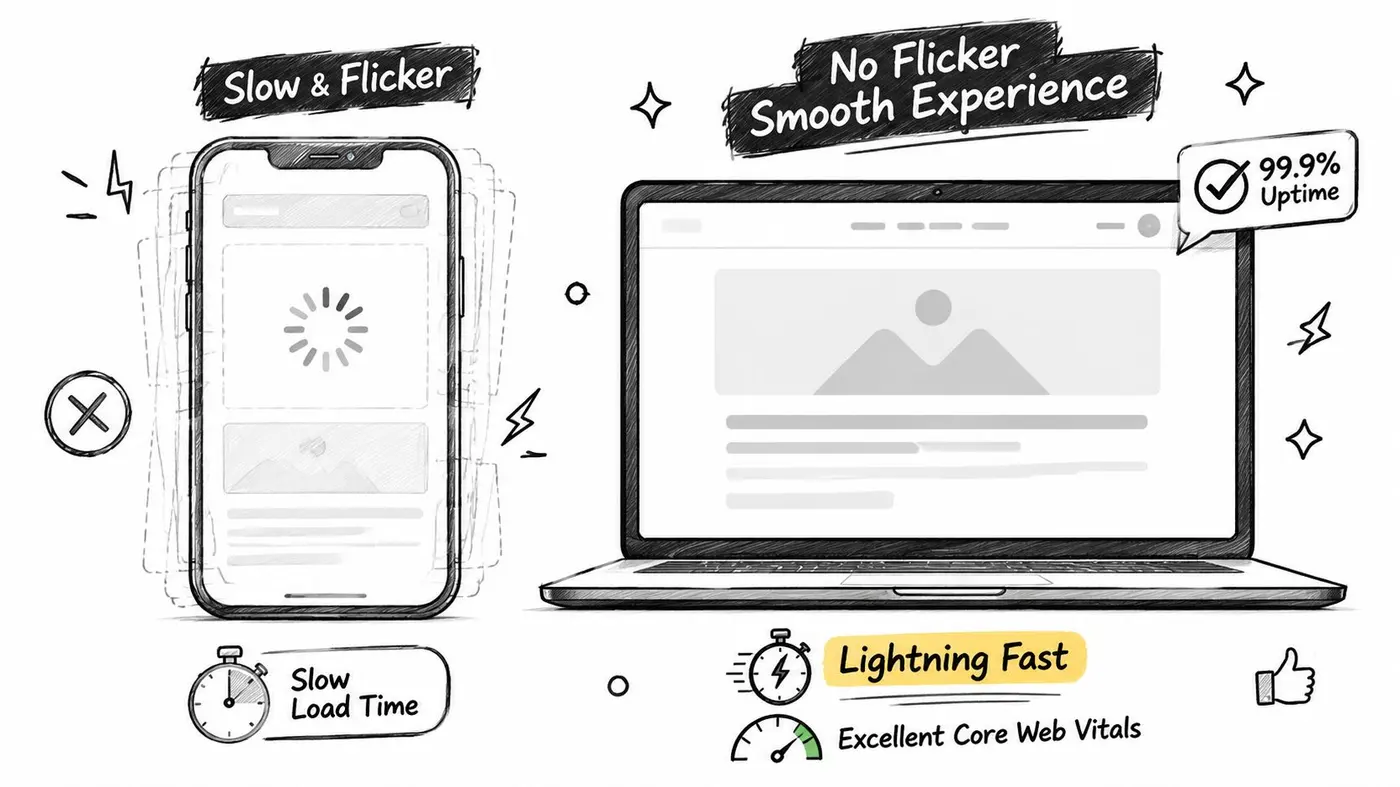
An experiment can damage the experience it claims to improve. Flicker occurs when visitors briefly see the control before the testing system applies the variation. That visual jump can undermine trust, particularly on checkout, signup, or high-intent pages. Heavy client-side tooling can also add work to the browser and complicate performance monitoring.
This makes delivery quality part of experiment quality. A variant that converts better only because it is shown under different loading conditions is not a dependable business improvement. Teams should compare page performance before, during, and after an experiment, and test the experience on mobile devices and slower connections rather than relying on a fast development laptop.
Otter A/B states that its 9KB SDK loads in under 50ms, provides zero-flicker delivery, and has 99.9% uptime, according to the publisher's product information. These are product specifications, not evidence that every implementation will preserve every performance measure. Site architecture, scripts, hosting, and the complexity of the variation still matter.
Protect the baseline
Set a performance baseline before launching the test. Watch for changes in loading behaviour, layout stability, responsiveness, and conversion tracking. A simple CTA test should not require the same implementation approach as a feature that changes application logic, and the delivery method should match the technical risk.
For WordPress teams, this practical A/B testing resource covers a relevant implementation context. Otter A/B also integrates with platforms including Shopify, WooCommerce, Webflow, Wix, Squarespace, Framer, and Next.js. The benefit isn't merely faster experimentation. It's the ability to gather evidence without making visitors pay for the measurement process through a slower or unstable page.
6. Rapid Experimentation and Faster Time-to-Insight
A testing programme creates value through learning as well as through winners. The faster a team can move from a specific hypothesis to a trustworthy result, the sooner it can refine the next decision. Speed therefore matters, but only when the team protects the validity of the experiment. A quick unreliable test produces quick confusion.
Otter A/B supports unlimited variants, goal definition through a dashboard, and delivery through a lightweight snippet. For straightforward front-end changes, marketers can often launch without waiting for a full development cycle. Agencies can create experiments for clients without turning every hypothesis into a new engineering ticket, while product teams can test messaging or interface changes before committing deeper implementation effort.
Build a learning queue
A useful backlog ranks ideas by expected business value, confidence in the hypothesis, implementation effort, and potential risk. A headline change may be easy to launch, but a checkout-flow experiment may have greater commercial importance and greater monitoring requirements. The team shouldn't confuse the number of tests launched with the quality of the programme.
Industry adoption is moving towards assisted experimentation. A 2024 UK study reported that 65% of marketers use AI within their experimentation approach, while 45% adopted it within the previous year, as reported by Optimizely. Those figures suggest that UK teams are modernising how they generate and manage experiments, but AI doesn't replace sound hypotheses or interpretation. It can help produce ideas and organise work. Human teams still need to decide what matters, what could harm users, and whether the evidence is sufficient.
Use milestone notifications, including Otter A/B's Slack integration, to keep stakeholders informed when a test reaches significance. Document the result, the audience, the metric, and the decision. A failed test can prevent repeated work if the organisation stores the learning where future teams can find it.
7. Precise Traffic Segmentation and Audience Insights
An overall result can hide meaningful differences between audiences. A variation may help mobile visitors but distract desktop users, or suit paid traffic while weakening the experience for people arriving through organic search. Segment analysis gives teams a more detailed view of the conditions under which an idea works.
The key is restraint. Splitting traffic by device, source, location, or custom property can reveal useful patterns, but each additional segment reduces the evidence available for that comparison. A small subgroup may appear to have a dramatic preference because its result is unstable. Treat segment findings as hypotheses unless the test was designed and powered to answer that segment-specific question.
Match experience to intent
An ecommerce team could compare product recommendations for visitors from paid campaigns and visitors from organic search. A SaaS business might examine onboarding behaviour by device type, then decide whether a mobile-specific improvement is warranted. A subscription company could investigate whether high-intent traffic responds differently to pricing-page messaging than broader acquisition traffic.
Otter A/B supports precise traffic splitting and custom targeting, which lets teams define the audience before the experiment begins. The platform can also track conversion goals such as page views, clicks, custom events, purchases, and GA4 events, according to the publisher's product information. That flexibility helps connect an audience insight to a measurable action, but it doesn't justify creating a separate experience for every small difference.
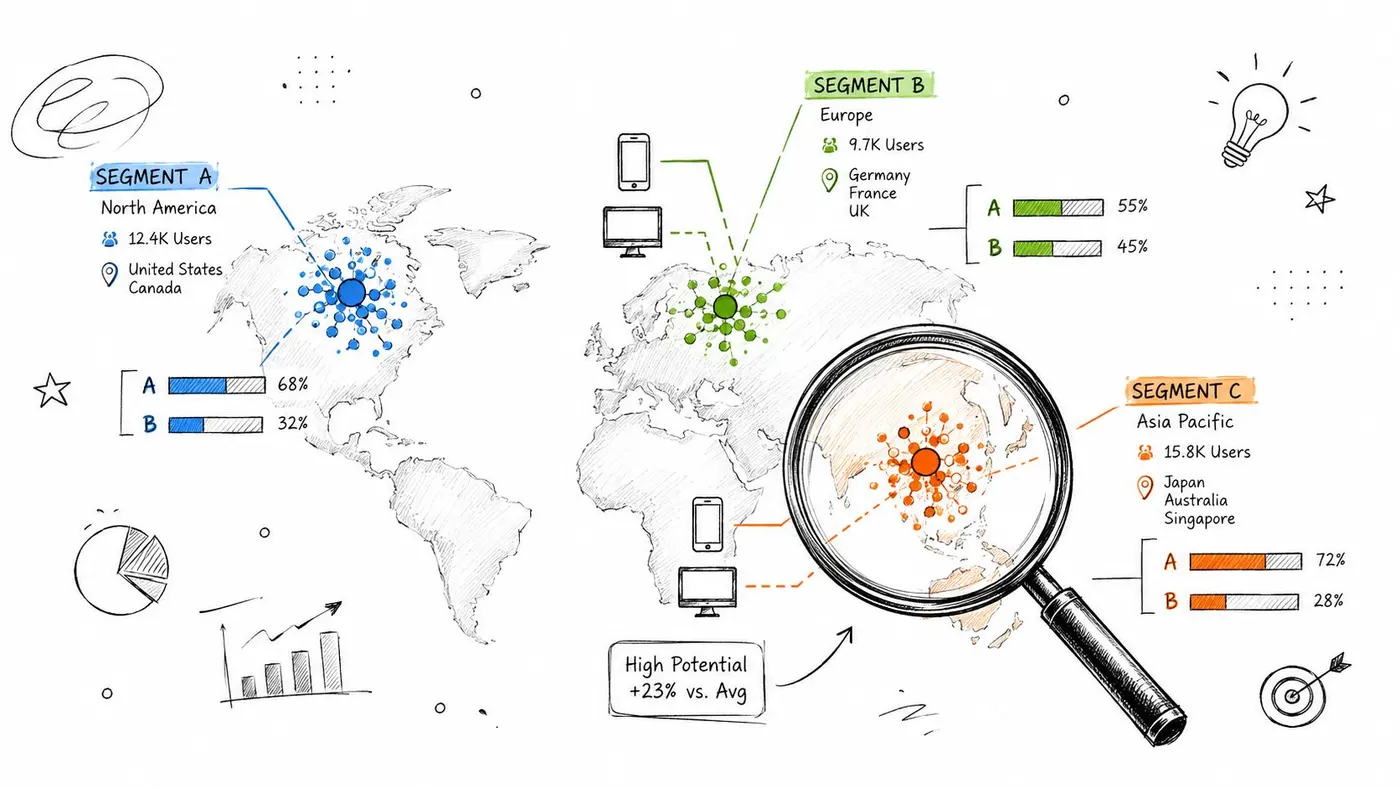
Start with a broad, strategically meaningful split. Compare desktop with mobile, or paid with organic, before moving to narrower groups. Then use the result to improve campaign alignment, landing-page language, or product onboarding. The strongest insight isn't “segment A likes version B.” It's “this message works under this intent and device context, so the acquisition and experience teams should coordinate around it.”
8. Stakeholder Buy-In and Objective Decision-Making
A/B testing changes the language of disagreement. Instead of asking whether a senior stakeholder likes a design, the team can ask which version better met the agreed objective. That doesn't remove judgement from the process. It moves judgement to the right place, namely hypothesis selection, metric choice, risk assessment, and interpretation of the evidence.
This is particularly valuable for agencies and cross-functional teams. A consultant can show a client the tested control, variation, audience, primary outcome, and decision. A product manager can explain why a preferred feature change should wait for validation. An engineering team can assess whether an implementation is justified by a measurable user or commercial benefit rather than by internal enthusiasm.
GOV.UK's long-running use of experimentation illustrates the institutional value of this approach. Its guidance describes A/B testing as a way to make changes based on numbers rather than opinion, and its live-service work frames testing as a method for reducing uncertainty about whether an iteration caused an improvement. The lesson applies outside government. Reliable evidence makes difficult decisions easier to defend.
Report the decision, not just the winner
A stakeholder report should make the result understandable to someone who wasn't involved in building the test. Include the original hypothesis, the primary metric, the audience, the traffic allocation, the result, the confidence assessment, and any guardrail or revenue metrics. Explain what the test does not prove. That final part prevents a narrow result from becoming an overconfident product rule.
Otter A/B provides brandable, password-protected reports and Slack notifications for significant milestones. These features support an agency's client workflow and an internal team's decision log. Unexpected findings should be documented rather than dismissed. A variation that fails to improve the primary metric may still reveal a problem with the hypothesis, the audience definition, or the page's role in the journey.
8-Point A/B Testing Benefits Comparison
| Item | 🔄 Implementation Complexity | ⚡ Resource Requirements | 📊 Expected Outcomes | ⭐ Key Advantages | 💡 Ideal Use Cases |
|---|---|---|---|---|---|
| Conversion Rate Improvement | Medium, set up variants, tracking, and funnels | Moderate, needs steady traffic and analytics tooling | Measurable lift in conversion rate and direct ROI | Replaces guesswork with data; compoundable small gains | High-traffic landing pages, checkout flows, signup pages |
| Revenue Per Visitor Optimization | Medium–High, requires revenue attribution and longer tests | High, payment integration, larger samples, longer duration | Increased AOV, revenue per visitor, and profitability insights | Measures true business impact beyond vanity metrics | E‑commerce merchandising, pricing, bundles, subscription tiers |
| Reduced Design and Development Risk | Low–Medium, pilot tests before full rollout | Low, small traffic splits and prototype variants | Fewer failed launches and validated design decisions | Lowers launch risk; rollback capability; client-proof reporting | Redesigns, feature rollouts, agency client validations |
| Statistical Significance and Confidence | Medium, requires sample planning and test discipline | Moderate, sufficient conversions and monitoring time | Reliable results with 95% confidence; fewer false positives | Mathematical proof for stakeholders; prevents Type I errors | High‑stakes experiments, executive sign‑offs, reproducible testing |
| UX Optimization Without Flicker or Performance Degradation | Medium, correct SDK implementation and QA | Moderate, lightweight SDK (9KB) plus dev verification | No page slowdowns; preserved Core Web Vitals and UX trust | Zero flicker; minimal performance impact; SEO-safe testing | Mobile‑heavy sites, SEO‑sensitive pages, high‑traffic storefronts |
| Rapid Experimentation and Faster Time‑to‑Insight | Low, no‑code builders speed setup; governance needed | Low, minimal dev for many tests; integrations for scale | Faster iterations; more experiments; quicker validated wins | Non‑technical launches; high velocity; lower barrier to entry | Growth teams, startups, agencies needing fast hypothesis testing |
| Precise Traffic Segmentation and Audience Insights | Medium–High, requires segmentation logic and targeting | High, larger per‑segment samples; analytics and targeting rules | Segment‑level performance; personalization opportunities | Reveals audience preferences; informs targeted marketing | Personalization, localization, channel‑specific optimizations |
| Stakeholder Buy‑In and Objective Decision‑Making | Low, report setup and goal alignment required | Low, reporting/dashboarding and shareable exports | Faster approvals; evidence‑based decisions; documented outcomes | Branded, password‑protected reports; reduces politics | Agencies, enterprise stakeholders, cross‑functional alignment |
Turn Test Results Into Compounding Growth
The most valuable A/B testing benefits appear when experiments become part of the organisation's operating system. A single conversion win can improve one page. A repeatable process improves how marketing, product, design, engineering, and leadership decide what to build and what to leave alone. Over time, the organisation accumulates evidence about user intent, message clarity, commercial quality, technical constraints, and the risks associated with different types of change.
Start with a business goal, not a component. If the goal is more completed purchases, define whether conversion rate is enough or whether revenue per visitor and average order value also need protection. If the goal is better onboarding, choose an action that represents meaningful activation rather than a convenient click. The primary metric should determine the decision, while secondary metrics explain the result and expose possible trade-offs.
Write a specific hypothesis before creating the variation. Identify the audience, choose the control and challenger, decide how traffic will be split, and define what would justify rollout or rejection. Randomisation matters because comparable groups make causal interpretation stronger, as GOV.UK's methodological guidance explains. Without a clear design, a dashboard can display precise-looking numbers that answer the wrong question.
Run the experiment long enough to produce dependable evidence. Don't stop just because an early result looks attractive, and don't keep testing after the result has become operationally clear without a reason. Watch the primary metric alongside performance, tracking quality, revenue indicators, and relevant audience segments. A conversion winner that slows the page, lowers order value, or attracts unsuitable leads isn't automatically a business winner.
Otter A/B can support this workflow with lightweight variant delivery, revenue tracking, significance monitoring, integrations, Slack milestone notifications, and shareable reports. Its product information states that the SDK is 9KB, loads in under 50ms, and offers 99.9% uptime, while its significance engine uses a 95% confidence threshold. Treat those specifications as implementation details to evaluate alongside your own site's performance and measurement setup, not as substitutes for sound experimental design.
Document both winners and non-winners. Record the hypothesis, audience, primary metric, result, confidence assessment, business decision, and follow-up idea. That record prevents teams from repeating inconclusive tests and helps new stakeholders understand why a decision was made. For marketers, product managers, agencies, and developers, A/B testing stops being a collection of conversion tricks and becomes a practical system for reducing risk, learning faster, and allocating effort to changes with defensible business value.
Choose one high-impact page element this week, define the outcome it should influence, and launch a controlled test only when the measurement plan is ready. A small, well-designed experiment creates a stronger foundation for the next decision than a large backlog of untested opinions.
Otter A/B helps teams create and compare website variants, split traffic precisely, track conversions and revenue, monitor statistical significance, and share decision-ready reports with stakeholders. Visit Otter A/B to start testing a headline, CTA, layout, or revenue-critical page with a lightweight implementation.
Stop guessing
Ready to start testing?
Set up your first A/B test in under five minutes. No credit card required.
- 14-day free trial
- No credit card required
- Cancel anytime