CTA Exam Dates Guide 2026
Discover all CTA exam dates for 2026 including May and November schedules, registration deadlines, verification steps, calendar downloads, and FAQs.
You've probably done this already. You picked a CTA paper, opened a spreadsheet, blocked out study weekends, and told yourself you'd “sort the admin later”. Then later turns out to be much later, and suddenly the exam entry window matters just as much as your revision plan.
That's why CTA exam dates deserve more attention than many candidates give them. With CTA, you're not dealing with a rolling system where you can register whenever you feel ready. You're working within a fixed cycle, and that means your study plan, annual leave, tuition timetable, and application tasks all need to line up.
Introduction to CTA Exam Planning
A typical CTA candidate isn't studying in perfect conditions. Most are balancing client work, deadlines, and some form of home life on top of revision. One missed date can turn a sensible plan into a delayed sitting, and that can be frustrating when you've already built momentum.
The first thing I tell students is simple. Treat CTA exam dates as part of the syllabus. You don't just need to know the tax rules. You also need to know when registration opens, when it closes, and when your chosen sitting occurs.
If your wider goal is to improve your academic performance, date management matters more than people expect. Good candidates often lose marks to weak planning rather than weak technical ability. The same principle shows up in professional settings too, where workload control and timing can affect outcomes, much like the trade-offs discussed in how many CTA is too many.
Practical rule: Put exam dates into your calendar before you build your revision plan, not after.
When you do that early, everything else becomes easier. You can work backwards from the sitting, protect your study leave, and avoid the last-minute panic that comes from discovering a deadline after it has passed.
CTA Exam Schedule for 2026
The CTA timetable follows a fixed pattern. The qualification has two sittings per year, May and November, and for 2026 the May entry window ran from 26 January to 28 February, while the November window opens on 20 July and closes on 31 August according to BPP's CTA exam dates overview.
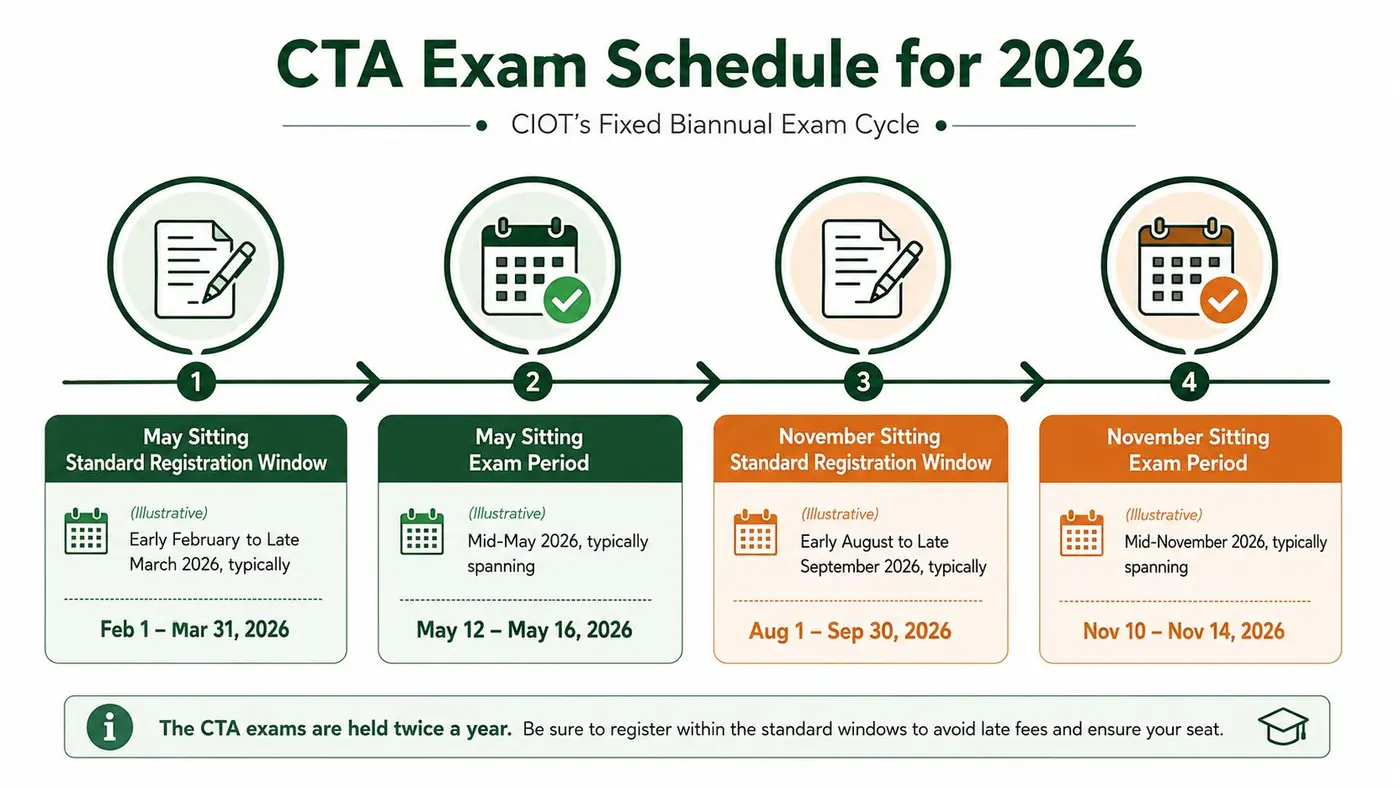
What catches candidates out is that this isn't just a pair of exam months. It's a planning system. Registration happens well ahead of the sitting, so you need to think in terms of a long lead time rather than a last-minute booking.
Why the fixed cycle matters
In some professional qualifications, you can choose from many test dates across the year. CTA doesn't work that way. The fixed biannual structure means your whole study year tends to revolve around one of two targets.
That changes how you should plan:
- Choose your sitting early. Don't wait until revision feels comfortable.
- Match tuition to the sitting. Your class timetable should support the exam you are entering.
- Book around the exam window. The sitting label can be misleading because the exam period may not sit neatly inside a single calendar month.
For example, the same BPP page notes that the May 2024 examinations ran from 30 April to 2 May, and the November 2024 session ran from 12 to 14 November. That's useful because it reminds you not to rely only on the session name when arranging work and leave.
A better way to think about the year
Many candidates do better when they split the year into three blocks:
-
Decision phase
Pick the sitting, tuition route, and paper combination. -
Registration phase
Complete the exam entry properly and check every confirmation. -
Execution phase
Revise, practise, and protect the exam days in your work diary.
If you skip the middle phase or leave it too late, the rest of your plan can unravel even if your revision is going well.
Detailed May 2026 Dates and Deadlines
If you're aiming for the spring sitting, your May cycle starts earlier than many people expect. For 2026, the May entry window opened on 26 January 2026 and closed on 28 February 2026, with a late entry period from 1 March to 19 March 2026, according to BPP's CTA exam information.
The dates that matter most
Here's the May sequence in plain terms:
-
Entry opens on 26 January 2026 This is your cue to stop “meaning to register” and complete your registration.
-
Standard entry closes on 28 February 2026
If you miss this, you move into the late-entry route. -
Late entry runs from 1 March to 19 March 2026
That gives you a fallback, but it's not the position you want to be in. -
Exam days for the May 2024 sitting ran from 30 April to 2 May
That historic pattern matters because it shows a “May” sitting can begin in late April on the calendar.
How to use these dates in your study plan
The strongest approach is to work backwards from the likely exam period, not forwards from the day you buy your notes. If the sitting may begin at the end of April, your final revision phase needs to be ready before many candidates instinctively expect.
A simple planning sequence works well:
-
Register as early as you reasonably can
Early entry removes uncertainty. It also makes the exam feel real, which often improves study discipline. -
Set a document check week
Make one short admin block where you confirm your subject choice, personal details, and any exam logistics. -
Protect the final fortnight
Keep that period lighter where possible. Leave space for past-paper practice, tutor feedback, and recovery.
Don't build a May plan that assumes all exam activity starts comfortably inside May. The calendar may be tighter than the sitting name suggests.
Common May sitting confusion
The most frequent misunderstanding is the phrase “May sitting”. Candidates hear that and picture a standard mid-May exam. In practice, the exam timetable can start earlier in the week and even cross the month boundary, as the previous May exam period shows.
The second confusion point is registration timing. Some candidates focus on spring revision and forget that entry opens in January. If you're planning a May attempt, January and February are not just study months. They're also admin months.
Detailed November 2026 Dates and Deadlines
For the autumn sitting, the key registration period sits across late summer. The standard entry window for November 2026 opens on 20 July 2026 and closes on 31 August 2026, with late entry from 1 September to 11 September 2026, according to the CIOT key dates and deadlines page.
What the November cycle feels like in practice
The November sitting often catches working candidates for a different reason than May. Summer can look spacious on paper, but holidays, client demands, and family commitments can make those weeks disappear quickly.
That means your real challenge isn't only knowing the deadline. It's deciding, before summer gets fragmented, how you'll use July, August, and early autumn.
A sensible rhythm looks like this:
- Late July for finalising your exam entry and confirming the paper you'll sit
- August for structured technical study and question practice
- Early September for any final admin if you're using the late-entry route
- Autumn for consolidation, timed practice, and exam readiness
Candidate responsibilities during the window
The registration period is short enough that you shouldn't rely on memory alone. Put the opening and closing dates into at least one digital calendar and one task list. If you use Outlook at work and Google Calendar personally, duplicate the reminders.
It also helps to build one “decision deadline” of your own before the official close. That way, if work gets busy or you need to recheck details, you're not making important choices on the final day.
If summer planning is hard for you
Some candidates revise well in autumn but lose control in August. If that sounds familiar, simplify the plan:
- choose your paper before the entry window opens
- prepare your registration details in advance
- schedule recurring study sessions before annual leave fills the calendar
- keep one weekly checkpoint to review progress and admin
A late summer exam entry feels manageable until other commitments stack up. Put the admin in place before the season gets crowded.
The November route can work very well for candidates who like a longer run-in through autumn. It's less comfortable for people who assume summer gives them unlimited free time.
Late Entry Periods and Constraints
Late entry exists to help candidates who miss the standard window, but it shouldn't be your preferred strategy. For the November 2026 session, the standard entry closes on 31 August and the late entry runs from 1 to 11 September, after which penalties and remote invigilation restrictions apply, as stated on the CIOT key dates page.
What late entry really means
Late entry is best understood as a backup option, not extra thinking time. Once you're in that period, you're usually working with less flexibility and more pressure.
Candidates often underestimate two things:
-
Penalty exposure
The official guidance notes that penalties apply after the standard window. -
Practical limitations
The same guidance states that remote invigilation restrictions apply in the late-entry phase.
Those constraints matter because late registration can affect more than cost. It can reduce your options and create avoidable stress at exactly the point where you should be settling into revision.
When late entry might still be reasonable
Late entry can still be useful if your circumstances changed unexpectedly and you're otherwise fully prepared. In that situation, a controlled late registration may be better than losing the sitting entirely.
But if you're using late entry because you still haven't decided whether to sit, that's usually a warning sign. Uncertainty at registration stage often shows up again in revision.
Steps to Verify Official CTA Dates
Online date information can drift. Training providers update pages at different times, forum threads stay live long after they stop being accurate, and candidates sometimes pass along old information in good faith. If you want confidence, verify the date yourself.
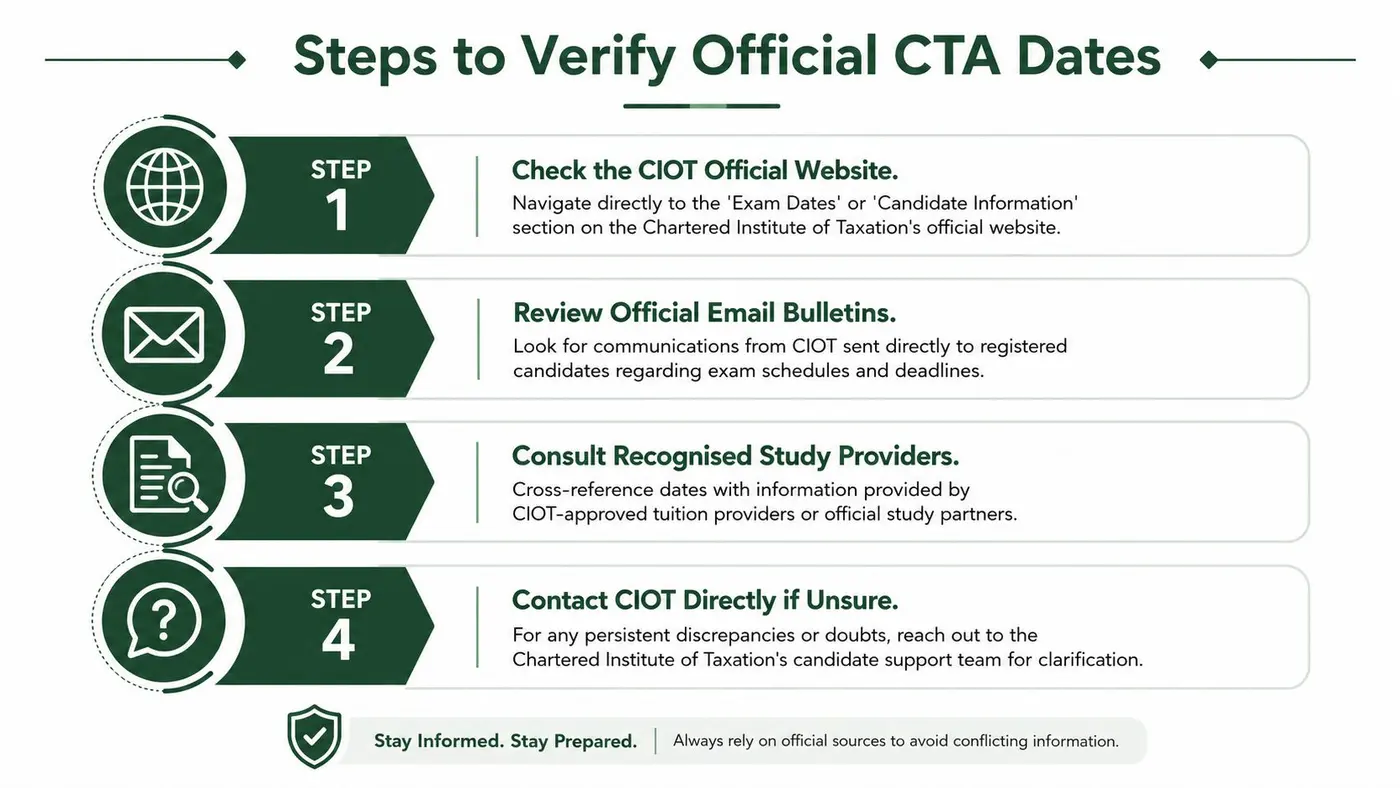
A four-step checking routine
-
Start with the CIOT website
Go directly to the official exam or candidate dates area. This should be your first check, not your final check. -
Read your CIOT emails carefully
Don't assume registration notices are routine admin. Save them in a folder so you can find them quickly later. -
Cross-check with a recognised tuition provider
Providers often present dates in a candidate-friendly format. That can help you spot whether you've misread the official wording. -
Contact CIOT if anything seems unclear
If two sources look inconsistent, ask rather than guess.
What to verify each time
When you check CTA exam dates, don't stop at the exam month. Confirm the whole chain:
- Entry open date
- Standard closing date
- Late-entry period
- Any restrictions attached to late entry
- The actual exam days once published or confirmed
A lot of confusion comes from checking only one part of that chain. A candidate may know the sitting is in November but still miss the point at which action was required.
Check once when you choose your sitting, again when entry opens, and once more after you register.
A simple verification habit
Keep a short note in your phone or task manager titled “CTA dates verified”. Each time you check, update the note with the source you used and the date you checked it. That gives you a clean audit trail for yourself and stops you from relying on half-remembered information.
Quick Reference Date Summary Table
If you want one snapshot to pin above your desk, use this table. Then keep the official confirmation in your calendar and email folder.
CTA Exam Key Dates 2026
| Session | Standard Entry Open | Standard Entry Close | Late Entry Period | Exam Dates |
|---|---|---|---|---|
| May 2026 | 26 January 2026 | 28 February 2026 | 1 March 2026 to 19 March 2026 | Use the official exam timetable for your papers. The May sitting may begin in late April based on prior scheduling patterns. |
| November 2026 | 20 July 2026 | 31 August 2026 | 1 September 2026 to 11 September 2026 | Use the official exam timetable for your papers once confirmed for your sitting. |
This table is best used as a reminder, not a substitute for verification. Keep it visible, but always check the official timetable and your registration confirmation before making work or travel commitments.
Setting Up Calendar Reminders
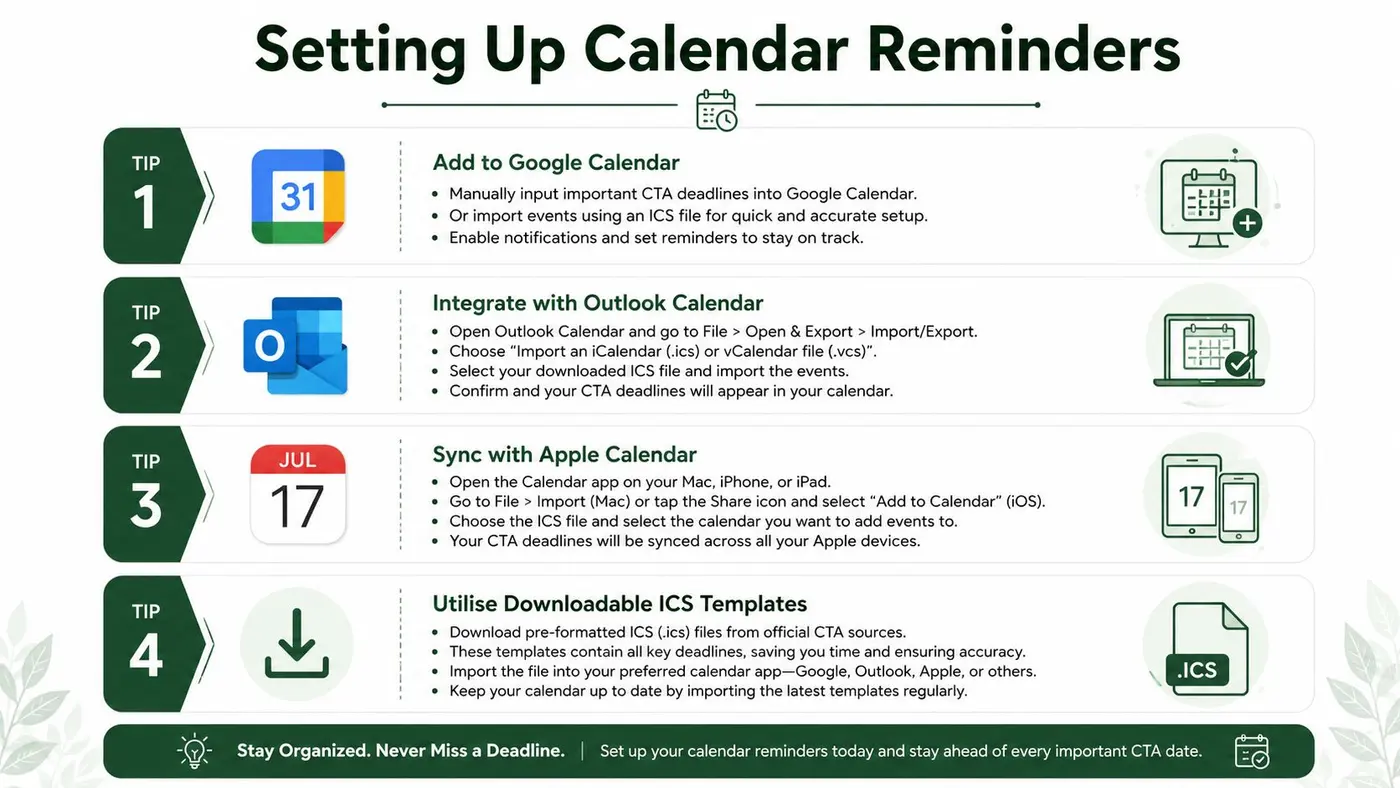
A date you remember today is easy to forget next month. Put your CTA milestones into a calendar system you already use. Google Calendar, Outlook, and Apple Calendar all work well if you keep the setup simple.
What to add to your calendar
Create separate entries for:
- Standard entry opening day
- Standard entry closing day
- Late-entry opening and closing days
- A personal decision deadline
- Your exam days
- Study leave and final revision blocks
Don't bundle everything into one event called “CTA”. You want distinct reminders that prompt a specific action.
How to make reminders actually useful
For Google Calendar, create events manually or import an ICS file if you've made one yourself.
For Outlook, add the same deadlines and use categories so exam admin doesn't get buried under client meetings.
For Apple Calendar, keep a dedicated exam calendar so personal appointments don't obscure revision milestones.
If you want a ready-to-import setup, make a simple ICS template with labels such as “CTA standard entry closes” and “CTA late entry closes”. You can build one in most calendar apps by exporting a dedicated calendar after entering the events once.
A good reminder structure uses more than one alert:
- First reminder a comfortable time before the deadline
- Second reminder close enough to force action
- Final reminder on the day itself
That way, you're not depending on one notification that appears while you're in a meeting.
Frequently Asked Questions
Can I reschedule a CTA exam if something unexpected happens
You need to check the current CIOT process and contact the institute directly as soon as the issue arises. Don't assume informal notice is enough. Keep written records and ask what evidence or forms are required for your situation.
When are CTA results released
Result timing can vary, so don't rely on forum estimates. Watch for official communication and keep checking the candidate information area and your registered email account.
What if CIOT changes a date after I've planned everything
Reconfirm the updated date through official channels, then immediately update your calendar, study plan, annual leave, and any tuition bookings. If the change creates a practical problem, contact CIOT promptly and ask what options are available.
A CTA for Otter A/B.
Stop guessing
Ready to start testing?
Set up your first A/B test in under five minutes. No credit card required.
- 14-day free trial
- No credit card required
- Cancel anytime