Definition of False Positive: A Complete Guide
Learn the definition of false positive and how it impacts growth teams, with clear examples and practical tips to avoid them.
A false positive is a result flagged as significant when no real effect exists, and in A/B testing it means calling a winner when the variants perform the same. In other words, you ship the “better” variant, but the lift was just noise.
You know the feeling if you've ever watched a test look great on Friday, rolled it out on Monday, and then seen the metric flatten or reverse by the end of the week. That's the trap this guide is built for, the kind that burns trust in experimentation one shiny win at a time.
What a False Positive Really Means
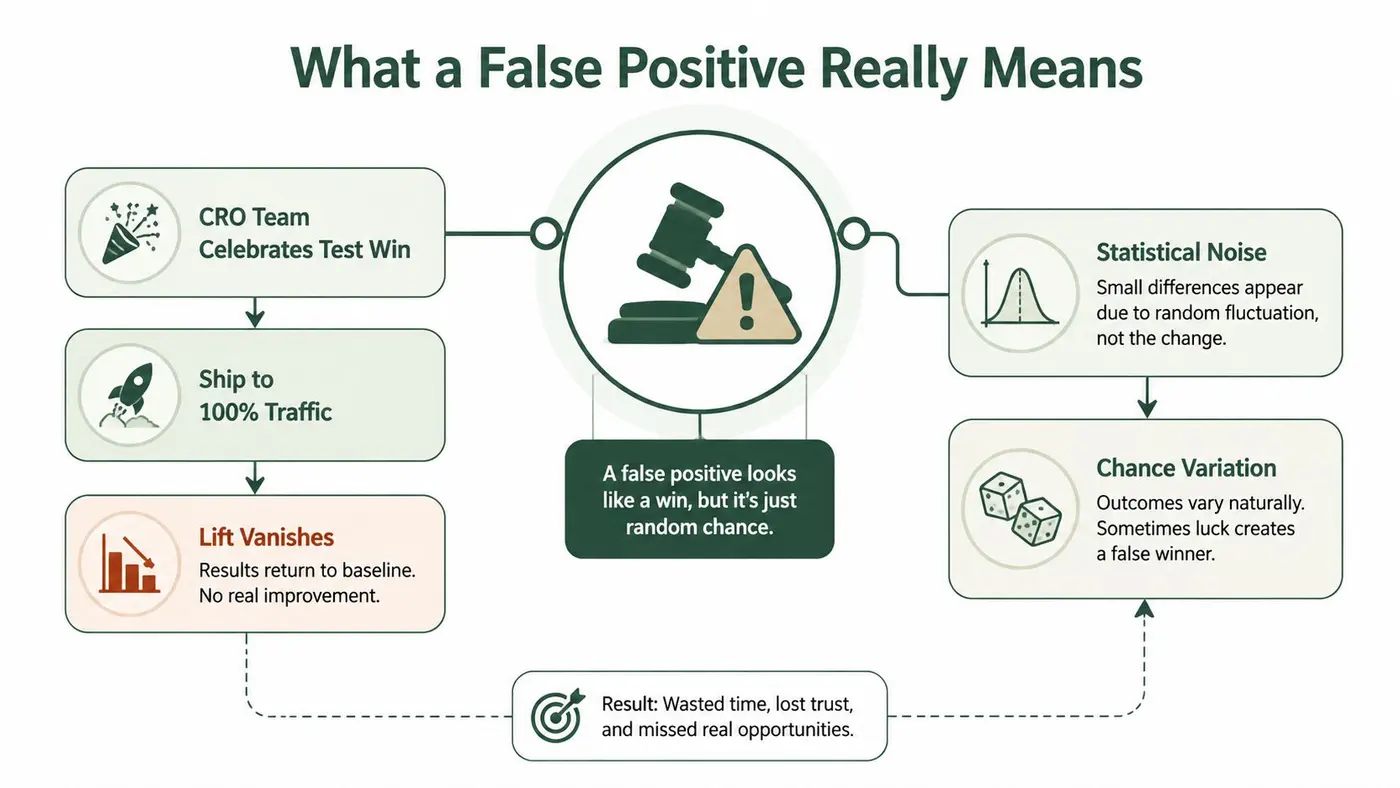
The simplest way to think about a false positive is this, your test says “yes” when the actual answer is “no.” In a CRO workflow, that usually means the dashboard shows a winner, the team celebrates, and the rollout goes live, only for the apparent lift to disappear once the variant faces the full messiness of real traffic.
That's why the definition of false positive matters so much for growth teams. It isn't just a statistics term, it's a costly mistaken signal that can send engineering, design, and product work in the wrong direction. In the UK screening context, the National Screening Committee treats false positives as a trade-off, because a positive result can lead to follow-up colonoscopy even when cancer or advanced polyps aren't present, which is exactly why the NHS bowel cancer screening programme uses a faecal immunochemical test with a 120 µg Hb/g cut-off and then confirms positives with colonoscopy (false positive and false negative overview).
The plain-English version
A false positive is a false alarm. In medical testing, it means the test says a condition is present when it isn't. In experimentation, it means you declare a variant the winner when the difference is really just chance.
Practical rule: if your “winner” can't survive a more careful look, it wasn't a winner, it was a false positive.
That's also why teams doing adjacent operational work care about the same mindset. If you're trying to verify email lists effectively, you don't want a tool that screams “bad address” every time the signal is ambiguous. The useful question is always the same, what's the cost of believing an error is real?
What you should carry into your next test
A working definition helps, but the operational version matters more. A false positive is a claim of success that doesn't hold up under reality, and in growth work that usually shows up as:
- A variant that “wins” on a dashboard, but not in actual customer behaviour
- A rollout that looks safe, then causes the metric to drift back to baseline
- A team that mistakes randomness for insight
Once you see it that way, the rest of the guide gets easier. You're not trying to avoid all uncertainty, you're trying to avoid being fooled by it.
The Intuitive and Mathematical Picture
A false positive is what happens when an innocent person gets convicted. That courtroom image lands because it separates “a strong accusation” from “the truth of the situation,” which is exactly the tension in testing. The verdict can look convincing and still be wrong.
In stats, that same idea is called a Type I error. Under the null hypothesis, meaning the two variants are the same, a 95% confidence threshold means you're accepting a 1 in 20 chance of declaring a difference real when it's only chance (Type I error explanation). In plain English, you're agreeing to a small but real risk of being fooled every time you call a result significant.
P-value and false positive are not the same thing
A lot of people blur these together, and that's where mistakes start. A p-value tells you how surprising the data are if the null hypothesis is true. A false positive is the bad outcome, the mistaken winner call itself.
So a low p-value is necessary, but it's not enough. It tells you the evidence looks unusual, not that your conclusion is automatically safe. If you want the cleanest mental model, think of the p-value as the courtroom evidence and the false positive as the wrongful conviction.
The easiest way to explain this to a teammate is simple, “The p-value tells us how suspicious the data look, the false positive is what happens when we still get the verdict wrong.” That's the version most marketers need.
A short internal explainer can help here too, especially if you want to separate terminology before a test review. The clearest walk-through I've seen is this explanation of p-value reasoning in testing, because it keeps the signal and the decision separate.
The domain switch matters
NIST is useful here because it shows the term isn't locked to one field. It gives multiple meanings, including a statistical Type I error, a security-tool misclassification, and a health-testing malfunction declaration (NIST false positive glossary). That matters for growth teams because the phrase can mean “wrong alert,” “wrong result,” or “wrong judgement,” and the operational consequences change with the context.
If you can't name the field, you can't interpret the false positive correctly.
Four Common Causes in A/B Testing
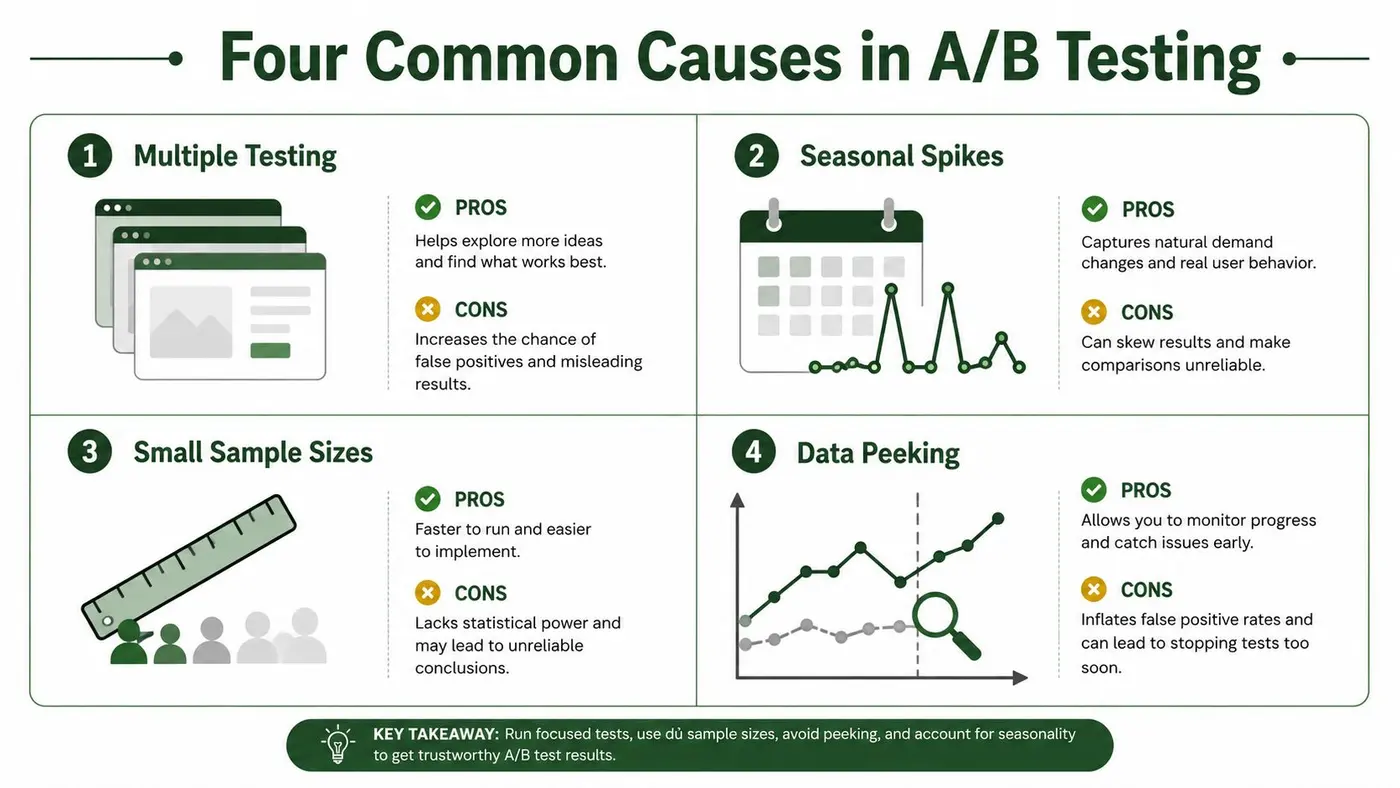
Most false positives in A/B testing don't come from one dramatic mistake. They come from a stack of small ones, each believable on its own. The hard part is that the dashboard usually doesn't tell you which one you've made.
Multiple testing
If you launch ten headline variants at once, one of them can look lucky just by chance. That's the trap of multiple testing, and it gets worse when the team only remembers the winner and forgets the nine quiet losers. In an e-commerce test, this often looks like a page title variant “winning” while the rest of the page has never been screened for the same amount of noise.
P-hacking
P-hacking is what happens when someone checks the test every day and stops the moment the number looks good. It feels disciplined because the team is “being data-driven,” but the actual effect is that repeated peeking makes a random bump more likely to be mistaken for a real lift. In SaaS, this can show up when a pricing-page test gets pulled early because the sign-up metric briefly spikes after a traffic mix shift.
Low statistical power
Small samples create noisy results. When you don't have enough traffic, random swings dominate the signal and people start treating ordinary volatility like a breakout. A small landing-page test can show a dramatic bump one day and a drop the next, and both can be nothing more than sampling noise.
Cherry-picking stopping rules
This is the classic “we stopped as soon as it looked good” problem. If the rule for ending the test is written after the fact, the result isn't really controlled anymore. A team shipping a new checkout layout the moment it crosses a threshold is often rewarding the timing of the spike, not the variant itself.
The pattern is easier to spot once you name it: too many comparisons, too much peeking, too little data, and stopping rules that move with the result. That's the core failure mode behind most A/B testing false positives.
What False Positives Cost Growth Teams
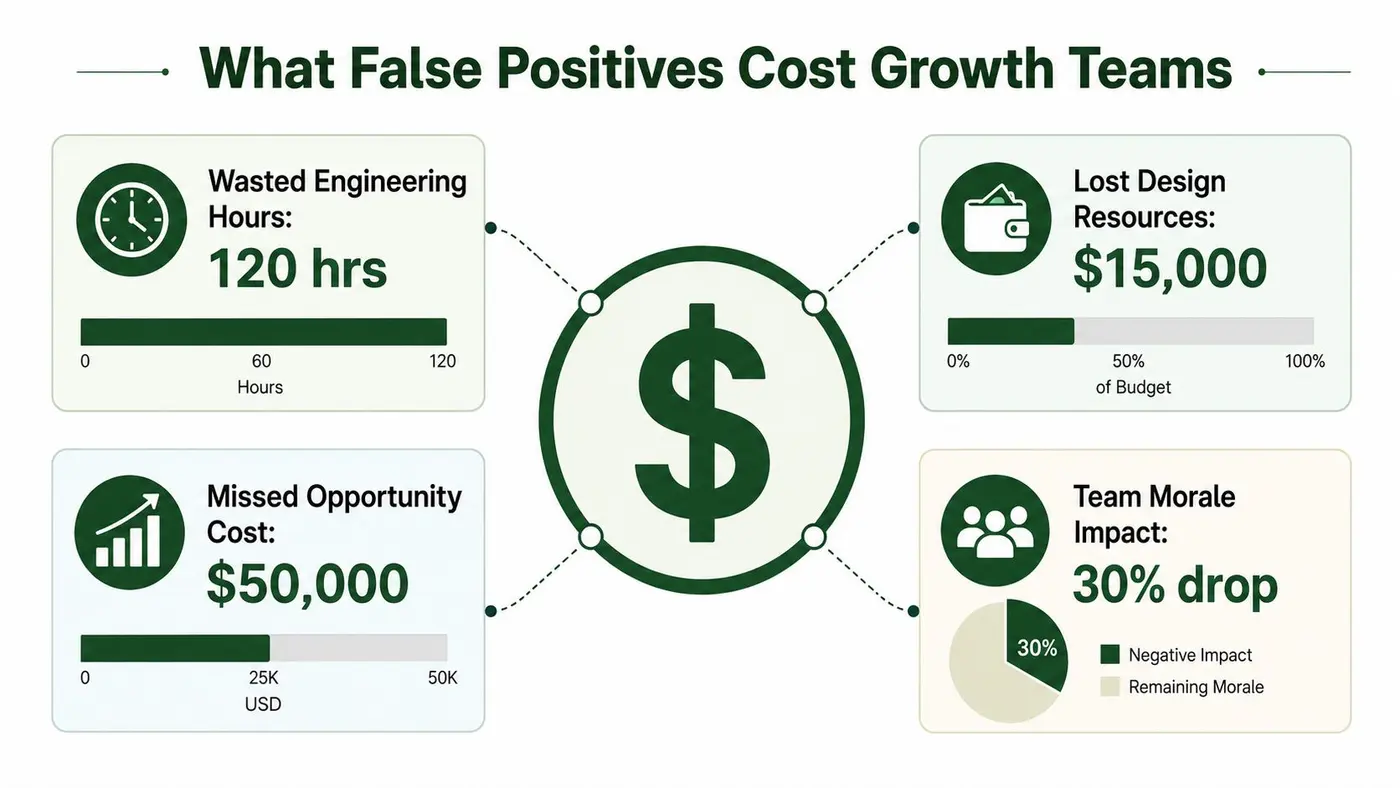
A false positive doesn't just waste a test. It can send a team down the wrong road, then make everyone less willing to trust the next result. That's the damage, because experimentation only works when people believe the winners are winners.
The obvious cost is wasted rollout effort
Once a variant gets shipped to 100% of traffic, the whole organisation pays for the mistake. Engineering time goes into the implementation, design time goes into the creative work, and product time goes into the decision. If the variant was never better in the first place, all of that effort goes into scaling the wrong experience.
The worst part is that the mistake can hide a regression. A headline or layout that looks harmless in a test can still hurt the downstream funnel once it reaches the full audience, and by then the team has already stopped looking because the test was declared a win. That's where the metric-decay problem starts.
The subtler cost is trust
When “winning” tests later get questioned, leaders start asking whether the experimentation programme is reliable at all. That skepticism slows future testing, which means fewer learning loops and weaker decisions across the board. It also makes it harder to argue for investment in experimentation, because the programme stops looking like an engine and starts looking like a gamble.
The best way to keep this concrete is to review suspicious tests on purpose. Teams that clean their event data and review attribution carefully are usually the ones that notice a bad signal sooner, which is why practical hygiene matters as much as the test design itself. A useful starting point is a solid data cleaning checklist for experiments, because noisy inputs make false positives easier to miss.
One bad win can distort the backlog
A single false positive can also reorder priorities. The team keeps iterating on a bad idea because the original result looked promising, while better opportunities stay untouched. That's how a mistake turns into a backlog problem.
Rule of thumb: if a test win changes roadmap priority, it deserves a second look before it becomes policy.
Five Mitigation Strategies That Actually Work
The best defence against false positives is not “trust your gut more.” It's to make the test harder to fool before you launch it. Good teams build this discipline into the workflow so they don't have to rely on memory when results start flashing green.
1. Pre-register the decision
Write down the hypothesis, the primary metric, and the stopping rule before the test starts. That simple habit cuts out a lot of p-hacking because the team can't redefine success after seeing the early shape of the data. Use this when a test is important enough to affect revenue, pricing, or onboarding.
2. Size the sample properly
A power calculation keeps you from calling a test before the data has a fair chance to speak. Underpowered tests are where random spikes masquerade as insight, especially on lower-traffic pages. Use this when your audience is small or your metric moves slowly.
3. Correct for multiple comparisons
If you're running lots of variants or lots of metrics, you need to account for the extra chances to fool yourself. Methods such as Bonferroni and Benjamini-Hochberg help tame that explosion of false alarms. Use this when you've got many headlines, many audiences, or many outcomes in the same experiment.
4. Use sequential testing methods
If your team wants to peek safely, use a method designed for it. Approaches such as mSPRT or always-valid inference let you monitor results without inflating Type I error in the same way as casual checking. Use this when the business wants frequent reads but the team can't wait for a single final review.
5. Keep a holdout group
A holdout slice gives you a long-run baseline that never sees the experiment. That makes it much easier to tell whether a “winner” really improved outcomes or just looked good in the short term. Use this when rollout risk is high or you suspect seasonality, channel mix shifts, or delayed effects.
The point isn't to use every safeguard on every test. The point is to match the control to the risk. A simple headline test and a revenue-critical pricing experiment should not carry the same level of scrutiny.
If you're building playbooks for creators or growth teams, this logic fits neatly into broader experimentation planning too, much like the decision rules in marketing playbooks for creators where the workflow matters as much as the idea.
Bayesian Alternatives and When to Use Them
Bayesian testing changes the question. Instead of asking whether a result crossed a binary significance line, it asks how likely one variant is to beat control and how much you should trust that outcome. That framing feels closer to how many marketing teams decide.
The language is different, but the idea is practical. Posterior probability tells you how much belief you should place on the current data given what you already know. Credible intervals describe the range of outcomes that still make sense, and expected loss helps you compare the downside of being wrong with the upside of moving faster.
Why some teams prefer this route
Bayesian methods can reduce the “did we cross the line or not” anxiety that comes with frequentist testing. They're often easier to explain to non-statisticians because the output looks more like a decision aid than a ritual. That said, they're not magic, and they're not automatically more honest.
The trade-offs are real
A Bayesian model still depends on a prior, and that prior can push the answer around if the sample is tiny. Teams that are used to p-values can also find the output subjective at first, especially when they want a single pass-fail answer. If you're comparing the two mindsets directly, this explainer on Bayesian and frequentist testing differences is a helpful companion because it keeps the workflow distinction clear.
Bayesian doesn't mean “no false positives.” It means the question changes, so the decision rule changes too.
Otter A/B's frequentist z-test engine is a useful example of a platform that makes the trade-off explicit. That matters because teams should know whether they're using a binary significance framework or a posterior-probability style workflow before they start calling winners.
Your False Positive Playbook
If you want fewer bad wins, make the process tighter before you ask for more traffic. The teams that do this well don't rely on luck, they rely on habits that catch bad signals early.
- Write a hypothesis doc before every test, so the team agrees on the question before the data starts talking.
- Run a power calculation, because underpowered tests make noise look persuasive.
- Use a fixed sample size or a sequential method, so the stopping rule is clear before anyone sees the trend line.
- Correct for multiple comparisons, especially when you're testing several variants or several metrics at once.
- Reserve a holdout slice, so you have a baseline that isn't touched by the experiment.
- Review past winners after rollout, because some false positives only show their damage once they're fully live.
- Keep data hygiene tight, since messy tracking can make a weak signal look stronger than it is.
The main comparison is simple. Frequentist methods give you a significance threshold and a known error risk, while Bayesian methods reframe the decision around probability and expected loss. Both can work, but neither removes the need for discipline.
False positives are a managed risk, not a fatal flaw of experimentation. The teams that respect that risk ship faster because they spend less time defending bad calls and more time learning from the right ones.
If you want to run experiments with cleaner decision rules and less guesswork, Otter A/B gives you a lightweight way to test headlines, CTAs, and layouts with a frequentist z-test engine and clear confidence thresholds. Visit Otter A/B to set up tests that are easier to trust before you roll them out to all your traffic.
Stop guessing
Ready to start testing?
Set up your first A/B test in under five minutes. No credit card required.
- 14-day free trial
- No credit card required
- Cancel anytime