Master Pricing: An Example of Psychological Pricing for 2026
Discover 8 top pricing strategies. See a compelling example of psychological pricing, from charm pricing to the decoy effect, & learn how to A/B test them in

The Price Is Right. Or Is It? How psychology shapes what we pay starts with a simple observation. Tiny changes in price presentation can change buying behaviour far more than generally anticipated. In UK retail, psychological pricing boosted retail sales by 60% in a 2021 university joint study cited in industry research, while an oft-quoted 2011 analysis found a 24% sales increase from charm pricing alone, according to Capital One Shopping's pricing psychology research.
That matters because many businesses still price by instinct, margin targets, or what a competitor happens to charge. None of those inputs tells you how a buyer will feel when they see £20 versus £19.99, a three-tier plan versus two, or a bundle versus standalone items. Pricing is part maths, part positioning, and part interface design.
As a CRO lever, pricing is unusually powerful because it changes both demand and perceived value. It can lift conversion, shift product mix, raise average order value, or damage trust if you apply the wrong tactic in the wrong category.
The useful question isn't whether price psychology exists. It clearly does. The useful question is which example of psychological pricing fits your product, your traffic source, and your customer intent, then how to test it properly. That means watching revenue per visitor, not just conversion rate, and running controlled experiments instead of redesigning your whole pricing model in one go.
1. Charm Pricing (The .99 Effect)
A one-penny change can shift demand enough to show up in revenue per visitor. That is why charm pricing is usually the first pricing test I would run on a value-led catalogue.
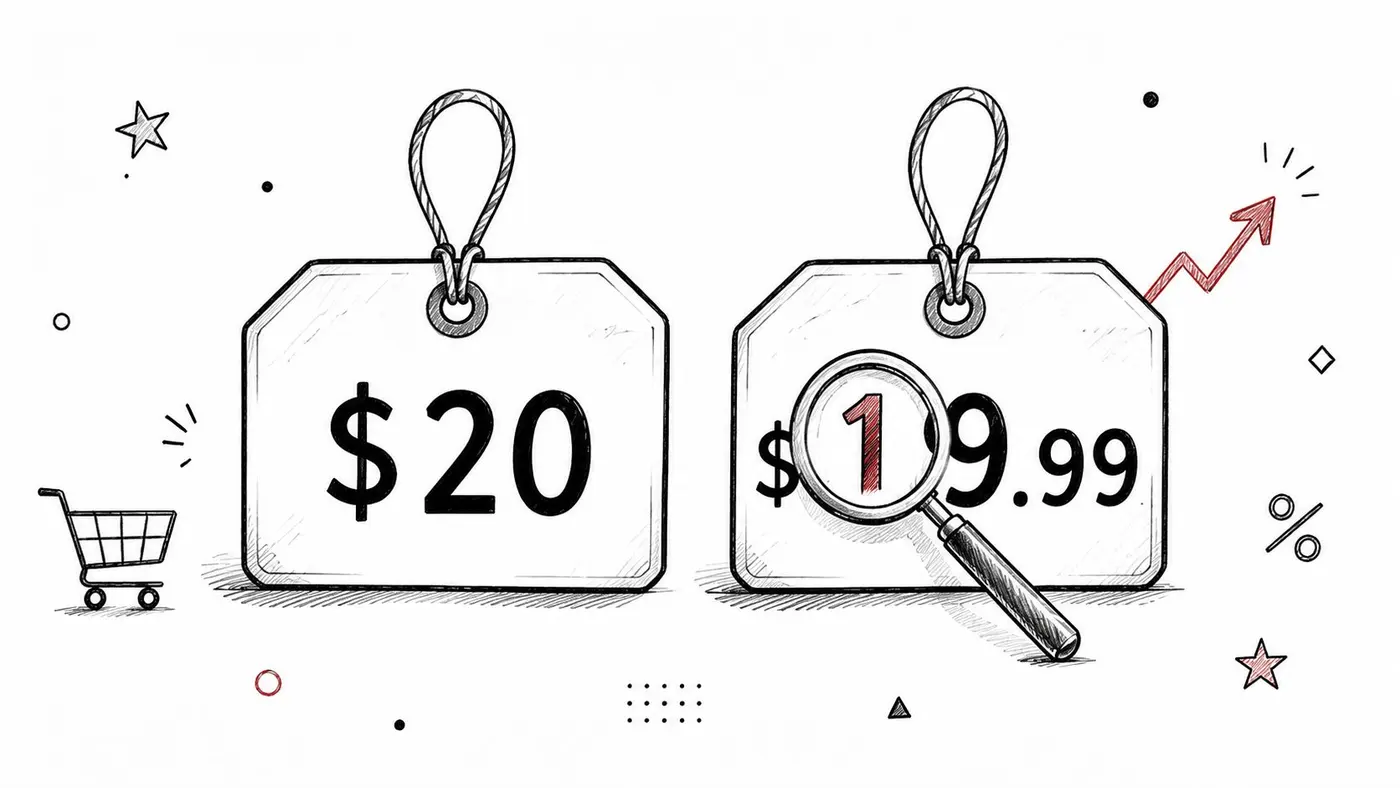
Charm pricing uses left-digit bias. Shoppers process the first number faster than the last digits, so £19.99 is often read as meaningfully cheaper than £20, especially on mobile, in category grids, and in any interface where people compare several options quickly. Earlier research cited in the introduction found demand can rise materially with charm endings. The practical point is simpler. Small price-format changes can produce measurable commercial effects without changing the product, offer, or traffic mix.
What works, and when it doesn't
Charm endings tend to work best in fast-comparison environments. Marketplaces, accessories, beauty, homeware, replenishable products, app pricing, and lower-consideration ecommerce all fit that pattern. In those categories, £14.99 or £29.99 signals value and keeps the item in the cheaper mental bucket.
Premium and trust-sensitive categories behave differently. A handcrafted product, luxury skincare set, high-end consultancy package, or gift item can lose some polish at £49.99 versus a clean £50. Round prices can feel more confident and more intentional.
The trade-off is straightforward. Charm pricing can raise conversion, but it can also lower perceived quality if the brand depends on taste, status, or craftsmanship.
Practical rule: Start with charm pricing on price-sensitive product lines. Test round pricing on premium ranges, giftable products, and higher-consideration offers.
A/B test framework in Otter A/B
Keep the test narrow. One product group, one pricing presentation change, one clear success metric.
- Control setup: Keep the current round price, such as £20.
- Variant setup: Change only the displayed price to a charm ending, such as £19.99.
- Primary KPI: Revenue per visitor.
- Secondary KPI: Conversion rate, average order value, checkout completion, and margin per order if margin is tight.
This measurement choice matters. A variant can win on conversion and still lose money if the lower displayed price pulls down revenue per visitor or attracts lower-intent buyers.
In Otter A/B, I would segment the result by device, traffic source, and product price band before rolling anything out. Charm pricing often performs better on paid social and mobile traffic than on branded search or desktop, where buyers may already be more intentional.
A strong follow-up test is ending-digit sensitivity. Compare .99 against .95 or .00 across similar SKUs. That test usually tells you two things at once. It shows whether buyers respond to the discount cue, and whether your audience prefers a sharper value signal or a cleaner brand presentation.
2. Decoy Effect (Asymmetric Dominance)
The decoy effect works best when buyers hesitate between “good enough” and “worth paying more for”. Add a strategically weaker option, and the choice you want to sell starts to look stronger by comparison.
This shows up all the time in subscription pricing and food service. A cinema popcorn menu is the classic example. Small is cheap, medium is oddly poor value, large is only a little more expensive than medium. The large suddenly feels sensible rather than expensive.
Where teams use it well
SaaS brands do this with Starter, Pro, and Enterprise plans. Streaming services do it with multiple plan tiers. Meal kits, software bundles, and membership products all use some version of the same structure.
The middle tier often does the heavy lifting. Sometimes it's the target product. Sometimes it's the decoy that makes the premium plan look like the obvious choice. The mechanics matter less than the comparison.
A weak decoy has to be plausibly buyable. If it looks fake or intentionally bad, customers notice the manipulation.
Here's a visual explainer worth reviewing before you build the test:
A/B test framework in Otter A/B
Use Otter A/B to compare page structures, not just prices.
- Control setup: Two pricing options only.
- Variant setup: Three options with one decoy positioned to favour the target plan.
- Primary KPI: Revenue per visitor.
- Secondary KPI: Plan mix, checkout starts, and average order value.
If you sell SaaS, test whether the middle plan should be labelled “Most popular” or whether the top plan should be framed as best value. If you sell physical products, test a standalone product page against a version with a nearby bundle or premium pack acting as the comparison anchor.
The trade-off is simple. More options can increase perceived value, but too many can slow decisions. Three is usually cleaner than four.
3. Price Anchoring
Anchoring changes what “reasonable” looks like. Show a higher reference price first, and the current price starts to feel like a deal even before the buyer evaluates the product itself.
That's why strikethrough pricing works. “Was £89.99, now £49.99” creates a stronger value impression than showing £49.99 on its own. The buyer isn't reacting to price in isolation. They're reacting to the gap.
The line between persuasive and sloppy
Anchoring only works if the reference feels legitimate. If the old price looks inflated, trust drops fast. On product pages, that means your previous price, list price, or regular price must be defensible and consistent with how you sell.
Pricing and CRO intersect with merchandising. If your discount framing is weak, your product page won't convert as efficiently no matter how polished the layout is. The broader mechanics are covered well in this guide to e-commerce conversion rate optimisation.
A strong anchor makes the current price easier to justify. A bad anchor makes the whole page feel fake.
A/B test framework in Otter A/B
Start with one sales collection or campaign page.
- Control setup: Current price only.
- Variant setup: Current price plus a crossed-out reference price.
- Primary KPI: Revenue per visitor.
- Secondary KPI: Conversion rate, average order value, and cart abandonment.
You can also test wording. “Was £99” may feel more promotional. “Regularly £99” can feel steadier. “List price” may work better in electronics than in fashion.
Don't stop at product pages. Test anchor placement in category grids, mini-cart views, and checkout summaries. A visible saving reminder near the moment of purchase often matters more than a dramatic badge higher up the page.
4. Price Bundling
Bundling is one of the most commercially useful pricing moves because it changes both perceived value and basket size. Instead of asking customers to evaluate three purchases separately, you package a complete solution at one price.
That's why “starter kits”, “complete routines”, and software suites work so well. Customers don't just see savings. They also see convenience and reduced decision effort.
Better bundles are built from buying behaviour
The best bundle isn't the one with the biggest discount. It's the one that feels like a logical purchase. A skincare brand pairing cleanser, toner, and moisturiser usually makes sense. A random inventory-clearing bundle usually doesn't.
A practical way to think about bundles is through cross-sell intent. If customers naturally buy certain items together, package that behaviour into a clearer offer. This matters even more if you're balancing bundle strategy with product recommendations, which is why it helps to understand cross-selling vs up-selling.
- Strong bundle: Products solve one job together.
- Weak bundle: Products share stockroom space but not buyer intent.
- Best presentation: Show what's included, what buying separately would look like, and why the set is easier.
For a broader commercial angle, this expert guide to increasing eCommerce revenue is useful reading alongside bundle testing.
A/B test framework in Otter A/B
Bundle tests need more than conversion tracking because a bundle can reduce single-item orders while still increasing total revenue.
- Control setup: Products sold individually on page.
- Variant setup: Bundle shown as the primary option.
- Primary KPI: Revenue per visitor.
- Secondary KPI: Average order value, product mix, and bundle take-up rate.
Test composition as well as price. One bundle may win because the product selection feels complete, not because the saving looks larger. Also test where the bundle appears. Product page, cart drawer, and post-add-to-cart modules often behave very differently.
5. Prestige Pricing (Premium Pricing)
Prestige pricing flips the normal logic. Instead of using a lower-looking price to trigger value perception, you use a higher or cleaner-looking price to signal quality, exclusivity, and confidence.
Brands like Apple have trained customers to expect that premium presentation and premium pricing belong together. In categories where quality is hard to judge before purchase, price itself becomes part of the message.
Round prices can say “premium” better than .99
Many teams over-apply charm pricing. If you sell handcrafted goods, consultancy packages, luxury accessories, or high-trust wellness products, £50 may outperform £49.99 because it feels more assured.
Existing UK commentary often misses this trade-off. myPOS's overview of psychological pricing in the UK points to an important gap: many articles explain £9.99-style tactics but rarely address when rounded prices signal quality better, especially under inflation and higher price scrutiny.
Premium pricing only works when the rest of the page supports it. Strong visuals, stronger copy, and obvious product substance have to carry the claim.
A/B test framework in Otter A/B
This is a positioning test as much as a pricing test.
- Control setup: Charm-priced or mid-market presentation.
- Variant setup: Rounded premium price with premium-supporting design and copy.
- Primary KPI: Revenue per visitor.
- Secondary KPI: Conversion rate, average order value, margin per order, and refund rate.
Don't isolate the number from the context. Test the price with supporting changes like cleaner typography, fewer promotional labels, and stronger craftsmanship or material copy. If you only change £49.99 to £50 without adjusting the surrounding presentation, you may learn very little.
This tactic is strongest on premium collections, flagship products, and returning visitor segments.
6. Psychological Reference Price (Willingness to Pay)
Every category has a rough zone where buyers think, “That sounds normal.” That's the reference price. Fall inside it and your page feels credible. Go too high and people hesitate. Go too low and some buyers assume the product is lower quality or incomplete.
This is one of the harder pricing tactics because the buyer's mental benchmark comes from past purchases, competitors, category norms, and context. The same £29 monthly fee can feel cheap in B2B software and expensive in a simple consumer app.
How to find the real reference point
Start with competitor mapping, but don't stop there. Competitor pricing tells you what the market shows. It doesn't tell you what your audience will accept on your page with your positioning.
Multi-price testing matters. For a SaaS plan, compare a small set of meaningful price points. For ecommerce, compare category-level thresholds and shipping-inclusive framing. You're not searching for the cheapest workable price. You're searching for the point where demand and value perception meet.
- Useful signal: Add-to-cart rate by traffic source.
- Useful signal: Revenue per visitor by segment.
- Useful signal: On-site behaviour around pricing sections, plan comparison modules, or checkout exits.
A/B test framework in Otter A/B
Set this up as a structured price-point experiment, not a one-off guess.
- Control setup: Current price point.
- Variant setup: One alternative price point at a time.
- Primary KPI: Revenue per visitor.
- Secondary KPI: Conversion rate, checkout completion, and plan or product mix.
If you're testing multiple prices, avoid changing too many page elements at once. Keep copy and layout stable so the pricing signal stays isolated. For higher-consideration offers, pair the test with feedback collection from exit surveys or sales calls. Quantitative data tells you what changed. Buyer language often tells you why.
7. Scarcity and Urgency Pricing
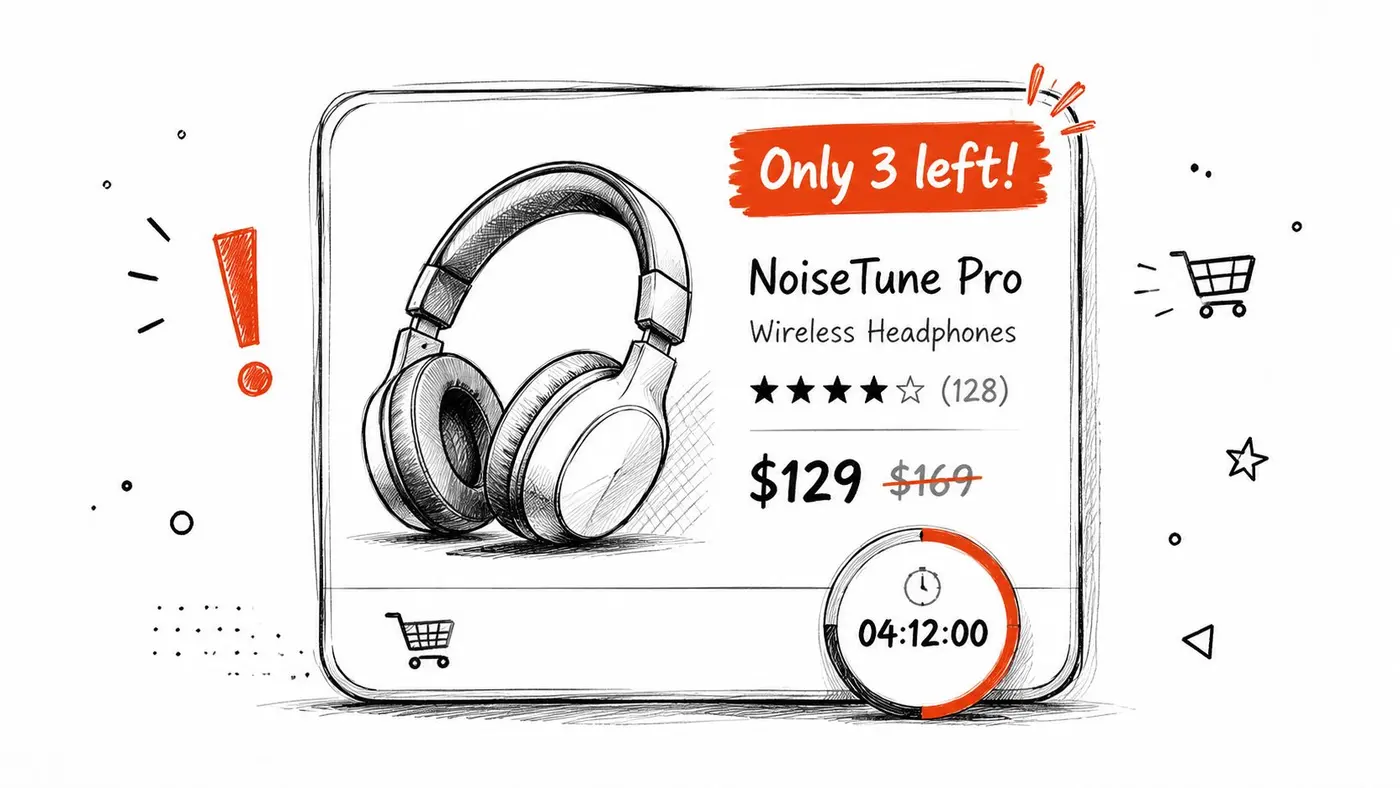
Scarcity and urgency don't change the product. They change decision timing. “Only 2 rooms left at this price” and “deal ends tonight” are familiar because they shorten hesitation.
Used well, this can rescue delayed decisions. Used badly, it makes a brand feel noisy and untrustworthy.
The biggest rule is credibility
Stock-based scarcity should reflect real stock. Time-limited offers should end. Once buyers suspect the timer resets every day, the tactic stops helping and starts hurting.
This kind of test also needs discipline because many urgency experiments are underpowered. If your baseline conversion volume is low, you can easily call a winner too early. That's where understanding minimum detectable effect helps before you launch the test.
Short-term conversion gains aren't enough. Watch for trust signals like return behaviour, support complaints, and post-purchase sentiment.
A/B test framework in Otter A/B
Test one urgency mechanism at a time.
- Control setup: Standard price display with no urgency cue.
- Variant setup: Add one truthful urgency or scarcity element, such as low-stock messaging or an offer end time.
- Primary KPI: Revenue per visitor.
- Secondary KPI: Conversion rate, cart completion, and post-purchase quality signals.
Placement matters. A timer on the product page behaves differently from a message in the basket or checkout. So does phrasing. “Limited-time price” feels different from “Only a few left”. Run isolated tests before combining them.
8. Framing and Context Effects (How Prices Are Presented)
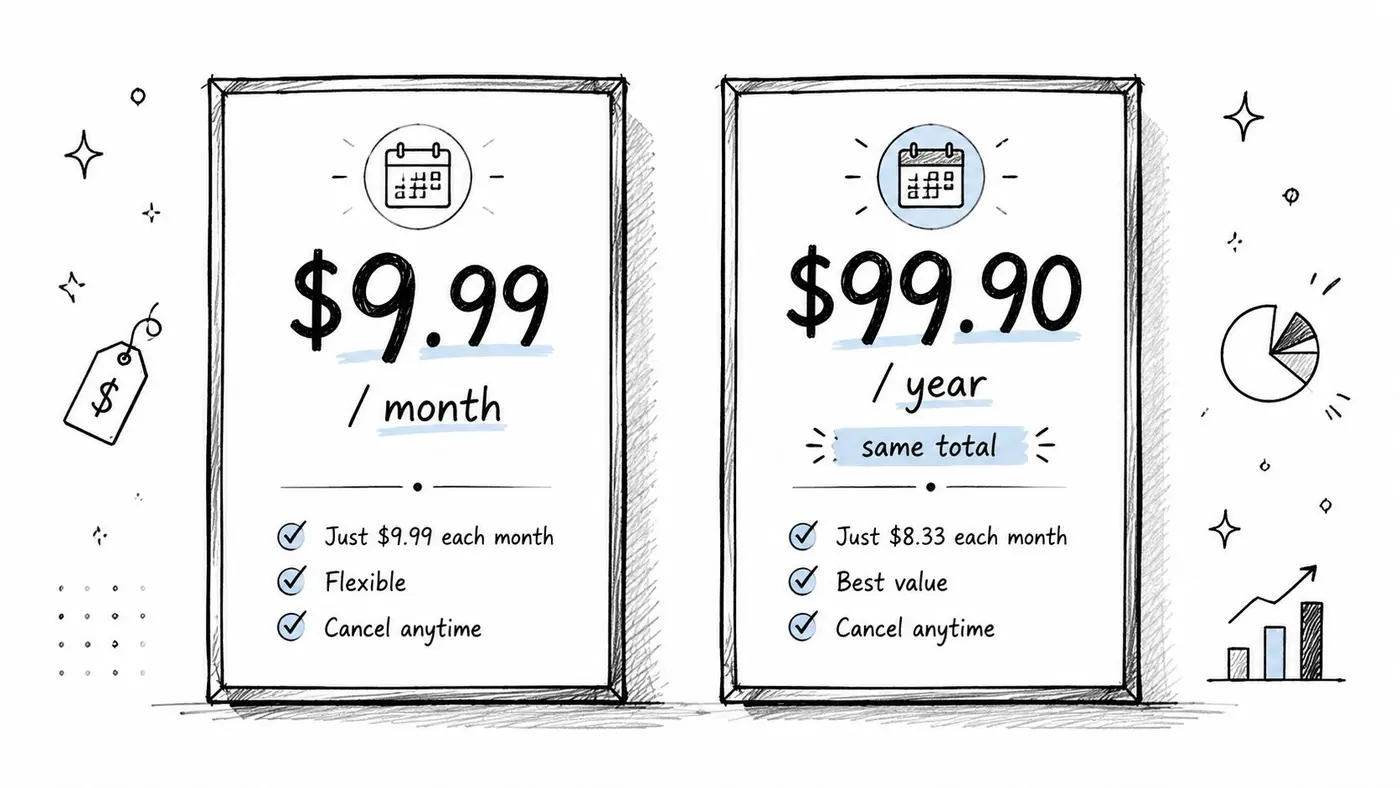
The number itself is only half the job. The rest is framing. A buyer can react differently to the same cost depending on whether you present it as monthly, annual, daily, discounted, or compared with an alternative.
That's why subscription businesses often lead with monthly pricing while annual plans sit nearby as the value option. The arithmetic may be straightforward. The perception isn't.
Framing changes what feels expensive
“£29 per month” can feel manageable. “Billed annually” can feel more committed. “Save when you choose annual” shifts attention from cost to value. This is the same reason “half price” and “save £X” can outperform a plain final price in some contexts.
The frame around price also includes surrounding copy, design hierarchy, and comparative context. If you operate under resale constraints or channel pricing rules, it's worth understanding MAP policies and pricing restrictions before testing visible frames too aggressively.
A/B test framework in Otter A/B
This is one of the richest areas for experimentation because the underlying price can stay constant.
- Control setup: Existing price presentation.
- Variant setup: Change framing only, such as monthly versus annual emphasis, savings-first messaging, or competitor-relative context.
- Primary KPI: Revenue per visitor.
- Secondary KPI: Conversion rate, plan selection, and average order value.
Good framing tests are especially useful when you can't or don't want to change the actual price. You can still test visual emphasis, comparative copy, savings language, and billing explanations. For many teams, that's the fastest way to improve pricing performance without touching margins.
8-Point Psychological Pricing Comparison
| Technique | 🔄 Implementation Complexity | ⚡ Resource Requirements | 📊 Expected Outcomes | 💡 Ideal Use Cases | ⭐ Key Advantages |
|---|---|---|---|---|---|
| Charm Pricing (The .99 Effect) | Very easy, change price display & A/B test | Low, CMS/pricing update, analytics | 📊 Typical +5–10% conversion lift | Mid-range products, broad e‑commerce catalogs | ⭐ Proven, easy-to-test lift with minimal effort |
| Decoy Effect (Asymmetric Dominance) | Medium, requires tier design and testing | Medium, pricing strategy, experiments, UX changes | 📊 Often increases AOV by ~10–25% | Subscription tiers, SaaS plans, tiered offerings | ⭐ Guides customers to higher‑value options naturally |
| Price Anchoring | Easy, show original vs sale price, strikethroughs | Low, copy/design change and tracking | 📊 Commonly +10–30% conversion during promotions | Sales pages, discounts, product promotions | ⭐ Boosts perceived value without cutting list price |
| Price Bundling | Medium, bundle setup, inventory/pricing logic | Medium–High, product pairing, fulfilment, analytics | 📊 AOV lift often 20–50%+ when well-structured | E‑commerce kits, SaaS feature bundles, combo offers | ⭐ Increases AOV and simplifies purchase decisions |
| Prestige Pricing (Premium Pricing) | Hard, requires brand positioning and consistency | High, product quality, marketing, distribution | 📊 Margin improvement ~30–100% but lower volumes | Luxury goods, premium tech, artisanal products | ⭐ Raises margins and brand prestige for affluent buyers |
| Psychological Reference Price | Medium, requires research and segmentation | High, market research, testing, ongoing analysis | 📊 Improves conversion by matching expectations (varies) | Competitive categories, price-sensitive markets, SaaS | ⭐ Data-driven pricing that aligns with willingness‑to‑pay |
| Scarcity & Urgency Pricing | Medium, implement timers, stock signals, rules | Low–Medium, UI elements, inventory/tracking, honesty | 📊 Large lifts possible (30–50%+) when genuine | Flash sales, limited-stock items, bookings | ⭐ Strongly accelerates purchase decisions (FOMO) |
| Framing & Context Effects | Easy–Medium, copy/design variations and tests | Low, copywriting, layout tests, A/B framework | 📊 Typical +10–30% via better presentation | Subscriptions, pricing pages, promotional messaging | ⭐ Improves conversion without changing price by reframing |
From Theory to Test: Putting Price Psychology into Practice
The main lesson is simple. Psychological pricing isn't a bag of tricks. It's a set of testable hypotheses about how buyers interpret value. The same tactic that helps one category can hurt another. £19.99 can increase response in a value-led retail context, while a rounded price can better support a premium product. A countdown timer can speed up indecisive shoppers, but it can also weaken trust if the offer feels manufactured.
That's why every example of psychological pricing in this article should be treated as an experiment, not a rule. Start with the tactic that matches your commercial goal. If you need more orders on lower-priced products, test charm pricing. If you need higher average order value, test bundles, decoys, or framing changes around plans and packs. If you need stronger premium perception, test round pricing with upgraded presentation rather than defaulting to .99 endings.
Measurement matters more than preference. A variant that wins on conversion rate but loses on revenue per visitor isn't a real win. The same goes for tests that improve immediate sales while increasing returns or weakening product mix. Good pricing experiments connect presentation to business outcomes, not just click behaviour.
A lightweight experimentation workflow proves beneficial. Tools like Otter A/B let teams test pricing presentation without rebuilding the entire site, and the useful part isn't just split testing the page. It's tying results to metrics like purchases, average order value, revenue per variant, and revenue trends over time.
A practical rollout looks like this:
- Pick one page type: Product pages, pricing pages, or cart first.
- Change one pricing mechanism: Don't test charm pricing, scarcity, and anchoring all at once.
- Choose one primary KPI: Revenue per visitor is usually the strongest default.
- Review trade-offs: Check order mix, trust signals, and margin implications before rollout.
If you're building a broader optimisation process around this, this website conversion framework is a useful companion to pricing tests because it keeps the experiment tied to the full user journey.
The fastest path forward is to run one focused test this week. Change one price presentation. Keep traffic split clean. Let the test run properly. Then decide based on revenue, not instinct. That's how pricing becomes a growth lever instead of a debate.
If you want to test pricing formats, tier structures, anchors, bundles, or urgency messages without a heavy setup, Otter A/B is one option built for fast website experiments. It's designed to track not just conversion rate but also purchases, average order value, and revenue per variant, which makes it a practical fit for psychological pricing tests.
Stop guessing
Ready to start testing?
Set up your first A/B test in under five minutes. No credit card required.
- 14-day free trial
- No credit card required
- Cancel anytime