Headline a B Testing
Headline A/B testing. Learn headline A/B testing the practical way — hypotheses, variants, traffic split, significance, and the moves that turn winners into
The popular advice is wrong. Most headline A/B tests don't fail because the wording lacks sparkle, urgency, or a clever power verb. They fail because the experiment was underpowered, poorly isolated, or stopped as soon as the dashboard flashed green.
That distinction matters. A UK-focused survey released in June 2024 found that 65% of UK marketers were already using AI in experimentation, while 87% said experimentation was important to achieving their 2024 goals. Yet 20% said their current web experimentation approach wasn't effective, and 23% described it as unsophisticated, based on responses from 100 marketers and 1,000 UK consumers (Optimizely's UK experimentation study). Testing is popular. Reliable testing is harder.
A large UK-relevant analysis of 2,408 tests run between January 2023 and March 2026 found that 74.2% were inconclusive or showed no detectable difference. Only 17.4% produced a statistically significant winner, while 8.4% reached significance with a losing variant (the 2026 A/B testing analysis). Headline testing deserves the same scepticism, because a headline can be persuasive and still produce an unreadable result.
Why Most Headline Tests Fail Before They Start
A headline test isn't a beauty contest between two sentences. It's a randomised experiment, and the copy sits at the end of a chain of decisions about traffic, allocation, events, sample size, and stopping rules. If those decisions are weak, a polished challenger only gives the noise a more attractive label.
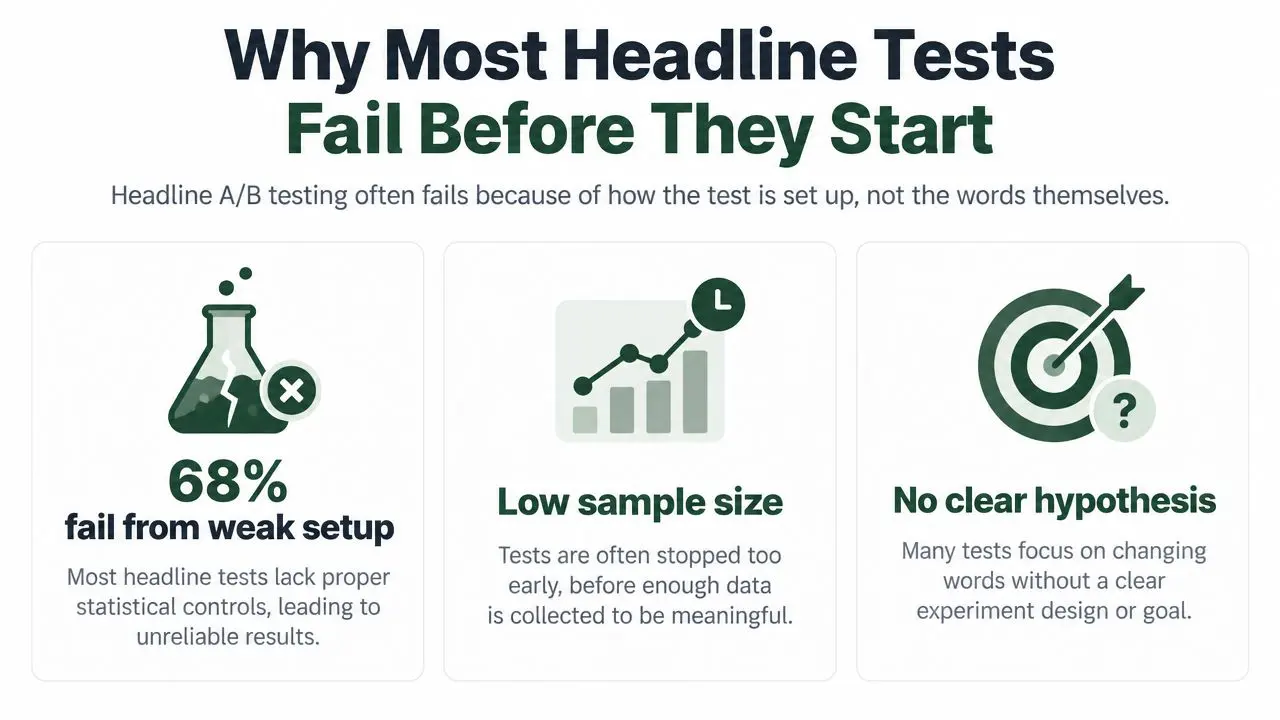
Three setup failures appear repeatedly:
- Underpowered traffic: The page doesn't receive enough relevant visitors to distinguish a meaningful change from normal variation. A small audience can make a strong headline look flat, while an apparent uplift can disappear once more visitors arrive.
- Multiple changes at once: The headline changes alongside the subheading, hero image, form, or CTA. A result might show that the page changed, but it can't tell you which change caused the movement.
- Early stopping: Someone checks the dashboard after a weekend, sees a lead, and ships it. The early sample often contains an unusual mix of channels, devices, returning visitors, or campaign traffic.
The third problem is especially expensive because repeated checking changes the decision rule. You haven't just observed the experiment. You've given yourself repeated opportunities to declare a winner before the planned evidence exists.
Practical rule: A test plan should state the expected detectable effect, traffic allocation, primary metric, and stopping rule before launch. Otherwise, the dashboard will make those decisions for you.
The right response isn't to write more variants. It's to make the experiment capable of answering one question. Methodology comes first, messaging second.
Forming a Headline Hypothesis That Can Actually Win
A testable hypothesis isn't a sentence with “we think” placed in front of it. It identifies a signal, a defined audience, one change, and the behaviour that should move.
Use this structure:
Because we observed [behaviour or signal] in [segment], changing [headline element] to [proposed variant] will move [primary metric] by [minimum detectable effect], because [mechanism].
Write the hypothesis before drafting the alternatives. If you create three appealing headlines first and explain them afterwards, you'll tend to select the explanation that fits the result. That creates a record of justification, not a record of learning.
Three worked examples
Fintech landing page: Returning visitors read the proof section more often than first-time visitors, suggesting that reassurance matters after the initial promise. A hypothesis could be: “Because first-time visitors need confidence before submitting their details, replacing an outcome-led headline with a proof-led headline will increase qualified application starts, because evidence reduces perceived risk.”
SaaS pricing page: Visitors compare plan details but abandon before speaking with sales. A useful test might shift from feature language to the cost of inaction: “Because visitors can see what the product includes but not what delay costs them, making the headline about the operational problem will increase demo requests, because it frames the purchase around avoided loss rather than functionality.”
Publisher homepage: Articles receive clicks when the subject is clear, but curiosity can encourage exploration. The hypothesis could pair both: “Because readers need a category cue before committing to an unfamiliar story, adding the topic category to a curiosity-led headline will increase article clicks, because the reader can understand the subject without losing the open loop.”
Use the guide to writing better headlines for copy development, but keep the experiment record separate from the drafting process. A good headline guide helps you generate plausible ideas. It can't decide whether your test was valid.
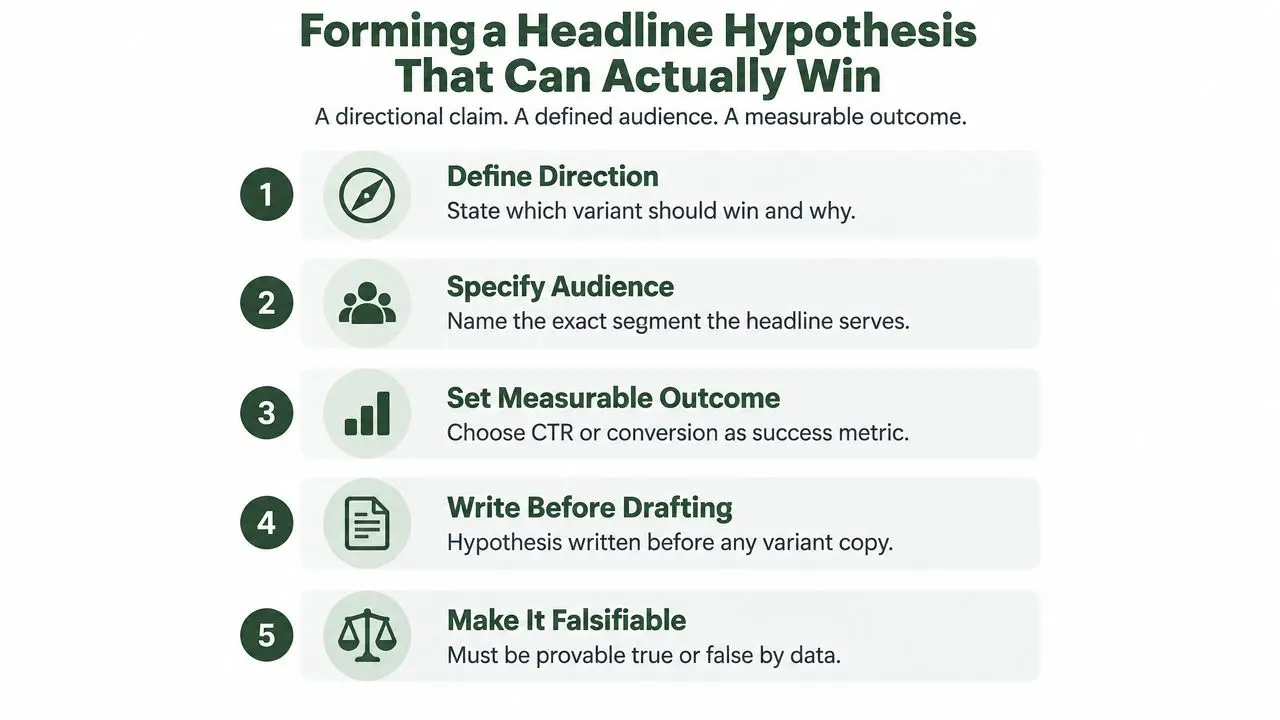
A tracker entry should answer five questions:
- What signal prompted the test?
- Which audience is affected?
- What single headline lever will change?
- Which primary metric decides the result?
- What result would disprove the hypothesis?
That final question prevents every outcome from being labelled a success.
Designing Variants Worth Testing
Once the design is sound, copy choices become useful. The strongest variants usually isolate one lever, such as specificity, proof, promise, length, or audience clarity. They don't attempt to improve every part of the message simultaneously.
| Lever | Control example | Variant example | Metric it tends to move |
|---|---|---|---|
| Specificity | Grow your business | Add 1,000 customers in 90 days | Click-through from colder traffic |
| Proof | Improve your financial future | Used by teams that need clearer cash-flow decisions | Trust-led engagement |
| Promise | Manage your projects | Keep delivery risks visible before they become delays | Conversion from informed visitors |
| Audience cue | Make reporting easier | Reporting for UK finance teams | Relevance and qualified action |
| Clarity | A smarter way to work | Project management software for distributed teams | Comprehension and click-through |
The examples are hypotheses, not guaranteed winners. A number can make a promise more concrete, but it can also make the claim less credible. A curiosity-led line can earn a click, yet category language may produce fewer clicks from cold traffic and better downstream intent. The correct metric depends on the page's job and the visitor's awareness.
A headline should change one meaningful decision variable, not five cosmetic details.
Keep the control recognisable. If the control says “Grow your business” and the challenger changes the headline, subheading, supporting proof, and CTA, you've created a new page experience. You may still learn something about the page, but you won't know whether the headline did the work.
For one variable per test, the sensible default. Multivariate testing needs enough traffic to support the combinations, and it makes interpretation harder even when the platform reports a neat result. A headline plus a new subhead plus a new CTA isn't a bold experiment. It's a confession that the team wanted a redesign but labelled it a headline test.
Headline copy also needs to survive outside the page context. If your organisation publishes across search, social, email, and AI-assisted discovery, you can analyse headlines for AI visibility alongside conventional clarity and conversion criteria. That doesn't replace an experiment. It helps you identify whether the variant communicates its subject and value clearly across the surfaces where people may encounter it.
Splitting Traffic and Shipping the Test
The cleanest launch starts with allocation. A balanced split gives both variants comparable exposure at the same time, which usually makes the result easier to interpret. An uneven split can protect a high-value control, but it gives the challenger fewer observations and can lengthen the path to a decision.
Don't treat traffic bucketing as a minor implementation detail. A visitor assigned to variant B should normally continue seeing B, including on later sessions, unless your test design explicitly requires session-level randomisation. Sticky assignment reduces contamination from visitors comparing experiences across visits and makes downstream conversion attribution more coherent.
Decide what belongs in the sample
Separate acquisition contexts when their intent differs materially. Paid search visitors, email recipients, direct visitors, and organic search landings may respond to different promises, even when they reach the same URL. You can include them in one analysis if the allocation is random and the hypothesis covers the combined audience, but you shouldn't mix them and then explain an unexpected result with a story about “the average visitor”.
A pre-launch plan should record:
- Allocation: Confirm how traffic is split and how returning visitors stay bucketed.
- Minimum detectable effect: Set the smallest change worth acting on before seeing results.
- Runtime: Estimate the required duration using eligible traffic and the chosen primary conversion.
- Exclusions: Remove obvious bot traffic, internal visits, test accounts, and planned anomaly windows.
- Events: Verify that impressions, clicks, leads, purchases, and relevant downstream actions fire for both variants.
QA the page, not just the dashboard
The most damaging bugs are often visible within minutes. Check for flicker before the headline changes, redirect loops, broken responsive layouts, missing tracking events, and skewed allocation caused by caching. Use a debug parameter, inspect the assigned variant in the browser, and run a two-user sanity check on separate devices or browsers.
If you need a tool for the implementation workflow, a headline testing tool can help organise variant delivery and result tracking. The tool doesn't remove the need to define the experiment correctly. It only makes a correct plan easier to execute consistently.
Reading Significance Without Fooling Yourself
A green “winner” badge is a display state, not a release decision. Separate statistical significance, which asks whether the observed gap is compatible with random variation, from practical significance, which asks whether the change is large and valuable enough to ship.
A 12% relative lift on a 0.4% baseline CTR may sound impressive while representing little absolute movement. With limited data, it can also disappear as more visitors enter the test. Ask for the underlying counts, confidence interval, traffic mix, and primary conversion definition before approving a rollout.
The broader evidence supports restraint. Across a UK-relevant analysis of 2,408 tests, successful tests had an average lift of 8.4% and a median lift of 6.1%, while most tests did not produce a detectable winner. Headline-specific results can be noisier. A benchmark covering more than 500 headline tests reported an 8% win rate, with 81% showing no measurable difference and 11% losing to control. Among winners, the median lift was 29.1% (the headline testing benchmark). Treat these figures as context, not a forecast for your page.
The peeking penalty
Daily checking creates a stopping bias. If you inspect results repeatedly and stop when they look favourable, the stated confidence level no longer reflects the actual decision process. Set a fixed runtime before launch, or use a sequential method built for repeated monitoring.
Report more than “variant B won by 18%”. Include the control and challenger rates, absolute difference, confidence interval, eligible sample, runtime, and meaningful segment differences. A losing headline can still show that the promise lacks credibility, proof matters more than phrasing, or the audience definition needs work.
| Scenario | Relative lift | Baseline CVR | 95% CI | Estimated revenue / 1k sessions |
|---|---|---|---|---|
| Stronger evidence, modest business effect | Report observed result | Report actual baseline | Report interval | Calculate from actual order value |
| Wider uncertainty | Report observed result | Report actual baseline | Show broad interval | Use a range, not a point estimate |
| Inconclusive result | Do not label a winner | Report actual baseline | Include zero if applicable | Avoid forecasting a change |
| Clear practical winner | Report observed result | Report actual baseline | Show interval and direction | Connect to verified downstream value |
Use this A/B testing statistical significance guide to check the calculation, then inspect the experiment setup. A correct formula cannot rescue contaminated traffic, an unplanned stopping rule, or an event that failed on one variant. The method determines whether the copy result deserves trust.
Actioning Winners Without Breaking the Funnel
A headline can win its primary metric and still damage the journey afterwards. Before a hard launch, check whether the challenger affected bounce behaviour, scroll depth, lead quality, checkout progression, or revenue per visitor. A click is not automatically a commercial improvement.
Use a controlled rollout:
- Confirm the evidence. Check the planned confidence threshold, sample adequacy, allocation integrity, and confidence interval.
- Hold a shadow window. Keep the winning experience under observation for 24 to 72 hours after the decision, checking telemetry for broken events or unexpected downstream movement.
- Promote without resetting history. Keep the experiment identifier and cumulative result accessible. If the production implementation creates a new campaign or page ID, preserve the old record in the reporting layer.
- Archive the challenger. Store the copy, hypothesis, audience, result, and interpretation. A loser can become a useful control for a different segment or future test.
- Recheck adjacent pages. A paid landing page headline reflects the promise that brought a visitor in. An organic article headline also has to satisfy search intent, editorial expectations, and the page's information need.
The last point prevents a common misuse. A headline that improves ad landing-page response may be too promotional for an SEO article. The intent, entry context, and success metric differ, so copying the wording without repeating the hypothesis is guesswork.
Questions that stop rationalisation
- “It looks right.” Which pre-declared metric moved, and what does the interval say?
- “The challenger was stronger on day three.” Was day three the planned stopping point?
- “The clicks increased.” Did qualified leads, purchases, or revenue follow?
- “The audience loved it.” Which audience was exposed?
- “The tool says winner.” Did the implementation and event QA pass?
A winner isn't a permanent truth about headlines. It's evidence for a particular audience, page, period, and decision.
Where Headline Testing Goes Next
Headline testing works best as part of an experimentation programme, not as an isolated request from a marketer who has spare traffic this week. The more tests a team runs, the more carefully it must manage shared controls, overlapping experiments, repeated measurement, and false-positive risk.
The next step is a shift from page-level testing towards platform-level measurement. Teams can create shared control pools, adopt fixed-horizon or sequential approaches, and use Bayesian or always-on frameworks where the decision rules are explicit. Those systems are useful, but they don't turn weak hypotheses into reliable learning.
The operating model matters more than the software label. A single marketer running an isolated test each quarter will mostly collect anecdotes. A CRO squad with a prioritised backlog, an ICE or PXL scoring method, a weekly review, and a documented learning library can build a cumulative advantage from ordinary tests.
AI can generate headline candidates quickly, especially when teams provide a product, audience, benefit, and tone. Human editorial judgement still needs to decide which claims are accurate, credible, on-brand, and appropriate for the visitor's intent. Automation should expand the hypothesis pool, not remove accountability for what ships.
Google Ads has also moved measurement closer to the asset level. A UK-facing PPC discussion notes that Google Ads introduced individual per-asset data in June 2025, which can reduce the need for some traditional headline-level split tests within responsive search ads, while controlled experiments still matter when isolating one headline variable (the PPC copy discussion). The practical question is no longer “Which headline is better?” It's “Which measurement method fits this ad, landing page, or SEO page?”
Track cumulative learning across a quarter, not just the most flattering individual lift. That habit turns headline A/B testing from a sequence of dashboard celebrations into a disciplined system for making better decisions.
Otter A/B helps teams test headlines, CTAs, and layouts with controlled traffic splits, defined goals, and statistical reporting tied to conversion outcomes. Use it to turn your next headline hypothesis into a properly instrumented experiment, then visit Otter A/B to start testing without a credit card.
Stop guessing
Ready to start testing?
Set up your first A/B test in under five minutes. No credit card required.
- 14-day free trial
- No credit card required
- Cancel anytime