10 Headline Testing Tool Options for Marketers
Compare 10 headline testing tool options by features, pricing, integrations, and use cases for marketers, e-commerce teams, and agencies.
The best headline testing tool isn't necessarily the one with the longest feature list. A dedicated optimiser, landing-page builder, WordPress plugin and enterprise experimentation suite may all test copy, but they differ sharply in how they deliver variants, measure outcomes, fit your CMS, charge for usage and govern decisions across teams. The right choice depends on whether you need a quick client-side test, server-side delivery, revenue reporting, behavioural insight or a controlled experimentation programme.
That distinction matters because headline testing is an evidence process, not a button labelled “optimise”. The UK government A/B testing guide recommends a hypothesis, a control, a variation, equal randomised groups, and a test duration based on traffic and expected change. In the UK, 65% of marketers already use AI in experimentation, while 87% believe experimentation is important. Yet 20% say their current web experimentation approach isn't effective, which points to an execution problem rather than a lack of interest.
The ten platforms below are judged by operational reality: delivery performance, statistical reporting, behavioural or revenue measurement, CMS fit, pricing model and governance burden. If your wider conversion programme includes usability testing for lead generation, the same principle applies. Choose the tool that matches the decision you need to make, not the tool that promises the most automation.
1. Otter A/B
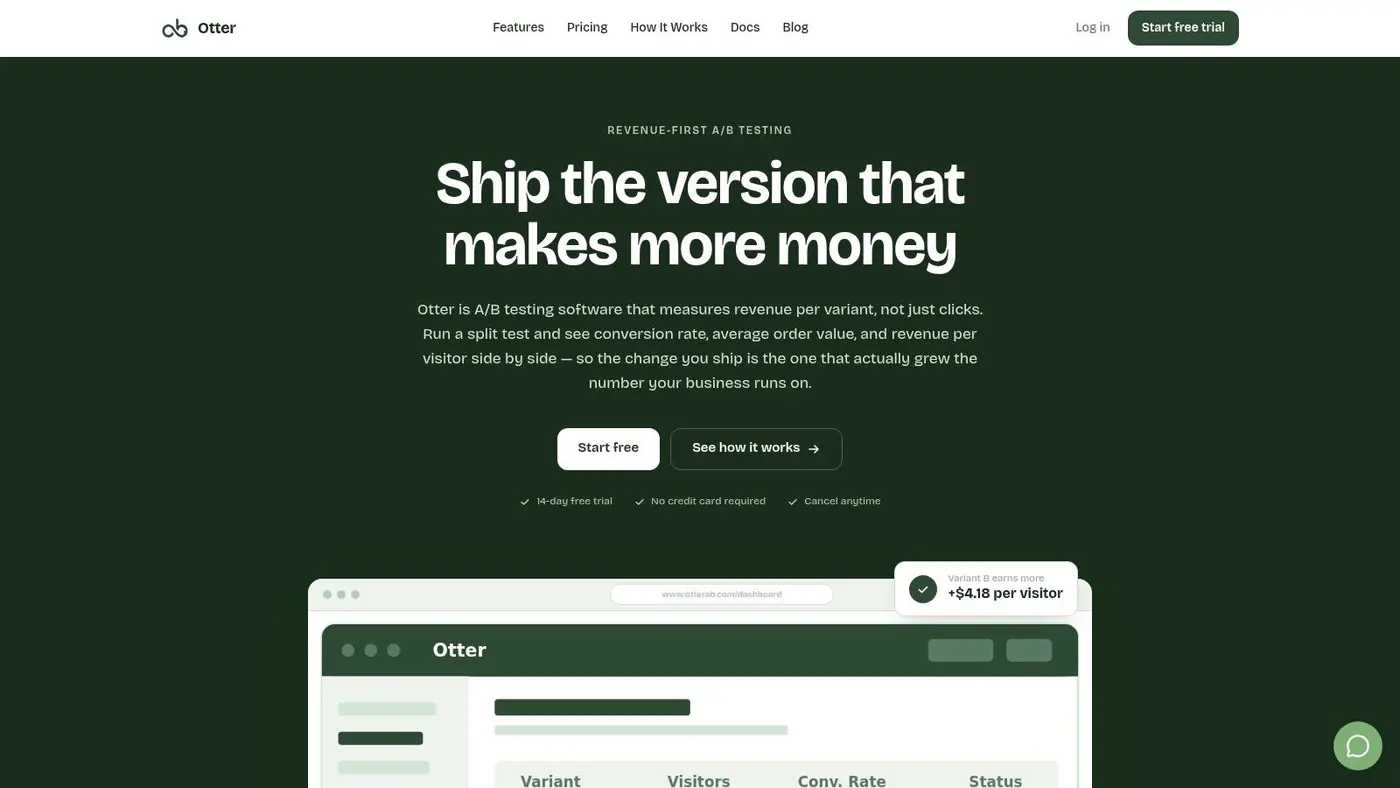
Otter A/B is the strongest fit for teams that want headline testing connected to commercial outcomes rather than isolated click or conversion metrics. Its dashboard places conversions, average order value and revenue per visitor together, helping teams identify situations where a headline lifts conversion rate but attracts lower-value customers. That makes it particularly relevant to Shopify, WooCommerce and other commerce teams where the winning headline should improve the economics of the visit, not merely produce more form submissions.
Deployment is deliberately lightweight. Otter uses a 9KB SDK, loads in under 50ms, aims for zero flicker and provides 99.9% uptime, according to the product information supplied by Otter A/B. Teams install it with a one-line snippet, then create variants through a visual editor. Traffic splits can be set precisely, while targeting supports device, location, URL and custom attributes.
Reporting that reaches beyond conversion rate
Otter continuously calculates statistical significance using a frequentist z-test at a default 95% confidence threshold. Users can also choose Bayesian reporting manually, while multi-armed bandits use Bayesian reporting automatically. Revenue tracking can reuse existing GA4 purchase events, so an e-commerce team doesn't need to build a separate purchase measurement system for every experiment. The dashboard includes revenue trends, AOV, uplift and decision scores.
That reporting model is useful when several metrics disagree. A headline may increase clicks while lowering order value, or increase leads without improving downstream revenue. Otter's warnings encourage the team to resolve that conflict before shipping a winner.
Practical rule: Define the business outcome before writing variants. A headline test is only as useful as the event and revenue mapping behind it.
Integrations cover Shopify, WordPress, Webflow, Wix, WooCommerce, ClickFunnels, Squarespace, Framer, Next.js, Google Tag Manager and custom JavaScript. Slack alerts, branded password-protected reports and AI-assisted workflows connected to Claude or ChatGPT reduce the reporting burden for agencies and distributed teams. The platform also supports an A/B test headline generator, which can create variants before they enter an experiment.
Pricing starts at $39 per month, with unlimited visitors and unlimited tests and no MTU caps or overage charges, based on the supplied product information. A 14-day free trial is available without a credit card. The main limitation is scope. Otter is primarily a client-side, snippet-based tool, so teams running backend feature experiments may need a separate feature-flag or server-side system. Accurate revenue reporting still depends on correct goal configuration and sufficient sample size. For growth marketers, e-commerce owners, UX leads, front-end engineers and agencies, its balance of speed, commercial reporting and transparent pricing is unusually practical. Teams planning conversion rate strategies can use it as a focused experimentation layer without adopting a wider enterprise suite.
2. Optimizely Web Experimentation
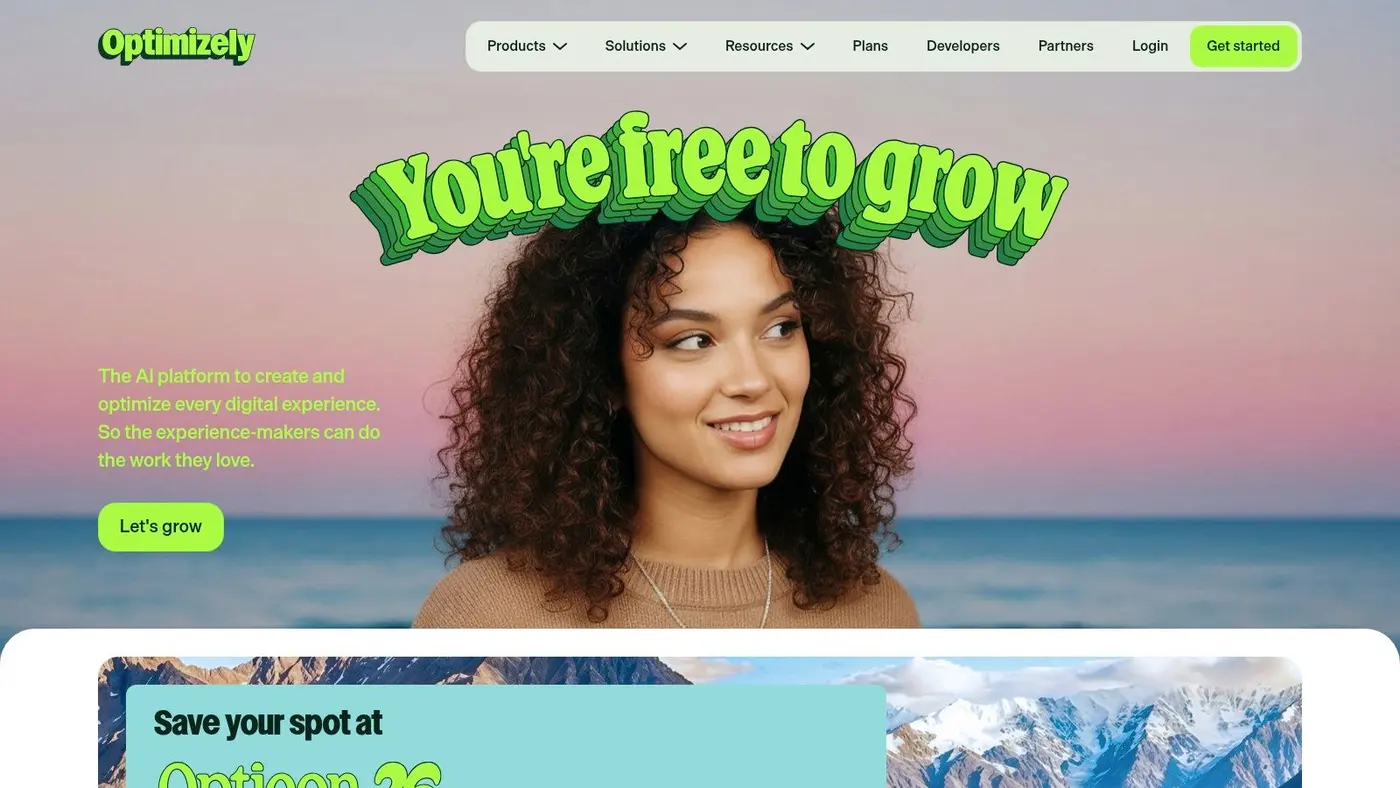
Optimizely Web Experimentation suits organisations that have moved beyond isolated tests and need a managed experimentation programme. It supports visual on-page headline and copy tests, but its more important distinction is the connection between client-side Web Experimentation and server-side Feature Experimentation. That gives product and engineering teams a route to test content without relying exclusively on DOM changes in the browser.
The visual editor makes straightforward headline changes accessible to marketers. More advanced teams can use the REST API, server-side SDKs and workflow controls to integrate testing into existing release processes. Server-side delivery can also reduce the visual flicker risk associated with poorly implemented client-side experiments, which matters on pages where headline changes must appear before the visitor evaluates the content.
Best for governed experimentation
Optimizely's advantage is operational maturity. Multiple teams can work within a governed programme, share results and use APIs rather than treating the platform as a standalone visual editor. Enterprise support and documentation are valuable where experimentation affects several brands, markets or product surfaces.
The trade-off is cost and implementation effort. Pricing is custom-quoted and typically positioned at a premium, so a small site testing a few headlines may struggle to justify the platform. Client-side tests also need careful implementation if the team wants to avoid flicker and performance problems.
Sample-size planning is essential rather than optional. Teams should use a documented sample size calculation method before launch, particularly because broader experimentation evidence found that 17.4% of tests produced a winning variant and 35.8% were inconclusive in a large study covering 2023 to 2026. Those figures come from the supplied UK-relevant statistical baseline and show why Optimizely's governance features matter more than a simple “winner” label.
Choose Optimizely when the organisation needs experimentation across web and product experiences, has engineering support and can absorb custom commercial terms. It isn't the efficient choice for a single WordPress site or a landing-page campaign.
3. VWO Testing
VWO Testing is designed for CRO teams that want headline experimentation and behavioural analysis in one workflow. Its visual editor lets marketers change page copy without waiting for a developer, while the code editor supports more controlled implementations. Headline tests can sit alongside A/B, split-URL and multivariate experiments, with audience targeting and scheduling rules available for more specific use cases.
The most useful differentiator is the connection between test results and interaction analysis. Integrated heatmaps and clickmaps can show whether a winning headline changes attention or merely shifts clicks around the page. That doesn't prove why a variant won, but it gives CRO teams more context than conversion data alone.
Where the all-in-one model helps
VWO works well when the same team owns hypothesis creation, test deployment and post-test analysis. A marketer can test a headline, inspect engagement patterns, and use those observations to formulate a follow-up test without stitching together several products.
Its public plan and pricing structure offer more visibility than fully quote-based enterprise suites, although the final cost depends on modules and traffic. Enterprise tiers can become expensive, particularly when a team wants testing, behavioural insight and additional optimisation capabilities together.
The principal risk is analytical overreach. Heatmaps and clickmaps are diagnostic tools, not substitutes for a properly designed experiment. The UK government guidance recommends setting a hypothesis and selecting sample size and duration based on expected change and monthly visitors, so a VWO user should establish the decision rule before opening the visual editor.
VWO is a sensible choice for a dedicated CRO team that values integrated insights. It has more depth than a basic headline plugin, but its broader suite may be unnecessary if the only requirement is changing one page title and measuring a single conversion event.
4. AB Tasty
AB Tasty is a European experimentation and personalisation suite with a strong fit for organisations operating across the UK and wider European market. It handles client-side A/B and multivariate tests, audience targeting, segmentation and personalisation rules. Headline testing is therefore part of a wider experience optimisation system rather than a standalone copy utility.
Its privacy and GDPR resources are relevant for teams that need a clear process around data handling, consent and governance. UX analytics options, including heatmaps and session recordings, can help teams investigate how headline changes affect subsequent behaviour. Personalisation rules also allow a team to tailor messages to defined audiences rather than relying only on one global winner.
A fit for mature European teams
AB Tasty's UK presence and enterprise support make it attractive to larger marketing and digital teams that need a vendor familiar with regional privacy expectations. It can support headline tests, but its value increases when the organisation also plans to use personalisation and broader UX experimentation.
Pricing is quote-based and generally premium. Implementation can require more planning than an SMB-focused tool, especially when several teams share audiences, environments and approval processes. That governance is helpful for a large digital estate, but it can slow a small team's first experiment.
The platform is best for teams that see headline testing as one component of experience management. If the business only needs quick copy tests on a low-complexity site, the additional workflow and commercial overhead may outweigh the benefit. If the business needs controlled experimentation across markets, audiences and personalisation rules, AB Tasty is more proportionate.
5. Convert Experiences
Convert Experiences, also known as Convert.com, is aimed at CRO specialists and agencies that want a focused testing platform without adopting a broad personalisation suite. It supports A/B, split-URL, multivariate and multipage experiments, with frequentist z-test reporting for teams that prefer a conventional statistical framework.
Headline delivery is a central consideration. Convert emphasises flicker-free delivery through SmartInsert and positions performance as part of the testing workflow. That matters because a headline test can undermine its own validity if the original appears briefly before the variant, or if the testing script creates a noticeable delay.
A practical agency option
Convert uses an MTU-based billing model focused on tested users. Pricing is listed as price on request and typically requires an annual quote, so buyers need to clarify how tested traffic is counted before comparing it with visitor-based or flat-rate plans. A 15-day free trial is available, according to the supplied product information.
The platform's focused workflow may appeal to agencies managing several client programmes. Clear documentation and an agency ecosystem can reduce repeat implementation work, while GA4 or another analytics platform can provide the broader behavioural and revenue context that Convert doesn't bundle as extensively as an all-in-one suite.
Choose Convert when delivery performance, privacy-conscious CRO and experiment control matter more than built-in personalisation. It is less suitable for teams that want one platform to manage cross-channel journeys, advanced audience activation and enterprise-wide customer profiles.
6. Kameleoon
Kameleoon combines web experimentation, personalisation and full-stack delivery. That combination gives it a useful position between a visual CRO platform and an engineering-led experimentation system. Marketers can create headline and message tests through web tooling, while developers can use SDKs and server-side methods for experiences that shouldn't wait for browser rendering.
AI-powered targeting and personalisation can help teams identify audiences for differentiated messaging. The benefit isn't just generating more headline variants. It lies in testing whether different propositions work better for defined customer groups, provided the team has a sound audience strategy and enough traffic to support those comparisons.
Balancing marketer access and engineering control
Kameleoon's European base, privacy focus and enterprise integrations make it relevant to regulated or privacy-sensitive organisations. Its web and full-stack options also reduce the need to select a separate platform when experimentation expands from headlines to product features.
The cost is complexity. Exact public pricing is rarely listed, and the platform is oriented around monthly unique users, so buyers should request a clear explanation of audience counting, environments, integrations and support. A sales cycle is likely, particularly for enterprise deployment.
Kameleoon makes sense for a product or digital team that expects its experimentation programme to grow. For a small publisher or single-site retailer testing a few headlines, it may be more platform than the immediate problem requires. For an organisation that needs both visual editing and server-side governance, the additional capability can justify the effort.
7. Dynamic Yield
Dynamic Yield is built for enterprise personalisation, particularly across complex retail and quick-service journeys. Headline A/B testing is one use case within a system that can coordinate experiences across web, mobile, email and kiosks. That breadth changes the buying question. The platform isn't primarily competing with lightweight headline tools on ease of setup. It is competing as a decisioning and personalisation layer for large customer journeys.
The platform supports A/B/n testing through client-side and server-side deployment paths. Server-side delivery is important where teams need to avoid flicker or coordinate content with application logic. Predictive targeting suggestions and Personalisation Opportunities can guide teams towards segments and follow-up tests rather than leaving every hypothesis to manual analysis.
The value depends on scale of ambition
Dynamic Yield's pricing is enterprise and quote-only. The platform is unlikely to be economical for a team that only wants to compare two headlines on one landing page. Its strongest case is an organisation that will use personalisation, cross-channel orchestration and predictive targeting across a substantial digital estate.
That also creates a governance burden. Teams need clear ownership for audience definitions, campaign conflicts, measurement and approval. Without those controls, a headline test can become one more competing rule in a crowded personalisation environment.
Select Dynamic Yield when the headline is part of a wider cross-touchpoint optimisation programme. If the test begins and ends on one page, a focused platform will usually be easier to deploy, govern and evaluate.
8. Adobe Target
Adobe Target is a high-capability experimentation and personalisation product for organisations already invested in Adobe Experience Cloud. It supports A/B testing, multivariate testing, rules-based allocation and automated allocation, with visual editing for common web use cases. API and server-side options extend testing into performance-sensitive and application-led experiences.
The Adobe integration is the central reason to consider it. Teams using Adobe's wider analytics, audience and experience stack can connect headline experiments to existing governance and customer data workflows rather than creating a separate optimisation island. That can be valuable across large digital estates where access controls, approval processes and reporting standards already exist.
Powerful, but rarely lightweight
Visual Target Standard supports a visual workflow, while Adobe also provides one-line site library deployment guidance for suitable implementations. That doesn't make the overall project simple. Integrations, data governance, tagging and internal ownership can take more effort than a small marketing team expects from a headline test.
Pricing is custom-quoted and enterprise-oriented. Implementation is heavier than with SMB-focused tools, but that burden can be justified where the business already operates Adobe Experience Cloud and needs consistent governance.
Adobe Target is a rational choice for large organisations with Adobe expertise, complex audiences and a need for server-side or automated allocation. It isn't the obvious first purchase for a small team that hasn't yet validated its testing process.
9. Unbounce
Unbounce is a landing-page platform with built-in A/B testing and Smart Traffic. Its appeal is operational simplicity. A marketer can build a landing page, create headline variants and launch the experiment without asking a development team to modify the main website.
Classic A/B testing provides a controlled comparison between variants. Smart Traffic takes a different approach by using AI to route visitors towards the version it predicts is most likely to convert. That can help a team seeking ongoing optimisation rather than a fixed, evenly split experiment, but it also changes how results should be interpreted and documented.
Strongest for campaign-led teams
Unbounce is best suited to landing pages, paid media campaigns and lead-generation journeys. It isn't a replacement for full-site experimentation across a complex product or commerce application. Teams wanting to test headlines on existing product templates may need another platform.
The no-developer path is its main advantage. A campaign team can move from copy draft to live test quickly, then use its landing-page workflow to iterate. A useful companion is this guide to writing better headlines, which can help teams produce meaningful variants instead of superficial wording changes.
Unbounce offers a 14-day free trial and multiple plan tiers, according to the supplied product information. Pricing scales with features and traffic, so buyers should compare the plan's limits with their campaign volume and page requirements. For teams creating pages designed to write headlines that drive calls, Unbounce is often easier to justify than an enterprise suite. It becomes less suitable when the organisation needs server-side delivery, revenue-per-visitor analysis or experimentation across its core application.
10. Nelio A/B Testing
Nelio A/B Testing is the most natural choice for teams that work primarily in WordPress. It runs inside the WordPress administration area and supports tests for page and post headlines, copy and themes. WooCommerce users can also test product names, images and pricing, which gives small online retailers a route from headline experimentation into product-page optimisation.
The native integration reduces setup overhead. A WordPress team doesn't need to introduce a separate visual platform or manage an external experimentation workflow for basic tests. That makes Nelio useful for agencies responsible for several WordPress sites, particularly when clients need results presented in familiar terms.
The trade-off is platform scope
Nelio offers a free plan with limited tested pageviews and one active test, based on the supplied product information. That creates a low-risk starting point for a small site, although teams should check current limits before committing to a wider programme.
The plugin isn't designed for non-WordPress stacks, cross-channel personalisation or enterprise full-stack experimentation. Its feature depth is lighter than Optimizely, Adobe Target or Dynamic Yield, but that isn't necessarily a weakness for its intended audience. A WordPress content team may value direct administration and low implementation friction more than an extensive governance layer.
Choose Nelio when the CMS is WordPress, the test scope is local to the site and the team wants a straightforward entry point. Move to a broader platform when experiments span multiple frameworks, products, channels or revenue systems.
Top 10 Headline Testing Tools, Feature Comparison
| Tool | Core features ✨ | Performance & quality ★ | Business impact & analytics 💰 | Target audience 👥 | Price & USP 💰✨ |
|---|---|---|---|---|---|
| Otter A/B 🏆 | Revenue-first A/B, unlimited variants, z-test + optional Bayesian, bandits ✨ | 9KB SDK <50ms, zero flicker, 99.9% uptime ★★★★★ | Tracks conversion, AOV, revenue/visitor; decision-ready reports 💰 | 👥 Growth marketers, e‑commerce, product/UX, front‑end, agencies | 💰 From $39/mo; 14‑day free trial, 🏆 Lightweight, revenue‑focused & fast |
| Optimizely Web Experimentation | Client & server-side tests, visual editor, REST API, governance ✨ | Server‑side SDKs reduce flicker; enterprise reliability ★★★★ | Advanced experiment workflows & reporting for large programs 💰 | 👥 Enterprises, multi‑team orgs, engineering-led programs | 💰 Custom/enterprise pricing; ✨ Mature ecosystem & support |
| VWO Testing (Visual Website Optimizer) | WYSIWYG editor, A/B/MVT, heatmaps & clickmaps, targeting ✨ | Usable UI with integrated insights; low friction ★★★★ | All‑in‑one testing + behavioral insights for CRO teams 💰 | 👥 CRO teams, mid‑market marketers | 💰 Plan-based pricing; ✨ Integrated heatmaps + testing |
| AB Tasty | A/B, MVT, personalization, UX analytics, GDPR resources ✨ | EU privacy posture; enterprise-grade performance ★★★★ | Personalization + testing tailored for EU/UK compliance 💰 | 👥 EU/UK enterprises, privacy‑sensitive brands | 💰 Quote-based; ✨ GDPR-focused personalization |
| Convert Experiences | A/B/MVT, frequentist reporting, SmartInsert flicker-free delivery ✨ | Performance-first, flicker-free emphasis ★★★★ | Streamlined testing workflow; lighter analytics (integrates with GA4) 💰 | 👥 CRO pros, agencies, performance-minded teams | 💰 MTU-based/quote; ✨ Privacy-forward & speed-focused |
| Kameleoon | Web & full‑stack testing, AI targeting, SDKs, personalization ✨ | EU vendor, balanced visual + SDK options ★★★★ | AI-driven targeting + personalization for revenue uplift 💰 | 👥 Regulated brands, enterprises, engineering + marketing | 💰 Quote-based; ✨ AI targeting & full‑stack capabilities |
| Dynamic Yield | A/B/n, predictive targeting, server & client deploy, cross‑channel ✨ | Enterprise scale, server‑side available to avoid flicker ★★★★ | Strong personalization & cross‑touchpoint orchestration for commerce 💰 | 👥 Large retailers, QSRs, enterprise commerce teams | 💰 Enterprise pricing; ✨ Predictive personalization & orchestration |
| Adobe Target | A/B, MVT, auto‑allocate, server API, Adobe Cloud integration ✨ | Robust but heavyweight; server options for performance ★★★★ | Deep Adobe integration → governance & cross‑product insights 💰 | 👥 Adobe Experience Cloud customers, large digital estates | 💰 Quote-only; ✨ Tight Adobe ecosystem integration |
| Unbounce (Landing Pages + A/B + Smart Traffic) | Visual landing builder, classic A/B, Smart Traffic AI routing ✨ | No‑developer path; fast to ship headline tests ★★★★ | AI routing accelerates wins on landing pages; conversion‑focused 💰 | 👥 Marketers, SMBs, agencies focused on landing pages | 💰 Tiered plans; ✨ Smart Traffic AI for faster learning |
| Nelio A/B Testing (WordPress) | Native WP plugin, page/post & WooCommerce tests, runs in WP admin ✨ | Lightweight for WordPress; easy setup ★★★ | Good for small WP shops; limited enterprise features 💰 | 👥 WordPress sites, small teams, agencies | 💰 Free tier available; ✨ Native WordPress integration |
Match the Platform to Your Experimentation Reality
The right headline testing tool depends on the operational constraint that matters most. A small team with a WordPress site doesn't need the same system as a retailer coordinating web, app and email personalisation. A product team testing backend messaging needs different delivery controls from a paid-media manager building a campaign landing page.
For lightweight deployment, broad CMS coverage, revenue-aware reporting and transparent pricing, Otter A/B is the most balanced option in this comparison. Its low-impact SDK, visual workflow and integrations make it practical for growth marketers, e-commerce teams and agencies. Its revenue, AOV and revenue-per-visitor views also address a common weakness in headline testing, conversion rate can improve while commercial value falls. The platform is still primarily client-side, so teams needing deep full-stack feature flags should plan for complementary engineering tooling.
Nelio A/B Testing is the logical WordPress-first choice. It keeps the workflow inside WordPress and extends into WooCommerce product testing, with a free starting tier. Unbounce is better when the business runs campaign-specific landing pages and wants marketers to ship without developer involvement. Its Smart Traffic option is particularly relevant to teams seeking adaptive routing, although those teams should document how the optimisation method affects decision-making.
For performance-conscious CRO teams and agencies, Convert Experiences offers a focused alternative with flicker-conscious delivery and conventional z-test reporting. VWO is more appropriate when heatmaps, clickmaps and testing belong in the same CRO workflow. The choice between them is less about headline generation and more about whether behavioural diagnostics justify a broader suite.
Enterprise buyers should be more selective. Optimizely fits mature programmes that need web and server-side experimentation, APIs and governance. AB Tasty suits European organisations combining testing with personalisation and privacy processes. Kameleoon is a strong candidate where web and full-stack experimentation must coexist. Dynamic Yield earns consideration when personalisation spans multiple channels and the team will use predictive targeting. Adobe Target is most defensible when Adobe Experience Cloud already forms the organisation's digital foundation.
Traffic should shape the decision before feature comparisons do. A large study covering 2023 to 2026 found that the median test needed 14,800 sessions per variation to detect a 5% minimum detectable effect on a 3% baseline conversion rate, at 95% confidence and 80% power. The supplied UK research also reports that headline and copy tests won in only 17.4% of 412 tests, while 74.2% were inconclusive or showed no detectable difference. Those findings don't make testing pointless. They make weak samples, tiny expected effects and premature stopping expensive.
Site performance deserves equal attention. In 2025, Core Web Vitals pass rates were reported at 48% for mobile and 56% for desktop, and UK CRO guidance notes that many Shopify stores receive 5,000 to 15,000 monthly visitors, while detecting a realistic 5% to 10% lift may require about 15,000 visitors per variant at 95% confidence. These figures come from the supplied UK web-design source. If a testing script slows the page or creates flicker, fix delivery quality before interpreting a marginal headline result.
Start with one primary business goal, verify the event or purchase tracking, and define the detectable change you care about. Check whether pricing is based on visitors, MTUs, modules or a custom quote. Then run a controlled test with a clear control, record the decision rule and document why the team shipped, rejected or extended the result. The best platform is the one your team can deploy cleanly, measure effectively and use repeatedly.
Otter A/B gives teams a lightweight way to test headline variants while tracking conversions, average order value and revenue per visitor, with integrations across platforms including Shopify, WordPress, Webflow and Google Tag Manager. Visit Otter A/B to start a free trial and connect your next headline experiment to a business outcome, not just a click count.
Stop guessing
Ready to start testing?
Set up your first A/B test in under five minutes. No credit card required.
- 14-day free trial
- No credit card required
- Cancel anytime