How to Write Better Headlines a Practical Playbook for 2026
Learn how to write better headlines that convert. Our step-by-step playbook covers formulas, A/B testing, and optimisation for higher engagement.
You wrote a headline that looked sharp in the draft doc. It got clicks. The campaign report even gave you a brief lift in traffic. Then the harder numbers came in. Bounce was high, add-to-cart was flat, demo requests barely moved, and sales asked why the leads were weak.
That gap is where most headline advice breaks down.
Good headline writing isn't about squeezing curiosity until people click. It's about matching promise to intent, then carrying that intent into the next action. If you're serious about learning how to write better headlines, start by judging them the way a conversion team does. Not by applause, but by what happens after the click.
Beyond Clicks Why Most Headlines Fail to Convert
A headline can win the click and still lose the sale.
That usually happens when the line is built to create excitement, but not trust. The wording pulls in broad interest, vague curiosity, or the wrong audience entirely. The click looks cheap and efficient. The fallout shows up later in poor lead quality, abandoned carts, and frustrated stakeholders.
In the UK market, 60% of e-commerce visitors abandon carts after reading a headline that overpromises, 72% of shoppers distrust headlines with emotional exaggeration, and headlines that score higher on accuracy and relevance drive 28% more qualified leads. Those numbers change the job description. The headline isn't there to entertain. It's there to pre-qualify.
What weak headlines usually do
A poor-performing headline often has one of these problems:
- It promises too much: “Transform your business overnight” attracts attention but creates doubt.
- It hides the offer: clever wording forces readers to decode the message.
- It attracts the wrong intent: broad curiosity pulls in readers who were never likely to buy.
- It creates friction after the click: the landing page says one thing, the headline said another.
A high CTR with weak downstream conversion usually means the headline made the wrong promise to the wrong person.
This is why headline work can't sit in isolation from the rest of the funnel. Social posts, ads, emails, and landing pages need a shared message spine. If your team publishes regularly on LinkedIn, a practical LinkedIn posting strategy is useful because it forces message discipline before distribution starts.
The real metric is intent quality
The strongest headlines do something subtler than “grab attention”. They help the reader self-select.
That means a buyer should know, within a second or two, what the offer is, who it's for, and why it matters now. If the right people click slightly less often but convert more often, that headline is better. This point warrants repeating, as vanity metrics are seductive and conversion friction is quieter.
Use this standard instead:
- Traffic quality over raw volume
- Qualified leads over empty clicks
- Revenue movement over CTR alone
If a headline makes your analytics dashboard look busy but your checkout, pipeline, or sign-up flow stays cold, it isn't a strong headline. It's expensive decoration.
The Anatomy of a High-Converting Headline
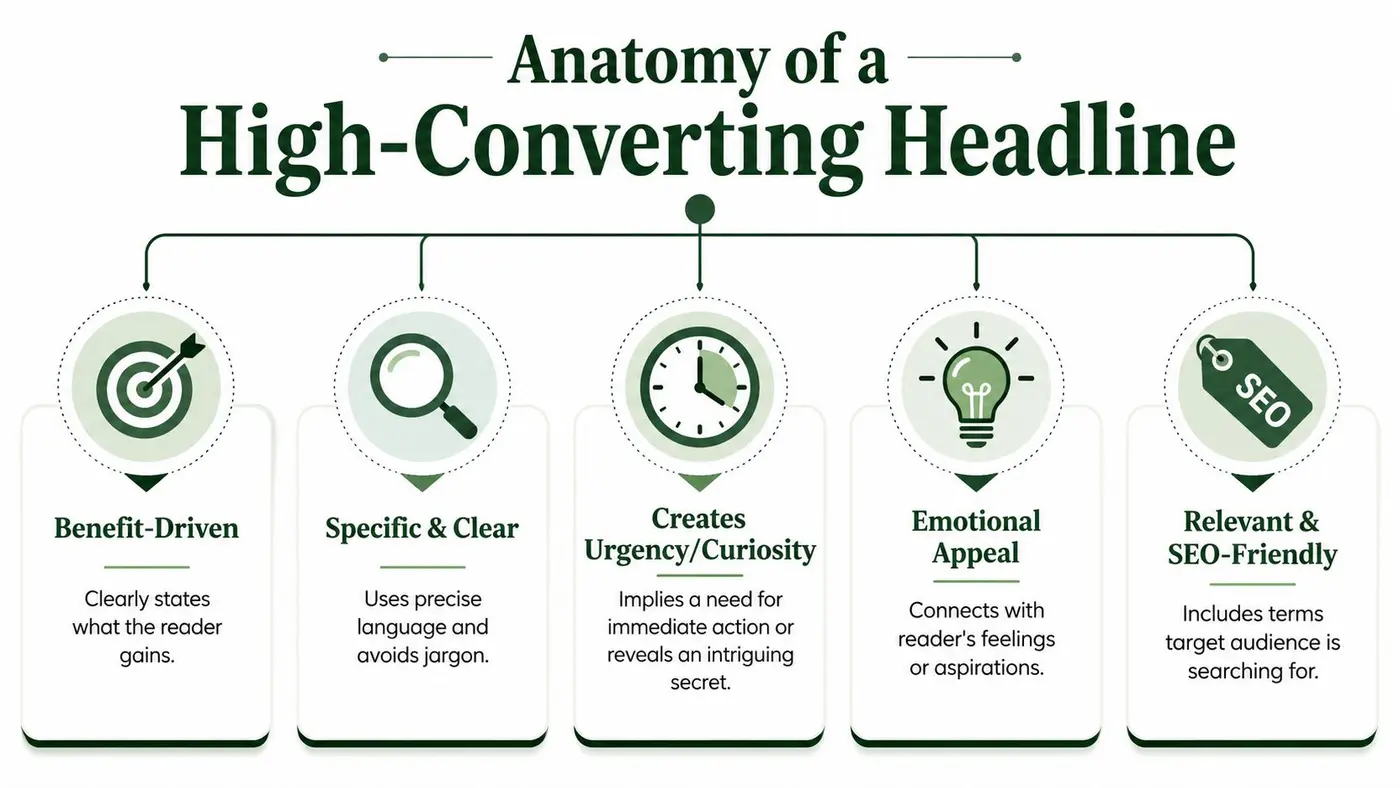
Most conversion-focused headlines are built from the same few parts. Not formulas in the cheesy sense. Functional components that reduce uncertainty and increase intent.
In UK publishing, digital attention has become harsher because news consumption has shifted heavily away from traditional channels. Print readership fell from 59% to 12% over 12 years, which means headlines now compete in fast-scrolling environments where comprehension has to happen instantly, as shown in the Reuters Institute UK digital news report. That same source also notes BBC style guidance that supports quick scanning, including the use of numerals below 10 in headlines while avoiding headlines that begin with digits.
Value first
The headline should answer one silent question immediately: “What do I get if I keep going?”
Weak:
- Better Marketing Results
Stronger:
- Cut Wasted Ad Spend With Clearer Offer Messaging
The second version names the benefit. It doesn't ask the reader to infer value.
Specificity beats blur
Specific language lowers resistance because it feels testable. General language feels padded.
Compare these:
| Version | Problem |
|---|---|
| Improve Your Website Fast | Too broad, no clear outcome |
| Fix the 3 Homepage Messages Blocking Demo Requests | Concrete and easier to believe |
Specificity doesn't always require a number. It can come from audience, outcome, timeframe, or mechanism. But when a precise number is real and relevant, use it.
Clarity outranks cleverness
Clever headlines often underperform because they make the reader work. That problem is worse on mobile, in ad previews, and in social feeds where attention is already fragmented.
Practical rule: if a new reader needs context to understand the headline, the headline is doing too little work.
This is also where headline and page strategy meet. Teams that are tightening headline clarity should review how the promise continues on-page. A useful companion read is this guide to optimizing landing pages for 2026, especially if your pages are getting traffic but not enough action.
Tension matters, but trust matters more
A high-converting headline usually carries some momentum. It may suggest urgency, consequence, or a meaningful gap the reader wants to close. But it can't slip into melodrama.
Useful tension:
- Why Your Pricing Page Gets Visits but Few Buyers
Unhelpful tension:
- The Shocking Pricing Mistake Destroying Your Business
One creates curiosity anchored in a real business problem. The other feels inflated.
A quick five-part check
Before approving a headline, run it through this checklist:
- Benefit: Is the outcome visible?
- Audience fit: Will the right reader know it's for them?
- Specificity: Is there at least one concrete detail?
- Clarity: Can it be understood on first read?
- Alignment: Does the page deliver exactly what the headline implies?
Miss one and you may still get clicks. Miss two and conversion usually slips.
Proven Headline Formulas and Ideation Techniques
When a team says they “can't think of a headline”, the underlying problem is usually that they're trying to invent one perfect line too early.
A better approach is to generate structured options. In UK digital content, using specific numbers and recency indicators can lift engagement by 22%, while avoiding label heads can prevent a 31% drop in organic traffic, according to this headline testing reference. That gives you two practical rules straight away. Use concrete framing where it helps, and don't write static noun phrases that say nothing active.
Swipe file of formulas that keep working
Below is a compact set of starting structures. Treat them as prompts, not templates to copy blindly.
| Formula Type | Structure | Example | Best For |
|---|---|---|---|
| How-to | How to achieve outcome without obstacle | How to Write Better Headlines Without Sounding Like Clickbait | Educational content, search-driven pages |
| Numbered list | Number + audience/problem + outcome | 7 Homepage Headline Fixes for SaaS Teams With Low Demo Conversion | Blog posts, lead magnets |
| Direct benefit | Verb + desired result | Increase Qualified Leads With More Accurate Ad Headlines | Landing pages, paid traffic |
| Question | Question tied to a business pain | Why Are Visitors Clicking but Not Buying? | Retargeting, mid-funnel content |
| Comparison | Option A vs Option B + decision angle | Clear Headlines vs Clever Headlines for Product Pages | Decision-stage readers |
| Mistake-based | Number + mistakes + consequence | 5 Headline Mistakes That Weaken Purchase Intent | Audits, expert content |
When to use which
Different headline types suit different buyer states.
- How-to headlines work when the reader already knows the problem and wants a method.
- Numbered lists work when scannability matters and the content is structured.
- Direct benefit headlines are strong on pages close to conversion because they minimise ambiguity.
- Question headlines work best when the question mirrors a real frustration the reader already feels.
A label head does none of this. “Headline Tips”, “Conversion Guide”, or “Marketing Insights” gives the reader no reason to continue.
A practical ideation routine
Use this sequence when you're stuck:
- Write the plain-English version first. State the offer with zero flair.
- Add the business outcome. Revenue, demos, qualified leads, lower waste.
- Add one concrete anchor. A number, audience, channel, or timeframe.
- Turn the line into four variants. Benefit-led, question-led, list-led, and problem-led.
If you want a fast starting point, this headline generator is useful for pressure-testing angles before you refine them by hand.
Good formulas don't replace judgement. They give judgement something solid to edit.
The strongest teams rarely pick the first idea. They force variety, then select from options that express different promises.
From Raw Ideas to Test-Worthy Candidates
Headline generation is easy compared with headline selection. A list of 20 ideas feels productive. Usually, only a few are worth exposing to live traffic.
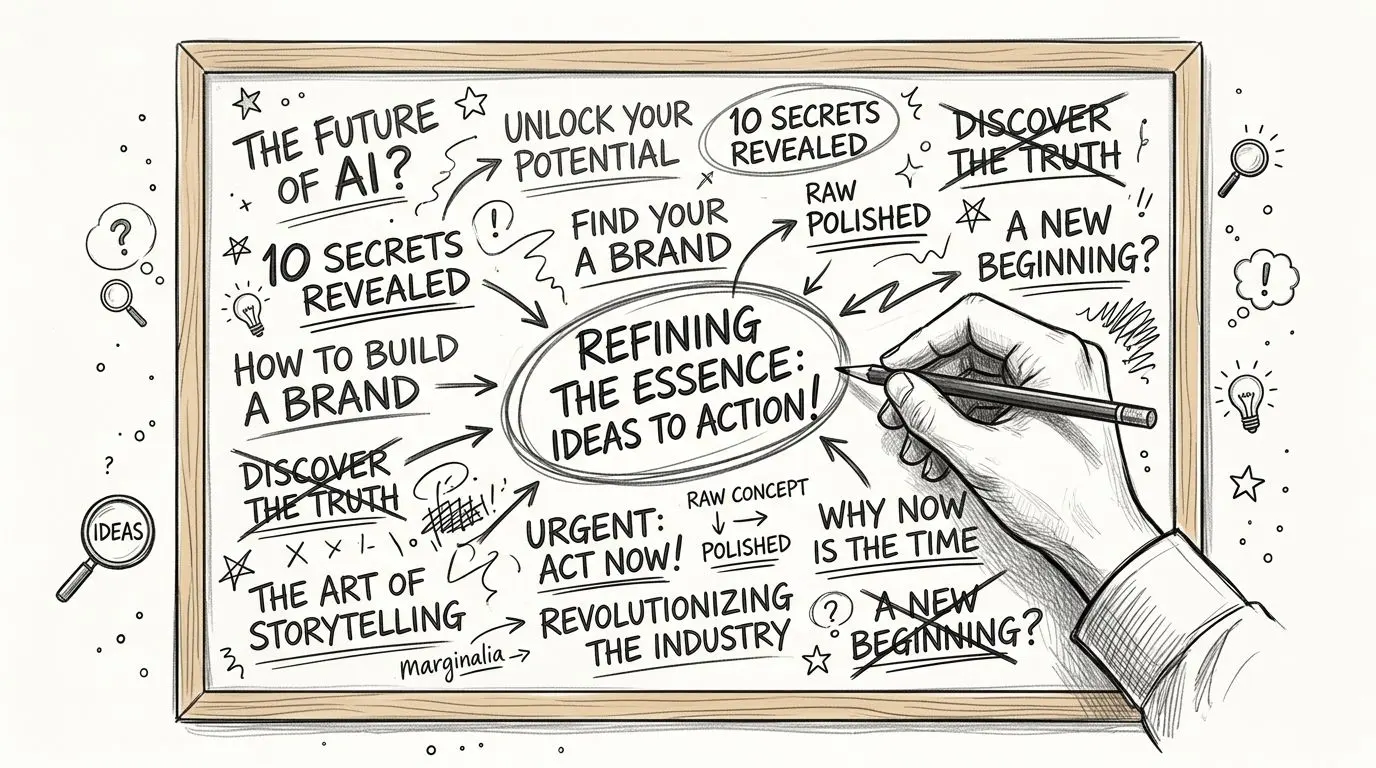
The most reliable filter is customer language. Reviews, live chat logs, support tickets, sales notes, product feedback, and call transcripts all reveal how buyers describe the problem in their own words. Those phrases often outperform polished internal terminology because they carry the customer's actual stakes.
Mine language, not adjectives
Look for recurring phrasing such as:
- “hard to justify”
- “takes too long”
- “not sure what's included”
- “feels generic”
- “we're getting clicks but poor leads”
Those fragments often belong in or near the headline because they mirror intent more accurately than abstract copy terms like “game-changing”, “revolutionary”, or “cutting-edge”.
Review competitors without copying them
Competitor research matters, but not for inspiration in the usual sense. Use it to find blind spots.
Scan category pages, ads, comparison pages, and organic titles. Then ask:
- What promise appears everywhere?
- What buyer concern is nobody naming?
- Which headlines sound interchangeable?
- Where is everyone relying on hype instead of specificity?
If your category is flooded with performance claims, a calmer and more precise headline can stand out because it sounds more credible.
Tools can speed up the collection phase. When teams are producing multiple ad and creative directions, a workflow tool like the ShortGenius AI ad creative tool can help surface angle variations faster, especially before human review tightens the message.
Score before you test
Don't send every idea into an experiment. Shortlist first with a simple review grid.
| Criterion | What to ask |
|---|---|
| Clarity | Can a cold reader understand it instantly? |
| Relevance | Does it speak to the buyer's real problem? |
| Specificity | Is there a concrete detail or outcome? |
| Intent match | Does it attract likely buyers, not just curious readers? |
Use the grid in a working session with marketing, sales, or product. Not to chase consensus, but to catch misalignment before traffic hits the page.
The best test candidates are rarely the flashiest. They're the lines your best-fit buyer recognises as true.
Once you have three or four strong candidates, stop writing more and start validating.
Validating Your Headlines with A/B Testing
At some point, opinion has to give way to evidence.
A headline review meeting can improve weak copy, but it can't tell you which promise produces more purchases, stronger leads, or better downstream engagement. Live behaviour does that. The UK Government Analysis Function says titles should clearly state the main points, provide context, and remain neutral in statistical communication, as outlined in its guidance on writing about statistics. A/B testing is how you check whether your audience experiences that clarity.
What to measure first
CTR can be useful, but it isn't enough on its own.
If your headline sits on an ad, email, social post, or search result, click-through is only the first checkpoint. True judgement should happen closer to business value.
Pick one primary metric such as:
- Add to cart
- Demo request
- Checkout completion
- Qualified lead submission
- Purchase value
Then track secondary metrics to spot side effects. A headline might lift clicks while lowering average order quality, or it might reduce clicks but improve conversion efficiency.
Keep the test clean
A clean headline test changes one variable. Not the hero image, not the CTA, not the page structure. Just the headline.
That matters because mixed changes create false confidence. If variant B wins, you need to know why.
Use a basic test plan:
| Element | Decision |
|---|---|
| Page | Product page, landing page, article, or ad destination |
| Variable | Headline only |
| Variants | Control plus 2 to 4 alternatives |
| Primary goal | One conversion event |
| Secondary goals | Quality and engagement checks |
| Run rule | Continue until sample size is adequate |
If you need help defining adequate traffic before launching, this guide on how to calculate sample size is the right place to start.
Don't call winners too early
Teams ruin good testing discipline by checking results too soon and declaring victory from noise.
A better habit is to predefine what success means before the test starts. What is the primary conversion? What outcome matters if click-through and conversion point in different directions? Who signs off on the winner?
This walkthrough is worth watching if you're building that discipline into your process:
Read the result like a strategist
When the test ends, don't just ask which headline won. Ask why it won.
Did a more precise line reduce weak clicks? Did a benefit-led version improve lead quality? Did a calmer promise outperform a more aggressive one? Those answers become reusable guidance for every future page, ad, and campaign.
Building Your Continuous Optimisation Playbook
Many teams treat headline work as a writing task. The better teams treat it as an operating system.
That means every test, every launch, and every performance review feeds a reusable playbook. One useful discipline is generating at least four distinct headline variants before testing, a method associated with a 14% average CTR increase in UK newsroom A/B tests. The numeric evidence was covered earlier, but the operational lesson matters even more here. Variety improves decision quality before traffic is involved.
What to document every time
After each test or launch, record:
- The audience context: who the page was for and what stage of intent it served
- The headline variants: control plus alternatives
- The core promise: savings, clarity, speed, trust, proof, or convenience
- The outcome: which variant produced the best business result
- The interpretation: what you believe the audience responded to
This becomes your internal swipe file. Not a collection of “winning headlines” in the abstract, but a record of what your buyers trusted.
Build a feedback loop across teams
Strong headline systems borrow language from multiple functions.
Sales hears objections first. Support sees confusion first. Product teams know what changed. Marketers can then turn those inputs into sharper promise statements. That loop matters because audiences don't stay static. Offers evolve, objections shift, and channels reshape how people scan.
A useful checkpoint for planning future tests is this piece on deciding what to A/B test. It helps stop random experimentation and keeps effort focused on the changes most likely to affect conversion.
Document losses as carefully as wins. A discarded angle can save you months of repeating the same mistake.
Keep the playbook alive
Review high-value pages regularly. Refresh old headlines when the offer changes, when a page starts underperforming, or when customer language shifts.
The point isn't constant rewriting. It's deliberate iteration. Teams that learn how to write better headlines usually don't become brilliant overnight. They become systematic.
Frequently Asked Questions About Writing Headlines
A few headline questions come up repeatedly because the right answer depends on context, not taste.
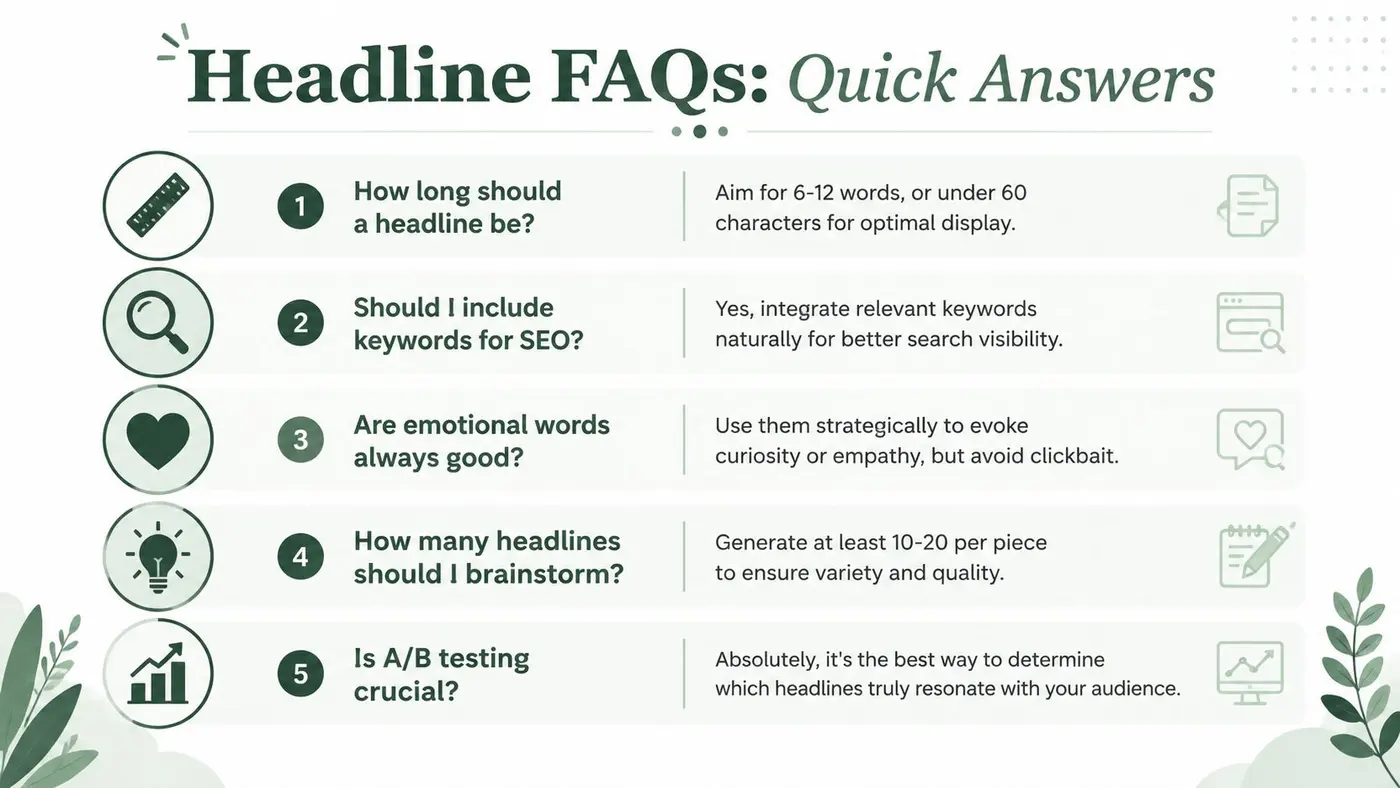
How long should a headline be
Short enough to scan instantly, long enough to carry a real promise.
For UK LinkedIn specifically, length matters a lot. 68% of clicks drop when headlines exceed 60 characters. That's a strong reason to front-load the main value and trim filler. On Facebook, the issue is different. Local relevance matters more because 54% of ad fatigue occurs when headlines lack local specificity. Only 12% of UK marketers report testing headlines by platform, which explains why many campaigns underperform despite solid creative strategy.
Should I write one headline for every platform
No. Adapt the same core promise to the platform.
Use one message spine, then rewrite for format and behaviour:
- LinkedIn: tighter, lower on emotional language, faster to parse
- Facebook: more specific, more contextual, often stronger with local relevance
- Landing pages: clearer and fuller because the user has already committed to the click
Are emotional words always a bad idea
No. Exaggerated emotional language is the problem.
Emotion is useful when it reflects a real buyer state such as frustration, relief, confidence, or urgency. It fails when it sounds theatrical. “Fix confusing pricing” can work. “The unbelievable pricing secret” usually weakens trust.
How many headlines should I brainstorm
Enough to force range.
A practical minimum is to explore several distinct angles before choosing candidates. If every option says the same thing with minor wording changes, you haven't generated alternatives. You've just edited one idea repeatedly.
What should I do if a headline gets clicks but poor conversion
Treat that as diagnostic information, not a creative success.
The headline may be attracting curiosity rather than purchase intent. Tighten the promise, add specificity, remove inflation, and check that the landing page delivers exactly what the headline implies.
If you want to turn headline decisions into measurable conversion gains, Otter A/B gives teams a fast way to test variants on real pages and judge them by outcomes that matter, including leads, purchases, and revenue rather than clicks alone.
Stop guessing
Ready to start testing?
Set up your first A/B test in under five minutes. No credit card required.
- 14-day free trial
- No credit card required
- Cancel anytime