Your Guide to a Release Management Job in 2026
Looking for a release management job? Our 2026 guide covers the role, skills, salary, and career path for this critical DevOps function. Learn how to get hired.
You're probably closer to a release management job than you think.
A lot of engineers first notice the role when a deployment goes wrong. A feature ships with the wrong config. A database change lands before the app is ready. Support starts escalating. Product wants answers. Security wants an incident trail. Developers want to roll back, but nobody agreed on the trigger or the sequence. What looked like “just a deployment” turns into a business event.
That's where release management stops being admin work and starts looking like leadership.
The modern Release Manager isn't just the person who schedules releases and chases approvals. They sit in the middle of delivery, risk, coordination, and increasingly, experimentation. They need to help teams move fast without creating a mess in production. They also need to understand that a release doesn't matter only because it was stable. It matters because it changed something for users and the business.
The Unsung Hero of Software Delivery
Release day often looks calm right up until it does not.
A feature flag is set to 100% instead of 10%. The database migration completed, but the app servers are still running the old code. Support starts seeing payment errors before engineering sees the alert. Product asks whether the A/B test should be paused. Marketing wants to know if the campaign has to be pulled. Nobody made one huge mistake. The release failed because ownership of the full path was fragmented.
That is why strong release management has real weight inside modern delivery teams. The job is to hold the whole release picture at once. Technical readiness, rollback paths, timing, approvals, communications, business exposure, and customer impact all have to line up. A reliable release process feels almost boring on launch day.
That quiet outcome takes work. It also takes judgement. Teams want faster deployment, smaller batches, and room to experiment. The business wants governance, auditability, and predictable service. A good Release Manager handles that tension instead of picking one side. They help teams ship quickly with feature flags, staged rollouts, and clear guardrails, rather than slowing everything down with process for its own sake.
If you are coming from engineering or delivery, it helps to understand the wider SDLC and Agile delivery flow, because release management sits across those handoffs rather than inside a single team.
Stability is necessary, but it is not the whole job
A lot of job descriptions still frame the role around release calendars, change control, and production safety. Those are real responsibilities. They are also only half the job.
Modern releases often include experiments. A checkout change might be behind a flag for 5% of traffic. A new onboarding flow might be tested in one market first. A pricing change might be technically safe and still be commercially risky. Release managers who only ask whether the deployment succeeded miss the harder question. Did the release behave as intended for users, support teams, and the business?
That wider view is one reason the role has become more strategic.
The role is becoming more strategic
The old stereotype is a gatekeeper with a checklist. The stronger version is a coordinator who can apply controls without blocking useful change.
In practice, that means asking questions like these:
- What exactly is changing? Code, config, infrastructure, data, or experiment logic all carry different risks.
- Who is exposed first? Internal users, one customer segment, one region, or the full production base.
- What is the recovery path? Rollback, roll forward, feature flag disable, traffic shift, or manual mitigation.
- What else depends on this release? Campaigns, customer communications, support runbooks, finance events, or compliance deadlines.
- How will we judge success? System health is part of it. User behaviour and business impact matter too.
That combination of delivery discipline and commercial awareness is what makes the role valuable. In healthy teams, the Release Manager is the person who helps speed and control coexist.
What Is a Release Manager Really
The easiest way to explain the role is this. A Release Manager is the air traffic controller for software.
Developers are building and refining features. QA is checking whether those changes behave as expected. Operations is making sure environments, infrastructure, and observability are ready. Product is trying to hit a market window. Security and compliance are watching for process risk. The Release Manager doesn't replace any of them. They coordinate the safe movement between them.
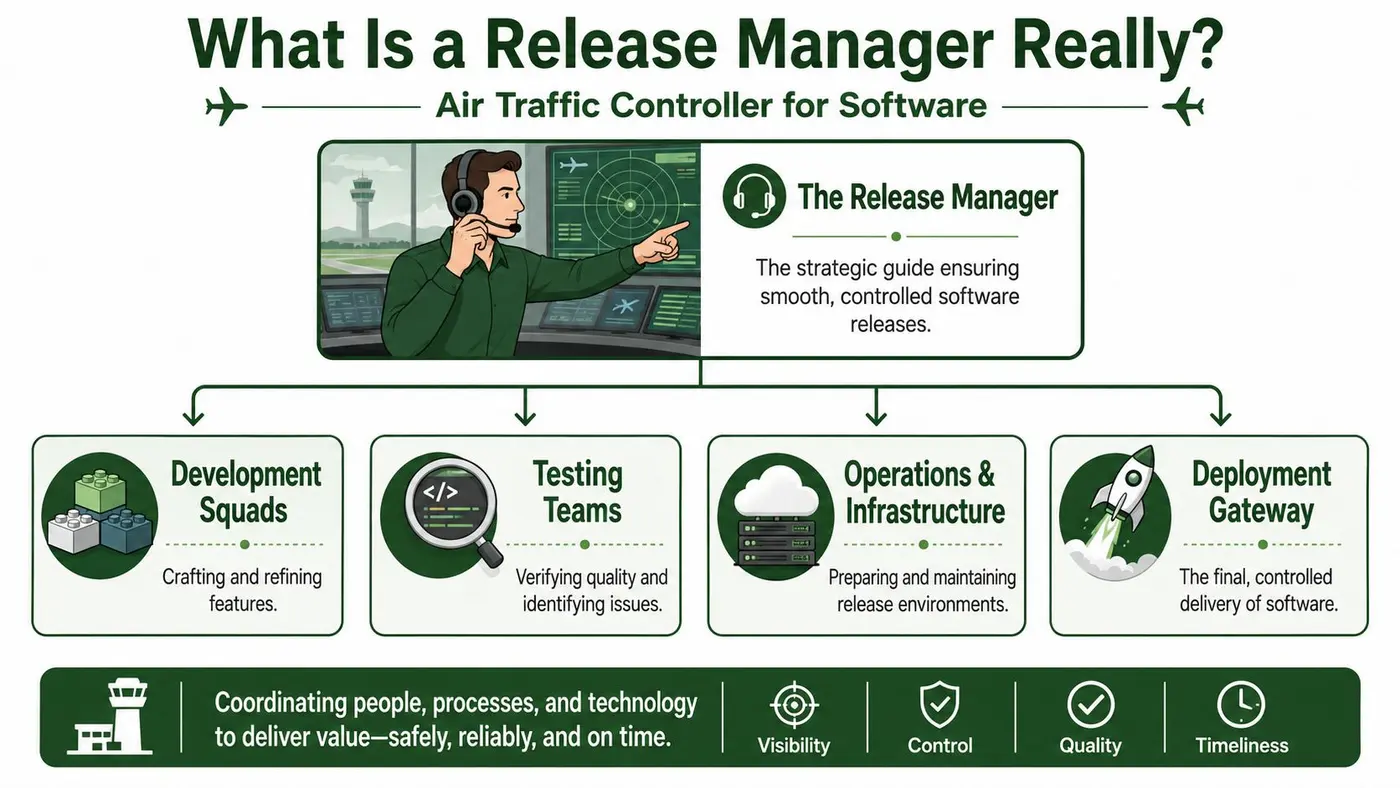
Where the role sits in the delivery flow
A Release Manager usually works across the full delivery path, not inside only one team. If you want a good mental model of where this fits, this overview of SDLC and Agile delivery practices is useful background.
Here's the practical position of the role:
| Stage | What the Release Manager is watching |
|---|---|
| Planning | Scope, dependencies, sequencing, approval path |
| Build | Branch discipline, integration timing, packaging readiness |
| Test | Exit criteria, defect risk, environment parity |
| Pre-release | Change window, communications, rollback readiness |
| Production | Execution flow, health checks, incident triggers |
| Post-release | Validation, lessons learned, release notes, follow-up actions |
That's why the role is never just “press deploy”.
What the best Release Managers actually do
They create rhythm. Teams need a predictable release cadence, clear sign-offs, and known escalation routes. Chaos often starts when every release becomes a custom event.
They force clarity. If a team says “we can roll back if needed”, the Release Manager asks how, by whom, under what condition, and how long it takes.
They reduce ambiguity between technical and non-technical teams. Product may say a launch is minor because the code diff is small. Engineering may say it's risky because of hidden dependencies. The Release Manager translates both sides into an operational decision.
Later in the cycle, the role becomes more visible.
Why the air traffic controller analogy works
Aircraft don't become safe because pilots are talented. They become safer because the system is organised. Routes are defined. Signals are standardised. Handoffs are clear. Exceptions have procedures.
Software delivery works the same way. A Release Manager builds those handoffs so releases don't depend on one heroic engineer remembering the right sequence under pressure.
A Release Managers Core Responsibilities
Release management gets real when a team wants to push an experiment before lunch, legal wants an audit trail, support wants customer-facing notes, and engineering spots a risky dependency ten minutes before the window opens. That mix of speed, control, and negotiation defines the job.
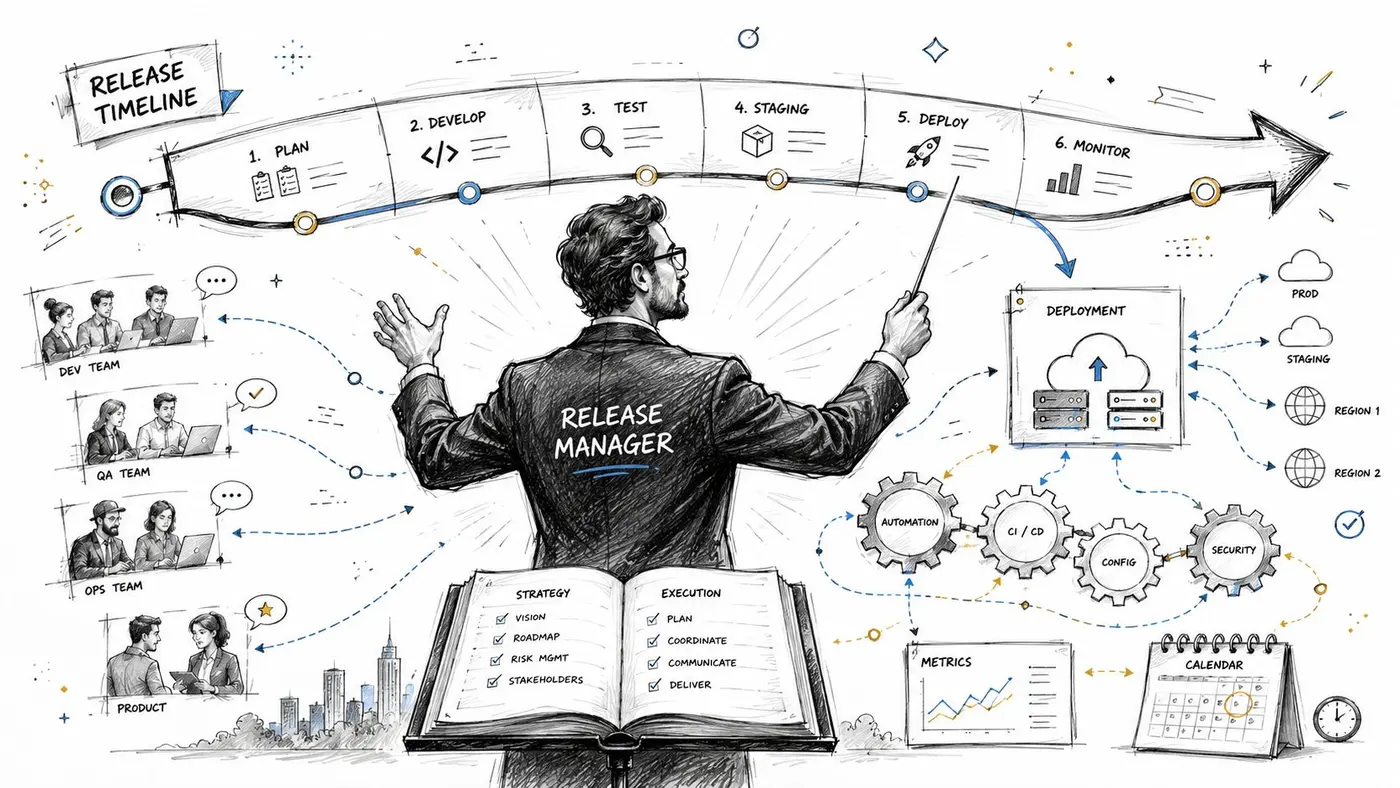
A release management job has two layers. One is visible to everyone. Calendars, approvals, change windows, stakeholder updates, and go-live coordination. The other layer decides whether releases stay boring in production. Dependency mapping, rollback design, environment checks, dry runs, and clear decision points sit there.
The weekly operating cycle
Strong Release Managers run a repeatable cadence, but they do not treat every release as identical. The job is to create enough structure that teams can move quickly without making every launch a fresh argument about process.
Typical responsibilities include:
- Release planning: grouping related changes into sensible release units, checking cross-team dependencies, and confirming that test, staging, and production are ready
- Change coordination: bringing together engineering, QA, operations, product, security, and support to resolve open risks before the release window
- Deployment oversight: tracking execution in real time, confirming gates are passed, and escalating early when a step goes off script
- Post-release follow-through: checking production health, documenting outcomes, publishing release notes, and feeding lessons into the next cycle
Communication is part of the control system, not admin work. Poor release notes waste time across support, sales, customer success, and incident response because each team has to reverse-engineer what changed. Good notes make ownership clear, state impact plainly, and separate internal implementation detail from customer-facing change. If you want a practical benchmark, these release notes format examples show the difference between vague updates and notes people can use.
Rehearsal beats optimism
Teams often overestimate what they can execute cleanly under pressure. A dress rehearsal fixes that.
Mock deployments expose the problems that look small on a planning board and turn expensive in production. Missing permissions. A script that only works if one engineer runs it manually. A rollback step that exists in theory but has never been timed. Configuration drift between environments is a frequent culprit, which is why disciplined teams document and test their environment model early. This guide to staging and configuration management is a useful reference if you want to tighten that part of the process.
Practical rule: If a deployment step cannot be tested before production, it should not be trusted in production.
Rehearsal also changes the conversation with stakeholders. Instead of saying "we should be fine," the Release Manager can say which steps were validated, what remains risky, and what the rollback trigger will be.
The balancing act modern teams miss
Older release models were built for control. Modern product teams are built for speed. The Release Manager sits between those forces and has to satisfy both.
A/B tests, pricing experiments, copy changes, feature flags, and gradual rollouts all create pressure for a faster path. Some of those changes are low risk. Some only look low risk because the code diff is small while the dependency chain is not. A flag change tied to billing, identity, or data collection still needs scrutiny.
That is why experienced Release Managers classify changes by blast radius, reversibility, and observability, not by who requested them or how urgent they feel.
| Change type | Release posture |
|---|---|
| Low-risk UI experiment | Lightweight approval, clear disable path, active monitoring |
| Backend service change | Standard release controls with deeper technical checks |
| Data migration | Highest scrutiny, explicit validation steps, tested recovery plan |
| Config-only change | Faster path, but documented, reviewed, and observable |
This is the part many career guides miss. Good release management does not slow experimentation by default. It creates proportional control. Teams can ship faster when they know which changes qualify for a light process, which ones need full coordination, and who makes the call when signals conflict.
That balance is the core responsibility. Keep delivery moving. Keep governance real. Keep production stable enough that the business can keep taking smart risks.
The Essential Skills and Tools of the Trade
Release Managers are hybrid operators. Pure process knowledge isn't enough. Pure technical depth isn't enough either. The job sits in the overlap.
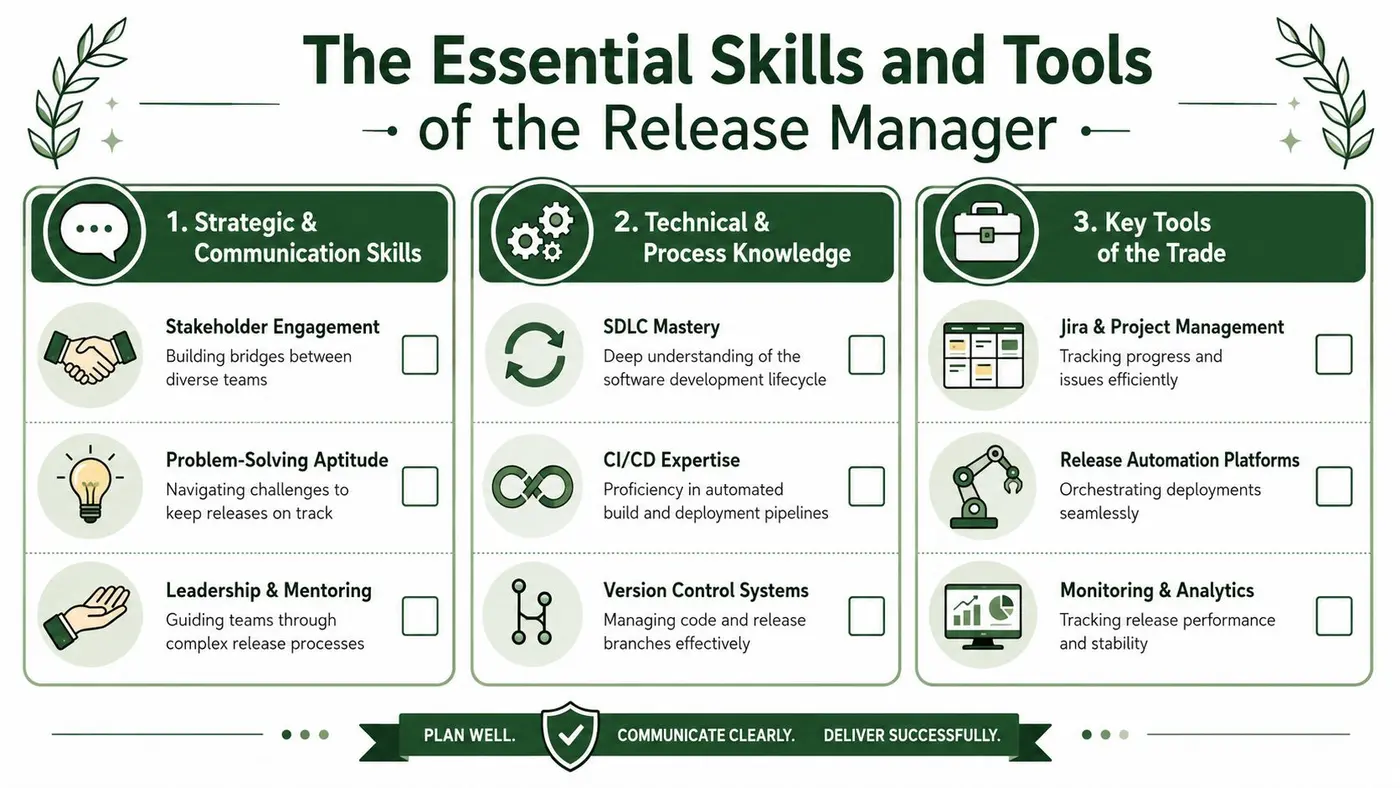
Technical capability
You don't need to be the strongest developer in the room, but you do need enough technical range to ask sharp questions and spot weak assumptions.
The technical core for UK Release Managers includes CI/CD pipeline orchestration, rollback strategy design, automated risk assessment, version control, release automation, and scripting in Python or Bash. Employers commonly expect hands-on familiarity with tools such as Git and Jenkins, plus enough scripting skill to support troubleshooting during release cycles.
That matters because a Release Manager often has to debug process and technical failure at the same time. If a pipeline fails halfway through a release, you need to know whether the problem sits in the build artifact, a branch mismatch, a secret, an environment variable, or the deployment sequence itself.
Process fluency
The strongest Release Managers understand more than one delivery model.
Some teams still run formal release boards and scheduled windows. Others deploy continuously with lighter controls and more automation. Many UK environments are mixed. Part legacy enterprise, part cloud-native delivery, part SaaS administration. You need to be comfortable in all of it.
A useful baseline is understanding how a deployment process works in practice, especially where deployment ends and release governance begins.
Here's the process stack that usually matters most:
- Agile delivery: Fast iteration, changing scope, shorter release cycles.
- DevOps practice: Automation, shared ownership, operational feedback.
- ITIL-style governance: Change control, traceability, service continuity.
- Risk management: Deciding what evidence is enough before production.
Soft skills that make or break the role
Many technically good candidates struggle with release management. Release management is a pressure job.
You need to be calm when people are tired, rushed, and slightly defensive. You need to say “not yet” without sounding bureaucratic. You need to know when a meeting needs detail and when it needs a decision.
The best Release Managers aren't the loudest people in the room. They're the ones who make the next action obvious.
A simple self-check helps:
- Can you translate risk: Explain a technical concern in language product, support, or leadership can act on.
- Can you negotiate trade-offs: Move a release, reduce scope, or split deployment from exposure without turning it into a political fight.
- Can you hold the line: Stop an unsafe release when the pressure to continue is high.
- Can you stay organised: Keep runbooks, approvals, notes, and dependencies current enough that others can trust them.
If you're aiming for a release management job, build all three layers together. Tools, process, and judgement.
Career Paths and Typical UK Salaries
A common route into release management starts with a messy production week. A developer becomes the person everyone trusts to sort build issues before a launch. A QA analyst starts calling out test gaps that would have slipped into production. A DevOps engineer takes ownership of deployment order, rollback steps, and change windows because nobody else is joining those pieces up.
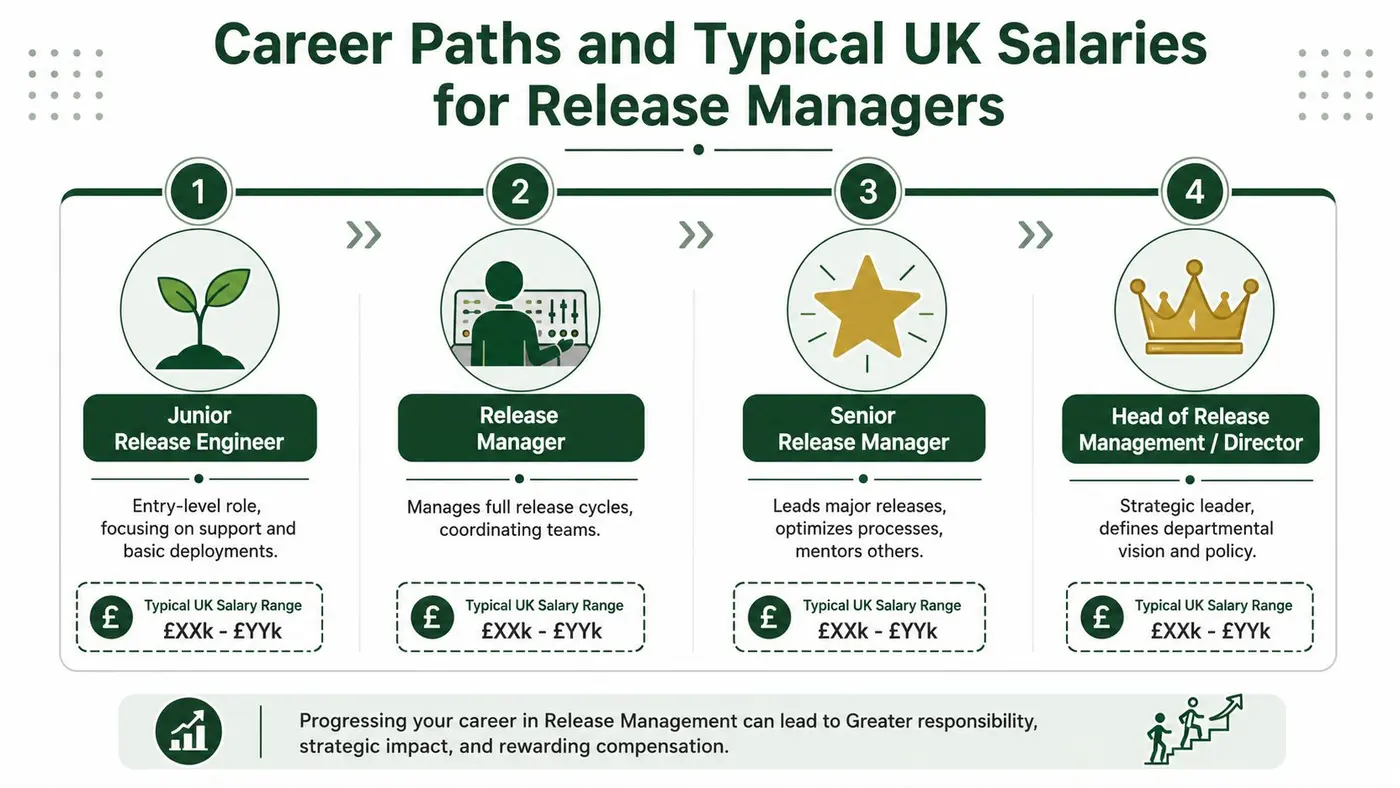
That is usually how the career starts. The title often comes later.
Common routes into the role
Release Managers rarely begin as pure coordinators. The stronger candidates usually come from jobs where they already had to make release trade-offs under pressure.
A junior developer can move toward the role by owning build pipelines, release scripts, and feature-flag configuration. That last part matters more now than it used to. Modern teams do not just deploy code. They stage exposure, run A/B tests, and control rollout by segment, region, or account type. Someone has to make sure that speed does not bypass approval, auditability, or rollback discipline.
Typical stepping-stone roles include:
- Release Engineer: Often the closest direct path, with hands-on responsibility for packaging, pipeline execution, and release scheduling.
- DevOps Engineer: A strong route if you already manage CI/CD, infrastructure changes, deployment automation, and production controls.
- Build and Configuration Analyst: Useful background for versioning, dependency handling, and environment consistency.
- QA Lead or Test Manager: Good preparation if you already own test gates, defect risk, and readiness decisions across teams.
- Technical Project or Delivery roles: A credible path if you can coordinate cross-functional work and speak comfortably about technical risk.
What UK employers usually expect
In the UK, the average base salary for a Release Manager is £54,455, and employers usually expect 3 to 6 years of relevant experience in release engineering, DevOps, build and release, or environment management.
That range reflects the true nature of the job. Employers are paying for judgment. They want someone who has seen a deployment plan look fine on paper and still fail because support was not briefed, a dependency was missed, or an experiment flag was enabled too broadly.
At the lower end of the salary range, the role is often narrower. You may run release calendars, support CAB preparation, and coordinate handoffs. At the higher end, the job becomes more strategic. You are deciding how to separate deployment from release, how much evidence is enough for a risky change, and how to let product teams test in production without turning governance into theatre.
If you are benchmarking roles or preparing applications, AIApply's AI-powered job tools can help you compare job descriptions, tailor your CV, and spot which release responsibilities employers care about.
Who a Release Manager reports to
Reporting lines vary with company structure.
| Company shape | Common reporting line |
|---|---|
| Enterprise IT | Head of Change, Service Delivery, or Infrastructure |
| Product-led SaaS | Engineering Manager, Director of Platform, or Head of DevOps |
| Regulated environment | PMO, IT Operations, or Change Management leadership |
| Scaling startup | CTO, VP Engineering, or Platform lead |
The reporting line matters less than the operating model. In a product-led SaaS company, a Release Manager may sit under engineering but spend half the week working with product, support, security, and data teams. In an enterprise environment, the role may report into change management but still need enough technical depth to challenge a risky rollout plan.
Where the path can lead
The next step depends on which part of the role you are strongest in.
Some Release Managers move into Senior Release Manager positions and take ownership of larger programmes, platform migrations, or multi-team release trains. Some shift into DevOps leadership or platform engineering management because they are strongest on automation and deployment design. Others move toward service delivery, change leadership, or technical programme management because they are good at governance, stakeholder handling, and operational planning.
The long-term value of the role is range. It builds technical credibility, operational judgment, and organisational trust at the same time. That mix is hard to replace, especially in teams trying to ship faster while keeping production stable.
How to Land Your First Release Management Job
The first challenge isn't usually learning what a Release Manager does. It's proving you've already done enough of it to be trusted with the title.
A lot of candidates undersell themselves because their current title says Developer, QA Analyst, DevOps Engineer, or Technical Project Coordinator. Hiring managers care less about the title than the evidence.
Build a CV around release ownership
Don't describe your work as generic support. Show where you managed risk, alignment, or repeatability.
A stronger CV usually includes examples like:
- Coordinated release windows: Mention cross-team scheduling, dependencies, sign-offs, or production readiness checks.
- Improved deployment discipline: Show that you built or maintained CI/CD pipelines, release scripts, branch strategy, or environment controls.
- Handled rollback planning: Include times when you defined rollback steps, release runbooks, or go/no-go criteria.
- Supported controlled experimentation: If you've worked with feature flags, config-based rollouts, or production gating, that counts.
One of the biggest opportunities for candidates is this. Many UK job posts ask for rollback strategies and risk assessment, but few explain how to integrate lightweight experiments into legacy IT environments without breaking security expectations. That gap is visible in UK Release Manager vacancies on Indeed, and it gives you a sharp angle if you can speak about experimentation with governance in mind.
If you can explain how to ship faster without weakening controls, you'll stand out from candidates who only talk about process or only talk about speed.
If you want help tightening the wording and structure of your applications, tools like AIApply's AI-powered job tools can help you refine role-specific CVs and application materials faster.
Prepare better interview stories
Release management interviews usually reveal whether you've operated under real pressure. Generic answers fall apart quickly.
Prepare stories for questions such as:
- Tell me about a release that almost failed and what you did.
- How do you decide whether to proceed or stop a deployment?
- What should a rollback plan include?
- How would you manage a release that includes a growth experiment in a tightly controlled environment?
- How do you handle conflict between product urgency and operational caution?
Your examples should show judgement, not just activity. Use a clear sequence: context, risk, action, result, and what you changed afterwards.
Get experience before you have the title
If you're not in a formal release role yet, start where you are.
Take ownership of release notes. Offer to run the pre-release checklist. Document the rollback procedure for one service. Standardise one deployment flow. Help your team separate code deployment from feature exposure. Those are all release management behaviours.
Candidates often wait for permission to “become” Release Managers. In practice, the role usually starts when someone sees delivery chaos and decides to organise it.
Your Action Plan for Becoming a Release Manager
If you want a release management job, don't treat it like a distant career switch. Treat it like a capability you can start building this quarter.
Start with a focused checklist
-
Assess your current gaps Review your strengths across technical tools, delivery process, and stakeholder communication. Be honest about what's weak. It's common to find oneself lopsided.
-
Own one release problem at work
Don't wait for a title change. Volunteer to improve one part of the release path. That might be release notes, rollback documentation, deployment rehearsal, or dependency tracking. -
Learn one core tool properly
Pick something central to release work, such as Jenkins, Git, Azure DevOps, or Bash scripting. Depth beats dabbling. -
Build proof, not just interest
Update your CV and LinkedIn profile with real examples of coordination, automation, risk reduction, and release execution. Hiring managers want evidence. -
Practise the modern angle
Learn to talk about both control and speed. A strong Release Manager protects production while helping the business test, learn, and ship.
This role suits people who like order, but not bureaucracy. People who can see both the deployment detail and the wider business consequence. People who stay calm when everyone else gets noisy.
If that sounds like you, you're not looking at a niche admin role. You're looking at one of the jobs that decides whether software teams move with confidence or with luck.
If your team is trying to balance rapid experimentation with release discipline, Otter A/B is built for that reality. It helps teams run fast website experiments without dragging engineering into heavy release cycles, while still giving stakeholders clear visibility into conversion and revenue outcomes. For Release Managers working alongside growth, product, and engineering, that makes it easier to support controlled change instead of becoming a bottleneck.
Stop guessing
Ready to start testing?
Set up your first A/B test in under five minutes. No credit card required.
- 14-day free trial
- No credit card required
- Cancel anytime