Post Purchase Experience: How to Turn Buyers Into Loyal Fans
Master the post purchase experience with proven tactics, KPIs, and A/B testing strategies. Reduce returns and increase customer loyalty in 2026.

£111.7bn of UK ecommerce value in 2025 is associated with post-purchase activity, making the period after checkout a revenue engine rather than operational housekeeping. Yet shoppers say communication falls short on £23.5bn of online orders, leaving a substantial opportunity for retailers that make delivery, returns and follow-up clearer.
A strong post-purchase experience doesn't begin when the parcel arrives. It starts with the order confirmation and continues through fulfilment, tracking, delivery, support, returns, exchanges, refunds and the next purchase decision. The practical question for a CRO lead isn't whether customers like a smooth journey. It's which touchpoints create avoidable friction, and which changes produce measurable commercial improvement.
Across Shopify stores, the same pattern appears repeatedly. Teams optimise product pages and checkout, then leave order updates, delivery exceptions and returns to carrier templates or an overloaded support inbox. That decision hands the most emotionally sensitive part of the customer journey to systems the retailer doesn't control.
Why Post-Purchase Experience Drives Revenue
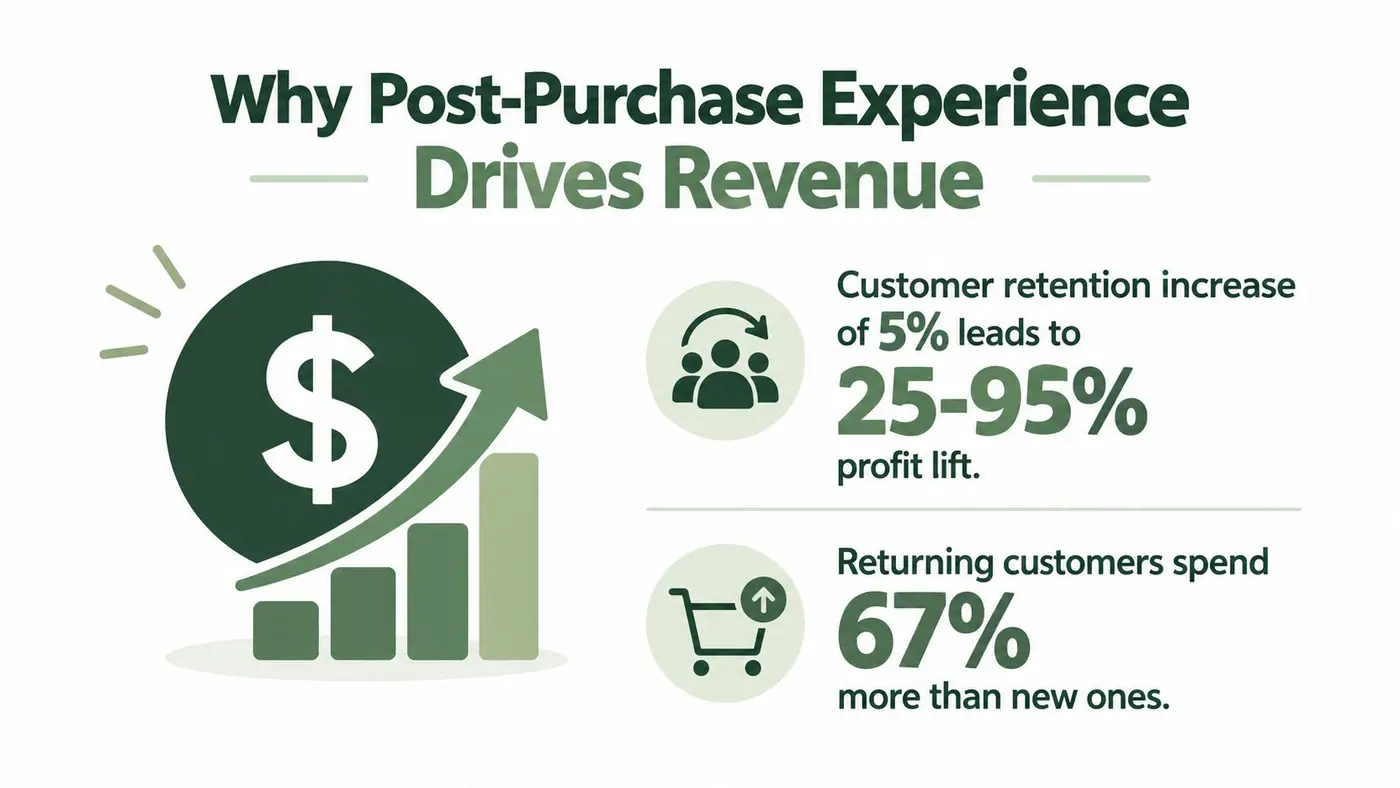
£111.7bn of UK ecommerce value in 2025 is associated with post-purchase activity, according to UK PPX research from ZigZag. Communication also falls short on £23.5bn of online orders. The commercial opportunity sits in the gap between a completed checkout and a customer who feels confident enough to keep buying.
A post-purchase experience covers more than delivery operations. Order confirmation, fulfilment updates, tracking, support, returns, exchanges, refunds and follow-up all influence whether the original sale remains profitable and whether another sale follows.
That makes fulfilment a revenue lever, not only a cost centre. A clear update can prevent an avoidable support contact. A well-designed return flow can shift a refund into an exchange. A timely follow-up can turn a resolved issue into a reason to buy again.
Returns are a conversion issue
Returns expose the trade-off most clearly. A 2024 report from Retail Economics and ZigZag forecast online returns reaching £27bn in 2024. It estimated that habitual serial returners represented 11% of customers, generated nearly a quarter of all returns and sent back about £6.6bn of online purchases in a single year.
The response should not be a blanket attempt to make returns difficult. A restrictive policy may reduce immediate return volume while lowering conversion and loyalty. Earlier UK consumer reporting found that 71% of online shoppers return items at least some of the time, with clothing, shoes, and bags or accessories among the most returned categories, in the same Retail Economics and ZigZag report. Customers account for return conditions when they cannot assess fit, colour or feel in person.
Friction has a measurable relationship cost
The 2023 UK consumer study from ZigZag reported that 79% of UK consumers wouldn't return to a retailer after a poor returns experience, while 82% considered free returns a core expectation. UK research also reported that 55% of shoppers had abandoned a purchase or stopped shopping with a retailer because of its returns policy, and 61% always or often check the policy before buying online. 92% said return fees affect how they shop online, according to Retail Insight Network's coverage.
Commercial rule: Treat every post-purchase decision as part of the next conversion funnel. A confusing return portal can lose the current order's margin and the next order's revenue.
The practical fix is targeted rather than universal free returns. Publish accurate eligibility rules, show the likely resolution before submission, offer an exchange where it fits, and communicate every status change. Then A/B test the flow to measure exchange acceptance, support demand and later purchases. That evidence lets a retailer improve trust without accepting unnecessary operational cost.
The Core Components of Customer Retention
Retention improves when the post-purchase journey has clear owners, measurable outcomes and fewer moments that force customers to seek help. A useful model has five connected components. Separating them helps teams identify the broken step instead of assigning every poor result to fulfilment.
Confirmation and expectation setting
The confirmation message should answer four immediate questions: what was ordered, where it is going, what happens next and how to get help. It must repeat the delivery promise shown before checkout, not replace it with a broader estimate after payment. If stock, processing or address details need attention, show that information before uncertainty becomes a support ticket.
Fulfilment visibility
Customers need a credible progress view, a delivery expectation and an explanation when the route changes. Generic “in transit” messages add little if the underlying estimate is wrong. Treat delivery updates as conversion touchpoints, then test whether clearer timing reduces contacts and improves later purchasing.
Delivery and exception handling
A delivery notification should confirm the outcome and state the next action. If a parcel is delayed, explain what changed, provide the latest credible estimate and offer a support route or resolution option. Leaving customers to discover the problem themselves creates anxiety and avoidable “where is my order?” enquiries.
Returns, exchanges and refunds
Returns deserve a dedicated interface rather than a buried policy page. Customers should see eligibility, select a reason, choose a refund or exchange, receive instructions and check status without repeating details to support.
The flow should also protect future revenue. An exchange option can preserve the customer relationship when the product issue is fit or preference, while a clear refund path limits further frustration. Use A/B testing to compare completion, exchange selection, support demand and subsequent purchases. That treats return initiation as a conversion lever, not merely a cost centre.
Relevance after delivery
After delivery, communication should help the customer use the product, resolve a problem or consider a relevant next purchase. An unrelated promotion immediately after arrival can weaken trust. The customer retention management framework should therefore connect each message to the customer's current state, such as delivered, activated, dissatisfied or ready to reorder.
Teams focused on improving repeat purchases on Shopify should map these components in sequence and assign an owner to each outcome. Measure the journey as a system, then run controlled tests on the moments with the clearest commercial trade-off. Better communication may reduce support cost, while a stronger return or follow-up experience can create another purchase.
Optimizing Fulfillment and Communication Channels
Fulfillment communication should reduce uncertainty at each order state while keeping the customer's effort low. Email suits receipts, confirmations and detailed instructions. SMS works better for time-sensitive delivery changes. A branded tracking page gives customers one stable destination and lets the retailer shape the surrounding experience.
UK shopper research points to two related problems: customers want tracking to remain connected to the retailer, and sparse updates make them check repeatedly. The study found that 61% prefer branded tracking on the retailer's site over being redirected to a carrier, while 35% are annoyed by repeatedly checking tracking because updates are too sparse, according to Ingrid's research. A useful tracking page should show the latest event, expected delivery point, time of the last update and a clear escalation route when movement stops.
Build a message sequence around customer questions
A practical sequence follows the questions customers ask as the order progresses:
- Order received: Confirm the product, address, payment and next fulfilment step.
- Dispatched: State that the parcel is in transit and provide branded tracking.
- Progress update: Report a meaningful change rather than repeating the same carrier status.
- Exception alert: Explain a delay or failed delivery attempt before the customer contacts support.
- Delivery confirmation: Confirm where and when the parcel was delivered.
- Product guidance: Help the customer use, care for or style the item.
- Resolution update: Confirm each return, exchange or refund milestone.
Message wording must reflect the actual event. “Your order is moving” gives the customer little to act on. “Your parcel has left our fulfilment centre and is expected on Tuesday” creates a usable expectation when the estimate is reliable. If that estimate changes, acknowledge the change promptly instead of displaying stale information.
This sequence also creates testable conversion points. Compare delivery-update formats, exception handling and return-entry prompts by completion, support demand and repeat purchase behaviour. A return initiation that clearly explains options can preserve the sale through an exchange, while a delayed or confusing flow can turn a manageable issue into lost trust.
Keep the retailer in control without hiding carrier data
Branded tracking should translate carrier events into plain customer language while retaining the underlying detail. It should not conceal the carrier or imply certainty that the data cannot support. Add delivery preferences, contact options and a return link where each is relevant. Customers who cannot remain at home need accurate delivery windows and practical alternatives, not another promotional message.
The email also shapes brand perception. Consistent sender details, a recognisable footer and useful support links reduce doubt. Teams reviewing the best ChatGPT email signature examples can apply that same consistency, while keeping the signature subordinate to order information.
Customers don't need more messages. They need the right message when the order state changes.
Connect Shopify order data, the carrier feed, returns platform and support inbox. If those systems disagree, prioritise the customer-facing promise and route the discrepancy to an exception queue for manual review. Automation creates value when it resolves uncertainty. It creates more work when inconsistent data is broadcast faster.
Key Performance Indicators for Post-Purchase Success
A post-purchase dashboard should connect customer behaviour to commercial outcomes. Open rate and click rate can help diagnose delivery communications, but neither proves that the journey is protecting revenue. The primary dashboard should show what happened to the order, how much effort the customer needed and what they did next.
Track the following metrics by product, fulfilment route, carrier and customer segment:
- Delivery promise accuracy: Compare the promise shown at checkout with the actual delivery outcome. A wide gap signals a merchandising, inventory or carrier problem.
- Support contact rate: Measure order-related contacts and classify them by tracking, delay, damage, return and refund. A falling total isn't automatically positive if customers are abandoning instead.
- Return initiation time: The IMRG and nShift study found 47.4% of consumers expect to initiate a return within 1 to 3 minutes. Use that expectation as a UX design requirement, then test completion and abandonment.
- Refund-to-exchange ratio: The same study found 66.1% said they would accept an exchange instead of requesting a refund. This makes exchange presentation, product availability and credit language important revenue variables.
- Resolution time: Measure the elapsed time from return initiation to exchange dispatch or refund completion. Break it into customer action, warehouse processing and finance processing.
- Repeat purchase behaviour: Compare later purchasing for customers exposed to different post-purchase journeys, while controlling for product, channel and customer value.
| Metric | Why It Matters | Target Benchmark |
|---|---|---|
| Delivery promise accuracy | Shows whether the retailer sets credible expectations | Establish a baseline, then improve accuracy |
| Support contact rate | Reveals avoidable uncertainty and operational friction | Reduce preventable order contacts |
| Return initiation time | Tests whether the portal matches customer expectations | Make the journey completable in a few minutes |
| Refund-to-exchange ratio | Shows whether the flow protects revenue | Increase appropriate exchange acceptance |
| Resolution time | Connects process speed with perceived service quality | Shorten each internal hand-off |
| Repeat purchase rate | Measures whether the experience supports retention | Compare against a consistent cohort baseline |
Don't set arbitrary benchmarks without a baseline. A low return rate might mean satisfied customers, or it might mean shoppers can't find the portal. A high exchange rate might reflect effective recovery, or it might conceal forced choices that create later complaints.
For a fuller view of customer lifetime value, connect post-purchase cohorts to gross margin, refund cost and subsequent order value. The dashboard should help a team decide what to fix next, not merely report activity.
A/B Testing Strategies with Otter A/B
Post-purchase optimisation needs controlled experiments because well-intended changes can shift cost from one part of the funnel to another. A shorter return form may improve completion but increase unsuitable requests. A generous exchange offer may preserve revenue but create inventory pressure. Test the customer outcome and the operational consequence together.
Start with one friction hypothesis
Write the hypothesis in a testable format:
If we show a clear delivery date and exception explanation on the branded tracking page, customers will contact support less often without increasing delivery-related complaints.
The hypothesis identifies the intervention, audience, primary metric and guardrails. Avoid testing “a better experience”. Test one specific change, such as delivery-date placement, return button wording, exchange-first ordering or the number of fields in a return form.
Choose the right surface
Post-purchase tests can run on several controlled surfaces:
- Confirmation page: Test guidance, order-summary hierarchy and the first support action.
- Tracking page: Test delivery-date presentation, carrier detail, FAQ placement and exception messaging.
- Returns portal: Test the sequence of refund and exchange choices, form length and reason selection.
- Follow-up email: Test product guidance, review timing or a relevant replenishment prompt.
Do not change the email, tracking page and returns portal in the same experiment. If the result moves, you won't know which intervention caused it.
Measure revenue, not just clicks
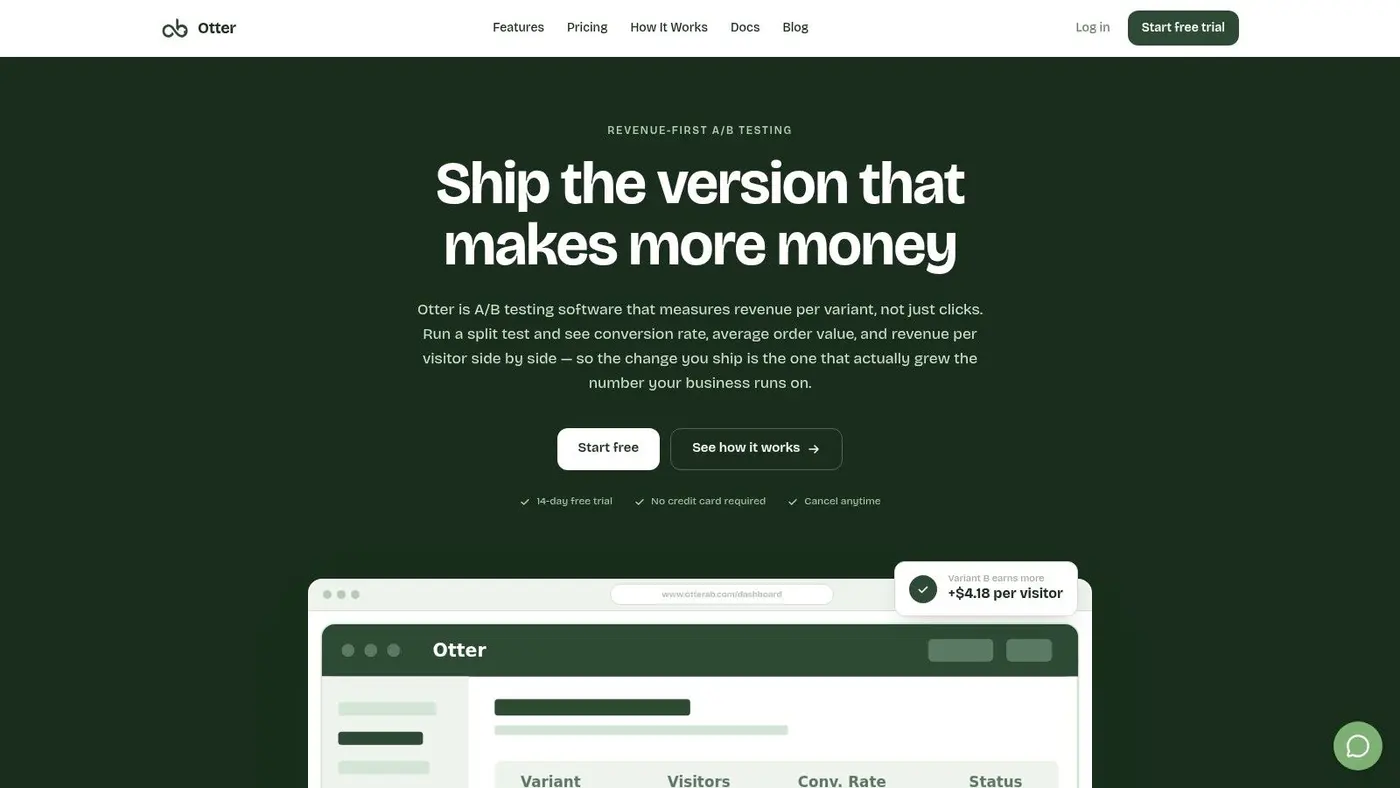
Otter A/B can be used as one testing option for experiments on web surfaces, with goals tied to purchases, revenue and custom events. For this use case, define a primary outcome such as completed exchange, completed return initiation or repeat purchase, then add guardrails such as support contact rate, refund value and fulfilment cost.
A test can produce a higher click rate and still damage economics if it increases refunds. Conversely, a tracking-page change may not generate an immediate purchase but could reduce avoidable contacts and improve later buying behaviour. Give each experiment a clear observation window and analyse customers by order cohort rather than mixing new orders with older journeys.
Use a disciplined testing workflow
- Prioritise by impact and confidence: Start with high-volume friction, such as unclear delivery promises or a difficult return entry point.
- Define the audience: Separate first-time buyers, repeat buyers, high-return categories and subscription customers where behaviour differs.
- Set the control: Keep the current experience live as the comparison point.
- Name the primary metric: Choose one decision metric before launch.
- Add guardrails: Monitor refunds, exchanges, support tickets, complaints and fulfilment workload.
- Wait for a reliable result: Use the platform's significance reporting, but don't stop a test because of an early fluctuation.
- Document the decision: Record the winner, the affected segment, the commercial result and the next question.
A statistically significant result isn't automatically a universal rollout. Check whether the change works across devices, product categories and delivery methods. If it improves one segment and harms another, deploy it selectively.
Real-World Customer Journey Scenarios
A poor post-purchase journey usually fails through accumulation rather than one dramatic error. The confirmation email arrives without a credible delivery date. The carrier link shows a status the customer doesn't understand. A delay occurs, but nobody explains it. When the customer finally finds the returns policy, the portal asks for information already held in the order record.
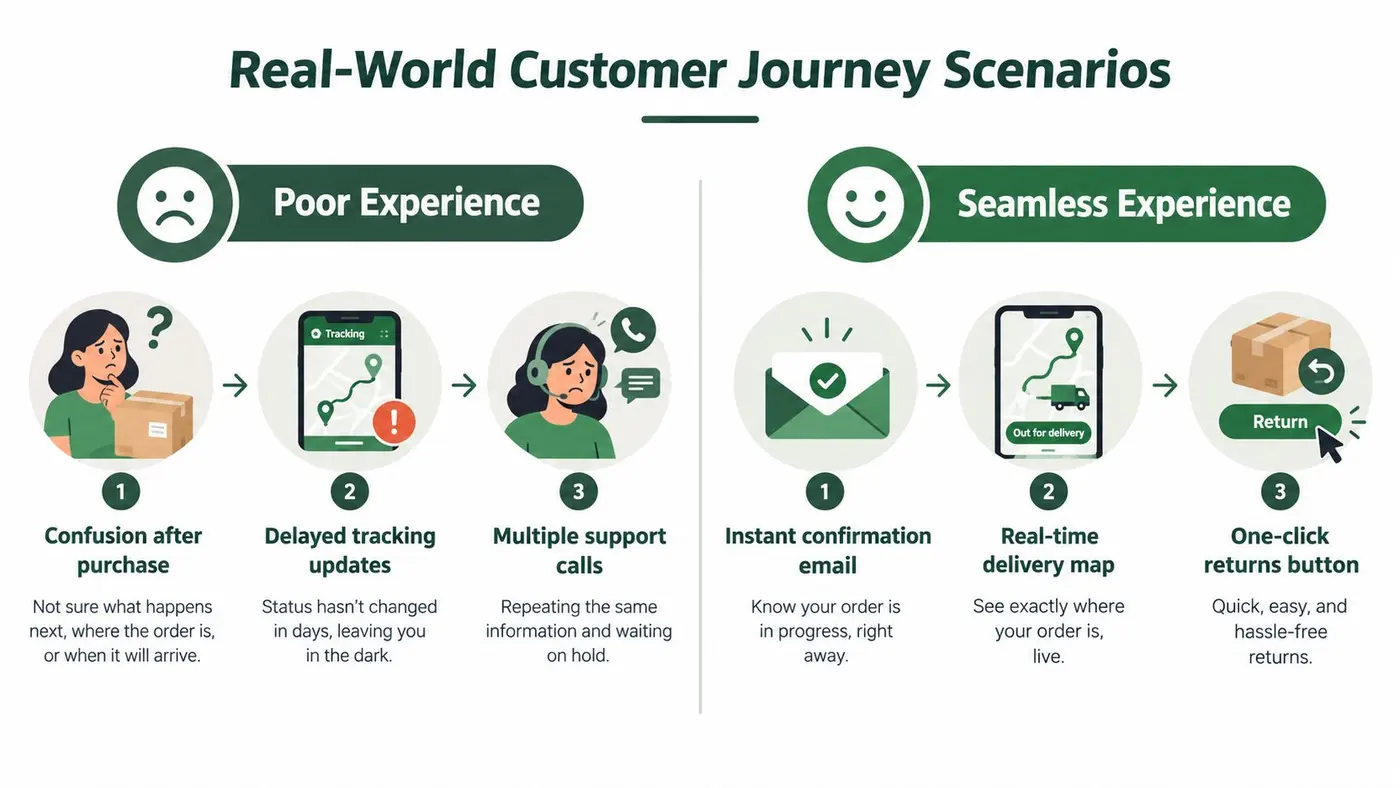
The buyer may contact support several times, purchase a replacement elsewhere or return an item because uncertainty made the original purchase feel unsafe. The retailer then pays for avoidable service work and loses the chance to recover the relationship through a fast exchange.
A post-purchase journey has a different rhythm. The confirmation page sets expectations, the branded tracking page shows a meaningful delivery update, and an exception message appears before the estimated date becomes impossible. After delivery, the customer receives practical product guidance. If the item isn't right, a visible one-click returns entry point presents an exchange alongside a refund and shows the resolution path clearly.
Watch the following video for another visual way to think about journey stages and customer friction.
The difference isn't decorative polish. The first journey makes the customer manage the retailer's systems. The second gives the retailer responsibility for coordination. Teams can use customer journey map examples to document every customer question, internal hand-off and measurable outcome.
For a Shopify store, map the sequence using order records, support tags and returns data. Look for the point where customers leave the owned experience, repeat a question or wait without a credible next step. That point is a stronger testing candidate than a generic redesign brief.
Building a Repeat Purchase Culture
A repeat-purchase culture starts when teams stop treating delivery and returns as someone else's workflow. Merchandising owns the promise, operations owns fulfilment accuracy, support owns recovery and growth owns the experiment design. Each team should share the same customer and order definitions.
Use a practical sprint checklist:
- Find the leak: Review delivery contacts, return abandonment and refund-to-exchange behaviour.
- Fix the clearest friction: Start with inaccurate expectations, sparse updates or a hard-to-find returns path.
- Protect the economics: Track support cost, refund value, exchange completion and later purchase behaviour together.
- Test one change: Keep the control, define guardrails and record the decision.
- Turn winners into systems: Update templates, portal logic, staff guidance and reporting.
The most durable gains come from making the reliable choice the easiest choice for the customer. A clear delivery promise reduces anxiety. A transparent returns flow preserves trust. A timely, relevant follow-up gives the buyer a reason to remember the brand positively.
Otter A/B lets ecommerce teams test post-purchase page layouts, messages and calls to action while tracking purchases, revenue and custom events by variant. Visit Otter A/B to run controlled experiments that connect customer experience changes with the commercial outcomes your Shopify store needs.
Stop guessing
Ready to start testing?
Set up your first A/B test in under five minutes. No credit card required.
- 14-day free trial
- No credit card required
- Cancel anytime