The Z Test in Statistics: A Practical Guide for 2026
Learn what a z test in statistics is, how it works, and when to use it. Our guide covers formulas, examples, and its role in A/B testing with 95% confidence.
You've probably had this moment. A new homepage headline goes live, conversions look better, and someone on the team asks the awkward question: “Is this better, or are we just looking at a lucky streak?”
That question sits at the centre of a lot of marketing, product, and CRO work. We change copy, adjust layouts, swap CTAs, and tweak flows because we want better outcomes. But raw results alone don't tell us whether a change is real or random.
That's where the z test in statistics becomes useful. It gives you a disciplined way to check whether the difference you're seeing is large enough to take seriously. Instead of relying on gut feel, you compare what happened in your sample against what you'd expect if nothing had really changed.
From Guesswork to Confidence
A growth marketer launches two versions of a landing page. Variant B looks stronger. More people seem to click through. The dashboard starts to tilt in B's favour, and the temptation is immediate: call it a winner, roll it out, move on.
But early lifts can mislead. Random variation can make one version look better for a while, even when there's no real improvement underneath. That's why disciplined teams don't stop at “B is ahead”. They ask whether the gap is big enough to count as evidence.
The z-test exists for that moment. It helps you test a simple idea: if there were no real difference, how unusual would your observed result be? If the result looks too unusual to chalk up to chance, you reject the “nothing changed” explanation.
Practical rule: A z-test doesn't tell you a change is guaranteed to win forever. It tells you whether the observed result is unlikely to be random noise under a stated assumption.
That matters well beyond academic statistics. In real experimentation work, confidence affects budgets, roadmaps, and stakeholder trust. If you ship every apparent win too early, you train your team to believe noise. If you never act until certainty feels absolute, you slow down progress.
A good mental companion to this topic is a confidence interval in statistics. A z-test helps with the decision. A confidence interval helps you think about the likely range of the effect. Together, they move you away from hunches and towards evidence.
What Is a Z-Test and When Should You Use It
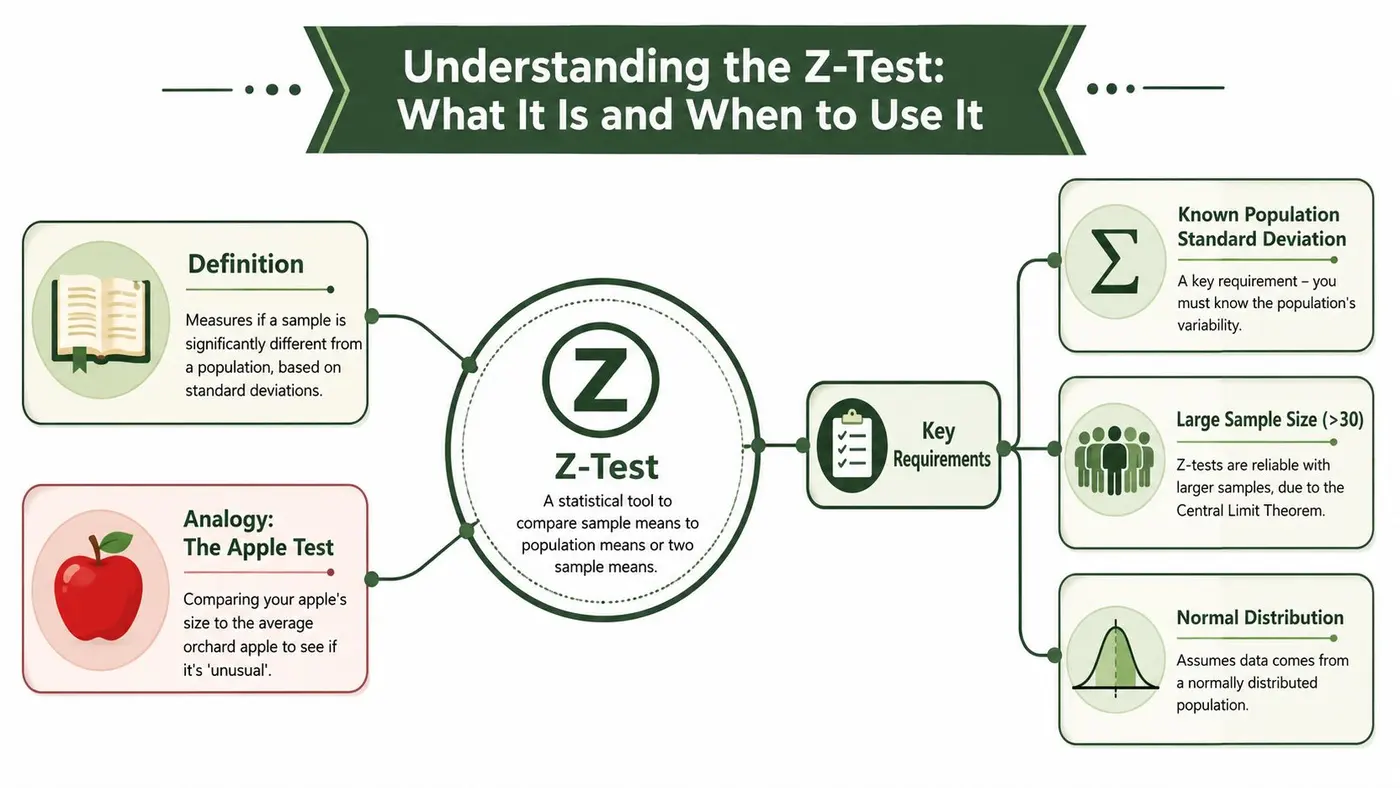
A z-test is a hypothesis test used to compare a sample result against a known benchmark. In plain language, it asks whether your sample is far enough from the expected value that chance is an unlikely explanation.
One useful analogy is an apple orchard. Suppose you know the average size of apples from a huge orchard, and you also know how much apple sizes usually vary. You pick a set of apples from one tree and notice they seem larger. A z-test helps you judge whether that tree is probably different, or whether your sample just happened to include some unusually big apples.
The formal idea
In statistics, the z-test is designed for situations where the population standard deviation, written as σ, is known. The Open University notes that when testing means with a sample size greater than 30, the z-test statistic follows a standard normal distribution, and for a 5% two-tailed significance level the critical value is 1.96. It also gives the core formula as Z = (x̄ - μ) / (σ / √n) in its explanation of hypothesis testing and the z-test.
If that formula looks dense, break it into parts:
- x̄ is your sample average
- μ is the population average you're comparing against
- σ is the known population standard deviation
- √n adjusts for sample size
The result is a z-score, which tells you how far your sample sits from the expected value after adjusting for normal variation.
When a z-test is appropriate
A z-test is not the universal answer to every testing problem. It works best under a specific set of conditions.
- Known population variability: You either know the population standard deviation or are working in a setting where the variance under the null is defined.
- Large enough sample: The verified guidance above states that a sample size greater than 30 supports use of the z framework for mean testing.
- Suitable distributional assumptions: For classic z-tests on means, the underlying setup assumes normality, or at least a situation where the sampling distribution behaves normally enough to justify the method.
Why these requirements matter
If you know the population variability, your denominator is stable. That makes the test more precise and easier to interpret.
If your sample is large enough, your sample average behaves more predictably. That reduces the chance that one odd sample swings your conclusion.
If the normality assumption is badly violated, the z-based result can become less trustworthy. The maths still runs, but the interpretation gets shakier.
Think of a z-test as a calibrated measuring tool. It works well when the measuring conditions match the tool's design.
For marketers, that often becomes practical in binary outcomes such as conversions, clicks, or sign-ups, where proportion tests use z-based logic under the null. For analysts working with means, it applies when the benchmark variation is already known from reliable historical or population-level information.
Decoding Z-Scores P-Values and Critical Values
The mechanics of a z-test often feel harder than the idea itself. Most confusion comes from three terms: z-score, critical value, and p-value. Once those click, the test starts to feel much less mysterious.
What a z-score tells you
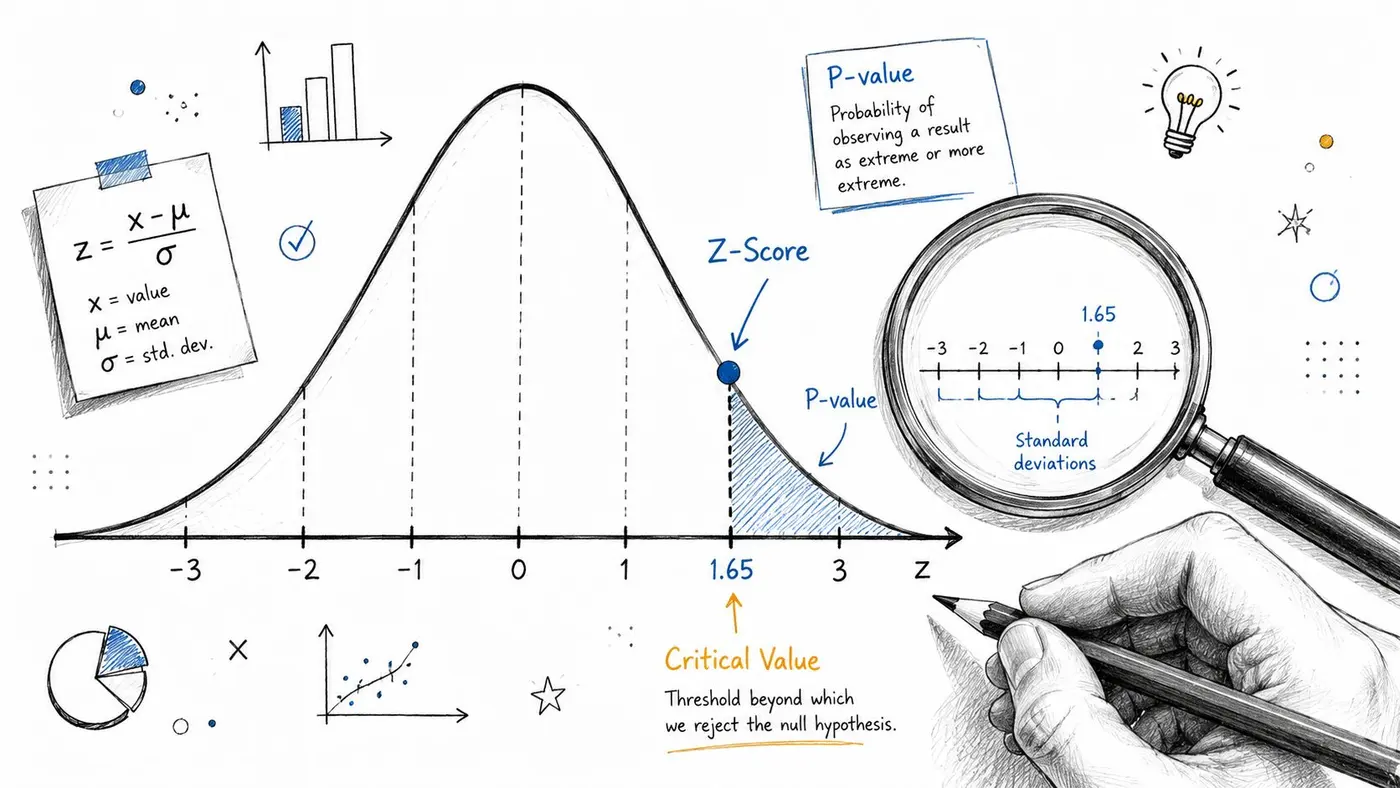
A z-score is a distance measure. It tells you how many standard errors your observed result is away from the value expected under the null hypothesis.
If your z-score is close to zero, your result looks ordinary. If it's far from zero, your result looks unusual under the “no real difference” assumption.
A marketer might interpret this as follows: If Variant B is only a tiny nudge above Variant A, that may sit well inside the range of normal fluctuation. If B is much farther away, the z-score grows, and the result starts looking harder to dismiss as noise.
What the critical value does
The critical value is the cut-off point for your decision. It's the line that says, “past here, this result is unusual enough to reject the null hypothesis”.
According to the verified practical summary of the z-test, a significance level of 0.05 is used in UK experimental design, and for a two-tailed z-test at that level the critical values are ±1.96. The same summary notes that this threshold is used by A/B testing tools to declare significance when the absolute z-statistic exceeds 1.96, as described in this overview of the z-test.
That means:
| Decision input | What it means |
|---|---|
| Z between -1.96 and 1.96 | Don't reject the null |
| Z less than -1.96 | Reject the null |
| Z greater than 1.96 | Reject the null |
What a p-value means in practice
A p-value answers a narrower question than many people think. It asks: if the null hypothesis were true, how likely is a result this extreme, or more extreme?
That's all.
It does not tell you the probability that your hypothesis is true. It does not tell you the size of the business impact. It does not promise that the result will repeat forever.
If you'd like a more detailed plain-English walk-through, this guide to p-value explanation is useful alongside the z-test itself.
A simple way to connect the three
Use this mental sequence:
- Calculate the z-score
- Compare it with the critical value
- Read the p-value as evidence strength under the null
A high absolute z-score pushes you towards significance. The critical value gives the threshold. The p-value expresses how surprising the result would be if nothing had changed.
That's why these quantities matter in decision-making. They convert a messy “this looks better” into a more defensible “this result is unlikely under the baseline assumption”.
Z-Test vs T-Test A Clear Comparison
People often mix up the z-test and the t-test because both deal with sample evidence and both ask whether a difference is meaningful. The actual difference is simpler than it first appears.
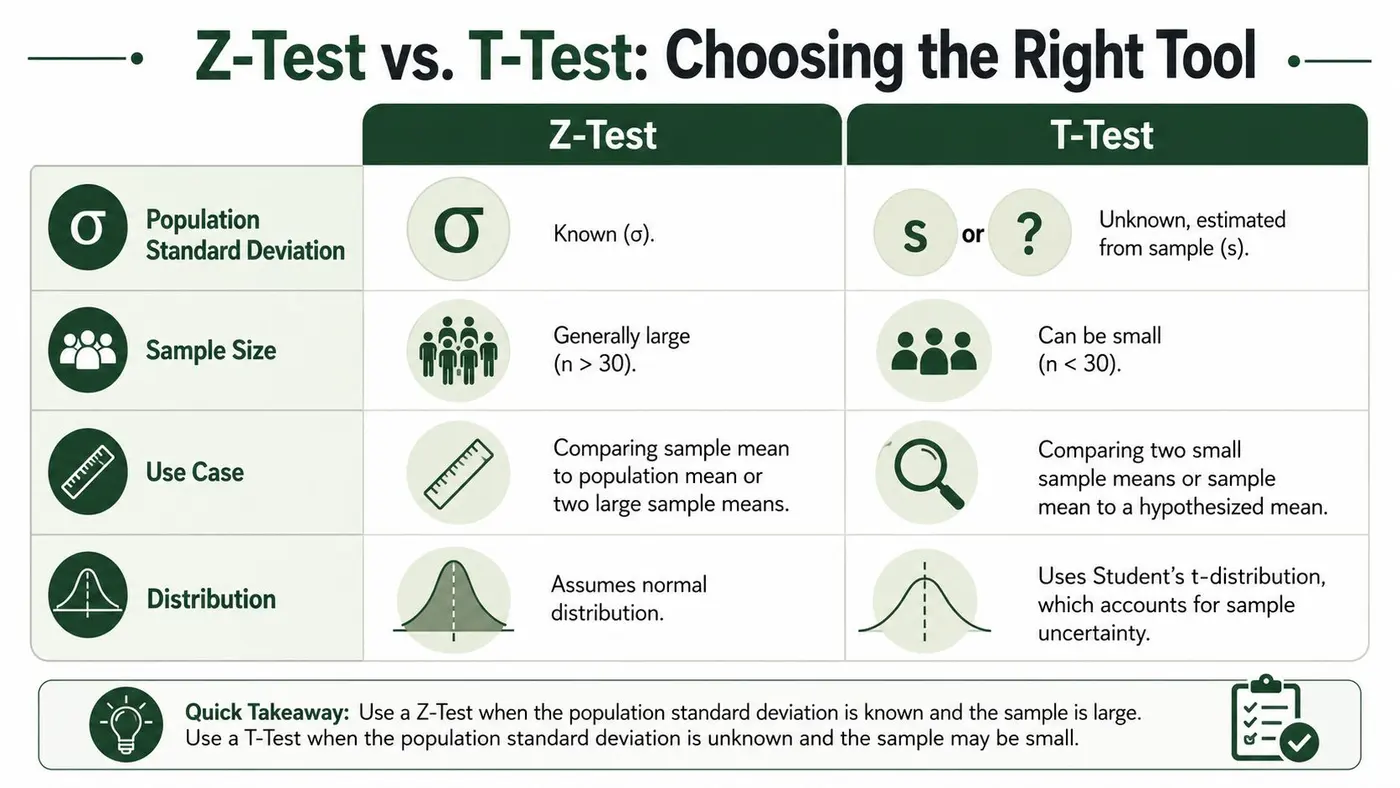
A z-test is the right tool when the population standard deviation is known, or when you're in a setting like proportion testing where the variance under the null is defined. A t-test is the fallback when that variability has to be estimated from the sample.
Side by side comparison
| Criteria | Z-test | T-test |
|---|---|---|
| Population standard deviation | Known | Unknown, estimated from sample |
| Typical sample situation | Larger samples, or null-defined variance | Smaller samples, more uncertainty |
| Reference distribution | Standard normal distribution | Student's t-distribution |
| Best use case | Means with known σ, or proportion tests | Mean comparisons when σ isn't known |
A practical analogy
A z-test is like using a precise satellite navigation system with a full map. You know the terrain well, so your measurements can be tight.
A t-test is like navigating with a sketch map and your own pacing. You can still get to a sound conclusion, but you need a method that allows for more uncertainty.
That's why the t-distribution has heavier tails. It reflects the extra uncertainty introduced when you estimate variability instead of knowing it beforehand.
Here's a visual explainer if you prefer seeing the distinction discussed aloud.
A quick rule of thumb
Use a z-test when both of these are true:
- Your setup fits z-test assumptions
- You have known variability or a proportion-testing case that supports z-based inference
Use a t-test when:
- Population variability isn't known
- You're estimating uncertainty from the sample itself
The easiest mistake is choosing the test because the formula looks familiar. Choose it because the assumptions match your data.
For many business users, this means proportion-based experimentation often leans on z-testing, while smaller-sample mean comparisons often point towards a t-test instead.
How to Perform a Z-Test Step-by-Step Examples
The cleanest way to understand a z-test is to run one manually. Even if software does the calculation later, knowing the sequence helps you spot bad assumptions and explain results to stakeholders.
The five-step process
-
State the hypotheses
Start with a null hypothesis, usually “no difference” or “no effect”. Then state the alternative, which reflects the change you care about. -
Choose the significance level
Many teams use 0.05 in practice for a two-tailed decision rule when they want a standard threshold for evidence. -
Calculate the z-statistic
Use the appropriate z formula for the type of test you're running. -
Compare with the decision threshold
For a common two-tailed setup at the 0.05 level, compare against ±1.96. -
Write the conclusion in plain English
Don't stop at “reject” or “fail to reject”. Translate it into business language.
Example one with a mean
Suppose you want to test whether a process average differs from a known benchmark. The formula from the verified source is:
Z = (x̄ - μ) / (σ / √n)
Read it as:
- sample mean minus benchmark mean
- divided by the standard error based on known population variability
You would proceed like this:
- Null hypothesis: the sample mean equals the benchmark mean
- Alternative hypothesis: the sample mean differs from the benchmark mean
- Compute Z: plug in your sample average, benchmark average, known population standard deviation, and sample size
- Decision: if the absolute z value is above the critical threshold used for your test, reject the null
The important intuition is that the numerator captures the observed gap, while the denominator scales that gap by expected noise. A bigger gap raises the z-score. More variability lowers it. Larger sample sizes usually make the denominator smaller, which can make genuine differences easier to detect.
Example two with proportions in A/B testing
Now switch to a common digital use case. You run Variant A and Variant B, and each visitor either converts or doesn't. That binary structure is what proportion z-tests are built for.
Your hypotheses might be:
- Null hypothesis: the conversion rates are the same
- Alternative hypothesis: the conversion rates are different
The test compares the observed difference in conversion rates against the amount of variation you'd expect if there were no true difference.
You don't need to memorise every algebraic detail to understand what's happening. The method asks whether the gap between two observed proportions is large relative to the expected random variation in binary outcomes.
If your observed lift is small compared with the normal wobble in conversion data, the z-statistic stays modest. If the lift is large relative to that wobble, the z-statistic rises.
Where readers often get stuck
Three things usually cause trouble:
- Confusing raw difference with significance: A larger observed uplift isn't automatically more trustworthy if the sample is thin or noisy.
- Forgetting the assumptions: A z-test isn't valid just because an analytics tool shows a number.
- Stopping at the maths: Decision-makers need the result translated into action and caution.
Why sample size keeps coming up
Sample size matters because it affects stability. Tiny samples bounce around. Larger samples settle down. If you're planning experiments, this guide on how to calculate sample size helps before you ever reach the z-test stage.
Manual calculation is useful for learning. In day-to-day work, though, professionals typically rely on software. That's sensible. The key is understanding what the software is doing, rather than treating significance like a magical badge.
The Z-Test in Action Modern A/B Testing
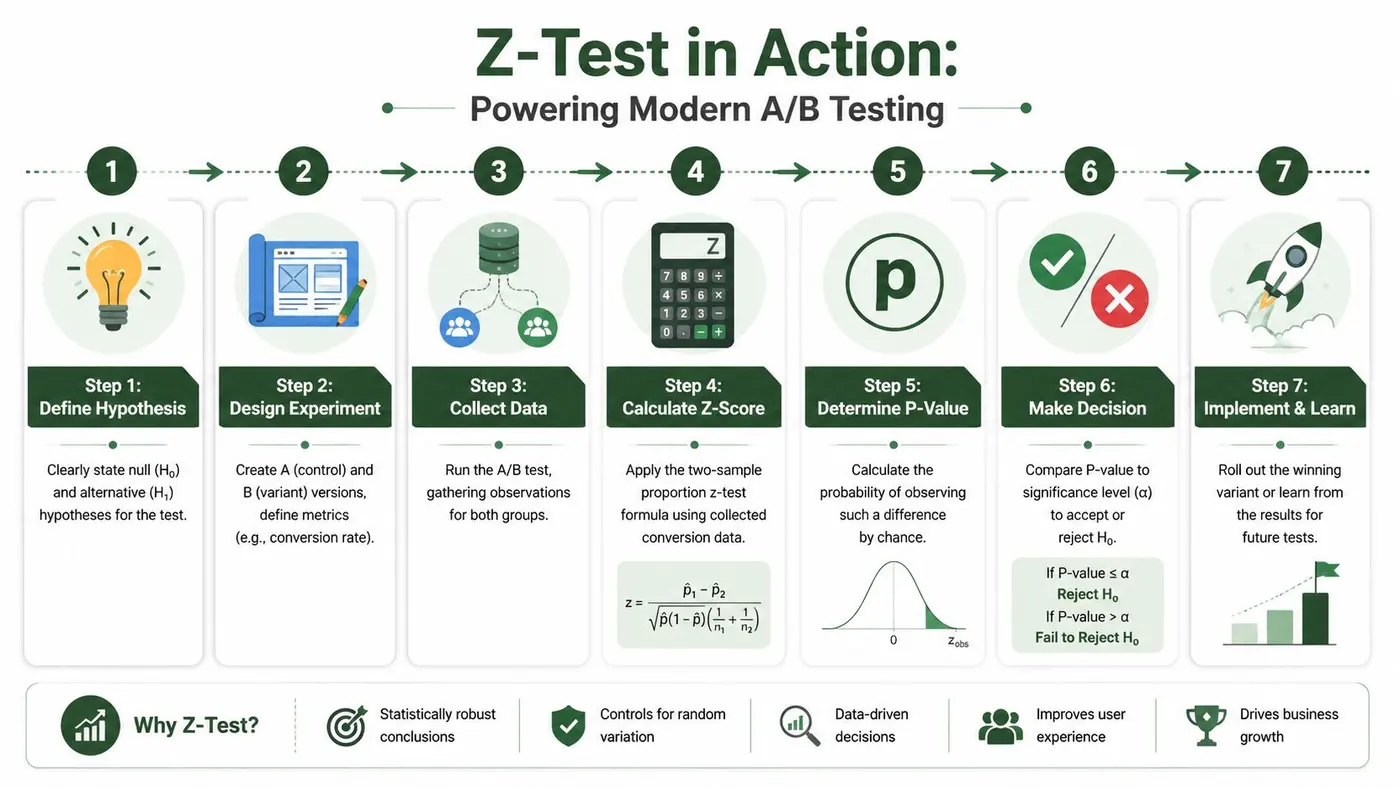
The z-test becomes most concrete when you look at an A/B test dashboard. Two variants are running. Each user either converts or doesn't. Behind the scenes, the platform is checking whether the observed difference in conversion rate is larger than you'd expect from chance alone.
That's why the z test in statistics matters so much in experimentation. It isn't just classroom theory. It's the logic many testing systems use to decide whether a winner has likely emerged.
Why proportions fit so well
For binary outcomes such as a click, a sign-up, or a purchase, the z-test for proportions is a natural fit. The verified data states that in this setting the variance under the null takes the form p(1-p)/n, and that the z-test for proportions serves as the primary engine for determining winner emergence in A/B testing. The same verified source also states that this setup uses 95% confidence thresholds with critical values of ±1.96 in large-scale experimentation contexts, as described in this guide on performing a z-test with practical examples.
That's the bridge from theory to tooling. The software isn't inventing a result. It's automating a standard frequentist decision process.
What the platform is doing in the background
When you launch an experiment, the platform generally follows a sequence like this:
- Split traffic: Some visitors see A, others see B.
- Record outcomes: Each visit becomes a success or non-success for the chosen metric.
- Estimate the difference: The tool compares the conversion rates.
- Compute the z-statistic: It scales the difference by expected random variation.
- Apply the decision rule: If the evidence crosses the configured threshold, the result is surfaced as meaningful.
For marketers who are still building their foundation, this primer on understanding A/B testing is helpful because it connects the experimental setup to the statistical logic underneath it.
Why automation helps, but doesn't replace judgement
Automation removes repetitive calculation. It doesn't remove the need to think.
A platform can tell you that a difference is statistically significant. It can't tell you whether the test was well designed, whether the metric was worth optimising, or whether the winning variant aligns with your brand and customer journey.
A/B tools make z-tests accessible. They don't make sloppy hypotheses, weak metrics, or poor experimental design harmless.
That's why experienced teams still care about fundamentals. They define the primary metric carefully. They avoid changing conditions mid-test. They make sure the variants answer a clear business question.
When those pieces are in place, the z-test becomes more than a formula. It becomes a decision engine that helps teams move faster without drifting back into guesswork.
Common Mistakes and Final Takeaways
The most common z-test mistakes are surprisingly ordinary. Teams use it with the wrong assumptions, check results too eagerly, or treat statistical significance as if it automatically means commercial importance.
Watch for a few traps:
- Using the wrong test: If variability isn't known in the way the z framework requires, a t-test may be more appropriate.
- Peeking too early: An early lead can disappear as more data arrives.
- Confusing significance with value: A statistically reliable difference can still be too small to matter in practice.
- Ignoring test quality: Weak hypotheses and messy experiment design produce weak conclusions, even with correct maths.
The lasting value of the z-test is simple. It helps you separate signal from noise. That's useful whether you're evaluating a benchmark, comparing proportions, or reading an A/B testing dashboard.
If you work in growth, product, or CRO, you don't need to become a full-time statistician. But you do need to know what the z-test is doing, what assumptions support it, and where its limits are. That understanding is what turns a dashboard result into a decision you can defend.
If you want a lightweight way to run website experiments without wrestling with the maths by hand, Otter A/B makes it easy to test headlines, CTAs, and layouts while a frequentist z-test engine handles significance in the background. It's built for teams that want fast experiments, clean reporting, and decisions grounded in evidence rather than instinct.
Stop guessing
Ready to start testing?
Set up your first A/B test in under five minutes. No credit card required.
- 14-day free trial
- No credit card required
- Cancel anytime